
Joseph Smith didn’t just bring forth new scripture. He revised the Bible itself. Here’s what he changed, why, and what came of it.
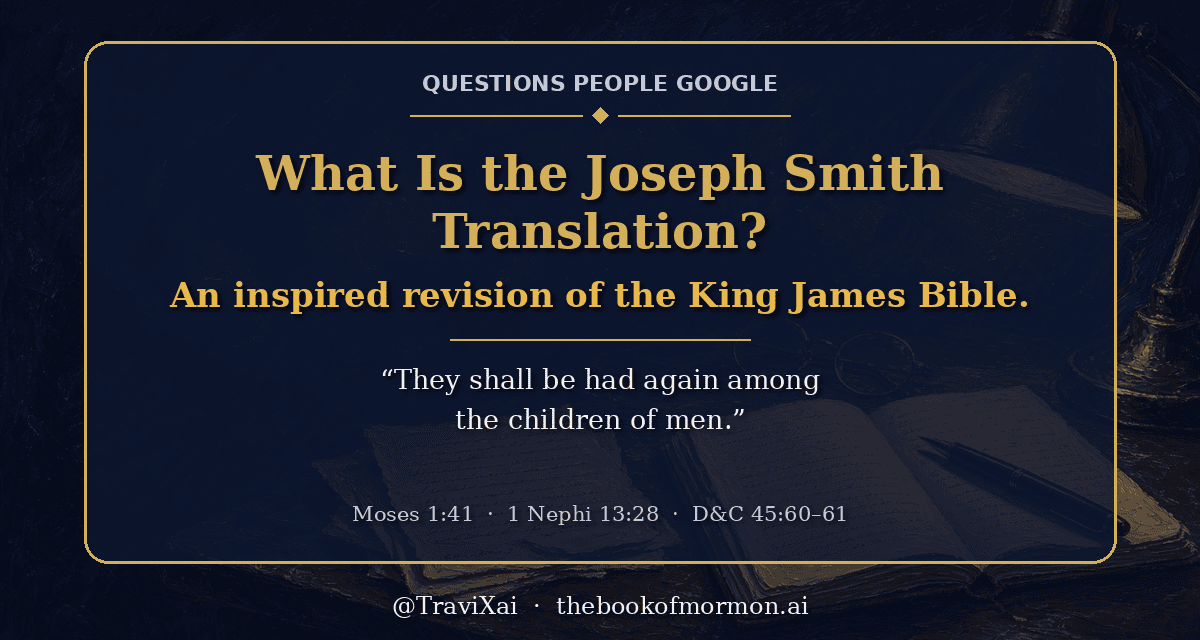
The Joseph Smith Translation is Joseph Smith’s inspired revision of the King James Bible, begun in June 1830. He was “divinely commissioned to make the translation” (Bible Dictionary), not from ancient manuscripts but by revelation, to restore “plain and precious things” lost from the Bible (1 Nephi 13:28). Latter-day Saints still use the King James Version, with JST changes in its footnotes; the Book of Moses and Joseph Smith—Matthew are JST excerpts canonized in the Pearl of Great Price.
The short answerJoseph Smith’s inspired revision of the Bible
The Joseph Smith Translation (JST) is a revision of the King James Version of the Bible that Joseph Smith began in June 1830, by revelation rather than from ancient manuscripts. The Bible Dictionary describes it as “a revision or translation of the King James Version,” says Joseph was “divinely commissioned to make the translation,” and notes that “the major portion of the work was completed by July 1833,” though he kept refining it until his death in 1844 (Bible Dictionary, “Joseph Smith Translation”).
Latter-day Saints still use the King James Version as their official English Bible. JST changes appear in its footnotes and appendix, and two pieces are canonized in the Pearl of Great Price: the Book of Moses and Joseph Smith—Matthew.
Why the Bible needed it“Plain and precious things”
Latter-day Saints love the Bible and believe it “to be the word of God as far as it is translated correctly” (Articles of Faith 1:8). Nephi saw in vision that “there are many plain and precious things taken away from the book, which is the book of the Lamb of God” (1 Nephi 13:28). God told Moses that men would “take many of them from the book which thou shalt write,” but “I will raise up another like unto thee; and they shall be had again among the children of men” (Moses 1:41). For the case that some of what was lost testified plainly of Christ, see The Old Testament Was Christian. So Who Took Christ Out?
In March 1831 the Lord directed Joseph, “I give unto you that ye may now translate it, that ye may be prepared for the things to come” (D&C 45:60–61). The Bible Dictionary says the JST “to some extent assists in restoring the plain and precious things that have been lost from the Bible.”
Three examplesWhat changed and why it matters
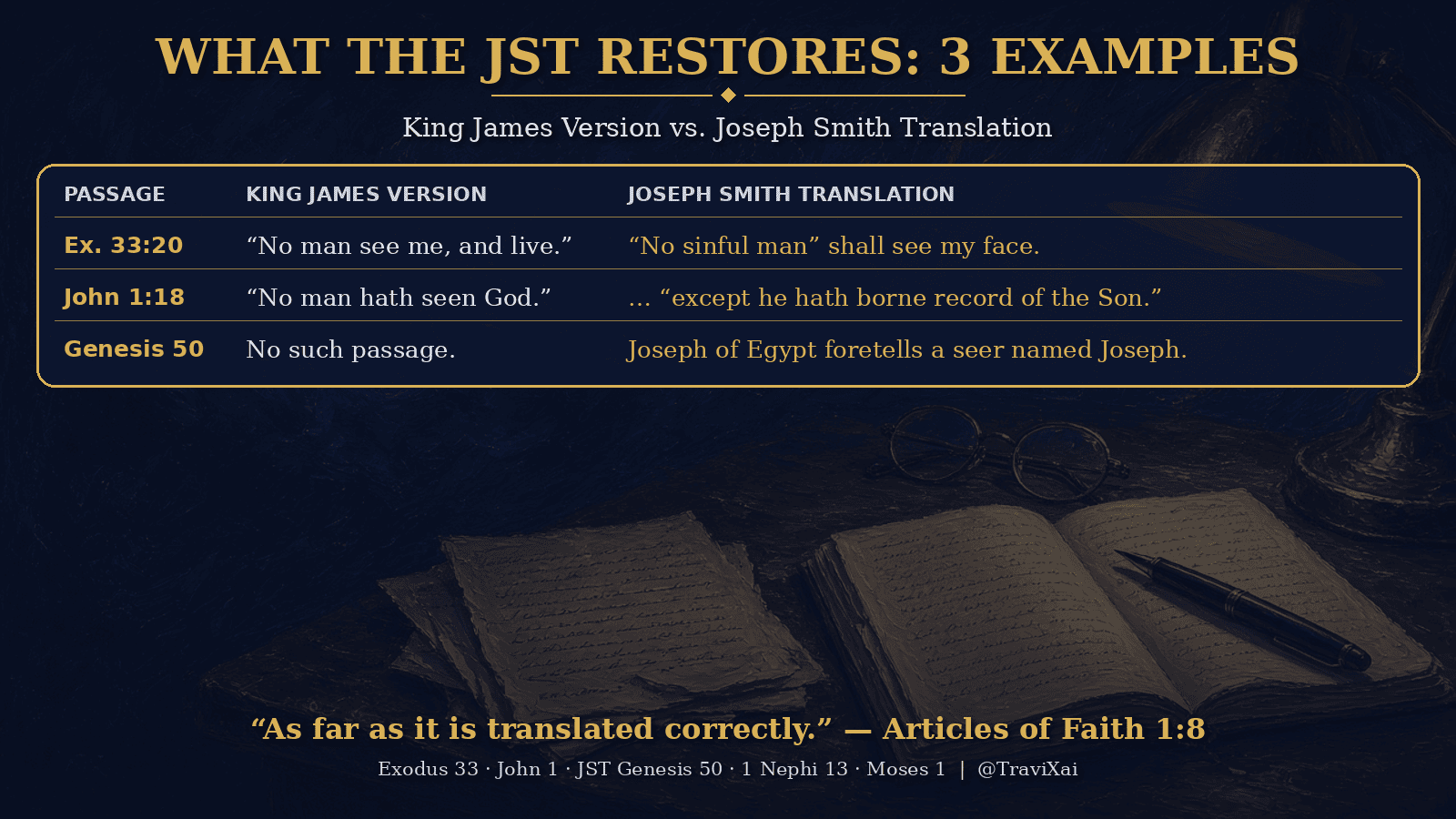
Exodus 33. The King James Version says Moses talked with God “face to face, as a man speaketh unto his friend” (Exodus 33:11), then nine verses later, “there shall no man see me, and live” (Exodus 33:20). The JST resolves it: “no sinful man hath at any time, neither shall there be any sinful man at any time, that shall see my face and live” (JST Exodus 33:20).
John 1:18. The KJV reads, “No man hath seen God at any time” (John 1:18). The JST reads, “no man hath seen God at any time, except he hath borne record of the Son; for except it is through him no man can be saved” (JST John 1:19). That fits the prophets who did see God, from Moses to Stephen.
Genesis 50. The JST restores a prophecy of Joseph of Egypt about a latter-day seer: “his name shall be called Joseph, and it shall be after the name of his father … for the thing which the Lord shall bring forth by his hand shall bring my people unto salvation” (JST Genesis 50:33). The Book of Mormon quotes the same prophecy from the brass plates (2 Nephi 3).
Revelations that came from itD&C 76 and the Book of Moses
Some of the greatest revelations of the Restoration came while Joseph was translating. The vision of the three degrees of glory began “while we were doing the work of translation … we came to the twenty-ninth verse of the fifth chapter of John” (D&C 76:15–18). See The Three Degrees of Glory.
The Book of Moses, the JST’s opening chapters of Genesis, contains God’s declaration of His purpose: “this is my work and my glory—to bring to pass the immortality and eternal life of man” (Moses 1:39). Eternal life is God’s kind of life: to become like the Father and inherit what He has, as His children forever. The JST restored Enoch’s Zion, the gospel preached to Adam, and the visions of Moses. See What Is the Pearl of Great Price?.
“Joseph rewrote the Bible”A fair answer to the charge
Critics say the JST shows Joseph “rewrote” scripture. But the Bible itself has thousands of textual variants, and every modern translation chooses among them. Joseph never claimed to work from Hebrew or Greek manuscripts; he claimed revelation, and the test is fruit. The JST resolves real tensions in the KJV, predicts a seer that matches the Book of Mormon’s brass-plates prophecy, and opened the door to D&C 76. The Bible Dictionary calls it “a witness for the divine calling and ministry of the Prophet Joseph Smith.” See Bible Textual Variants: “As Far as It Is Translated Correctly”.
Check the premiseThe presuppositions baked into the question
Before this question can be answered fairly, the person asking has to justify a few assumptions packed inside it:
- That Latter-day Saints replaced the Bible. The Church uses the King James Version; JST changes appear in footnotes and an appendix.
- That the Bible came down to us without loss. 1 Nephi 13:28 and Moses 1:41 say plain and precious things were taken away and would be restored.
- That Joseph claimed to translate from ancient manuscripts. The JST was a revision by revelation (D&C 45:60–61).
- That the JST is just cosmetic. It produced the Book of Moses and led to the vision in D&C 76.
FAQQuick answers
What is the Joseph Smith Translation?
An inspired revision of the King James Bible that Joseph Smith began in 1830 and mostly completed by July 1833.
Do Latter-day Saints use the Joseph Smith Translation?
They use the King James Version as their official English Bible, with JST excerpts in footnotes and an appendix.
Is the JST scripture?
The Book of Moses and Joseph Smith—Matthew, both from the JST, are canonized in the Pearl of Great Price.
Did Joseph Smith use Hebrew or Greek manuscripts?
No. He revised the KJV by revelation, as the Lord commanded in D&C 45:60–61.
What revelations came from the JST?
D&C 76, the vision of the degrees of glory, came while translating John 5:29 (D&C 76:15–18).
Why did Joseph Smith revise the Bible?
Because Latter-day Saints believe the Bible is the word of God “as far as it is translated correctly” (Articles of Faith 1:8), and Nephi foresaw “many plain and precious things taken away from the book” (1 Nephi 13:28).
What does the JST add to Genesis?
The Book of Moses: a vision given to Moses before he wrote Genesis (Moses 1), expanded accounts of Adam and Eve, and much more about Enoch and his city Zion (Moses 6–7).
Where can I read the full Joseph Smith Translation?
Excerpts are in the footnotes and appendix of the Church’s Bible and in the Pearl of Great Price. The complete original manuscripts were published in 2004 and are also available through the Joseph Smith Papers.
SummaryKey takeaways
- The JST is an inspired revision of the KJV begun in 1830.
- It restores “plain and precious things” (1 Nephi 13:28).
- The Book of Moses and Joseph Smith—Matthew come from it.
- D&C 76 was revealed while Joseph was translating John 5:29.
Look up the JST footnotes next time you read the Bible. For quick, sourced answers, open Galatians18, and follow me on X at @TraviXai.
Sources
- King James Bible (churchofjesuschrist.org): Exodus 33:11 · Exodus 33:20 · John 1:18
- Joseph Smith Translation (Bible appendix): JST Genesis 50:33 · JST Exodus 33:20 · JST John 1:19
- Book of Mormon: 1 Nephi 13:28–29
- Doctrine and Covenants: D&C 45:60–61 · D&C 76:15–18
- Pearl of Great Price: Moses 1:39–41 · Articles of Faith 1:8
- Bible Dictionary, “Joseph Smith Translation”
- Featured image and in-article graphic: original graphics by thebookofmormon.ai (painterly backgrounds; no photographs or likenesses of real people).