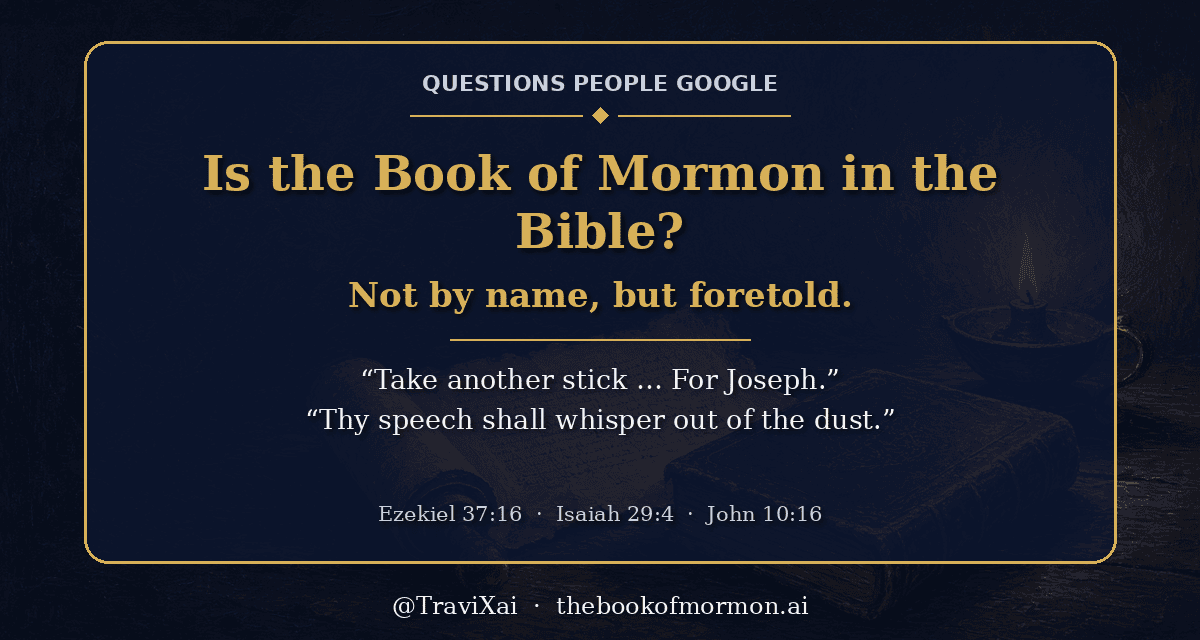

If the Book of Mormon is scripture, shouldn’t the Bible mention it? Here are the passages, read honestly, from all four standard works.
The Bible doesn’t mention the Book of Mormon by name, but Latter-day Saints believe it foretells it. Ezekiel was told to join the “stick of Judah” and the “stick of Joseph” into one (Ezekiel 37:15–20). Isaiah saw a people speaking “out of the dust” and a sealed book delivered to one “not learned” (Isaiah 29:4, 11–12). Jesus spoke of “other sheep … not of this fold” (John 10:16), and the Book of Mormon records Him telling the Nephites, “ye are they” (3 Nephi 15:21).
The honest answerNot by name, but Latter-day Saints believe it was foretold
The Bible never uses the words “Book of Mormon.” It couldn’t: the Book of Mormon is a record kept on the American continent from about 600 B.C. to A.D. 421, and it came forth in 1830. Latter-day Saints believe several Bible prophecies point to a record like it, written by a branch of Joseph’s descendants and brought forth in the last days. Other Christians read these passages differently, so this post shows the text and lets you weigh it.
Our eighth article of faith holds both books together: “We believe the Bible to be the word of God as far as it is translated correctly; we also believe the Book of Mormon to be the word of God” (Articles of Faith 1:8).
Ezekiel 37The stick of Judah and the stick of Joseph
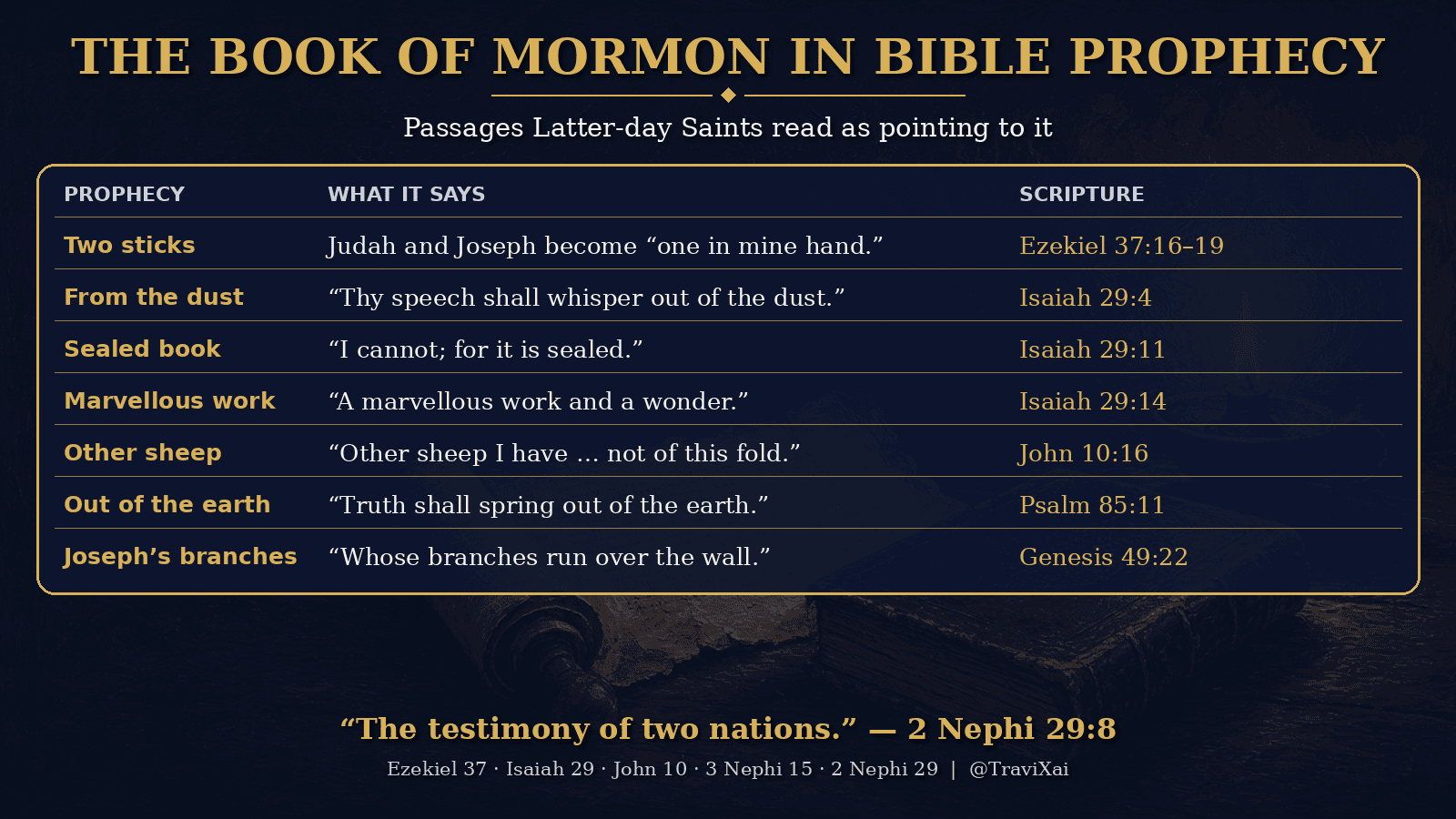
The Lord told Ezekiel: “take thee one stick, and write upon it, For Judah, and for the children of Israel his companions: then take another stick, and write upon it, For Joseph, the stick of Ephraim, and for all the house of Israel his companions: And join them one to another into one stick; and they shall become one in thine hand” (Ezekiel 37:15–20).
Many Bible scholars read this as a sign of the northern and southern kingdoms reuniting, and that’s part of its meaning. Latter-day Saints see a further fulfillment in two written records: the Bible from Judah, and the Book of Mormon from the descendants of Joseph. The Book of Mormon makes the same connection: “the fruit of thy loins shall write; and the fruit of the loins of Judah shall write; and that which shall be written … shall grow together, unto the confounding of false doctrines” (2 Nephi 3:12). In modern revelation the Lord calls Moroni the one “to whom I have committed the keys of the record of the stick of Ephraim” (D&C 27:5).
Jacob blessed Joseph as “a fruitful bough … whose branches run over the wall” (Genesis 49:22), with blessings reaching “unto the utmost bound of the everlasting hills” (Genesis 49:26). The Book of Mormon tells of a branch of Joseph that crossed the sea.
Isaiah 29A voice from the dust and a sealed book
Isaiah described a fallen people who “shalt speak out of the ground, and thy speech shall be low out of the dust … and thy speech shall whisper out of the dust” (Isaiah 29:4). A buried record of a destroyed people fits that image. Nephi used Isaiah’s words for his own people’s record: “those who shall be destroyed shall speak unto them out of the ground … and their speech shall whisper out of the dust” (2 Nephi 26:16).
Isaiah continues: “the vision of all is become unto you as the words of a book that is sealed, which men deliver to one that is learned, saying, Read this, I pray thee: and he saith, I cannot; for it is sealed: And the book is delivered to him that is not learned” (Isaiah 29:11–12). Then God promises “a marvellous work and a wonder” and that “the deaf [shall] hear the words of the book” (Isaiah 29:14; 29:18).
In 1828 Martin Harris took a copy of characters from the plates to Professor Charles Anthon in New York. By Harris’s account, Anthon asked to have the plates brought to him, and when told part were sealed, replied, “I cannot read a sealed book” (Joseph Smith—History 1:64–65). Anthon later gave a different account of the meeting, but he didn’t deny that it happened. Joseph Smith, an unlearned farm boy, then translated the book.
John 10:16The “other sheep”
Jesus told His disciples in Jerusalem: “other sheep I have, which are not of this fold: them also I must bring, and they shall hear my voice; and there shall be one fold, and one shepherd” (John 10:16). Most Christians take this to mean the Gentiles.
In the Book of Mormon, the risen Christ tells the people at the temple in Bountiful, “ye are they of whom I said: Other sheep I have which are not of this fold” (3 Nephi 15:21). The Gentiles never heard Jesus’s voice in person during His ministry. The Nephites did. The Psalmist’s line “Truth shall spring out of the earth; and righteousness shall look down from heaven” (Psalm 85:11) is echoed in the Pearl of Great Price: “truth will I send forth out of the earth, to bear testimony of mine Only Begotten” (Moses 7:62).
2 Nephi 29“A Bible! A Bible!”
The Book of Mormon expected people to ask this very question: “many of the Gentiles shall say: A Bible! A Bible! We have got a Bible, and there cannot be any more Bible” (2 Nephi 29:3). The Lord answers: “Know ye not that the testimony of two nations is a witness unto you that I am God … because that ye have a Bible ye need not suppose that it contains all my words; neither need ye suppose that I have not caused more to be written” (2 Nephi 29:8–10).
The Book of Mormon doesn’t compete with the Bible. An angel told Nephi that these latter records “shall establish the truth of the first, which are of the twelve apostles of the Lamb … and shall make known to all kindreds, tongues, and people, that the Lamb of God is the Son of the Eternal Father, and the Savior of the world” (1 Nephi 13:40). See also The Canon Was Never Meant to Close and Books the Bible Quotes That Aren’t in the Bible.
Check the premiseThe presuppositions baked into the question
Before this question can be answered fairly, the person asking has to justify a few assumptions packed inside it:
- That a true book of scripture must be named in the Bible. Most of the New Testament isn’t named in the Old Testament either. The Bible itself cites books it doesn’t contain.
- That the Bible contains all of God’s words. The Bible never says that. John 21:25 says the world couldn’t contain the books if everything Jesus did were written, and 2 Nephi 29:10 says “ye need not suppose that it contains all my words.”
- That Ezekiel 37 can only mean one thing. Prophecy often has layers. The joining of Judah and Joseph can mean the kingdoms reuniting and also two records growing together (2 Nephi 3:12).
- That the Book of Mormon replaces the Bible. It was written to “establish the truth of the first” (1 Nephi 13:40). Latter-day Saints read both (Articles of Faith 1:8).
FAQQuick answers
Is the Book of Mormon mentioned in the Bible?
Not by name. Latter-day Saints believe it is foretold in Ezekiel 37:15–20 (the stick of Joseph), Isaiah 29 (a voice from the dust and a sealed book) and John 10:16 (the “other sheep”).
What is the stick of Joseph in Ezekiel 37?
Ezekiel was told to write on one stick “For Judah” and on another “For Joseph,” and join them. Latter-day Saints see the Bible (Judah) and the Book of Mormon (Joseph’s descendants) as these two records (2 Nephi 3:12; D&C 27:5).
Who are the “other sheep” in John 10:16?
In 3 Nephi 15:21 the risen Christ told the Nephites in the Americas, “ye are they of whom I said: Other sheep I have.” They heard His voice in person.
How does Isaiah 29 relate to the Book of Mormon?
Isaiah foresaw speech “out of the dust,” a sealed book the learned could not read, and “a marvellous work and a wonder.” Latter-day Saints connect it to the buried plates, the 1828 visit to Charles Anthon (Joseph Smith—History 1:64–65) and the translation by Joseph Smith.
Does the Book of Mormon contradict the Bible?
No. It testifies of the same Jesus Christ and says it was written to “establish the truth” of the Bible (1 Nephi 13:40).
What does “A Bible! A Bible!” mean in 2 Nephi 29?
Nephi foresaw people rejecting new scripture by saying, “A Bible! A Bible! We have got a Bible, and there cannot be any more Bible” (2 Nephi 29:3). The Lord answers that He speaks to more than one nation.
What does the Book of Mormon say happened to the Bible?
Nephi saw “many plain and precious things taken away from the book” (1 Nephi 13:28), and that later records would restore them and confirm the Bible.
Doesn’t Revelation 22:18 forbid adding to the Bible?
No. Moses said the same thing centuries earlier: “Ye shall not add unto the word which I command you” (Deuteronomy 4:2), and God kept giving scripture for over a thousand years afterward. Both verses forbid people from changing God’s word, not God from speaking.
SummaryKey takeaways
- The Bible doesn’t name the Book of Mormon, but it foretells more records and more sheep.
- Ezekiel’s two sticks: Judah’s record and Joseph’s record become one (Ezekiel 37; 2 Nephi 3:12).
- Isaiah 29: a voice from the dust and a sealed book (Joseph Smith—History 1:64–65).
- The Book of Mormon was written to confirm the Bible, not replace it (1 Nephi 13:40).
Read Ezekiel 37 and 2 Nephi 3 side by side, then ask God (James 1:5). For quick, sourced answers, open Galatians18, and follow me on X at @TraviXai.
Sources
- King James Bible (churchofjesuschrist.org): Genesis 49:22 · Genesis 49:26 · Psalm 85:11 · Isaiah 29:4 · Isaiah 29:11–14 · Isaiah 29:18 · Ezekiel 37:15–20 · John 10:16
- Book of Mormon: 1 Nephi 13:40 · 2 Nephi 3:12 · 2 Nephi 26:16 · 2 Nephi 29:3–10 · 3 Nephi 15:21
- Doctrine and Covenants: D&C 27:5
- Pearl of Great Price: Moses 7:62 · Joseph Smith—History 1:64–65 · Articles of Faith 1:8
- Featured image and in-article graphic: original graphics by thebookofmormon.ai (painterly backgrounds; no photographs or likenesses of real people).