
The idea that God isn’t alone, that we have a Mother in Heaven, surprises a lot of people. Here’s what the Church actually teaches, with sources.
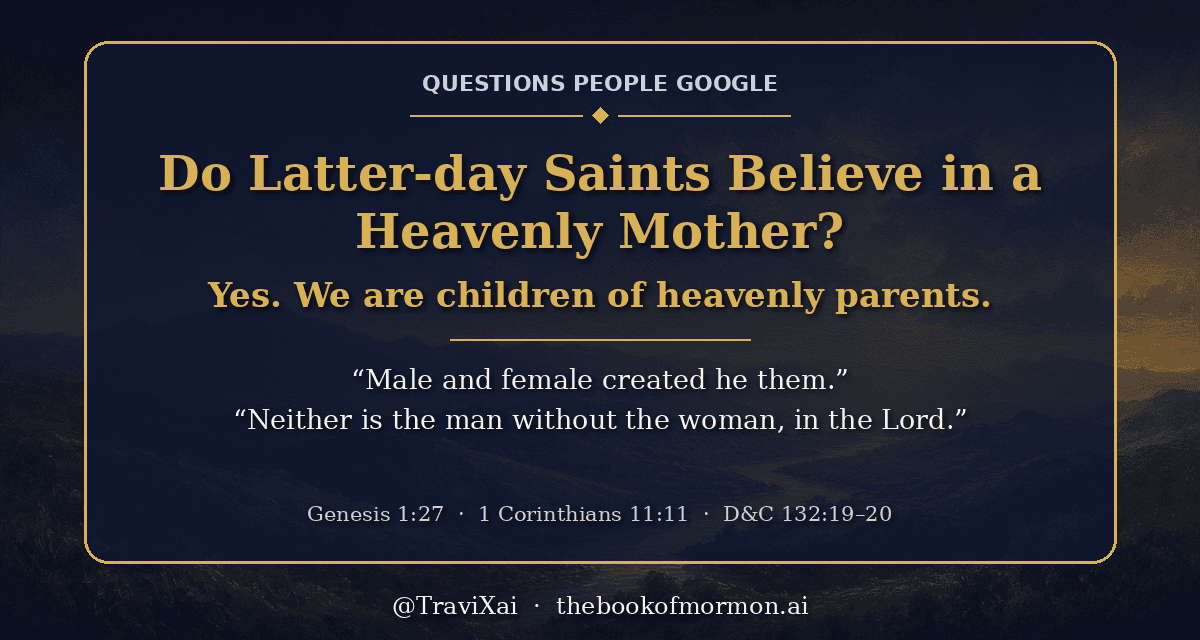
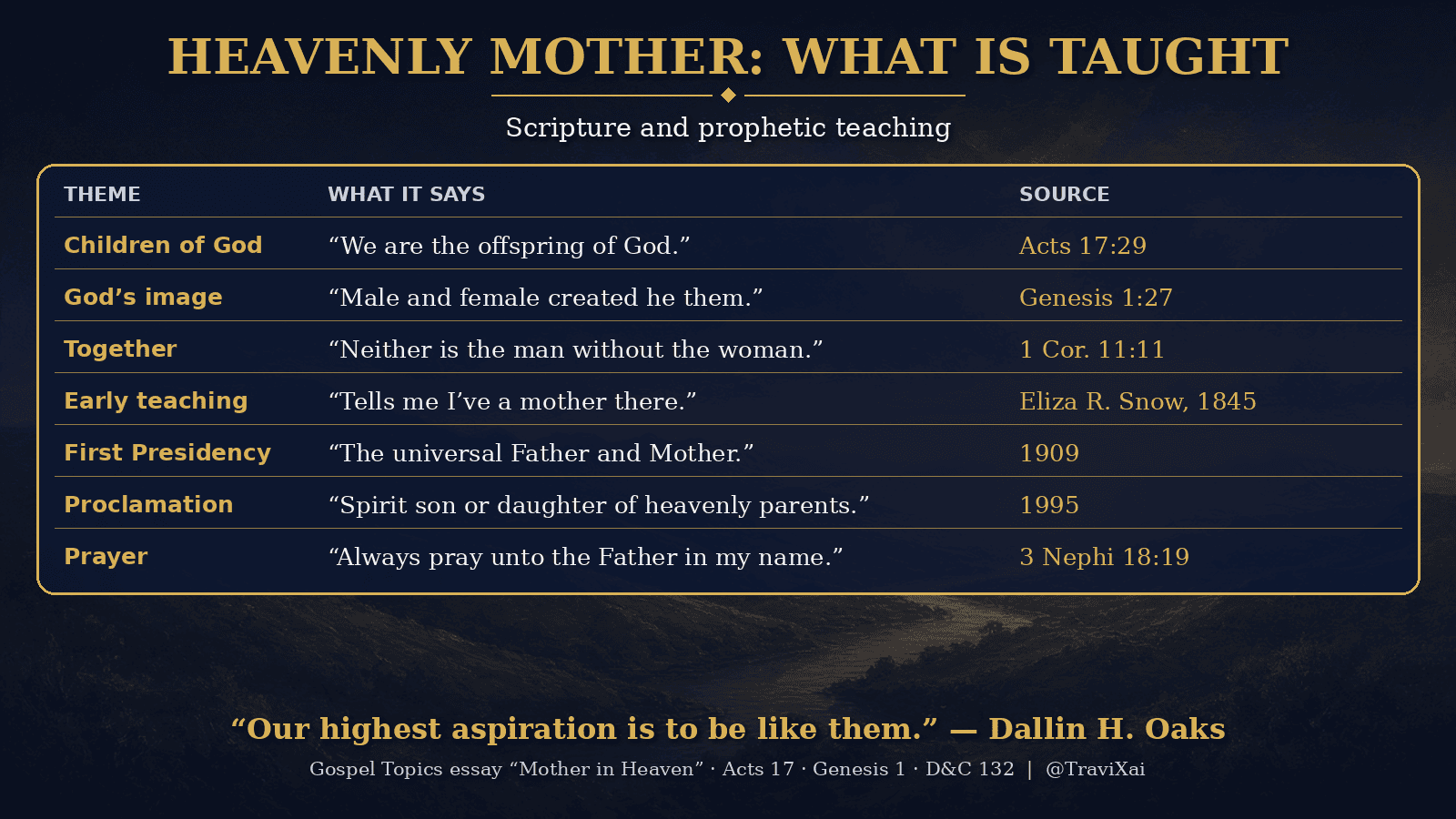
Yes. The Church teaches that all people are “beloved spirit children of heavenly parents, a Heavenly Father and a Heavenly Mother.” The Bible calls us God’s offspring (Acts 17:29) and says “male and female” were made in God’s image (Genesis 1:27). Early members recalled Joseph Smith teaching it, Eliza R. Snow wrote “I’ve a mother there” in 1845, and the 1995 family proclamation affirms “heavenly parents.” Latter-day Saints pray only to the Father in Christ’s name (3 Nephi 18:19). Few details about her have been revealed, but her reality is certain: exaltation is a Father and a Mother together (D&C 132:19–20), and that is what our Heavenly Parents are.
The short versionYes, and the Church says so plainly
The Church’s Gospel Topics essay “Mother in Heaven” opens: “The Church of Jesus Christ of Latter-day Saints teaches that all human beings, male and female, are beloved spirit children of heavenly parents, a Heavenly Father and a Heavenly Mother … The doctrine of a Heavenly Mother is a cherished and distinctive belief among Latter-day Saints” (Mother in Heaven).
It’s just as honest about the limits: “As with many other truths of the gospel, our present knowledge about a Mother in Heaven is limited. Nevertheless, we have been given sufficient knowledge to appreciate the sacredness of this doctrine.” Few details have been revealed. Her reality is not in doubt: prophets have taught it, plainly and repeatedly, for more than 180 years.
The BibleChildren of God, made male and female
Paul told the Athenians, “For in him we live, and move, and have our being; as certain also of your own poets have said, For we are also his offspring. Forasmuch then as we are the offspring of God …” (Acts 17:28–29). Hebrews calls God “the Father of spirits” (Hebrews 12:9), and the Lord told Jeremiah, “Before I formed thee in the belly I knew thee” (Jeremiah 1:5). See also We Are God’s Offspring: Acts 17:29.
At creation, “God said, Let us make man in our image, after our likeness … So God created man in his own image, in the image of God created he him; male and female created he them” (Genesis 1:26–27). Latter-day Saints read that as meaning that both men and women reflect the divine image. Paul adds, “neither is the man without the woman, neither the woman without the man, in the Lord” (1 Corinthians 11:11). The essay applies that verse directly: “Men and women cannot be exalted without each other. Just as we have a Father in Heaven, we have a Mother in Heaven.”
Restoration scriptureHeavenly parents and eternal marriage
The Pearl of Great Price teaches that God “created all the children of men … for in heaven created I them” before there was “flesh upon the earth” (Moses 3:4–7). We lived with God before we were born.
The Doctrine and Covenants teaches that the highest degree of the celestial kingdom requires “the new and everlasting covenant of marriage” (D&C 131:1–4), and that a husband and wife sealed by that covenant will receive “a fulness and a continuation of the seeds forever and ever” (D&C 132:19–20). Exaltation is something a husband and wife receive together, never alone. The essay lists D&C 132:19–20 among the scriptural foundations of the doctrine, and the logic is direct: exaltation is becoming what our Father is, and what the faithful become is a Father and a Mother. So is He.
HistoryWhere the teaching came from
The essay is open about the history: “While there is no record of a formal revelation to Joseph Smith on this doctrine, some early Latter-day Saint women recalled that he personally taught them about a Mother in Heaven.” Zina D. H. Young remembered that after her mother died in 1839, Joseph comforted her by saying she would “become acquainted with her eternal Mother.”
The best-known expression is Eliza R. Snow’s 1845 poem, now the hymn “O My Father”: “In the heav’ns are parents single? / No, the thought makes reason stare; / Truth is reason—truth eternal / Tells me I’ve a mother there.” In 1909 the First Presidency taught that “all men and women are in the similitude of the universal Father and Mother, and are literally the sons and daughters of Deity.” In 1995 “The Family: A Proclamation to the World” declared, “Each [person] is a beloved spirit son or daughter of heavenly parents, and, as such, each has a divine nature and destiny” (Mother in Heaven).
Exaltation is a Father and a MotherWhat our heavenly parents are, we may become
Eliza R. Snow’s hymn doesn’t stop at “I’ve a mother there.” Its last verse looks forward to going home to both: “When I leave this frail existence, / When I lay this mortal by, / Father, Mother, may I meet you / In your royal courts on high? / Then, at length, when I’ve completed / All you sent me forth to do, / With your mutual approbation / Let me come and dwell with you” (“O My Father”). The 1909 First Presidency said the same in doctrinal prose: “all men and women are in the similitude of the universal Father and Mother, and are literally the sons and daughters of Deity” (as quoted in the Mother in Heaven essay), and in “The Origin of Man” (1909) taught that God’s children are capable, “by experience through ages and aeons, of evolving into a God.”
Here is how it fits together. The Lord promised that a husband and wife sealed “by the new and everlasting covenant” will receive “a fulness and a continuation of the seeds forever and ever. Then shall they be gods, because they have no end … because they continue” (D&C 132:19–20). An exalted man is never exalted alone; an exalted couple is a Father and a Mother with eternal increase. That is exactly what our Heavenly Parents are. Joseph Smith taught in the King Follett sermon that “God himself was once as we are now, and is an exalted man,” and that the faithful must learn “how to be gods yourselves … the same as all gods have done before you.” In the Sermon in the Grove he taught that the Father of Jesus Christ “had a Father also.” And because no one is exalted alone (D&C 131:1–4), every exalted Father in that endless line has an exalted wife at His side.
That is why eternal marriage matters so much to Latter-day Saints, and why the doctrine of a Mother in Heaven isn’t an add-on. It is the pattern of heaven: a Father and a Mother, and children who can grow up to become like them, creating worlds without number, yet always their children, always worshipping our Father in the name of Christ. See What Is Eternal Marriage? and Was God Once a Man?.
PrayerWhy Latter-day Saints don’t pray to her
“Latter-day Saints direct their worship to Heavenly Father, in the name of Christ, and do not pray to Heavenly Mother,” the essay says. That follows Jesus’s own instruction to the Nephites: “ye must always pray unto the Father in my name; And whatsoever ye shall ask the Father in my name, which is right, believing that ye shall receive, behold it shall be given unto you” (3 Nephi 18:19–21). In the Sermon on the Mount He taught, “After this manner therefore pray ye: Our Father which art in heaven” (Matthew 6:9).
This isn’t about putting her down. President Gordon B. Hinckley said, “The fact that we do not pray to our Mother in Heaven in no way belittles or denigrates her.” And Elder Dallin H. Oaks summed it up: “Our theology begins with heavenly parents. Our highest aspiration is to be like them” (quoted in Mother in Heaven). We become like them while always remaining their children.
Check the premiseThe presuppositions baked into the question
Before this question can be answered fairly, the person asking has to justify a few assumptions packed inside it:
- That Latter-day Saints worship a goddess. We worship Heavenly Father in the name of Jesus Christ and “do not pray to Heavenly Mother” (Gospel Topics essay; 3 Nephi 18:19).
- That this is a secret or fringe teaching. The 1995 family proclamation says each person is “a beloved spirit son or daughter of heavenly parents,” and the Church has published an essay on it.
- That because few details are revealed, her existence is uncertain. Few details are revealed, but the First Presidency affirmed “the universal Father and Mother” (1909) and the proclamation affirms “heavenly parents” (1995).
- That the Bible has nothing to say about it. The Bible teaches we are God’s offspring (Acts 17:29) and that “male and female” were created in God’s image (Genesis 1:27).
FAQQuick answers
Do Latter-day Saints believe in a Heavenly Mother?
Yes. The Church teaches that all people are “beloved spirit children of heavenly parents, a Heavenly Father and a Heavenly Mother” (Gospel Topics essay “Mother in Heaven”).
Do Latter-day Saints pray to Heavenly Mother?
No. Following Jesus’s instruction to “always pray unto the Father in my name” (3 Nephi 18:19), Latter-day Saints pray to Heavenly Father in the name of Jesus Christ.
Where does the idea of a Heavenly Mother come from?
Early Latter-day Saint women recalled Joseph Smith teaching it. Eliza R. Snow’s 1845 poem “O My Father” expressed it, and the First Presidency affirmed it in 1909 and in the 1995 family proclamation.
Is Heavenly Mother in the Bible?
The Bible doesn’t name her. Latter-day Saints see the doctrine reflected in teachings that we are God’s offspring (Acts 17:29), that “male and female” bear God’s image (Genesis 1:27), and that “neither is the man without the woman … in the Lord” (1 Corinthians 11:11).
Why don’t Latter-day Saints talk more about Heavenly Mother?
Few details have been revealed; the essay says “our present knowledge about a Mother in Heaven is limited.” But her reality is taught plainly, and exaltation itself is a Father and a Mother together (D&C 132:19–20).
What does the family proclamation say about heavenly parents?
“The Family: A Proclamation to the World” (1995) says each person “is a beloved spirit son or daughter of heavenly parents, and, as such, each has a divine nature and destiny.”
Will the exalted become heavenly parents themselves?
Yes. Exaltation is for a husband and wife sealed together, who receive “a continuation of the seeds forever and ever” and “Then shall they be gods, because they have no end” (D&C 132:19–20). They become like our heavenly parents, while our Father always remains our Father.
What does the Bible say about being God’s children and heirs?
“The Spirit itself beareth witness with our spirit, that we are the children of God: And if children, then heirs; heirs of God, and joint-heirs with Christ” (Romans 8:16–17).
SummaryKey takeaways
- The Church teaches we are children of heavenly parents, a Father and a Mother.
- The Bible supports the pattern: God’s offspring (Acts 17:29), made “male and female” (Genesis 1:27).
- Latter-day Saints pray only to the Father in Christ’s name (3 Nephi 18:19; Matthew 6:9).
- Exaltation is a Father and a Mother together (D&C 132:19–20), which is what our Heavenly Parents are.
Read the Gospel Topics essay “Mother in Heaven” for yourself, then sing “O My Father.” For quick, sourced answers, open Galatians18, and follow me on X at @TraviXai.
Sources
- King James Bible (churchofjesuschrist.org): Genesis 1:26–27 · Jeremiah 1:5 · Matthew 6:9 · Acts 17:28–29 · 1 Corinthians 11:11 · Hebrews 12:9
- Book of Mormon: 3 Nephi 18:19–21
- Doctrine and Covenants: D&C 131:1–4 · D&C 132:19–20
- Pearl of Great Price: Moses 3:4–7
- Eliza R. Snow, “O My Father,” Hymns · First Presidency, “The Origin of Man,” 1909 · Joseph Smith, King Follett sermon (HC 6:305–306) and Sermon in the Grove (HC 6:476), BYU Studies online edition
- “Mother in Heaven,” Gospel Topics Essays, churchofjesuschrist.org (with its citations to Eliza R. Snow 1845, the First Presidency 1909, the 1995 family proclamation, Gordon B. Hinckley 1991 and Dallin H. Oaks 1995)
- Featured image and in-article graphic: original graphics by thebookofmormon.ai (painterly backgrounds; no photographs or likenesses of real people).