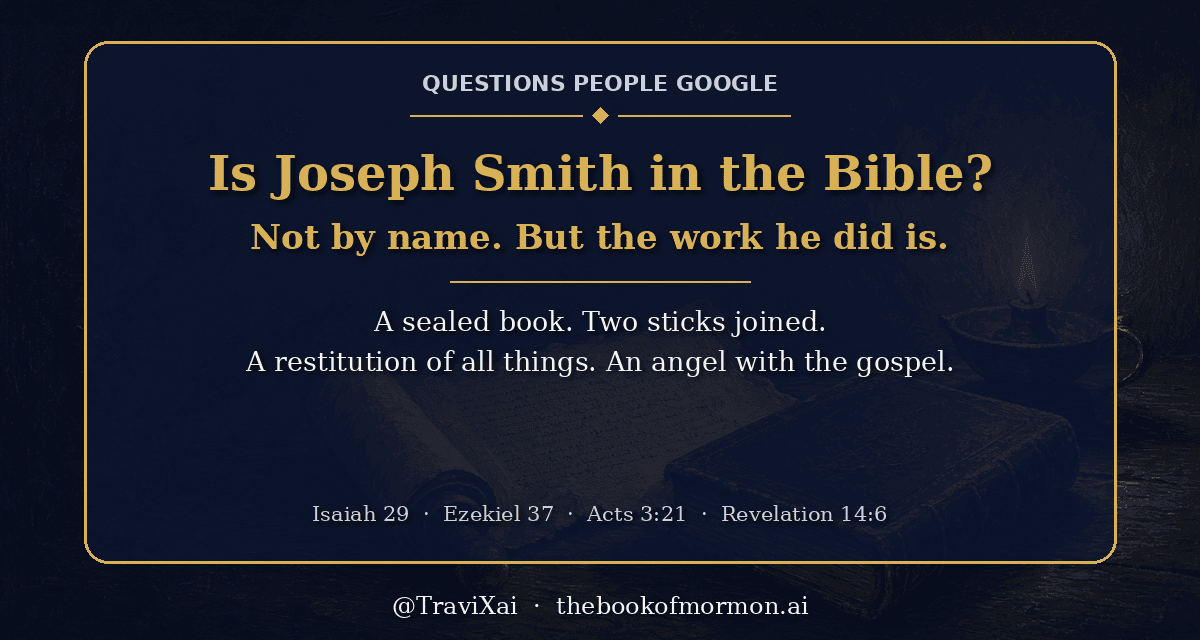

People search this to settle an argument. The honest answer has two halves: his name isn’t in the Bible, and the work he did is foretold in it.
Not by name. The words “Joseph Smith” don’t appear in the Bible, and Latter-day Saints don’t claim they do. But the Bible foretells the work he did: a sealed book given to an unlearned man (Isaiah 29:11–12), the stick of Joseph joined with the stick of Judah (Ezekiel 37:16–19), a “restitution of all things” (Acts 3:21), and an angel bringing “the everlasting gospel” (Revelation 14:6). The Book of Mormon (2 Nephi 3:15) records Joseph of Egypt prophesying a seer named after his father.
The honest answerHis name isn’t in the Bible, and that’s normal
Let’s start with what isn’t true. The words “Joseph Smith” don’t appear anywhere in the King James Bible, and Latter-day Saints don’t claim they do. If someone tells you there’s a verse that names him, ask to see it.
But that’s not how Bible prophecy usually works anyway. The Bible almost never names a person ahead of time. The rare exceptions stand out precisely because they’re rare: Isaiah names Cyrus, “He is my shepherd, and shall perform all my pleasure” (Isaiah 44:28), and a prophet names King Josiah three centuries early, “a child shall be born unto the house of David, Josiah by name” (1 Kings 13:2).
John the Baptist is the better pattern. Isaiah never wrote the name John. He wrote about “the voice of him that crieth in the wilderness” (Isaiah 40:3), and Malachi wrote, “I will send my messenger, and he shall prepare the way before me” (Malachi 3:1). Matthew later said, “this is he that was spoken of by the prophet Esaias” (Matthew 3:3). The prophecy described the work, and the fulfillment showed who did it. That’s exactly the claim Latter-day Saints make about Joseph Smith.
Genesis 50 · 2 Nephi 3Joseph of Egypt named him, in the record Latter-day Saints have
There is one prophecy that does name him, but it isn’t in the King James text. The Book of Mormon quotes a prophecy of Joseph who was sold into Egypt, preserved on the brass plates. Lehi reads it to his son Joseph:
A seer shall the Lord my God raise up, who shall be a choice seer unto the fruit of my loins.
2 Nephi 3:6
The seer would be “great like unto Moses” (2 Nephi 3:9), would bring forth the Lord’s word to Joseph’s descendants, and that record would “grow together” with the writings of Judah “unto the confounding of false doctrines” (2 Nephi 3:12). Then the detail that makes it unmistakable:
And his name shall be called after me; and it shall be after the name of his father.
2 Nephi 3:15
Joseph Smith Jr. was named after his father, Joseph Smith Sr. The Joseph Smith Translation restores the same prophecy to Genesis 50, ending with “his name shall be called Joseph, and it shall be after the name of his father” (JST Genesis 50:33). The King James Genesis 50 gives Joseph’s dying words in just a few lines, “God will surely visit you” (Genesis 50:24–25), and Jacob’s blessing calls Joseph “a fruitful bough … whose branches run over the wall” (Genesis 49:22).
A critic will say that’s circular, because it comes from books Joseph Smith brought forth. Fair enough: it’s a Latter-day Saint claim, and I’m labeling it as one. But the Bible itself admits it doesn’t contain everything the prophets wrote, as the post on books the Bible quotes that aren’t in the Bible shows. Whether the brass plates preserved more of Joseph’s words is exactly the question the Book of Mormon invites you to take to God.
Isaiah 29Isaiah’s sealed book, the learned man, and the unlearned man
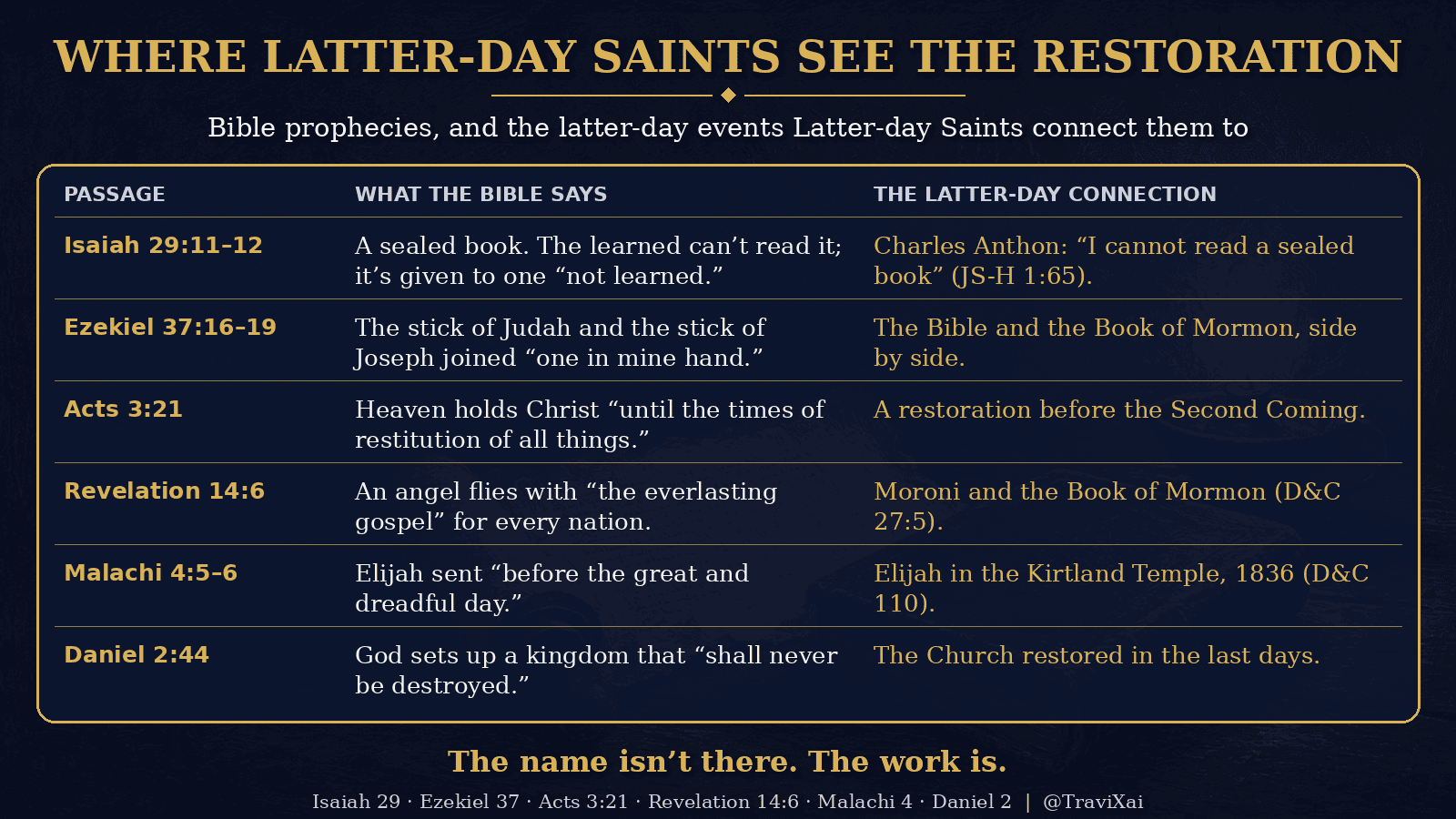
Isaiah 29 describes a people who “speak out of the ground” with speech “low out of the dust” (Isaiah 29:4), and then a book:
And the vision of all is become unto you as the words of a book that is sealed, which men deliver to one that is learned, saying, Read this, I pray thee: and he saith, I cannot; for it is sealed: And the book is delivered to him that is not learned, saying, Read this, I pray thee: and he saith, I am not learned.
Isaiah 29:11–12
In 1828 Martin Harris took a transcript of characters from the plates to Professor Charles Anthon in New York. By Harris’s account, Anthon first gave a certificate, then asked where the plates came from, tore up the certificate, and when told part of the plates were sealed, replied: “I cannot read a sealed book” (Joseph Smith—History 1:65). The book went instead to a farm boy with little schooling.
Isaiah goes on: “I will proceed to do a marvellous work among this people, even a marvellous work and a wonder: for the wisdom of their wise men shall perish” (Isaiah 29:14). Nephi’s longer version of the same prophecy says the Lord would hand the words “to him that is not learned,” adding, “I am able to do mine own work” (2 Nephi 27:19–20). How that unlearned man translated is covered in how the Book of Mormon was translated.
Ezekiel 37Ezekiel’s two sticks: Judah and Joseph
Take thee one stick, and write upon it, For Judah, and for the children of Israel his companions: then take another stick, and write upon it, For Joseph, the stick of Ephraim, and for all the house of Israel his companions: And join them one to another into one stick; and they shall become one in thine hand.
Ezekiel 37:16–17
The Lord repeats it: “I will take the stick of Joseph … and will put them with him, even with the stick of Judah, and make them one stick” (Ezekiel 37:19). Ancient writing was often done on wooden tablets or rolled on sticks, and Latter-day Saints read the two sticks as two records: the Bible, written by the house of Judah, and the Book of Mormon, written by descendants of Joseph. That matches 2 Nephi 3:12 almost word for word: the writings of Joseph and Judah “shall grow together.”
In a revelation to Joseph Smith, the Lord described Moroni as the one “to whom I have committed the keys of the record of the stick of Ephraim” (D&C 27:5). Other readings of Ezekiel 37 see only the reunion of the two kingdoms, and that reunion is in the chapter too. The Latter-day Saint reading doesn’t deny it; it says the joined records are part of how the Lord gathers Israel.
Acts 3 · Revelation 14A restitution of all things, and an angel with the gospel
Peter told a crowd in Jerusalem that Jesus must stay in heaven “until the times of restitution of all things, which God hath spoken by the mouth of all his holy prophets since the world began” (Acts 3:21). A restitution means something has to be restored. Jesus said the same about the last days: “Elias truly shall first come, and restore all things” (Matthew 17:11). Paul wrote of “the dispensation of the fulness of times” in which God would “gather together in one all things in Christ” (Ephesians 1:10).
John saw how it would start:
And I saw another angel fly in the midst of heaven, having the everlasting gospel to preach unto them that dwell on the earth, and to every nation, and kindred, and tongue, and people.
Revelation 14:6
If the gospel had never been lost, it wouldn’t need an angel to bring it back. Joseph Smith said an angel named Moroni came to him in 1823, called him by name, and told him “that God had a work for me to do” (JS-H 1:33). Moroni quoted Isaiah 11 “saying that it was about to be fulfilled,” and Acts 3:22–23 “precisely as they stand in our New Testament” (JS-H 1:40). The post on the Great Apostasy in the New Testament’s own words covers why a restoration was needed.
Malachi 4 · Daniel 2Elijah’s return and a kingdom that won’t be destroyed
The Old Testament ends with a promise that hadn’t been fulfilled when it closed: “Behold, I will send you Elijah the prophet before the coming of the great and dreadful day of the Lord: And he shall turn the heart of the fathers to the children, and the heart of the children to their fathers” (Malachi 4:5–6).
On April 3, 1836, in the Kirtland Temple, Joseph Smith and Oliver Cowdery recorded that Elijah stood before them and said, “the time has fully come, which was spoken of by the mouth of Malachi” (D&C 110:14), and “the keys of this dispensation are committed into your hands” (D&C 110:16). Turning the hearts of the fathers and children is why Latter-day Saints do family history and temple work, including baptism for the dead.
Daniel, interpreting Nebuchadnezzar’s dream, wrote, “in the days of these kings shall the God of heaven set up a kingdom, which shall never be destroyed” (Daniel 2:44). Latter-day Saints believe that prophecy is being fulfilled in the restored Church. And Amos gives the principle behind all of it: “Surely the Lord God will do nothing, but he revealeth his secret unto his servants the prophets” (Amos 3:7). If God is restoring His Church, Amos says to expect a prophet.
Isaiah 11Isaiah 11 and the “root of Jesse”
Isaiah 11 is one of the chapters Moroni quoted. It promises that “the Lord shall set his hand again the second time to recover the remnant of his people” and “set up an ensign for the nations” (Isaiah 11:11–12). Verse 10 speaks of “a root of Jesse, which shall stand for an ensign of the people.”
When Joseph Smith asked about the chapter, the answer described a latter-day servant “who is partly a descendant of Jesse as well as of Ephraim, or of the house of Joseph, on whom there is laid much power” (D&C 113:4), one “unto whom rightly belongs the priesthood, and the keys of the kingdom, for an ensign, and for the gathering of my people in the last days” (D&C 113:6). The revelation doesn’t name the servant. Many Latter-day Saints have seen Joseph Smith in it, but it’s honest to say the text leaves the name open.
The real testThe test Jesus gave: fruits, not a name in a verse
Jesus didn’t tell us to check whether a prophet’s name was printed in an older book. He said, “Ye shall know them by their fruits” (Matthew 7:16), and again, “by their fruits ye shall know them” (Matthew 7:20).
The fruit Joseph Smith left is a 500-page book of scripture that testifies of Christ on almost every page, revelations, temples, and millions of people who follow Jesus Christ because of what he restored. Even a prophecy given to him at 17 has come true: Moroni said his name “should be had for good and evil among all nations, kindreds, and tongues” (JS-H 1:33), and two centuries later it still is, as I wrote in His Name Had for Good and Evil. More of his prophecies are in Joseph Smith’s Fulfilled Prophecies.
Check the premiseThe presuppositions baked into the question
Before this question can be answered fairly, the person asking has to justify a few assumptions packed inside it:
- That a true prophet has to be named in the Bible. Almost no prophet was. Elijah, Jeremiah, Peter and Paul weren’t named ahead of time. John the Baptist was described by his work, not his name (Isaiah 40:3; Matthew 3:3).
- That the Bible is the complete record of every prophecy. The Bible itself cites prophetic books it doesn’t contain, and Genesis gives Joseph of Egypt’s last words in just two verses (Genesis 50:24–25). The asker has to show where the Bible says it holds everything God ever revealed.
- That God stopped calling prophets. Amos 3:7 says God reveals His secrets to His prophets, and Acts 3:21 and Revelation 14:6 describe work still to come before Christ returns. Where does the Bible say the calling ended?
- That a Latter-day Saint reading is automatically “reading into” the text. Every Christian reads Isaiah 40 or Malachi 3 through its fulfillment. Reading Isaiah 29 or Ezekiel 37 through the events of 1828–1830 is the same method. Judge the reading by whether the details fit.
FAQQuick answers
Is Joseph Smith mentioned in the Bible?
Not by name. Latter-day Saints believe Bible prophecies describe the work he did, including Isaiah 29 (a sealed book), Ezekiel 37 (the stick of Joseph), Acts 3:21 (a restitution of all things), Revelation 14:6 (an angel with the everlasting gospel), and Malachi 4:5–6 (Elijah’s return).
Where does scripture prophesy Joseph Smith by name?
In 2 Nephi 3:15 in the Book of Mormon and in the Joseph Smith Translation of Genesis 50:33, where Joseph of Egypt prophesies of a latter-day seer: “his name shall be called after me; and it shall be after the name of his father.”
What is the sealed book in Isaiah 29?
Latter-day Saints believe it describes the Book of Mormon. Isaiah 29:11–12 speaks of a sealed book that a learned man cannot read and that is given to one “not learned.” In 1828 Professor Charles Anthon told Martin Harris, “I cannot read a sealed book” (JS-H 1:65).
What are the two sticks in Ezekiel 37?
Ezekiel 37:16–19 describes a stick “for Judah” and a stick “for Joseph” joined into one. Latter-day Saints read them as the Bible (the record of Judah) and the Book of Mormon (a record of Joseph’s descendants).
Do Latter-day Saints believe Joseph Smith replaced Jesus?
No. Joseph Smith taught that Jesus Christ is the center of the gospel and testified, “That he lives!” (D&C 76:22). He is honored as a prophet who restored Christ’s Church, not worshipped.
Did Joseph of Egypt prophesy about Joseph Smith?
The Book of Mormon records that he did. Joseph of Egypt foresaw a latter-day seer and said, “his name shall be called after me; and it shall be after the name of his father” (2 Nephi 3:15). Joseph Smith Jr. was named after his father, Joseph Smith Sr.
What did the angel Moroni say about Joseph Smith’s name?
In 1823 Moroni told the 17-year-old Joseph that his “name should be had for good and evil among all nations, kindreds, and tongues” (Joseph Smith—History 1:33).
Is Malachi’s promise of Elijah connected to Joseph Smith?
Yes. Malachi wrote, “Behold, I will send you Elijah the prophet” (Malachi 4:5). Latter-day Saints believe this was fulfilled on April 3, 1836, when Elijah appeared to Joseph Smith and Oliver Cowdery in the Kirtland Temple (D&C 110:13–16).
SummaryKey takeaways
- The name “Joseph Smith” isn’t in the Bible. Bible prophecy rarely names anyone ahead of time.
- Like John the Baptist, the Restoration is foretold by its work: Isaiah 29, Ezekiel 37, Acts 3:21, Revelation 14:6, Malachi 4:5–6.
- Joseph of Egypt’s prophecy of a seer “called after me” is preserved in 2 Nephi 3 and JST Genesis 50.
- Jesus’s test is fruits (Matthew 7:16), not whether a name appears in an older book.
Read Isaiah 29 and Ezekiel 37 next to each other, then ask God about the book they describe (Moroni 10:4). For quick, sourced answers, open Galatians18, and follow me on X at @TraviXai.
Sources
- King James Bible (churchofjesuschrist.org): Genesis 49:22 · Genesis 50:24–25 · 1 Kings 13:2 · Isaiah 11:10–12 · Isaiah 29:4–14 · Isaiah 40:3 · Isaiah 44:28 · Ezekiel 37:16–19 · Daniel 2:44 · Amos 3:7 · Malachi 3:1 · Malachi 4:5–6 · Matthew 3:3 · Matthew 7:16–20 · Matthew 17:11 · Acts 3:21–23 · Ephesians 1:10 · Revelation 14:6
- Book of Mormon: 2 Nephi 3:6–15 · 2 Nephi 27:19–20
- Doctrine and Covenants and Pearl of Great Price: D&C 27:5 · D&C 76:22 · D&C 110:13–16 · D&C 113:4–6 · JS-H 1:33 · JS-H 1:40 · JS-H 1:64–65
- Joseph Smith Translation: JST Genesis 50:27–33
- Featured image and in-article graphic: original graphics by thebookofmormon.ai (painterly backgrounds; no photographs or likenesses of real people).