
The Lord asked the early Saints to give everything and receive back a stewardship. Here is the law, its history, why it was suspended, and how it is lived now.
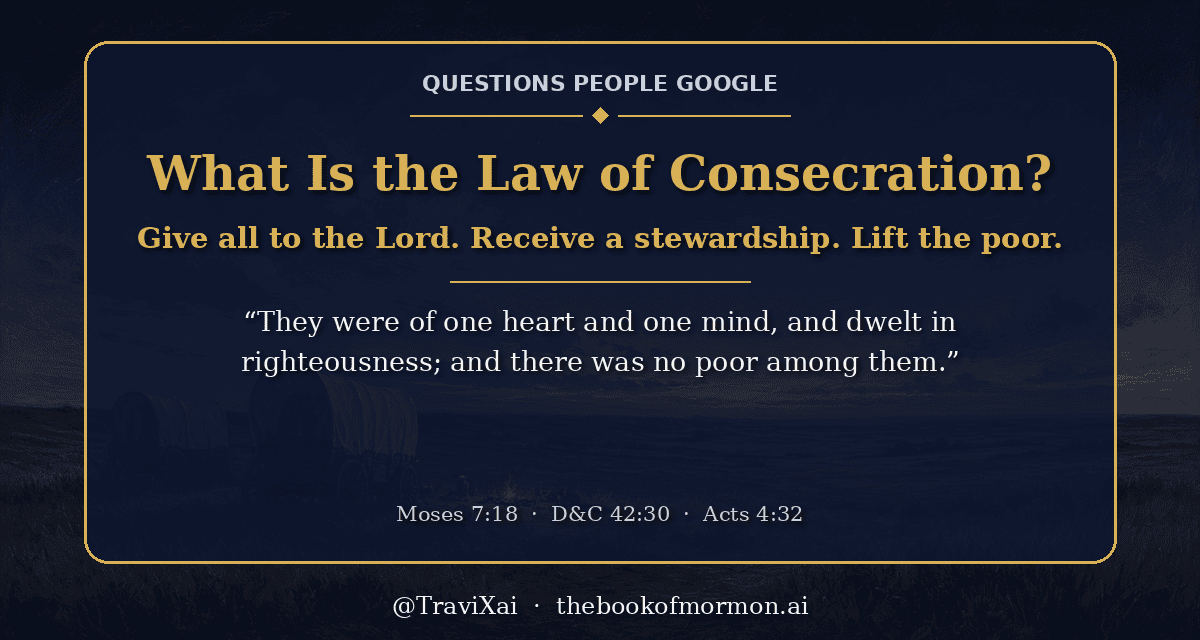
The question often assumes the United Order was communism, or that the Church simply took people’s property. Neither fits the text. The law of consecration, revealed in 1831 (D&C 42), asks Saints to consecrate their property to the Lord through the bishop, receive back a stewardship “sufficient for himself and family,” and give their surplus to care for the poor and build Zion. It was tried in Missouri, suspended when the Saints were not united (D&C 105), and replaced for now by tithing (D&C 119). Members still covenant to live it today. And it is not communism. Communism is imposed by the state through confiscation and force. Consecration is offered freely to God, works only when He is at its head and His people are of one heart, and comes apart the moment pride and covetousness move in. The goal is Enoch’s Zion: “there was no poor among them” (Moses 7:18).
What it isThe law in D&C 42
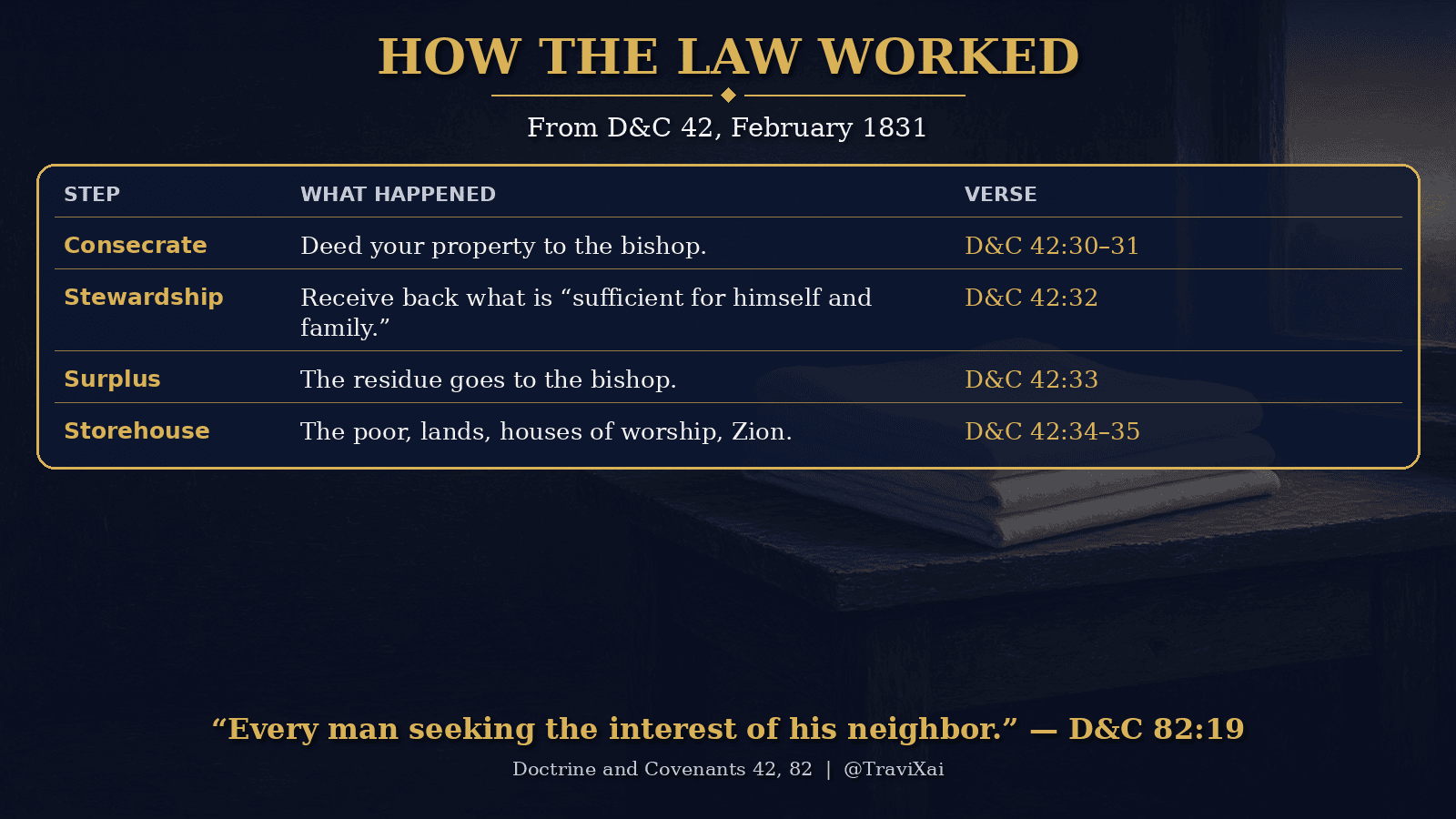
The law of consecration is the Lord’s economic law for Zion. It was revealed on February 9, 1831, in Kirtland, as part of what the Lord called “the law” of the Church: “thou wilt remember the poor, and consecrate of thy properties for their support that which thou hast to impart unto them, with a covenant and a deed which cannot be broken” (D&C 42:30–31).
It had three steps. A member deeded his property to the bishop. The bishop deeded back a stewardship, “as much as is sufficient for himself and family,” for which “every man shall be made accountable unto me, a steward over his own property.” And any surplus went to the bishop’s storehouse “to administer to the poor and the needy,” to buy land, to build houses of worship and to build “the New Jerusalem” (D&C 42:32–35). Portions were fitted to each family: “every man equal according to his family, according to his circumstances and his wants and needs” (D&C 51:3).
The point was never equality for its own sake. “If ye are not equal in earthly things ye cannot be equal in obtaining heavenly things; for if you will that I give unto you a place in the celestial world, you must prepare yourselves” (D&C 78:5–7). Consecration is training for exaltation. A people who will share everything here are learning to live as the Father lives.
The historyFrom Missouri to Orderville
Bishop Edward Partridge put the law into practice in Jackson County, Missouri, from 1831 to 1833, using deeds of consecration and stewardship. In 1832 the Lord organized a small group of leaders into what the current edition of the D&C calls the United Firm (earlier editions said “United Order”), to manage the Church’s printing and mercantile enterprises (D&C 82:17–19). Mobs drove the Saints out of Jackson County in 1833, and in April 1834 the firm was dissolved and its properties divided as stewardships (D&C 104).
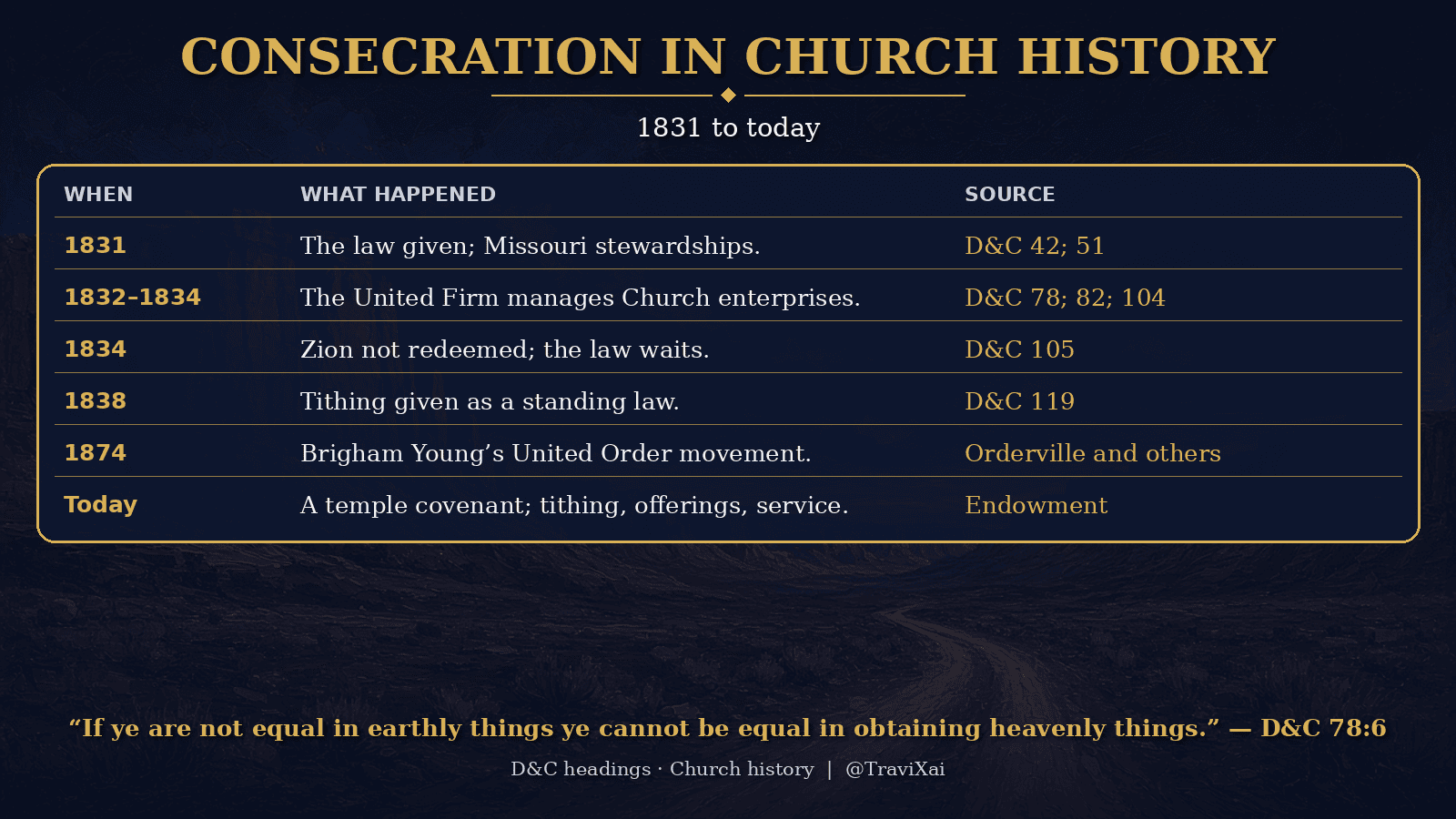
In 1838 the Lord gave the law of tithing: “all their surplus property,” and “after that, those who have thus been tithed shall pay one-tenth of all their interest annually; and this shall be a standing law unto them forever” (D&C 119:1–4). In Utah, Brigham Young launched a United Order movement in 1874, and some two hundred communities tried versions of it. Orderville, in southern Utah, ran the most complete one for about a decade. By the late 1880s nearly all had ended. See Why Do Latter-day Saints Pay Tithing? and Who Was Brigham Young?.
Why it was suspendedThe Lord said why
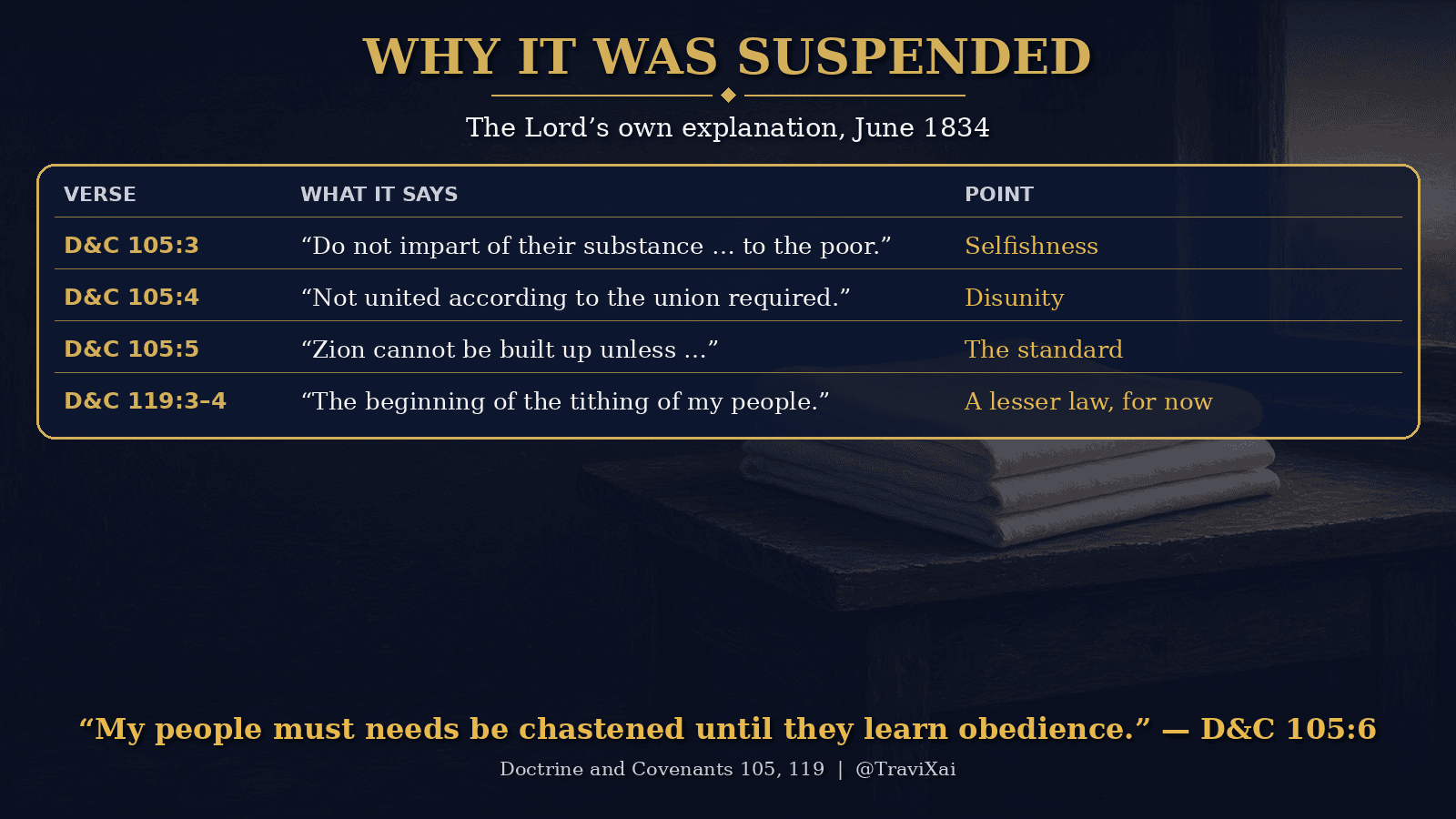
The Lord’s explanation at Fishing River in June 1834 is blunt. The Saints “have not learned to be obedient … and do not impart of their substance, as becometh saints, to the poor and afflicted among them; and are not united according to the union required by the law of the celestial kingdom; and Zion cannot be built up unless it is by the principles of the law of the celestial kingdom” (D&C 105:3–6). The problem was not the law. It was us.
The BibleThe church at Jerusalem
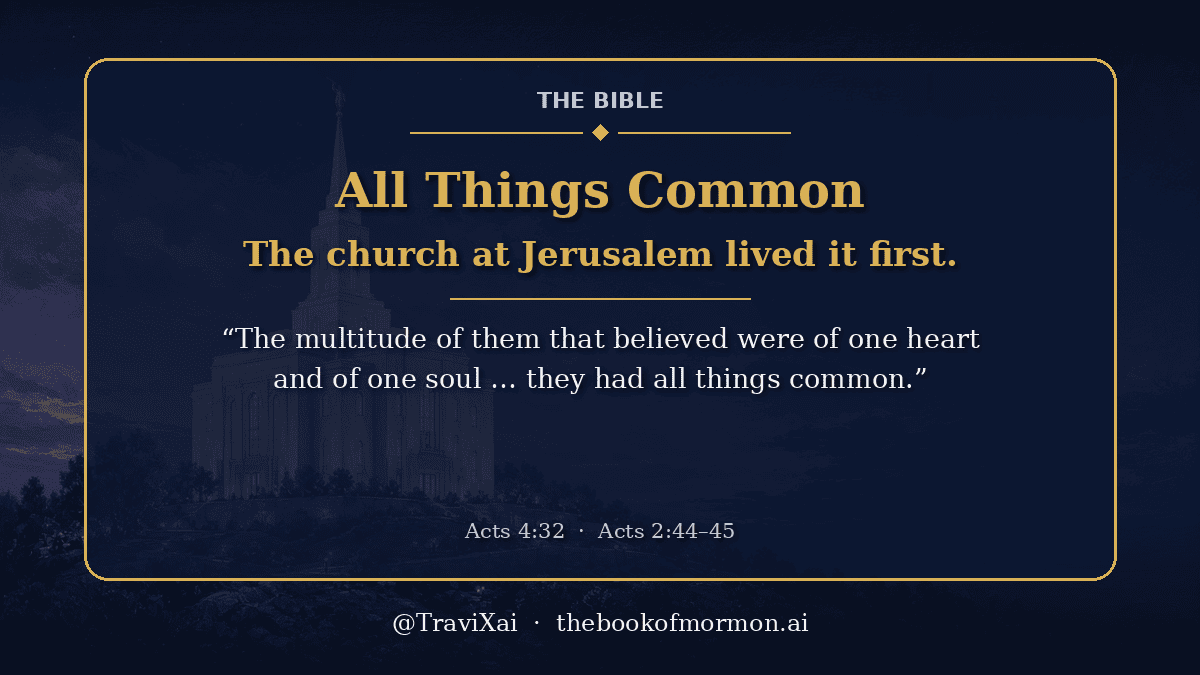
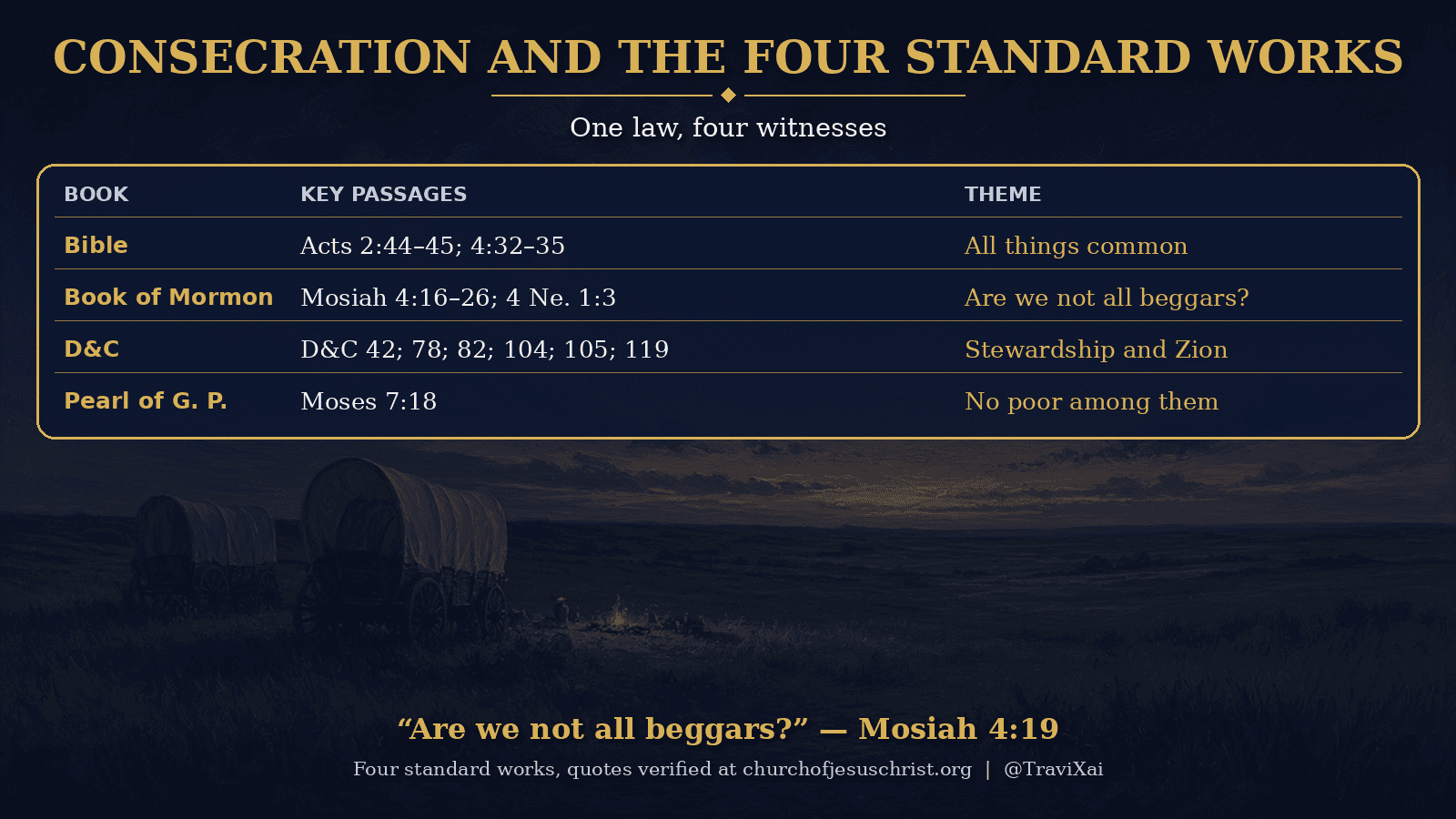
Consecration is not a Latter-day Saint invention. After Pentecost, “all that believed were together, and had all things common; and sold their possessions and goods, and parted them to all men, as every man had need” (Acts 2:44–45). “The multitude of them that believed were of one heart and of one soul: neither said any of them that ought of the things which he possessed was his own … Neither was there any among them that lacked … and distribution was made unto every man according as he had need” (Acts 4:32–35). Most Christian churches treat that as a passing episode. The Restoration treats it as a pattern to restore. See What Is the Restoration of the Gospel?.
Read one more chapter, because it settles whether this was ever forced. When Ananias and Sapphira sold land, kept back part of the price and pretended they had given it all, Peter’s charge was the lie, not the keeping: “Whiles it remained, was it not thine own? and after it was sold, was it not in thine own power? why hast thou conceived this thing in thine heart? thou hast not lied unto men, but unto God” (Acts 5:1–4). The land was theirs. The money was theirs. The giving was voluntary. Anyone who reads Acts as a charter for forced redistribution has to explain why the apostle said the opposite out loud.
The Book of MormonAre we not all beggars?
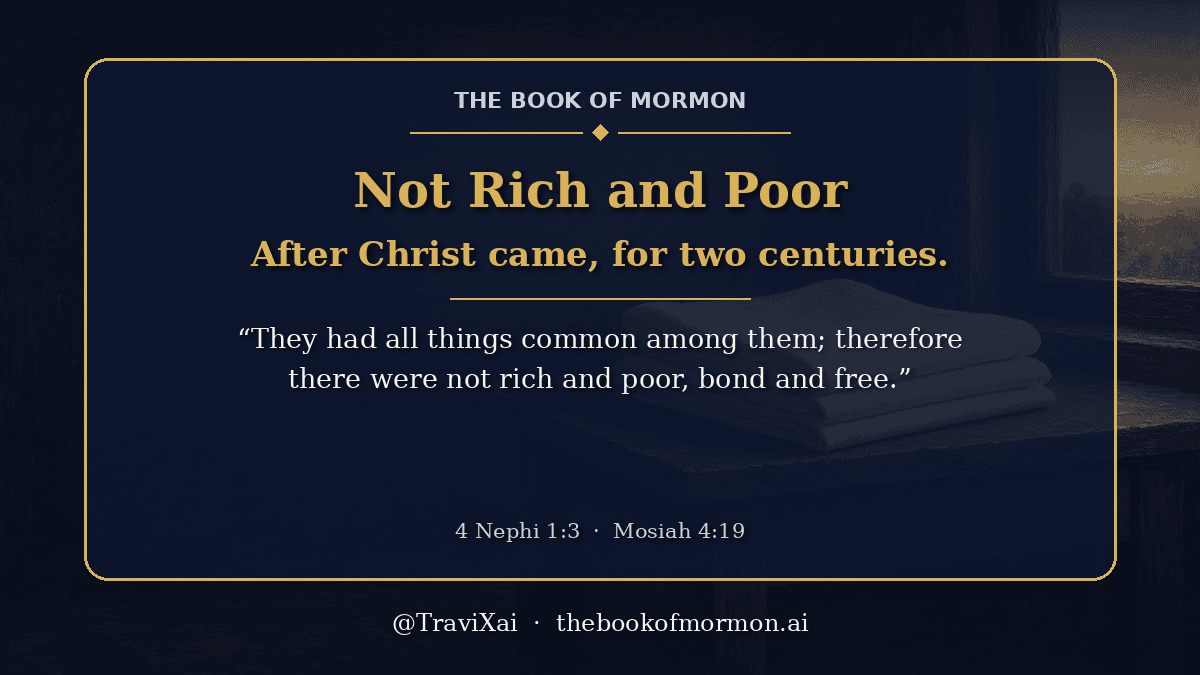
King Benjamin gave the reason behind the law: “Perhaps thou shalt say: The man has brought upon himself his misery … But I say unto you, O man, whosoever doeth this the same hath great cause to repent … For behold, are we not all beggars? Do we not all depend upon the same Being, even God, for all the substance which we have” (Mosiah 4:16–19). He tied it to forgiveness itself: “for the sake of retaining a remission of your sins from day to day … impart of your substance to the poor” (Mosiah 4:26).
After the risen Christ visited, the Nephites lived it for nearly two centuries: “they had all things common among them; therefore there were not rich and poor, bond and free, but they were all made free, and partakers of the heavenly gift” (4 Nephi 1:3). See Did Jesus Visit the Americas?.
The Doctrine and CovenantsStewardship, not a commune
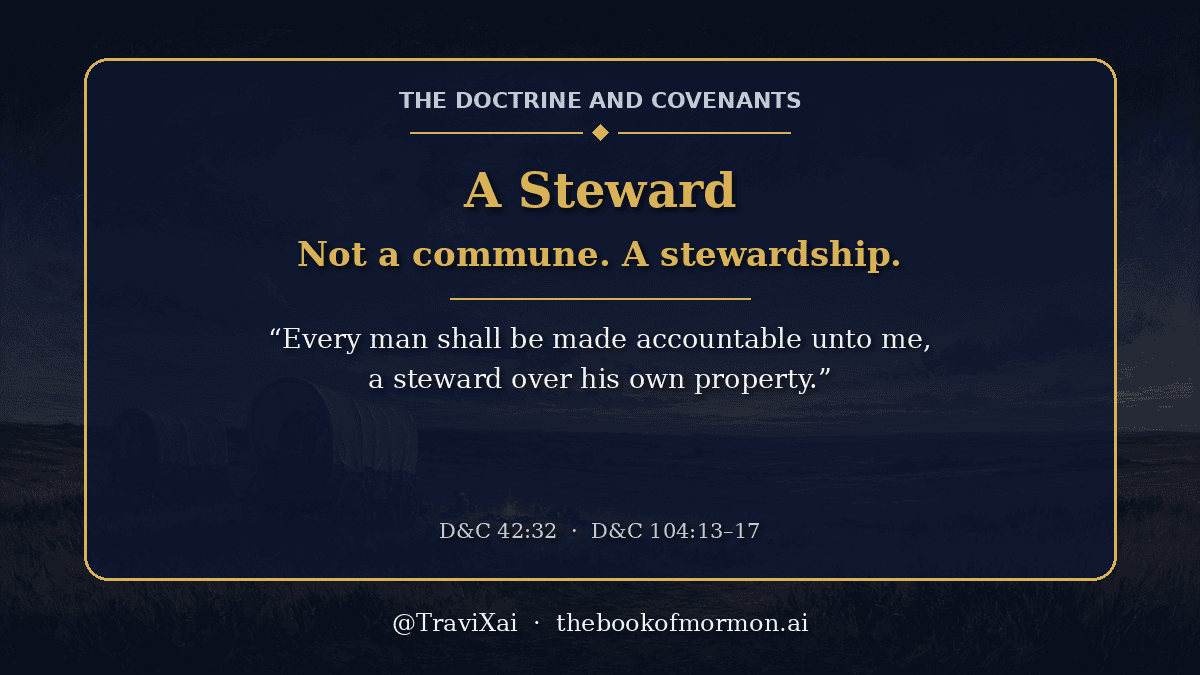
The question people ask most is whether the United Order was communism. The Lord’s own framing answers it: “it is expedient that I, the Lord, should make every man accountable, as a steward over earthly blessings … I, the Lord, stretched out the heavens, and built the earth, my very handiwork; and all things therein are mine … But it must needs be done in mine own way … that the poor shall be exalted, in that the rich are made low. For the earth is full, and there is enough and to spare; yea, I prepared all things, and have given unto the children of men to be agents unto themselves” (D&C 104:13–17).
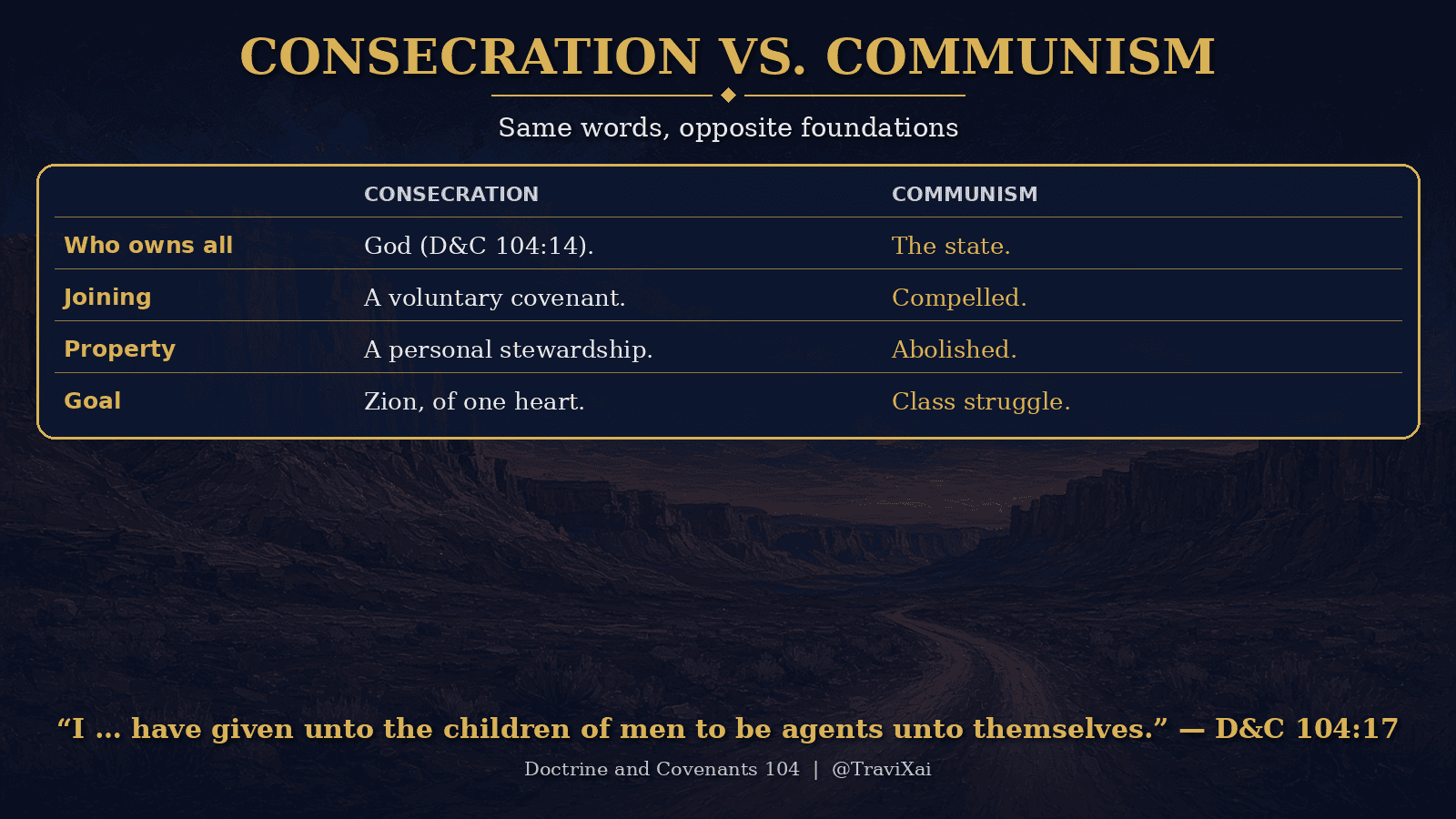
Ownership is God’s, not the state’s. Joining is a covenant, not a compulsion. Each person keeps a real stewardship and is accountable for improving it: “that every man may improve upon his talent, that every man may gain other talents … every man seeking the interest of his neighbor, and doing all things with an eye single to the glory of God” (D&C 82:17–19).
The Lord pressed the point in the same revelation that dissolved the United Firm: “Behold, all these properties are mine, or else your faith is vain, and ye are found hypocrites, and the covenants which ye have made unto me are broken; and if the properties are mine, then ye are stewards; otherwise ye are no stewards” (D&C 104:55–56). That is the entire foundation. Take God out and there is no owner to consecrate to, no covenant to keep and no stewardship to account for. What is left is a man with power deciding what you get to keep.
The Pearl of Great PriceEnoch’s Zion
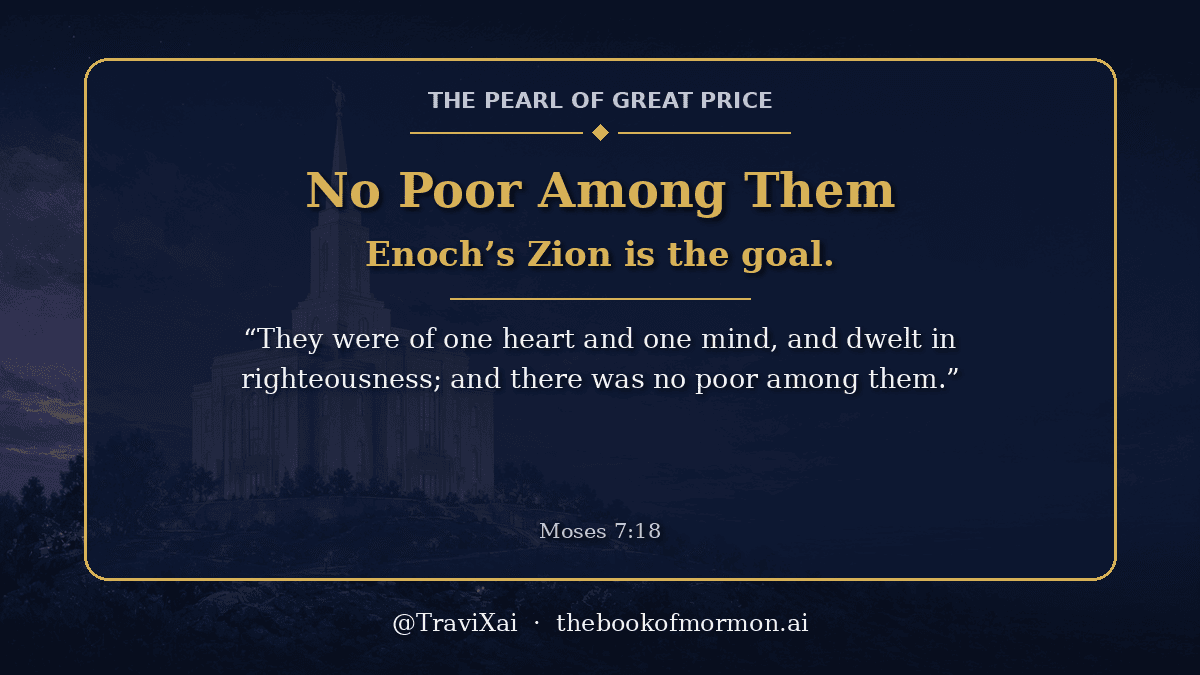
The goal is the city of Enoch: “the Lord called his people Zion, because they were of one heart and one mind, and dwelt in righteousness; and there was no poor among them” (Moses 7:18). That city was taken up to God. A people who become what Enoch’s people became are a people ready to live with their Father, and in time to become like Him.
God at the headWhy it only works with the Lord at its head
Here is the part critics and utopians both skip. The law of consecration is not an economic system with a prayer bolted on. It is a covenant with God, and it only works when He is at its head and His people are united in righteousness. The Lord said so before it was tried: “For if you will that I give unto you a place in the celestial world, you must prepare yourselves by doing the things which I have commanded you and required of you” (D&C 78:7). He said it again when it failed: “Zion cannot be built up unless it is by the principles of the law of the celestial kingdom; otherwise I cannot receive her unto myself” (D&C 105:5).
Enoch’s city did not end poverty with a better distribution plan. Look at the order of the verse: “they were of one heart and one mind, and dwelt in righteousness; and there was no poor among them” (Moses 7:18). Unity and righteousness come first. The absence of poverty is the fruit, not the root.
The Nephites prove it from both directions. After Christ’s visit, “the people were all converted unto the Lord, upon all the face of the land, both Nephites and Lamanites, and there were no contentions and disputations among them, and every man did deal justly one with another. And they had all things common among them” (4 Nephi 1:2–3). Conversion came first. Common property followed. Why did it hold for nearly two centuries? Mormon answers directly: “there was no contention in the land, because of the love of God which did dwell in the hearts of the people” (4 Nephi 1:15–17). Then pride arrived, and it came apart in three verses: “there began to be among them those who were lifted up in pride, such as the wearing of costly apparel … And from that time forth they did have their goods and their substance no more common among them. And they began to be divided into classes” (4 Nephi 1:24–26). Nobody repealed the system. The hearts changed, and the system went with them.
King Benjamin put the motive where it belongs. The rich are told their substance “doth not belong to you but to God” (Mosiah 4:22), and the poor who have nothing are told to say in their hearts, “I give not because I have not, but if I had I would give” (Mosiah 4:24). That is a law written on the heart, not a quota enforced by a commissar. No government on earth can command what Mosiah 4:24 commands, because it governs desire.
The Latter-day Saints learned the same lesson the hard way. In Missouri the Lord named the problem: “there were jarrings, and contentions, and envyings, and strifes, and lustful and covetous desires among them; therefore by these things they polluted their inheritances” (D&C 101:6). The United Firm was dissolved because “some of my servants have not kept the commandment, but have broken the covenant through covetousness, and with feigned words” (D&C 104:4). In Utah, the United Orders of the 1870s and 1880s faded as federal antipolygamy raids scattered their members and, in the words of the Church’s own history, “most Latter-day Saints opted to integrate into the expanding market economy” (Church History Topics, “United Orders”). Every time it was tried by a people not yet ready to live it, it unwound. The law did not fail. The people did, and the Lord said so in writing.
Even before D&C 42, a group of converts on Isaac Morley’s farm in Ohio were holding all things in common on their own terms. Joseph Smith and John Whitmer judged it unsustainable, and once the Lord revealed His law, that “common stock” plan “was readily abandoned for the more perfect law of the Lord” (Church History Topics, “Consecration and Stewardship”). Man-made communalism was the thing the Lord replaced, not the thing He revealed.
Not worldly socialismOffered to God, not taken by the state
So be blunt about the comparison people keep making. Consecration and communism both talk about the poor. That is where the resemblance ends. Communism and coercive state socialism remove God and put the state in His place as owner of everything, then enforce it. Consecration starts with God as the owner and leaves every person free to say yes or no.
Agency is not a side feature of the law. It is the law. The same verse that says the earth is the Lord’s says He has “given unto the children of men to be agents unto themselves” (D&C 104:17). Lehi taught that “men are free according to the flesh … And they are free to choose liberty and eternal life” (2 Nephi 2:27). And the Lord warned that the moment anyone tries “to exercise control or dominion or compulsion upon the souls of the children of men, in any degree of unrighteousness, behold, the heavens withdraw themselves” (D&C 121:37). Compulsion is the one tool God refuses to use. A system built on it cannot be His.
The Saints’ own declaration on government says the same thing about the state: “no government can exist in peace, except such laws are framed and held inviolate as will secure to each individual the free exercise of conscience, the right and control of property, and the protection of life” (D&C 134:2), and the civil magistrate “should restrain crime, but never control conscience” (D&C 134:4). Consecration never used the sheriff. No one was drafted into it. A member who left, or was found unworthy, kept his stewardship: he “shall only have claim on that portion that is deeded unto him” (D&C 51:4–5). Try leaving a Soviet collective farm with your land.
History has already run the other experiment, and the results are not a matter of opinion. When Stalin forced collectivization on Soviet agriculture beginning in 1929, Communist Party teams made peasants give up their land, property and sometimes their homes, and deported those who resisted. Between 1931 and 1934 at least 5 million people died of hunger across the U.S.S.R., including at least 3.9 million Ukrainians in the Holodomor of 1932–33 (Encyclopaedia Britannica, “Holodomor,” citing Ukrainian demographers). In Mao’s China, the Great Leap Forward herded peasants into communes and set off the famine of 1959–62. Britannica puts the toll at about 20 million (“Great Leap Forward”). Historians working from party archives put it far higher: Yang Jisheng at about 36 million (Tombstone) and Frank Dikötter at no fewer than 45 million (Mao’s Great Famine). That is what “all things common” looks like when the state takes it by force instead of a people offering it to God.
An apostle drew the same line in general conference. Comparing the two point by point in April 1966, Elder Marion G. Romney said: “The United Order is implemented by the voluntary free-will actions of men, evidenced by a consecration of all their property to the Church of God. … Socialism is implemented by external force, the power of the state.” Then: “Thus in both implementation and ownership and management of property, the United Order preserves to men their God-given agency, while socialism deprives them of it.” And the point this whole post turns on: “A righteous people is a prerequisite to the United Order” (Conference Report, Apr. 1966, 97; quoted in the Church’s Doctrine and Covenants Student Manual).
One is a covenant made at an altar. The other is a decree enforced at gunpoint. Calling them the same thing because both involve sharing is like calling a gift and a robbery the same thing because property changed hands in both.
TodayHow Latter-day Saints live it now
Latter-day Saints have not stopped living the law of consecration. In the temple endowment, members covenant to consecrate their time, talents and everything the Lord has blessed them with to building His kingdom. Day to day, that covenant is lived through tithing, generous fast offerings, the Church’s welfare and self-reliance programs, unpaid callings and missionary service. The full economic order is expected to return when Zion is built. See What Happens in a Latter-day Saint Temple? and Why Was Joseph Smith Tarred and Feathered?, where fear of consecration helped stir up the Hiram mob.
Check the premiseThe presuppositions baked into the question
Before this question can be answered fairly, the person asking has to justify a few assumptions packed inside it:
- That consecration was communism with a religious label. It rests on God’s ownership, a voluntary covenant and personal stewardship (D&C 104:13–17, 55–56). Communism rests on state ownership enforced by compulsion, the very thing the Lord says drives the heavens away (D&C 121:37).
- That anyone was forced into it. It was entered by covenant, and a member who left kept the portion deeded to him (D&C 51:4–5). Even in Acts, Peter told Ananias the land was “thine own” (Acts 5:4).
- That the Church took people’s property. Members deeded property by covenant and received back a stewardship “sufficient for himself and family” (D&C 42:32).
- That the law was abandoned because it failed. The Lord said Zion was delayed because the Saints were not united (D&C 105:3–5); tithing was given as a standing law in the meantime (D&C 119).
- That it can work as a system without God. Zion “cannot be built up” except by celestial principles (D&C 105:5). Among the Nephites it held “because of the love of God” in their hearts and ended when pride came in (4 Nephi 1:15, 24–26).
- That Latter-day Saints no longer live it. They covenant to live it in the temple and practice it through tithing, offerings, welfare and service.
FAQQuick answers
What is the law of consecration?
The Lord’s law, revealed in D&C 42 in 1831, in which Saints consecrate their property to the Lord through the bishop, receive back a stewardship, and give their surplus to care for the poor and build Zion.
What is the United Order?
A common name for efforts to live the law of consecration, including the 1830s United Firm (called “United Order” in older D&C editions) and Brigham Young’s 1874 United Order movement in Utah.
Was the United Order communism?
No. It rested on God’s ownership, voluntary covenant and personal stewardship (D&C 104:13–17). Communism is imposed by the state through force; consecration is offered freely to God, and no one is compelled (D&C 121:37).
Why did the Church stop living the United Order?
The Lord said the Saints were not united enough to build Zion (D&C 105:3–5). The Utah United Orders mostly ended by the late 1880s.
Is the law of consecration the same as tithing?
No. Tithing (D&C 119) is a lesser, standing law. Consecration asks for everything.
Do Latter-day Saints still live the law of consecration?
Yes. Members covenant to live it in the temple, and practice it through tithing, fast offerings, welfare and service.
What was Orderville?
A town in southern Utah that lived one of the most complete United Orders from 1875 for about a decade.
Where is the law of consecration in the Bible?
Acts 2:44–45 and 4:32–35 describe the early church having “all things common.”
Can the law of consecration work without God?
No. Zion “cannot be built up” except by the principles of the celestial kingdom (D&C 105:5). Among the Nephites it lasted “because of the love of God” in their hearts and fell apart when pride came in (4 Nephi 1:15, 24–26).
Was anyone forced to live the United Order?
No. It was entered by covenant, and anyone who left kept the portion deeded to him (D&C 51:4–5). Even in Acts, Peter told Ananias the land “was it not thine own?” (Acts 5:4).
SummaryKey takeaways
- Revealed February 9, 1831, in D&C 42.
- Consecrate, receive a stewardship, give the surplus to the storehouse.
- Not communism: God owns all, joining is voluntary, no one is compelled, stewardship is personal.
- It only works with the Lord at its head and a people of one heart (D&C 105:5; Moses 7:18; 4 Nephi 1:15).
- Every time pride and covetousness came in, it unwound (4 Nephi 1:24–26; D&C 101:6; 104:4).
- Suspended because the Saints were not united (D&C 105); tithing given (D&C 119).
- Still a temple covenant, lived through tithing, offerings and service.
Read D&C 42:30–35 and Mosiah 4:16–26 tonight. For quick, sourced answers, open Galatians18, and follow me on X at @TraviXai.
Sources
- King James Bible (churchofjesuschrist.org): Acts 2:44–45 · Acts 4:32–35 · Acts 5:1–4
- Book of Mormon: Mosiah 4:16–19 · Mosiah 4:26 · 4 Nephi 1:3 · 2 Nephi 2:27 · Mosiah 4:21–24 · 4 Nephi 1:2–3 · 4 Nephi 1:15–17 · 4 Nephi 1:24–26
- Doctrine and Covenants: D&C 42:30–35 · D&C 51:3 · D&C 78:5–7 · D&C 82:17–19 · D&C 104:13–17 · D&C 105:3–6 · D&C 119:1–4 · D&C 51:4–5 · D&C 101:6 · D&C 104:4 · D&C 104:55–56 · D&C 121:37 · D&C 134:2–4
- Pearl of Great Price: Moses 7:18
- Section headings to D&C 42, 78, 82, 104, 105, 119 (churchofjesuschrist.org) · Leonard J. Arrington, Feramorz Y. Fox and Dean L. May, Building the City of God: Community and Cooperation Among the Mormons (1976)
- Marion G. Romney, “Socialism and the United Order Compared,” Conference Report, Apr. 1966, 95–101, quoted in Doctrine and Covenants Student Manual, Enrichment L · Church History Topics: “United Orders” and “Consecration and Stewardship”
- Encyclopaedia Britannica: “Holodomor” (Anne Applebaum) and “Great Leap Forward” · Yang Jisheng, Tombstone: The Great Chinese Famine, 1958–1962 (2012) · Frank Dikötter, Mao’s Great Famine (2010)
- Featured image and in-article graphic: original graphics by thebookofmormon.ai (painterly backgrounds; no photographs or likenesses of real people).