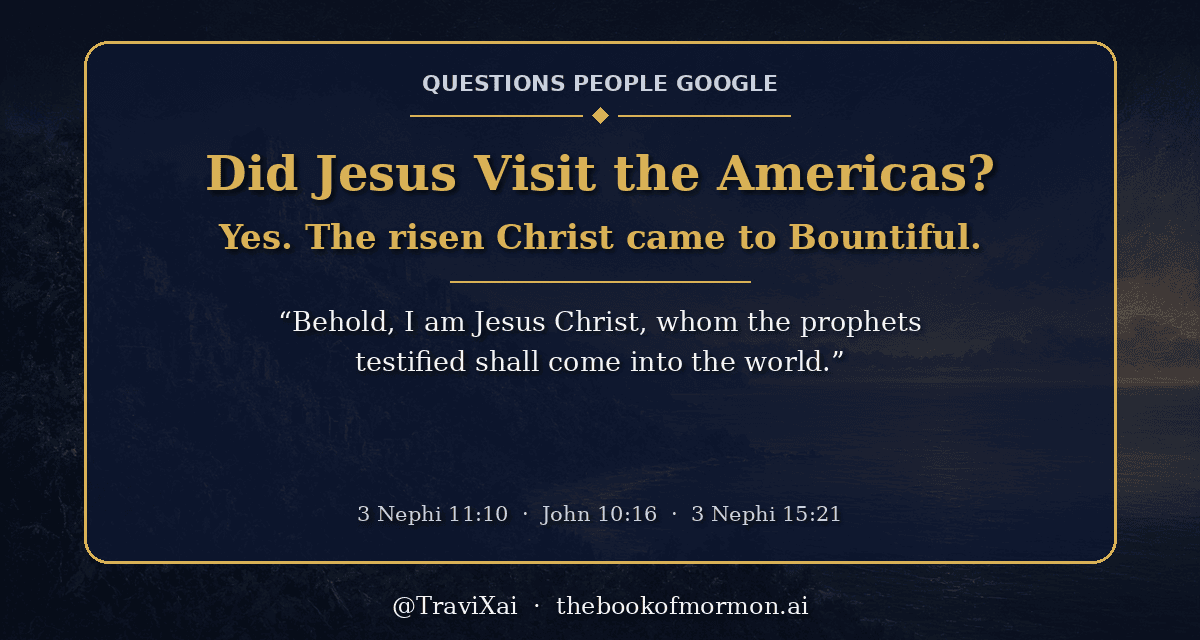

The risen Christ came down and stood among a people in the Americas. Here is what happened, why it fits the Bible, and what it means.
The question often assumes the Bible rules out any appearance outside Judea and that “other sheep” must mean Gentiles. Neither holds. Latter-day Saints believe that after His Resurrection, Jesus Christ appeared to the Nephites at the temple in Bountiful, let them feel “the prints of the nails in his hands and in his feet,” and taught them for days (3 Nephi 11:14; 26:13). He told them, “ye are they of whom I said: Other sheep I have which are not of this fold” (3 Nephi 15:21; John 10:16).
What happenedThe risen Christ at Bountiful
After His Resurrection and Ascension in Jerusalem, Christ appeared to a gathering of Nephites at their temple in the land Bountiful. They first heard the Father: “Behold my Beloved Son, in whom I am well pleased, in whom I have glorified my name—hear ye him.” Then “they saw a Man descending out of heaven; and he was clothed in a white robe; and he came down and stood in the midst of them” (3 Nephi 11:7–8).
He introduced Himself: “Behold, I am Jesus Christ, whom the prophets testified shall come into the world. And behold, I am the light and the life of the world; and I have drunk out of that bitter cup which the Father hath given me” (3 Nephi 11:10–11). Then He invited them: “Arise and come forth unto me, that ye may thrust your hands into my side, and also that ye may feel the prints of the nails in my hands and in my feet, that ye may know that I am the God of Israel, and the God of the whole earth, and have been slain for the sins of the world.” They went “one by one until they had all gone forth,” and then cried, “Hosanna! Blessed be the name of the Most High God!” (3 Nephi 11:14–17).
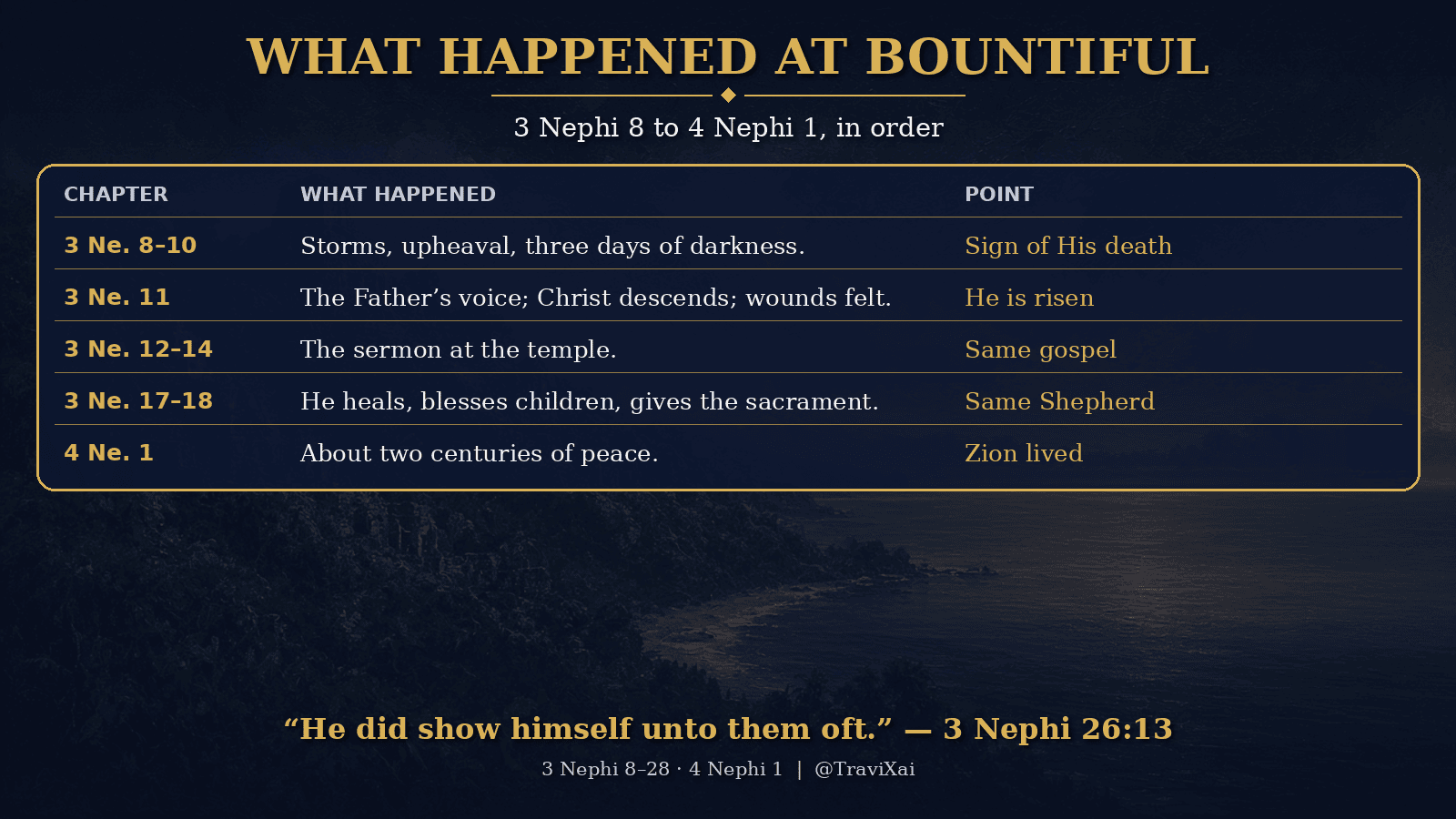
He stayed and taught. Mormon summarizes it: “the Lord truly did teach the people, for the space of three days; and after that he did show himself unto them oft, and did break bread oft, and bless it, and give it unto them” (3 Nephi 26:13). He healed the sick. He “took their little children, one by one, and blessed them, and prayed unto the Father for them,” and angels “came down and encircled those little ones about” (3 Nephi 17:21–24). He gave the sacrament: “this shall ye do in remembrance of my body, which I have shown unto you” (3 Nephi 18:7). The result was a society the Bible never records: “there could not be a happier people among all the people who had been created by the hand of God” (4 Nephi 1:15–17).
The Bible“Other sheep I have”
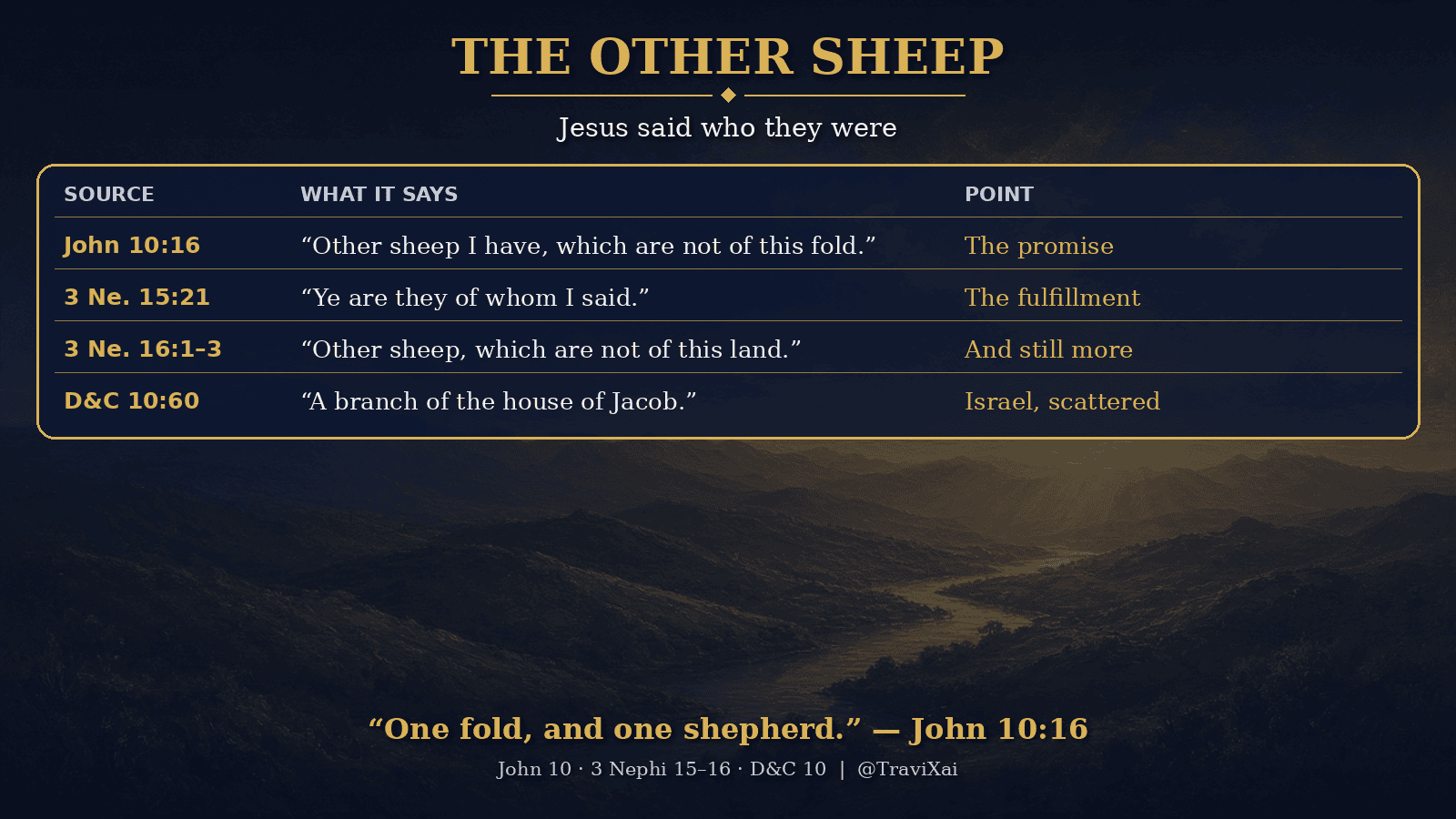
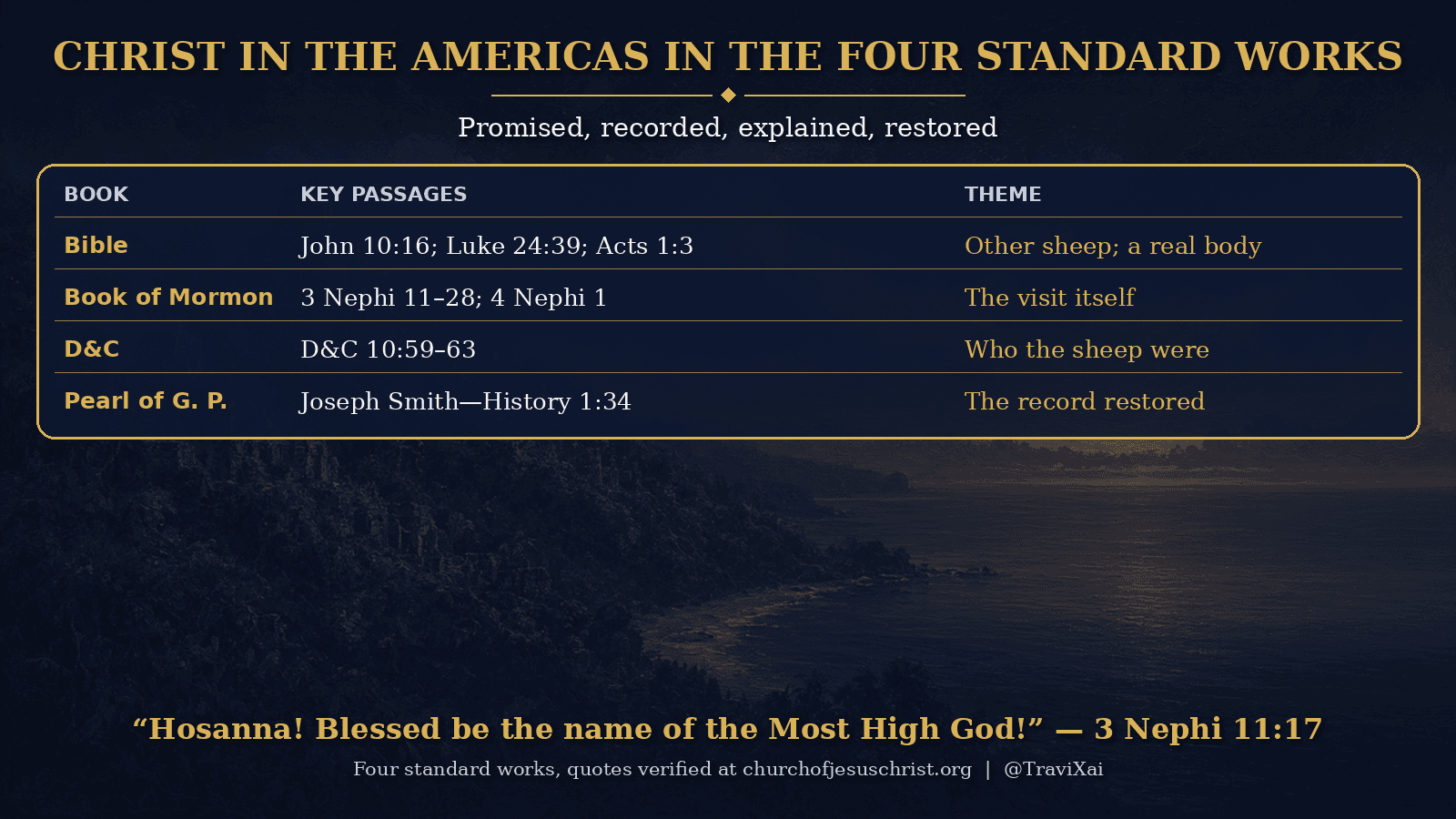
In Jerusalem the Good Shepherd said: “And other sheep I have, which are not of this fold: them also I must bring, and they shall hear my voice; and there shall be one fold, and one shepherd” (John 10:16). Most commentators read that as the Gentiles. But Jesus said they “shall hear my voice,” and the Gentiles heard Him through apostles, not in person. He told the Canaanite woman, “I am not sent but unto the lost sheep of the house of Israel” (Matthew 15:24). The other sheep were Israel, in another fold.
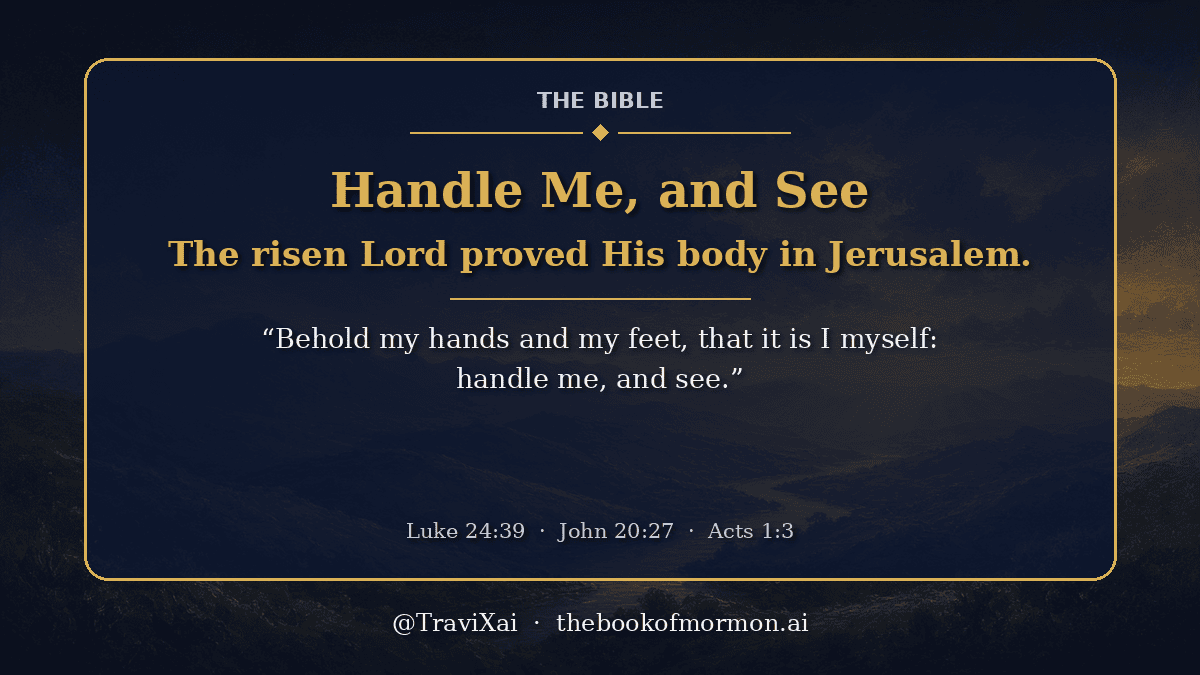
The Bible also shows the pattern the Nephites saw. The risen Christ proved He had a body: “Behold my hands and my feet, that it is I myself: handle me, and see; for a spirit hath not flesh and bones, as ye see me have” (Luke 24:39). He told Thomas, “Reach hither thy finger, and behold my hands; and reach hither thy hand, and thrust it into my side” (John 20:27). And He “shewed himself alive after his passion by many infallible proofs, being seen of them forty days” (Acts 1:3). Nobody says the forty days were His only appearances.
The Book of MormonHe named them Himself
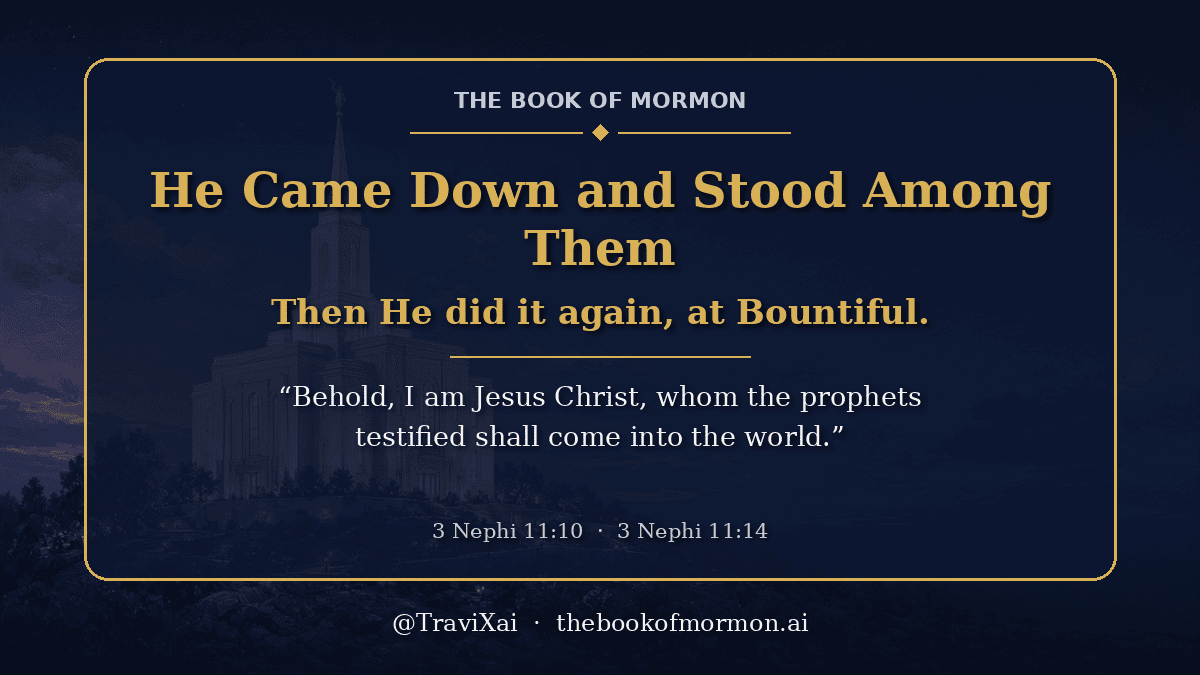
At Bountiful, Christ quoted John 10:16 and told the people who it was about: “ye are they of whom I said: Other sheep I have which are not of this fold; them also I must bring, and they shall hear my voice; and there shall be one fold, and one shepherd” (3 Nephi 15:21). Then He said there were still others: “I have other sheep, which are not of this land, neither of the land of Jerusalem … I have received a commandment of the Father that I shall go unto them” (3 Nephi 16:1–3).
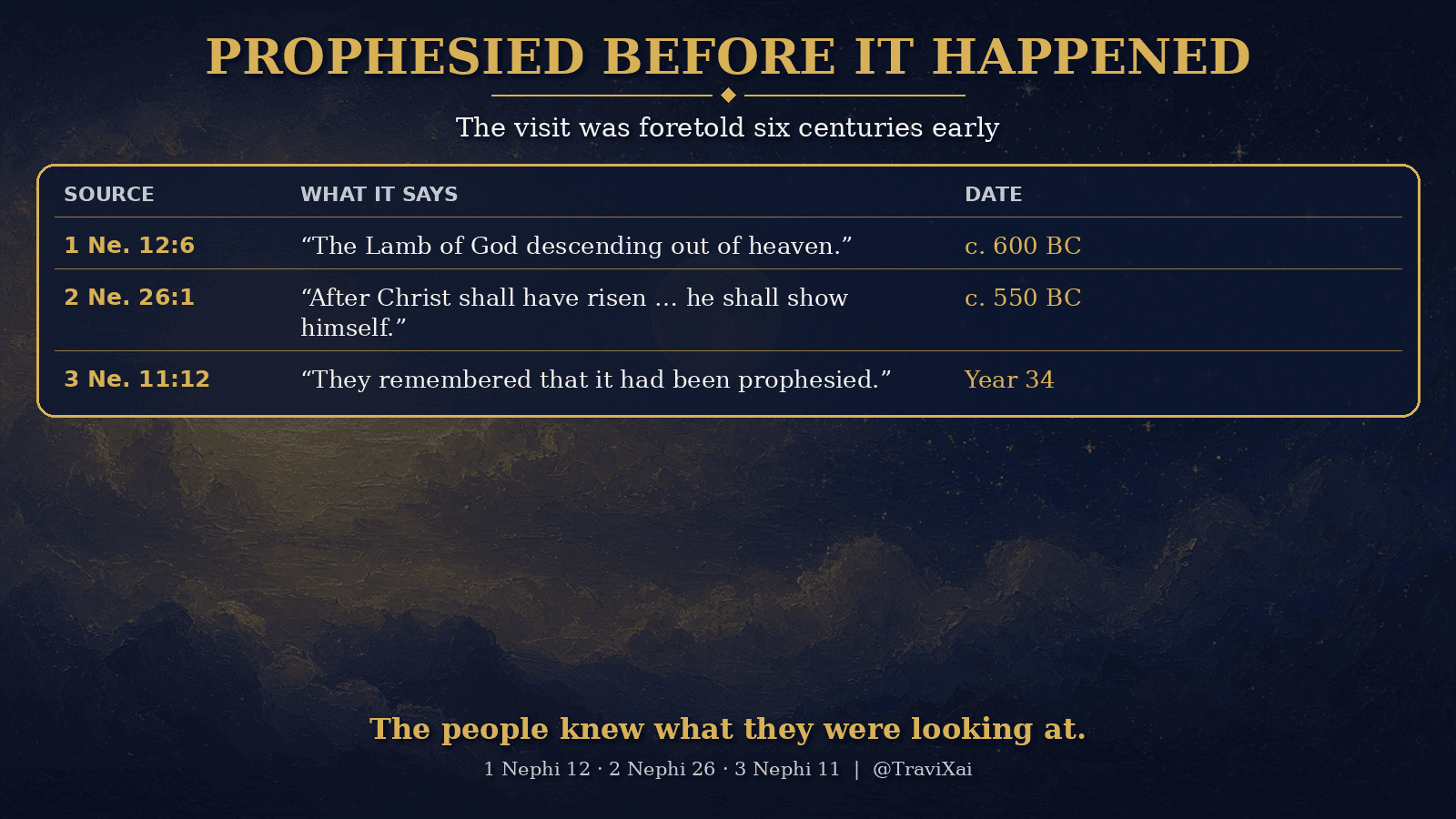
The visit had been foretold for centuries. About 600 BC Nephi saw “the heavens open, and the Lamb of God descending out of heaven; and he came down and showed himself unto them” (1 Nephi 12:6). Later he wrote, “after Christ shall have risen from the dead he shall show himself unto you” (2 Nephi 26:1). When it happened, “they remembered that it had been prophesied among them that Christ should show himself unto them after his ascension into heaven” (3 Nephi 11:12).
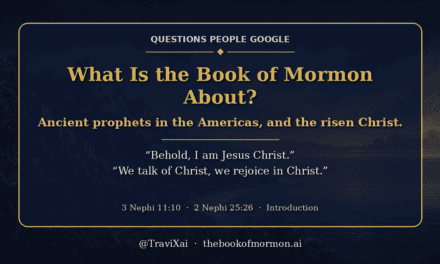
Before He came, His voice spoke in the darkness: “Behold, I am Jesus Christ the Son of God. I created the heavens and the earth, and all things that in them are. I was with the Father from the beginning” (3 Nephi 9:15). He is the Creator, and He always gives glory to the Father, from the first words He spoke at Bountiful (3 Nephi 11:11) to the end. See What Is the Book of Mormon About?.
The Doctrine and CovenantsThe Lord explains John 10:16
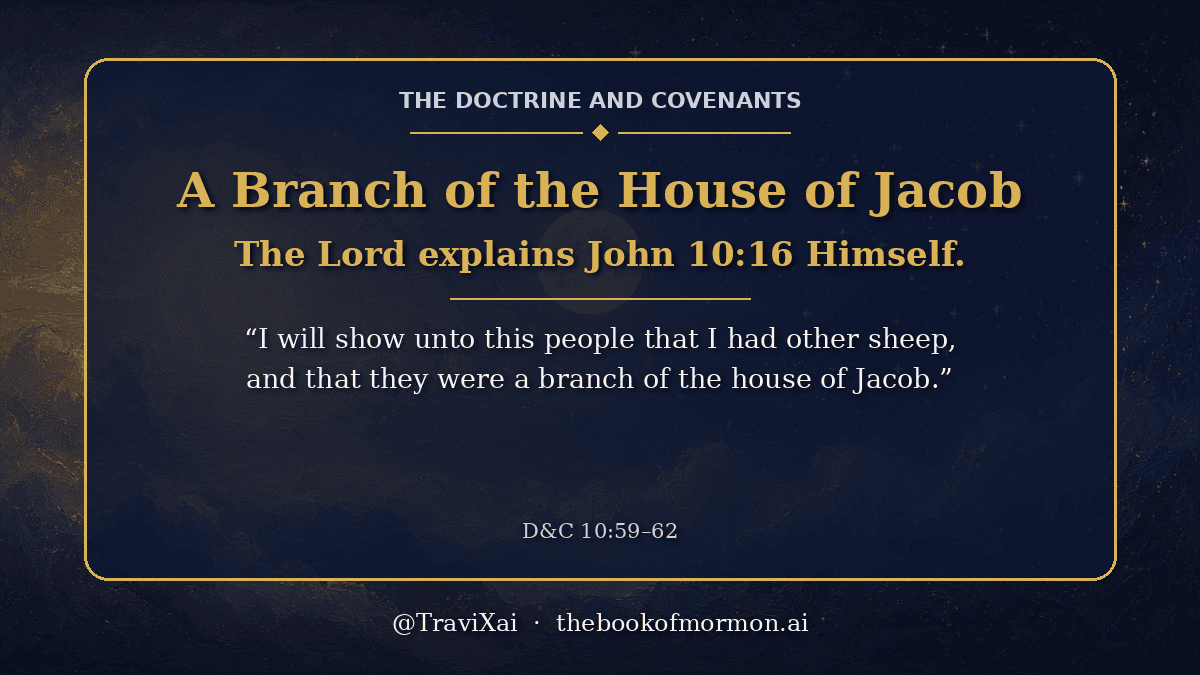
In 1829, while the Book of Mormon was still being translated, the Lord said: “I am he who said—Other sheep have I which are not of this fold—unto my disciples, and many there were that understood me not. And I will show unto this people that I had other sheep, and that they were a branch of the house of Jacob; and I will bring to light their marvelous works, which they did in my name; yea, and I will also bring to light my gospel which was ministered unto them” (D&C 10:59–62). The purpose was “that there may not be so much contention,” because people “do wrest the scriptures and do not understand them” (D&C 10:63).
The Pearl of Great PriceWhat Moroni told Joseph
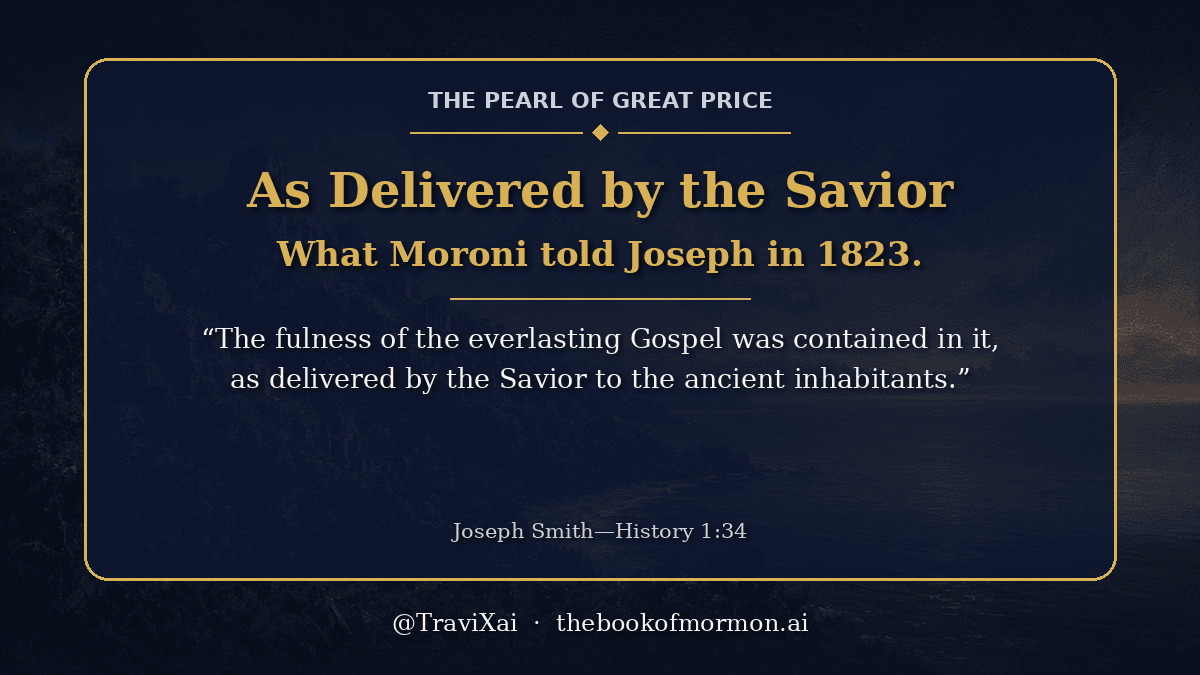
On the night of September 21, 1823, Moroni told Joseph Smith “there was a book deposited, written upon gold plates, giving an account of the former inhabitants of this continent, and the source from whence they sprang. He also said that the fulness of the everlasting Gospel was contained in it, as delivered by the Savior to the ancient inhabitants” (Joseph Smith—History 1:34). The visit of Christ is the core of the book from the beginning. See Who Is the Angel Moroni?.
Same JesusNot a different Christ
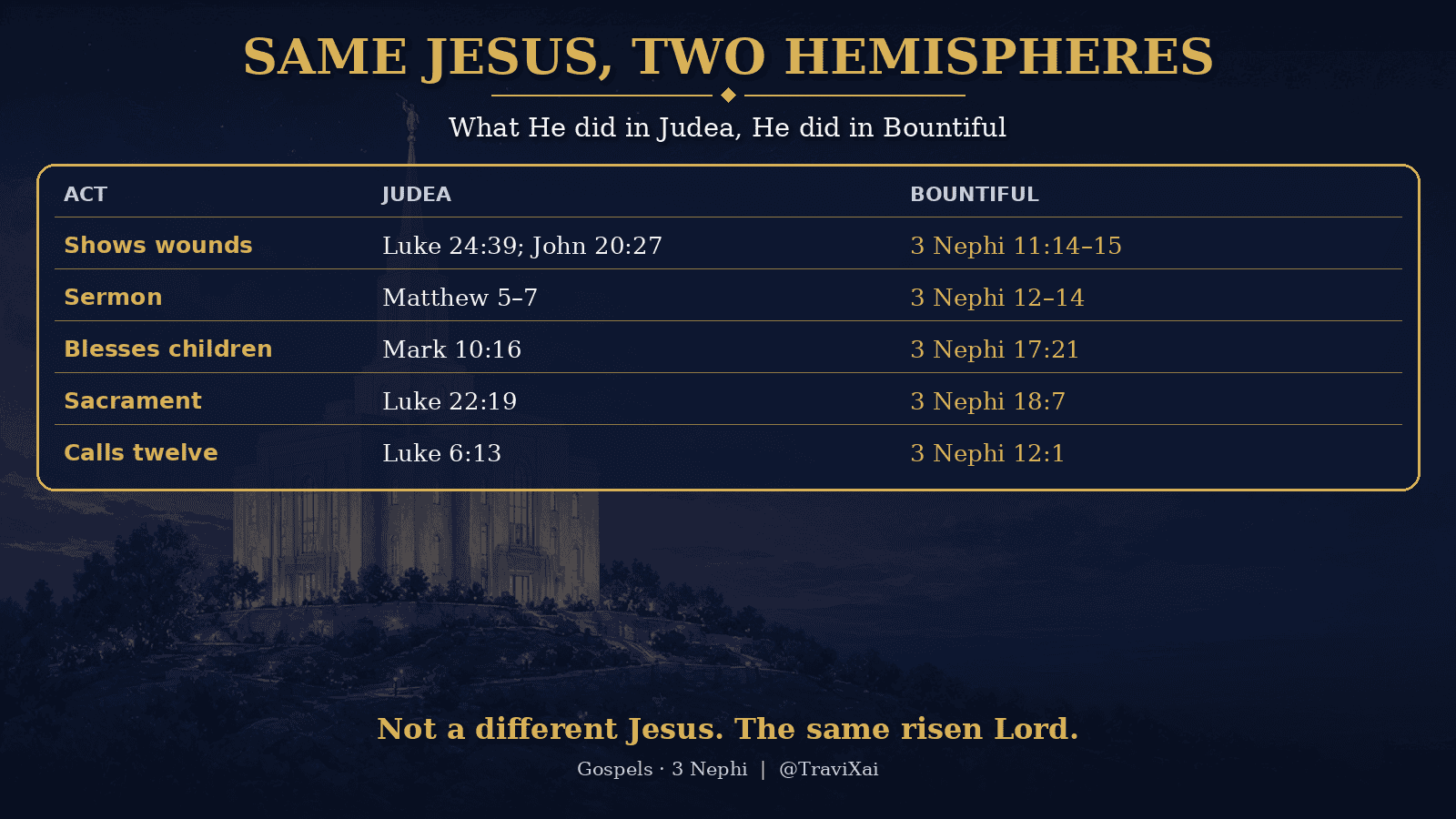
Critics say the Book of Mormon Jesus is a different Jesus. Line the accounts up and the opposite is obvious. He shows the same wounds, preaches the same sermon (3 Nephi 12–14 parallels Matthew 5–7), blesses children, institutes the sacrament and calls twelve. He also says the same thing about the Father. He has “suffered the will of the Father in all things from the beginning” (3 Nephi 11:11), just as in Gethsemane: “not my will, but thine, be done” (Luke 22:42). See A Different Jesus? 3 Nephi 11 and the New Testament.
He also set the standard for His disciples: “what manner of men ought ye to be? Verily I say unto you, even as I am” (3 Nephi 27:27). That is the Latter-day Saint view of discipleship stated in one line. We are to become like Christ, who is like His Father, and we stay children of that Father forever. The Book of Mormon’s Christ is not smaller than the Bible’s Christ. He is the same Lord, the God of the whole earth.
Check the premiseThe presuppositions baked into the question
Before this question can be answered fairly, the person asking has to justify a few assumptions packed inside it:
- That the Bible rules out any appearance outside Judea. Nothing in the Bible says the forty days were Christ’s only appearances, and John 10:16 promises “other sheep” who “shall hear my voice.”
- That “other sheep” must mean the Gentiles. The Gentiles never heard His voice in person, and He said He was sent “unto the lost sheep of the house of Israel” (Matthew 15:24). 3 Nephi 15:21 and D&C 10:59–60 identify them.
- That the Book of Mormon Jesus is a different Jesus. Same wounds, same sermon, same sacrament, same submission to the Father (3 Nephi 11:11–15; 3 Nephi 12–14; 3 Nephi 18).
- That no physical trace means it never happened. The Book of Mormon makes no claim about where exactly Bountiful was, and absence of evidence for a specific city is not evidence of absence. See Where Did the Book of Mormon Take Place?.
FAQQuick answers
Did Jesus visit the Americas?
Latter-day Saints believe He did. After His Resurrection, Christ appeared to the Nephites at the temple in Bountiful, as recorded in 3 Nephi 11–28.
Where in the Book of Mormon does Jesus visit America?
3 Nephi 11 records His appearance. Chapters 11–28 cover His teaching, and 4 Nephi 1 describes the peace that followed.
Who are the “other sheep” in John 10:16?
Christ told the Nephites, “ye are they of whom I said” (3 Nephi 15:21). D&C 10:60 calls them “a branch of the house of Jacob.”
How long did Jesus stay with the Nephites?
He taught “for the space of three days,” and “after that he did show himself unto them oft” (3 Nephi 26:13).
What did Jesus do in the Americas?
He showed His wounds, taught a sermon like the Sermon on the Mount, healed the sick, blessed children, gave the sacrament and called twelve disciples (3 Nephi 11–18).
When did Jesus visit the Americas?
“Soon after the ascension of Christ into heaven,” in the Nephites’ thirty-fourth year after the sign of His birth (3 Nephi 10:18; 3 Nephi 8:5).
Is the Jesus of 3 Nephi a different Jesus?
No. He shows the same wounds, preaches the same gospel and glorifies the same Father (3 Nephi 11:11–14; Luke 24:39).
Did Jesus visit other people too?
He said so: “I have other sheep, which are not of this land, neither of the land of Jerusalem” (3 Nephi 16:1–3).
SummaryKey takeaways
- After His Resurrection, Christ appeared to the Nephites at Bountiful (3 Nephi 11).
- He identified them as the “other sheep” of John 10:16 (3 Nephi 15:21).
- They felt His wounds, as Thomas did (3 Nephi 11:14–15; John 20:27).
- The visit was prophesied 600 years earlier (1 Nephi 12:6; 2 Nephi 26:1).
- Same Jesus, same gospel, same Father (3 Nephi 11:11).
Read 3 Nephi 11 and 17 tonight. For quick, sourced answers, open Galatians18, and follow me on X at @TraviXai.
Sources
- King James Bible (churchofjesuschrist.org): Matthew 15:24 · Mark 10:16 · Luke 6:13 · Luke 22:19 · Luke 22:42 · Luke 24:39 · John 10:16 · John 20:27 · Acts 1:3
- Book of Mormon: 1 Nephi 12:6 · 2 Nephi 26:1 · 3 Nephi 8:5 · 3 Nephi 9:15 · 3 Nephi 10:18 · 3 Nephi 12:1 · 3 Nephi 11:7–17 · 3 Nephi 15:21 · 3 Nephi 16:1–3 · 3 Nephi 17:21–24 · 3 Nephi 18:7 · 3 Nephi 26:13 · 3 Nephi 27:27 · 4 Nephi 1:15–17
- Doctrine and Covenants: D&C 10:59–63
- Pearl of Great Price: Joseph Smith—History 1:34
- Featured image and in-article graphic: original graphics by thebookofmormon.ai (painterly backgrounds; no photographs or likenesses of real people).