
Never read it? Here’s the whole story in five minutes, with links to the best chapters to start with.
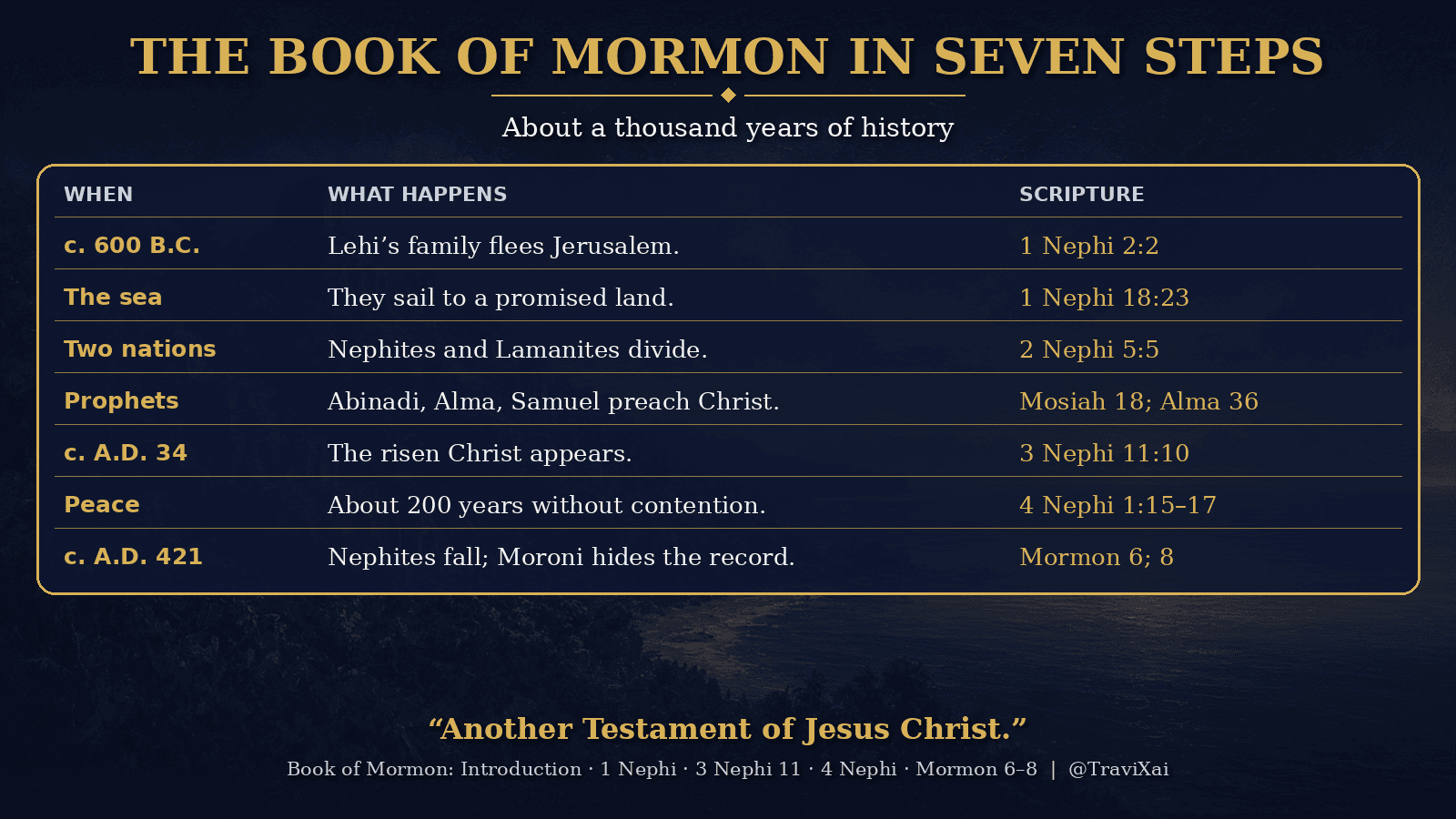
The Book of Mormon is a record of ancient prophets in the Americas, and its high point is a visit from the resurrected Jesus Christ. It begins around 600 B.C., when the prophet Lehi leads his family out of Jerusalem (1 Nephi 2:2). They sail to the Americas (1 Nephi 18:23) and split into two nations, the Nephites and Lamanites. Prophets preach of Christ for centuries. After His Resurrection, Christ appears to them, saying, “Behold, I am Jesus Christ” (3 Nephi 11:10), and there are about two centuries of peace. The Nephites later fall, and Moroni buries the record.
The short versionA record of God’s dealings with ancient Americans
The book’s own introduction says: “The Book of Mormon is a volume of holy scripture comparable to the Bible. It is a record of God’s dealings with ancient inhabitants of the Americas and contains the fulness of the everlasting gospel … The crowning event recorded in the Book of Mormon is the personal ministry of the Lord Jesus Christ among the Nephites soon after His resurrection” (Introduction).
Modern revelation describes it as a book “which contains a record of a fallen people, and the fulness of the gospel of Jesus Christ to the Gentiles and to the Jews also” (D&C 20:9). Its subtitle sums it up: Another Testament of Jesus Christ.
The storyFrom Jerusalem to the promised land
It opens in Jerusalem around 600 B.C., just before the Babylonian conquest. A prophet named Lehi warns the city and is nearly killed, and “the Lord commanded my father, even in a dream, that he should take his family and depart into the wilderness” (1 Nephi 2:2). His son Nephi writes the first book. Nephi’s theme is set in the first chapter: “the tender mercies of the Lord are over all those whom he hath chosen” (1 Nephi 1:20).
After years in the Arabian desert, they build a ship and “did arrive at the promised land” (1 Nephi 18:23). After Lehi dies, the family splits. Nephi flees with those who follow him (2 Nephi 5:5), and two nations form, the Nephites and the Lamanites, who are often at war for the next thousand years. The book also includes a shorter record of an earlier people, the Jaredites, who came “when the Lord confounded the tongues at the Tower of Babel” (Introduction).
The prophetsCenturies of looking forward to Christ
Most of the book follows prophets and ordinary people trying to follow God. Alma baptizes believers at the waters of Mormon, who promise “to bear one another’s burdens … to mourn with those that mourn … and to stand as witnesses of God at all times” (Mosiah 18:8–10). Alma the Younger, a former persecutor like Paul, is converted when he cries, “O Jesus, thou Son of God, have mercy on me” (Alma 36:17–18).
Helaman tells his sons, “remember that it is upon the rock of our Redeemer, who is Christ, the Son of God, that ye must build your foundation” (Helaman 5:12). Through all of it, the writers point forward: “we talk of Christ, we rejoice in Christ, we preach of Christ” (2 Nephi 25:26).
3 NephiThe risen Christ in the Americas
The center of the book comes after Christ’s Resurrection. Following great storms and three days of darkness, the people gather at a temple and “saw a Man descending out of heaven; and he was clothed in a white robe … Behold, I am Jesus Christ, whom the prophets testified shall come into the world” (3 Nephi 11:8–11). He lets them feel the wounds in His hands and feet, teaches the Sermon on the Mount, heals the sick, blesses their children and organizes His Church.
He tells them they are the “other sheep” He mentioned in Jerusalem (John 10:16; 3 Nephi 15:21). For about two centuries afterward, “there was no contention in the land, because of the love of God which did dwell in the hearts of the people … neither were there Lamanites, nor any manner of -ites; but they were in one, the children of Christ” (4 Nephi 1:15–17).
The endingA warning, and an invitation
Pride returns, and the Nephites are eventually destroyed around A.D. 400. Their last prophet, Mormon, mourns: “O ye fair ones, how could ye have rejected that Jesus, who stood with open arms to receive you!” (Mormon 6:17). He abridges their records onto gold plates, and his son Moroni finishes and buries them. In 1823 Moroni, as a resurrected angel, showed Joseph Smith where they were (Joseph Smith—History 1:34).
The book closes with Moroni’s invitation to read it and ask God whether it’s true (Moroni 10:3–5). Along the way it offers some of scripture’s most personal promises: “I give unto men weakness that they may be humble; and my grace is sufficient for all men that humble themselves before me” (Ether 12:27). For the evidence, see Is the Book of Mormon True?.
Check the premiseThe presuppositions baked into the question
Before this question can be answered fairly, the person asking has to justify a few assumptions packed inside it:
- That the Book of Mormon is about Joseph Smith. Joseph Smith isn’t in the story. It’s a record of ancient prophets, centered on Jesus Christ (Introduction; 3 Nephi 11).
- That it replaces the Bible. It calls itself “comparable to the Bible” and testifies of the same Christ (Introduction; 1 Nephi 13:40).
- That it’s mostly about wars. There are wars, but the high point is Christ’s visit and the two centuries of peace after it (3 Nephi 11; 4 Nephi 1:15–17).
- That it’s a book about Mormons. “Mormon” is the name of the ancient prophet who abridged the record (Words of Mormon 1:9).
FAQQuick answers
What is the Book of Mormon about?
It’s a record of ancient peoples in the Americas, mainly the descendants of Lehi, who left Jerusalem around 600 B.C. Its high point is the visit of the resurrected Jesus Christ to them (3 Nephi 11).
Who are the Nephites and Lamanites?
Two nations descended from Lehi’s family, named after his sons Nephi and Laman. They were often in conflict over about a thousand years.
Is Jesus in the Book of Mormon?
Yes. Prophets testify of Him throughout, and in 3 Nephi the risen Christ appears, saying, “Behold, I am Jesus Christ, whom the prophets testified shall come into the world.”
Why is it called the Book of Mormon?
It’s named after Mormon, a prophet-historian around A.D. 385 who abridged the records of his people onto gold plates.
How long is the Book of Mormon?
It has 15 books, from 1 Nephi to Moroni, covering roughly a thousand years of history, from about 600 B.C. to A.D. 421.
What does the Book of Mormon teach about Jesus Christ?
He is its center. Nephi wrote, “we talk of Christ, we rejoice in Christ, we preach of Christ, we prophesy of Christ” (2 Nephi 25:26).
Who is Nephi in the Book of Mormon?
Lehi’s son and the book’s first writer, who opens with “I, Nephi, having been born of goodly parents” (1 Nephi 1:1). He led the righteous part of the family after Lehi’s death.
How does the Book of Mormon end?
With Moroni’s invitation to the reader: “come unto Christ, and be perfected in him” (Moroni 10:32), just after his promise that God will reveal the book’s truth by the Holy Ghost.
SummaryKey takeaways
- The Book of Mormon is a record of God’s dealings with ancient peoples in the Americas.
- It starts with Lehi leaving Jerusalem around 600 B.C. and ends around A.D. 421.
- Its center is the resurrected Christ’s ministry in 3 Nephi 11–28.
- It’s named after Mormon, the prophet who abridged it, and it testifies of Jesus Christ.
Start with 3 Nephi 11, then go back to 1 Nephi 1. For quick, sourced answers, open Galatians18, and follow me on X at @TraviXai.
Sources
- King James Bible (churchofjesuschrist.org): John 10:16
- Book of Mormon: Introduction · 1 Nephi 1:20 · 1 Nephi 2:2 · 1 Nephi 18:23 · 2 Nephi 5:5 · 2 Nephi 25:26 · Mosiah 18:8–10 · Alma 36:17–18 · Helaman 5:12 · 3 Nephi 11:8–11 · 4 Nephi 1:15–17 · Mormon 6:17 · Ether 12:27
- Doctrine and Covenants: D&C 20:9
- Pearl of Great Price: Joseph Smith—History 1:34
- Featured image and in-article graphic: original graphics by thebookofmormon.ai (painterly backgrounds; no photographs or likenesses of real people).