
Don’t take anyone’s word for it, ours included. Here are the tests the Bible itself gives for a prophet, applied fairly.
Latter-day Saints believe Joseph Smith was a true prophet, and the Bible gives the tests to check. His words came to pass: in 1832 he prophesied a war “beginning at the rebellion of South Carolina,” with the South divided against the North and calling on Great Britain (D&C 87:1–3). His fruit is the Book of Mormon and a Church that testifies of Christ (Matthew 7:16–20). He saw the Father and the Son and testified, “That he lives!” (D&C 76:22). And the Bible invites anyone to ask God directly (James 1:5).
The short answerYes, and the Bible tells you how to check
Latter-day Saints believe Joseph Smith was a true prophet, called like the prophets of the Bible. The Bible doesn’t ask us to take that on someone’s word. It gives tests, and they can be applied to Joseph Smith the same way they’re applied to Moses, Elijah or Peter.
God promised to keep speaking through prophets: “Surely the Lord God will do nothing, but he revealeth his secret unto his servants the prophets” (Amos 3:7). Paul said Christ “gave some, apostles; and some, prophets … till we all come in the unity of the faith” (Ephesians 4:11–13). We aren’t there yet, so the question isn’t whether God calls prophets today. It’s whether Joseph Smith was one.
Test 1: fulfilled prophecy“If the thing follow not”
Moses gave the test: “When a prophet speaketh in the name of the Lord, if the thing follow not, nor come to pass, that is the thing which the Lord hath not spoken” (Deuteronomy 18:22).
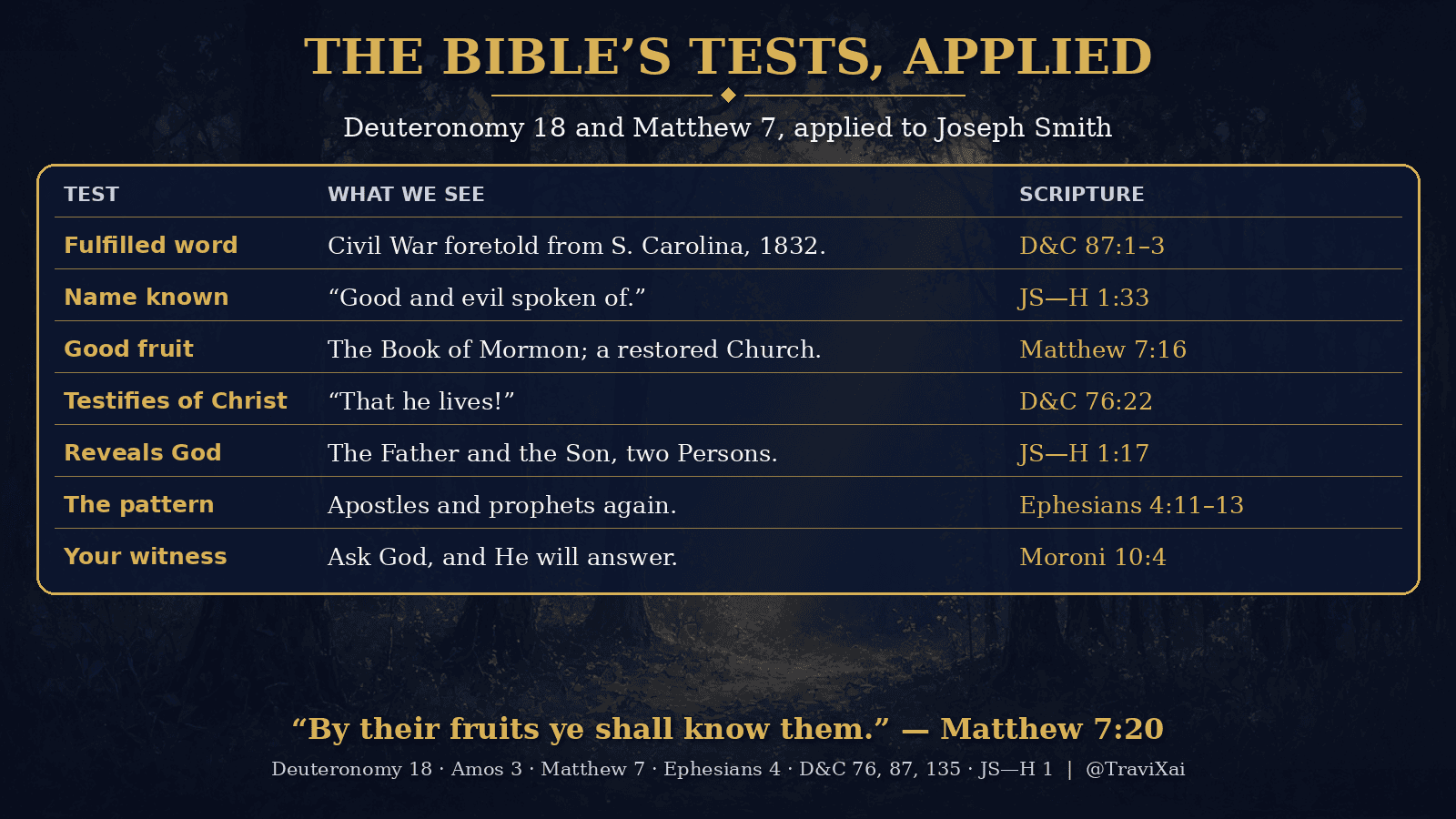
On December 25, 1832, Joseph Smith recorded: “Verily, thus saith the Lord concerning the wars that will shortly come to pass, beginning at the rebellion of South Carolina … For behold, the Southern States shall be divided against the Northern States, and the Southern States will call on other nations, even the nation of Great Britain” (D&C 87:1–3). Twenty-eight years later, South Carolina seceded first, the Civil War began at Fort Sumter in South Carolina, and the Confederacy sought British support.
At 17, Joseph was told by the angel Moroni “that my name should be had for good and evil among all nations, kindreds, and tongues” (Joseph Smith—History 1:33). An unknown farm boy said that in 1823. It is happening as you read this page. For more, see Joseph Smith’s Fulfilled Prophecies and His Name for Good and Evil.
Test 2: the fruit“Ye shall know them by their fruits”
Jesus gave the test that matters most: “Beware of false prophets … Ye shall know them by their fruits … A good tree cannot bring forth evil fruit, neither can a corrupt tree bring forth good fruit” (Matthew 7:15–20).
Joseph Smith’s fruit is open to inspection. He brought forth the Book of Mormon, which testifies of Christ on nearly every page, and a Church that bears His name. The Doctrine and Covenants sums up his life: “In the short space of twenty years, he has brought forth the Book of Mormon, which he translated by the gift and power of God … has sent the fulness of the everlasting gospel … to the four quarters of the earth … and left a fame and name that cannot be slain” (D&C 135:3). He sealed his testimony with his blood at Carthage in 1844 (Carthage: Like a Lamb to the Slaughter).
Test 3: does he point to Christ?“That he lives!”
A true prophet points people to the true God and His Son. Joseph’s first vision was of the Father and the Son: “I saw two Personages … One of them spake unto me, calling me by name and said, pointing to the other—This is My Beloved Son. Hear Him!” (Joseph Smith—History 1:17).
With Sidney Rigdon he testified: “And now, after the many testimonies which have been given of him, this is the testimony, last of all, which we give of him: That he lives! For we saw him, even on the right hand of God” (D&C 76:22–24). The same vision taught that by Christ “the worlds are and were created, and the inhabitants thereof are begotten sons and daughters unto God.”
Joseph restored what the creeds had lost about God’s nature. In 1844 he taught plainly that “God himself was once as we are now, and is an exalted man,” and that His children must “learn how to be gods yourselves … from grace to grace, from exaltation to exaltation” (History of the Church 6:305–306). He taught an endless line of divine Fathers and sons, and that the faithful become like our Father and share His work of creating worlds without number, while always remaining His children. See Was God Once a Man?.
What critics sayThe objections, briefly
Critics point to prophecies they say failed, such as the Independence temple in D&C 84. Scripture answers it. God sometimes changes course when people repent, as He did with Jonah’s Nineveh, and He told Joseph that when enemies hinder a commanded work, He will “require that work no more” (D&C 124:49). We walk through it in Deuteronomy 18:22, Elisha, Jonah and D&C 84.
Others call him a con man or point to his early treasure seeking. Our answers are at Was Joseph Smith a Con Man? and What Non-LDS Scholars Think of Joseph Smith. Joseph never claimed to be perfect. Neither were Moses, Jonah or Peter. The test is the word and the fruit.
How to know for yourselfAsk God
In the end, the Bible’s promise is personal: “If any of you lack wisdom, let him ask of God, that giveth to all men liberally” (James 1:5). That verse is what sent Joseph Smith into the grove in 1820.
The Book of Mormon offers the same test: “ask God, the Eternal Father, in the name of Christ, if these things are not true; and if ye shall ask with a sincere heart, with real intent, having faith in Christ, he will manifest the truth of it unto you, by the power of the Holy Ghost” (Moroni 10:4–5). If the Book of Mormon is true, Joseph Smith was a prophet. See Read It and Ask.
Check the premiseThe presuppositions baked into the question
Before this question can be answered fairly, the person asking has to justify a few assumptions packed inside it:
- That God stopped calling prophets after the Bible. The Bible says God works through prophets (Amos 3:7) and gave apostles and prophets “till we all come in the unity of the faith” (Ephesians 4:11–13).
- That a true prophet must be perfect. Moses struck the rock, Jonah ran, and Peter denied Christ. The Bible’s test is whether the word comes to pass and the fruit is good (Deuteronomy 18:22; Matthew 7:16–20).
- That Latter-day Saints worship Joseph Smith. We worship the Father in the name of Jesus Christ. Joseph Smith pointed to Christ: “That he lives!” (D&C 76:22).
- That you have to settle it by argument. The Bible invites you to ask God directly (James 1:5).
FAQQuick answers
Was Joseph Smith a prophet?
Latter-day Saints believe he was. His prophecies came to pass, including the Civil War beginning in South Carolina (D&C 87), his fruit includes the Book of Mormon, and he testified of the living Christ (D&C 76:22).
What prophecies did Joseph Smith fulfill?
Examples include the Civil War prophecy of 1832 (D&C 87:1–3), the prophecy that his name would be known for good and evil worldwide (Joseph Smith—History 1:33), and the spread of the restored gospel.
How does the Bible test a prophet?
By whether his words come to pass (Deuteronomy 18:22), by his fruits (Matthew 7:16–20), and by whether he leads people to the true God.
Did Joseph Smith claim to be perfect?
No. Like Bible prophets he had weaknesses. Prophets are called by God, not because they are flawless.
How can I know if Joseph Smith was a prophet?
Read the Book of Mormon and ask God in faith (James 1:5; Moroni 10:4–5). If it is true, he was a prophet.
How did Jesus say to recognize a false prophet?
“Ye shall know them by their fruits” (Matthew 7:16). Latter-day Saints point to the fruits of Joseph Smith’s work: the Book of Mormon, millions of lives centered on Christ, and a worldwide church.
How did Joseph Smith die?
He was killed by a mob at Carthage Jail, Illinois, on June 27, 1844, along with his brother Hyrum. D&C 135:3 says he “sealed his mission and his works with his own blood.”
Does the Bible say there would be prophets after Jesus?
Yes. Christ “gave some, apostles; and some, prophets” to the Church “Till we all come in the unity of the faith” (Ephesians 4:11, 13). Prophets like Agabus kept prophesying after the Ascension (Acts 11:27–28).
SummaryKey takeaways
- The Bible says God works through prophets (Amos 3:7) and gives tests to recognize them.
- Joseph Smith’s prophecies came to pass, including the Civil War from South Carolina (D&C 87).
- His fruit includes the Book of Mormon and a witness that Christ lives (D&C 76:22).
- Anyone can ask God for themselves (James 1:5; Moroni 10:4–5).
Read D&C 87 and Joseph Smith—History 1, then ask God. For quick, sourced answers, open Galatians18, and follow me on X at @TraviXai.
Sources
- King James Bible (churchofjesuschrist.org): Deuteronomy 18:22 · Amos 3:7 · Matthew 7:15–20 · Ephesians 4:11–13 · James 1:5
- Book of Mormon: Moroni 10:4–5
- Doctrine and Covenants: D&C 76:22–24 · D&C 87:1–3 · D&C 124:49 · D&C 135:3
- Pearl of Great Price: Joseph Smith—History 1:17 · Joseph Smith—History 1:33
- History of the Church 6:305–306 (King Follett discourse), BYU Studies
- Featured image and in-article graphic: original graphics by thebookofmormon.ai (painterly backgrounds; no photographs or likenesses of real people).