
Isaiah called it “the second time.” Here is what Latter-day Saints mean by the gathering of Israel, from all four standard works.
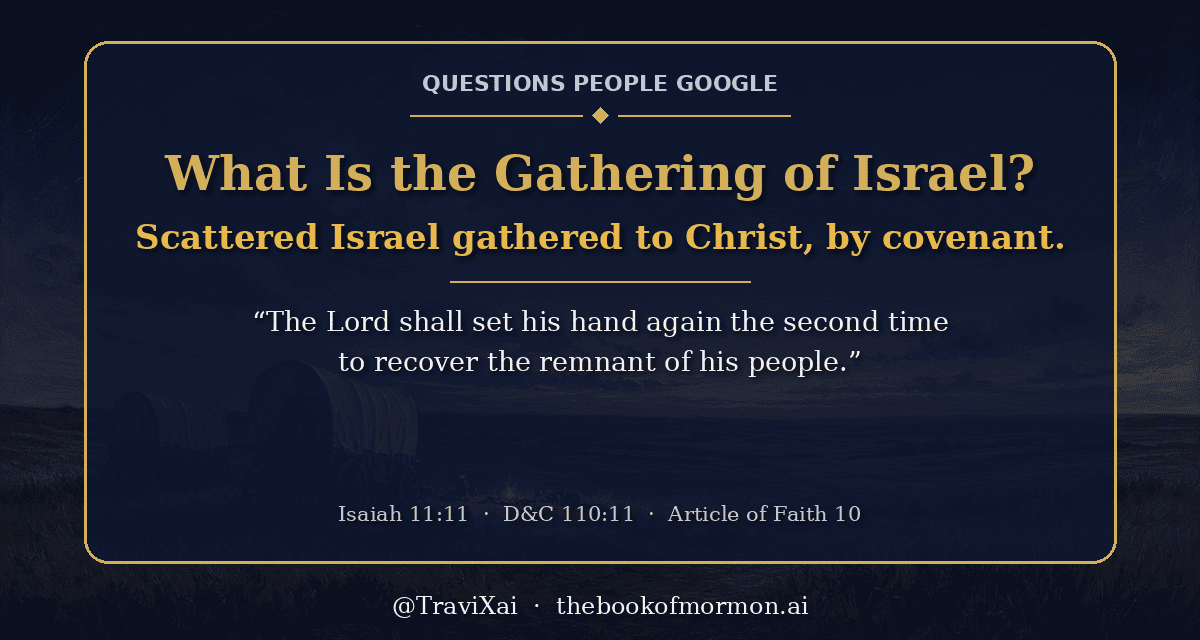
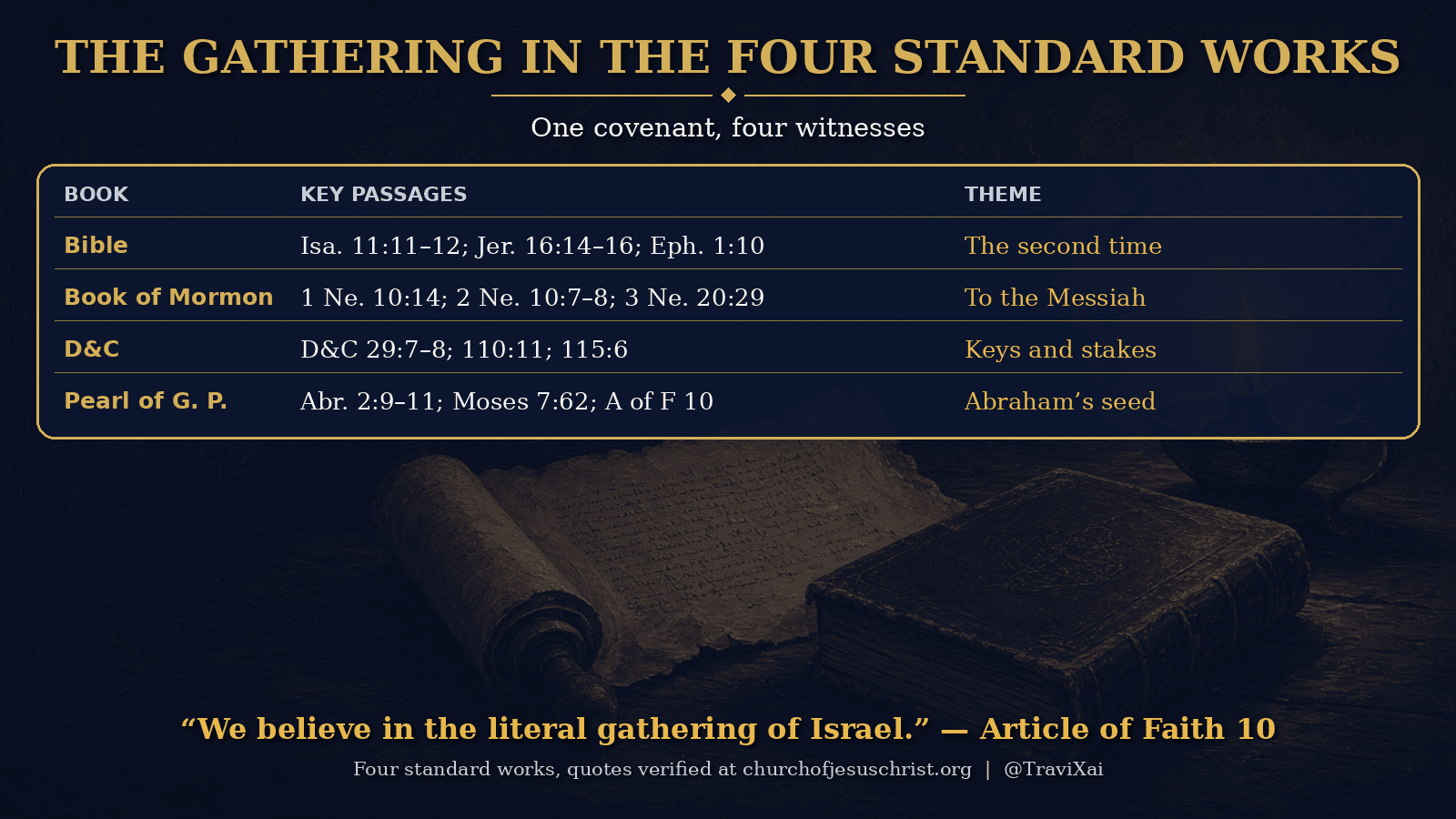
The question often assumes the gathering means moving to Utah, or that it is about bloodline alone. It is neither. The gathering of Israel is God’s promise to bring scattered Israel back to Christ by covenant: “the Lord shall set his hand again the second time to recover the remnant of his people” (Isaiah 11:11). Moses restored its keys in 1836: “the keys of the gathering of Israel from the four parts of the earth” (D&C 110:11). Today it happens through missionary work, stakes worldwide and temple work for the dead, and “as many as receive this Gospel … shall be accounted thy seed” (Abraham 2:10).
What it isA literal promise, literally kept
The tenth Article of Faith states it plainly: “We believe in the literal gathering of Israel and in the restoration of the Ten Tribes; that Zion (the New Jerusalem) will be built upon the American continent; that Christ will reign personally upon the earth; and, that the earth will be renewed and receive its paradisiacal glory” (Article of Faith 10). The house of Israel was scattered for breaking covenant, and God promised to gather it again by bringing it back to that covenant and to the Messiah. Latter-day Saints believe that gathering began with the Restoration and is going on now.
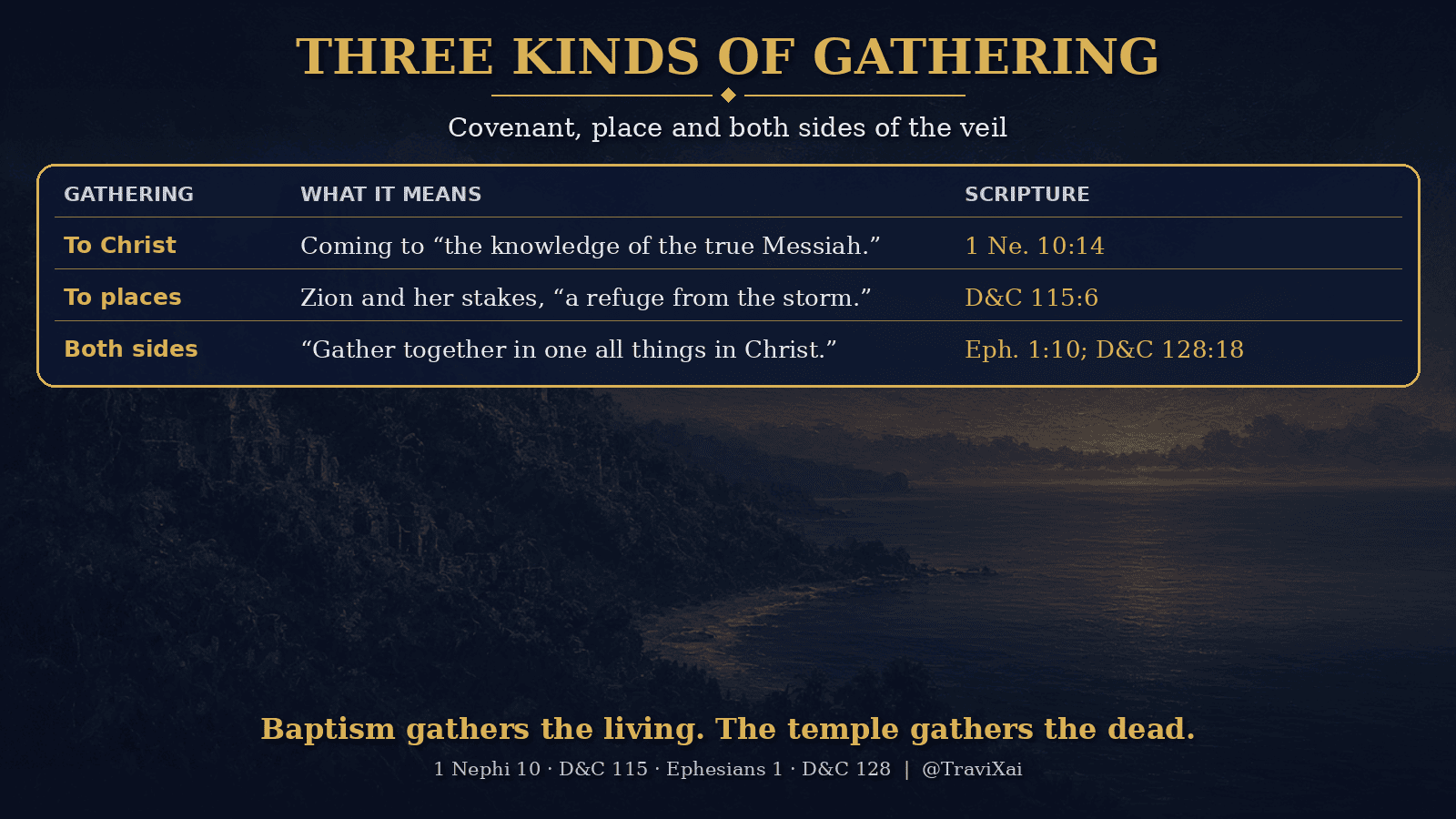
The gathering works on three levels. People are gathered to Christ by covenant. They are gathered to places, meaning Zion and her stakes. And the gathering crosses the veil, through temple work for the dead. All three are in scripture, and all three are underway.
The Bible“The second time”
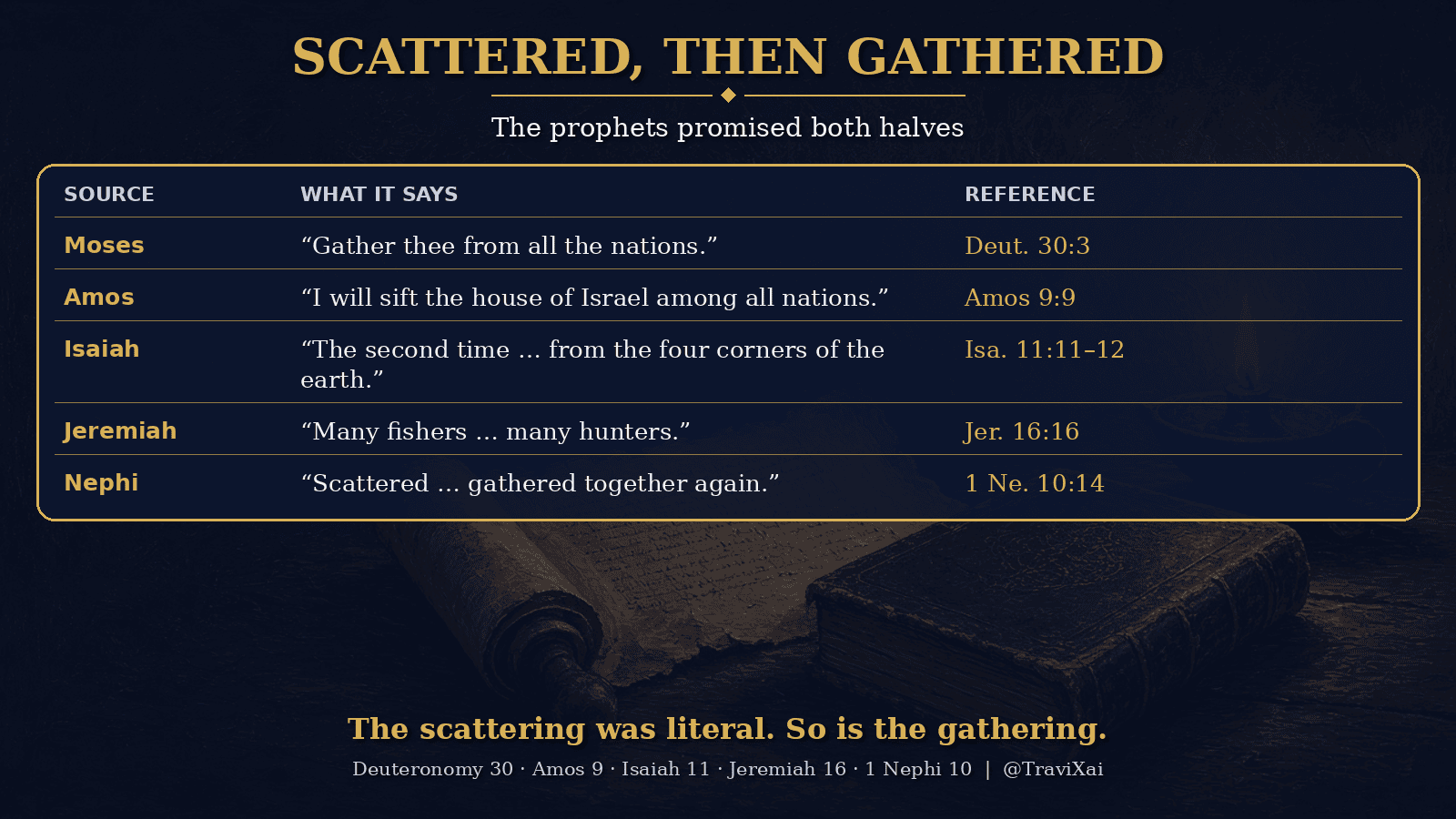
Moses promised it before Israel crossed the Jordan: “the Lord thy God will turn thy captivity, and have compassion upon thee, and will return and gather thee from all the nations, whither the Lord thy God hath scattered thee” (Deuteronomy 30:3). Amos described the scattering: “I will sift the house of Israel among all nations, like as corn is sifted in a sieve, yet shall not the least grain fall upon the earth” (Amos 9:9).
Isaiah numbered it: “the Lord shall set his hand again the second time to recover the remnant of his people … And he shall set up an ensign for the nations, and shall assemble the outcasts of Israel, and gather together the dispersed of Judah from the four corners of the earth” (Isaiah 11:11–12). The first time was the Exodus. Jeremiah says the second will be bigger: “it shall no more be said, The Lord liveth, that brought up the children of Israel out of the land of Egypt; but, The Lord liveth, that brought up the children of Israel from the land of the north, and from all the lands whither he had driven them” (Jeremiah 16:14–15).
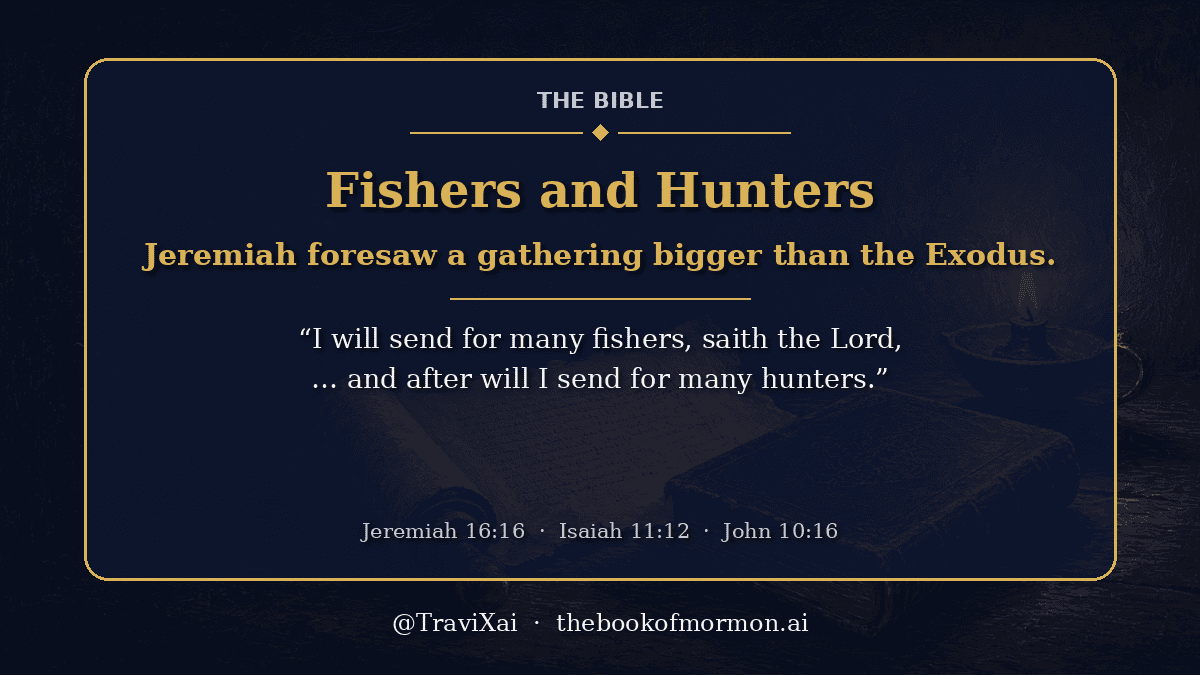
He also said how it would happen: “Behold, I will send for many fishers, saith the Lord, and they shall fish them; and after will I send for many hunters, and they shall hunt them from every mountain, and from every hill” (Jeremiah 16:16). Latter-day Saints see that in tens of thousands of missionaries. Ezekiel promised one nation instead of two kingdoms (Ezekiel 37:21–22). Jesus spoke of “other sheep” who “shall hear my voice” (John 10:16). Paul named the era: “in the dispensation of the fulness of times he might gather together in one all things in Christ, both which are in heaven, and which are on earth” (Ephesians 1:10). See Why Do Latter-day Saints Serve Missions?.
The Book of MormonA book written for the gathering
The Book of Mormon comes from a branch of Joseph “whose branches run over the wall” (Genesis 49:22), and its title page says it is written “to show unto the remnant of the house of Israel what great things the Lord hath done for their fathers.” Lehi taught the pattern: “after the house of Israel should be scattered they should be gathered together again; or, in fine, after the Gentiles had received the fulness of the Gospel, the natural branches of the olive tree, or the remnants of the house of Israel, should be grafted in, or come to the knowledge of the true Messiah, their Lord and their Redeemer” (1 Nephi 10:14). Jacob 5, the allegory of the olive tree, is the long version (Jacob 5:3).
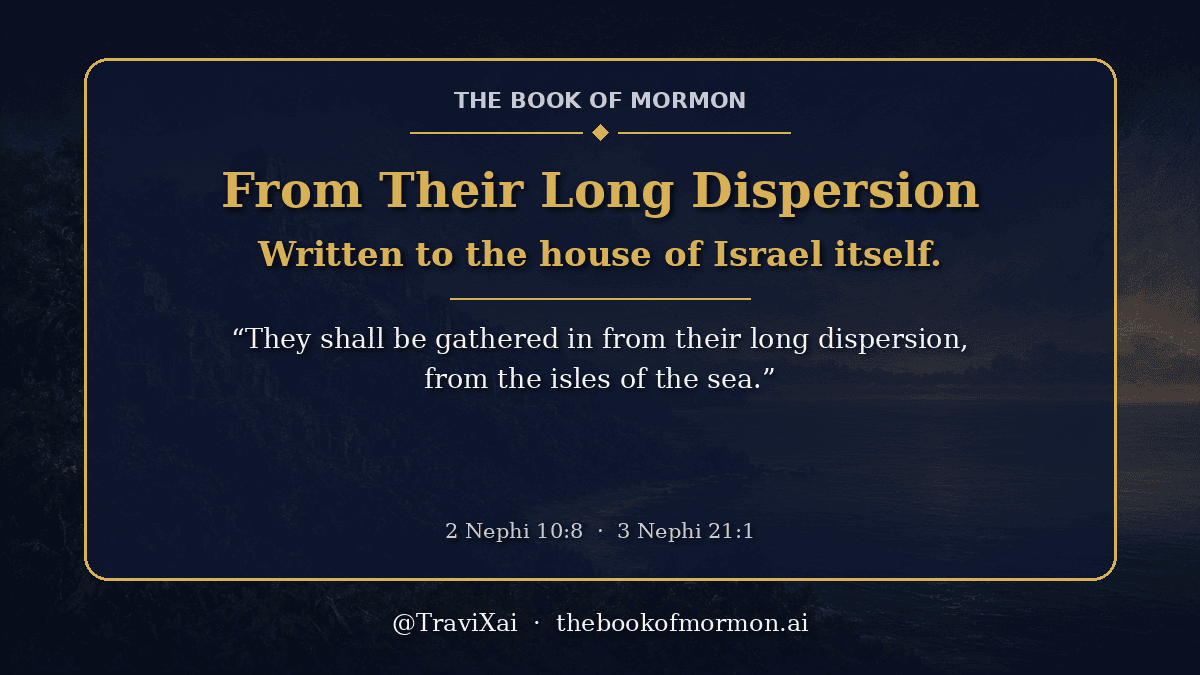
The gathering is first to Christ and then to land: “When the day cometh that they shall believe in me, that I am Christ, then have I covenanted with their fathers that they shall be restored in the flesh, upon the earth, unto the lands of their inheritance. And it shall come to pass that they shall be gathered in from their long dispersion, from the isles of the sea, and from the four parts of the earth” (2 Nephi 10:7–8). The risen Christ promised the Jews “the land of Jerusalem, which is the promised land unto them forever, saith the Father” (3 Nephi 20:29), and gave a sign for when it would begin: “that I shall gather in, from their long dispersion, my people, O house of Israel, and shall establish again among them my Zion” (3 Nephi 21:1). See Is the Book of Mormon in the Bible?.
The Doctrine and CovenantsMoses brings the keys
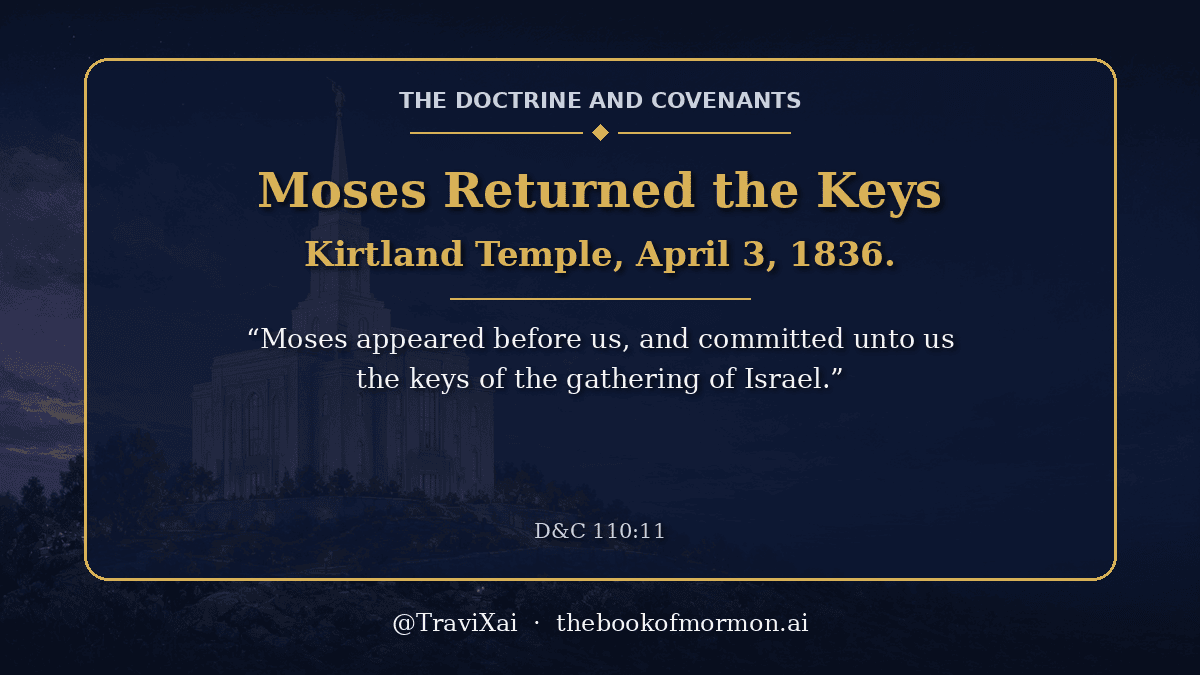
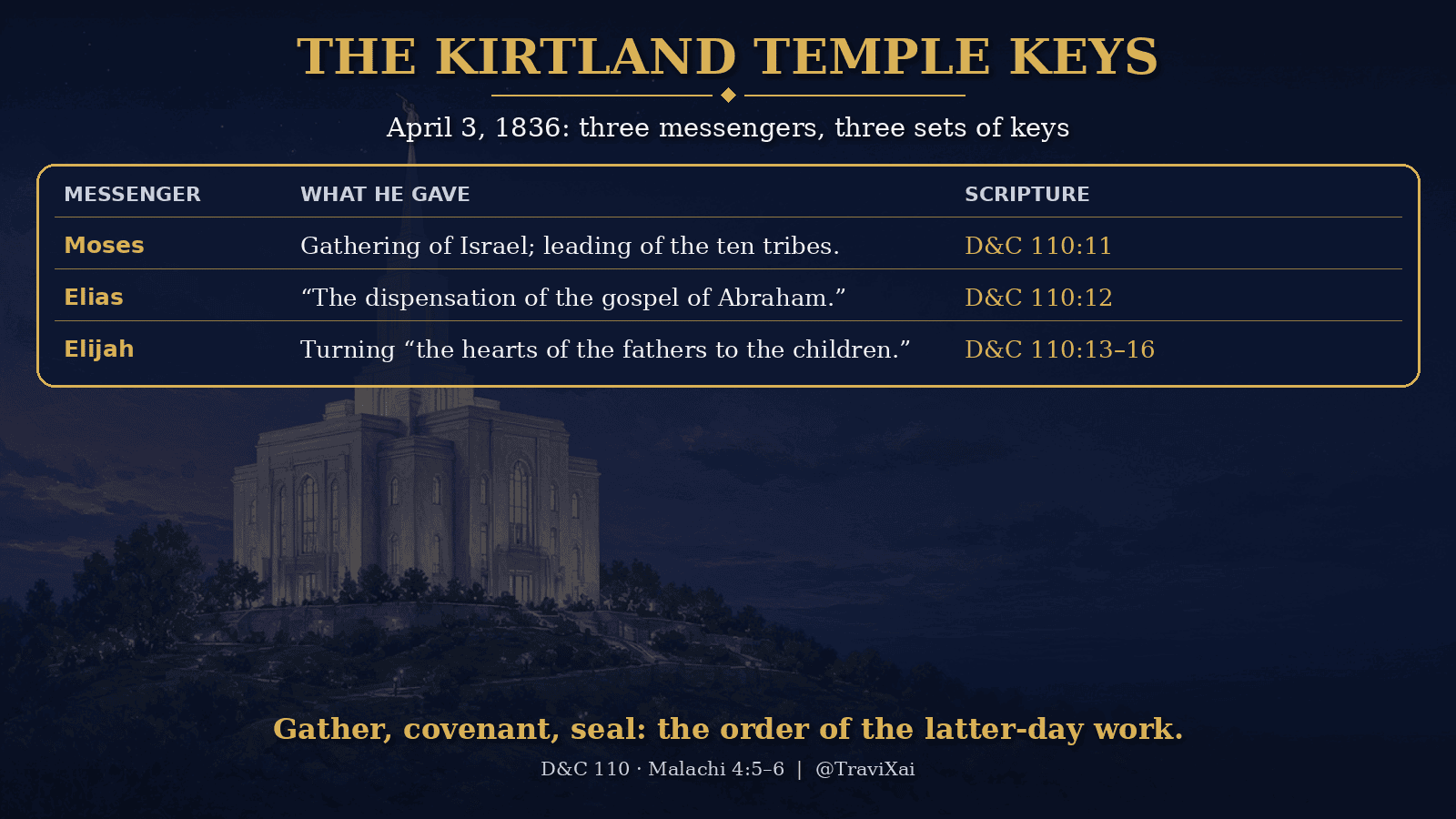
A prophecy that big needs authority. On April 3, 1836, in the Kirtland Temple, “Moses appeared before us, and committed unto us the keys of the gathering of Israel from the four parts of the earth, and the leading of the ten tribes from the land of the north” (D&C 110:11). Then Elias “committed the dispensation of the gospel of Abraham,” and Elijah came “to turn the hearts of the fathers to the children, and the children to the fathers” (D&C 110:12–16). The man who led Israel out of Egypt the first time handed over the keys for the second time.
The Lord had already given the commission: “ye are called to bring to pass the gathering of mine elect; for mine elect hear my voice and harden not their hearts” (D&C 29:7–8). Section 133 sends it worldwide: “Go ye out of Babylon; gather ye out from among the nations, from the four winds, from one end of heaven to the other. Send forth the elders of my church unto the nations which are afar off” (D&C 133:7–8). Stakes are where the gathered stand: “that the gathering together upon the land of Zion, and upon her stakes, may be for a defense, and for a refuge from the storm” (D&C 115:6). See What Is a Stake?.
Gathering on both sides of the veil
Joseph Smith tied the gathering to the dead: “the earth will be smitten with a curse unless there is a welding link of some kind or other between the fathers and the children … It is the baptism for the dead. For we without them cannot be made perfect; neither can they without us be made perfect” (D&C 128:18). Family history and temple work are the gathering of Israel extended to people who already died. See Why Do Latter-day Saints Do Family History? and Baptism for the Dead.
The Pearl of Great PriceAbraham’s seed, by blood and by adoption
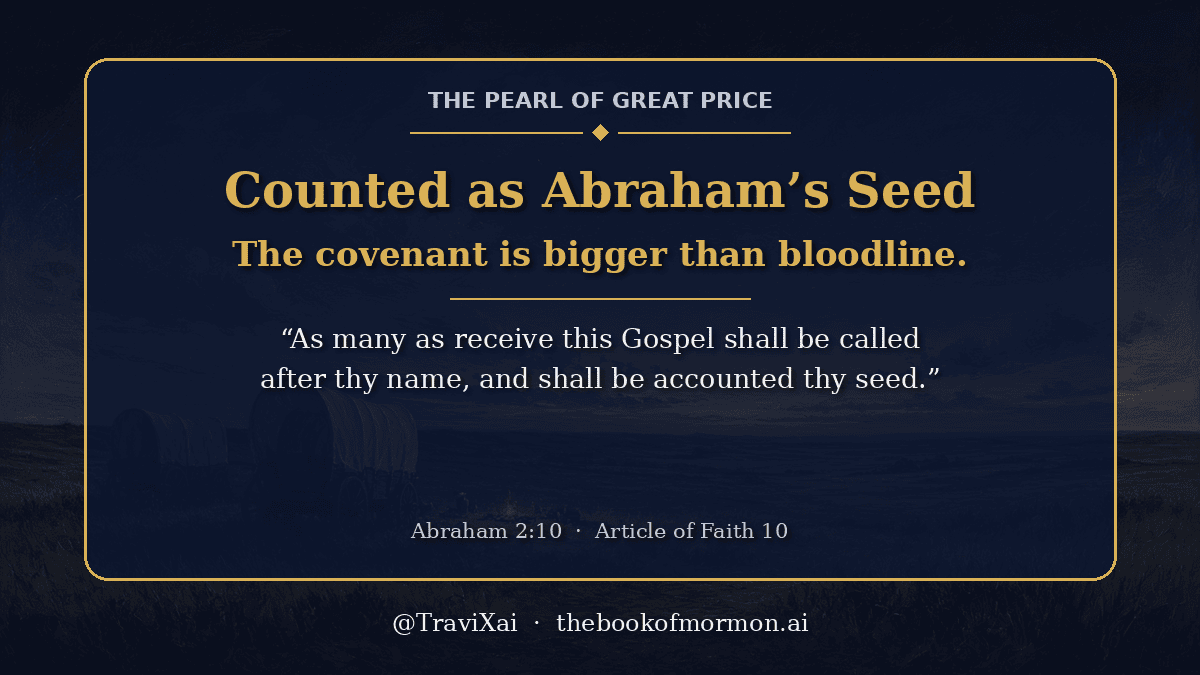
The Book of Abraham shows the covenant that the gathering restores. The Lord told Abraham his seed “shall bear this ministry and Priesthood unto all nations,” that “as many as receive this Gospel shall be called after thy name, and shall be accounted thy seed, and shall rise up and bless thee, as their father,” and that through his priesthood and “the literal seed, or the seed of the body” all families of the earth would be blessed “with the blessings of salvation, even of life eternal” (Abraham 2:9–11). That covers both the literal lineage and the adoption of everyone who comes in. Patriarchal blessings declare a member’s lineage in Israel for this reason. See What Is a Patriarchal Blessing?.
Enoch saw how it ends: “righteousness and truth will I cause to sweep the earth as with a flood, to gather out mine elect from the four quarters of the earth, unto a place which I shall prepare, an Holy City … and it shall be called Zion, a New Jerusalem” (Moses 7:62). See Will Jesus Return to Missouri?.
Then and nowFrom wagon trains to stakes in every land
In the 1830s the gathering meant moving. Saints gathered to Kirtland, to Missouri, to Nauvoo and then across the plains to the Great Basin, obeying the decree that the elect “be gathered in unto one place upon the face of this land” (D&C 29:8). As stakes spread across the world, Church leaders taught converts to build Zion where they live. The doctrine stayed the same, and only the logistics changed: “all they who call on my name, and worship me according to mine everlasting gospel, should gather together, and stand in holy places” (D&C 101:22).
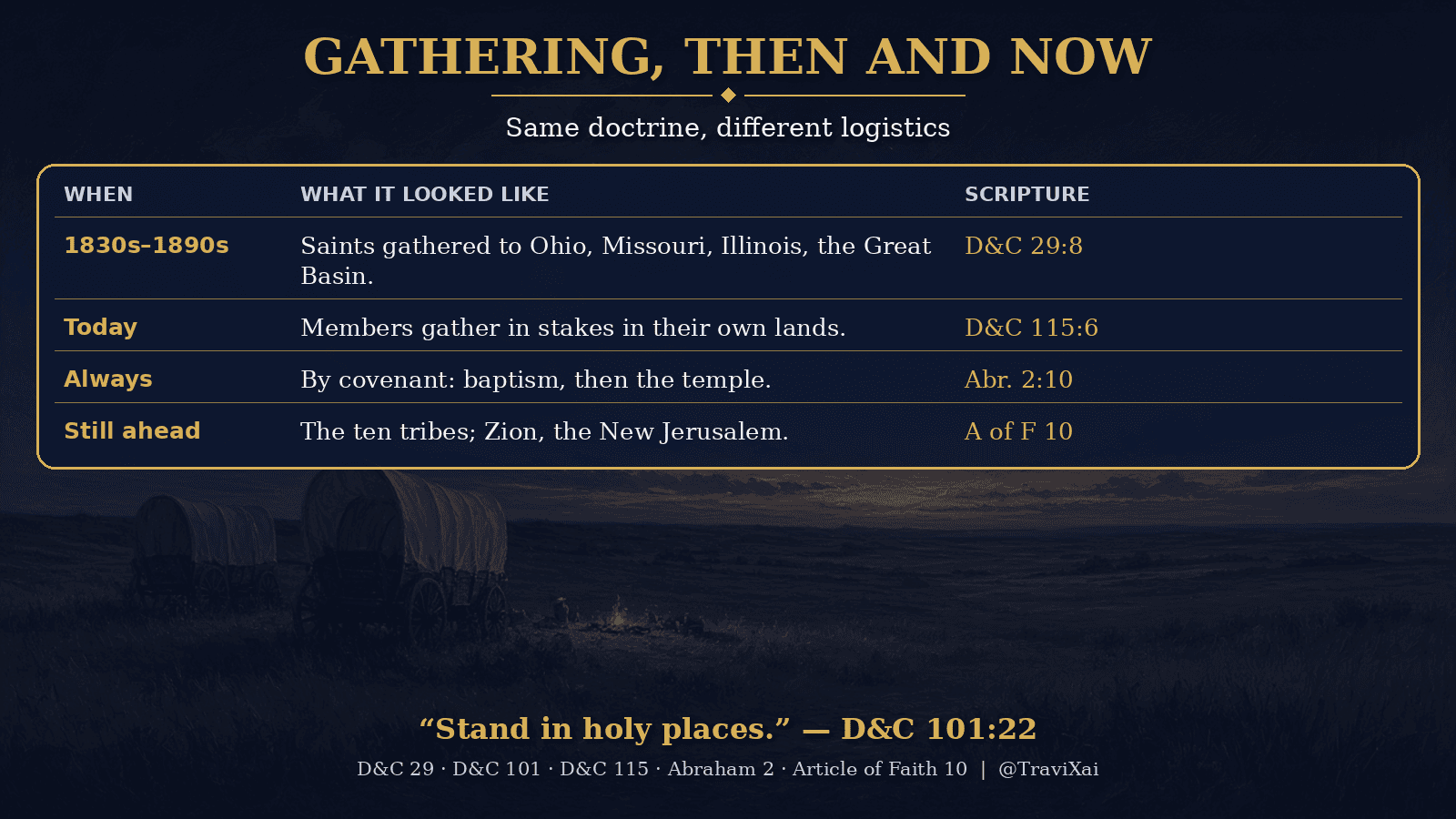
Some of it is still ahead, and it is meant literally: the restoration of the ten tribes, the building of the New Jerusalem, and Christ reigning “personally upon the earth” (Article of Faith 10). The goal of all of it is the covenant. The gathered are “gathered unto me in time and in eternity” (D&C 39:22), sealed into the family of God. They are heirs to everything the Father has promised Abraham’s seed, always as His children and under His hand.
Check the premiseThe presuppositions baked into the question
Before this question can be answered fairly, the person asking has to justify a few assumptions packed inside it:
- That it means everyone has to move to Utah. Early Saints physically gathered. Today members gather in stakes worldwide, “for a defense, and for a refuge” (D&C 115:6).
- That it is about race. Abraham 2:10: “as many as receive this Gospel shall be called after thy name, and shall be accounted thy seed.” The covenant includes literal lineage and adoption.
- That it is a Latter-day Saint invention. Deuteronomy 30, Isaiah 11, Jeremiah 16 and Ezekiel 37 promised it first.
- That it was fulfilled once and for all in 1948. The return of Jews to the land matters, but the prophets tie the gathering to coming to the Messiah (2 Nephi 10:7; 1 Nephi 10:14) and include the ten tribes (D&C 110:11).
- That “literal” is a figure of speech. Article of Faith 10 says “literal” on purpose: real people, real lineage, real places and a real Zion.
FAQQuick answers
What is the gathering of Israel?
God’s promise to gather scattered Israel back to Him by covenant and to the lands of their inheritance. Latter-day Saints believe it is going on now (Isaiah 11:11–12; Article of Faith 10).
Who restored the keys of the gathering?
Moses, in the Kirtland Temple on April 3, 1836. He “committed unto us the keys of the gathering of Israel from the four parts of the earth” (D&C 110:11).
Do Latter-day Saints still gather to Utah?
No. Members gather in stakes in their own lands, which the Lord calls “a defense” and “a refuge from the storm” (D&C 115:6).
Do you have to be a literal descendant of Israel?
No. “As many as receive this Gospel shall be called after thy name, and shall be accounted thy seed” (Abraham 2:10). Literal lineage also matters, and patriarchal blessings declare it.
What are the fishers and hunters in Jeremiah 16?
The Lord’s messengers who find scattered Israel “from every mountain, and from every hill” (Jeremiah 16:16). Latter-day Saints see missionaries in that prophecy.
Where are the ten tribes?
Scripture says Moses gave keys for “the leading of the ten tribes from the land of the north” (D&C 110:11), and Article of Faith 10 affirms their restoration. Where and how have not been revealed in detail.
How does temple work relate to the gathering?
It gathers Israel on the other side of the veil. “We without them cannot be made perfect; neither can they without us be made perfect” (D&C 128:18; Ephesians 1:10).
Where is the gathering in the Book of Mormon?
Throughout. 1 Nephi 10:14, Jacob 5, 2 Nephi 10:7–8 and 3 Nephi 20–21 all teach that scattered Israel will come to Christ and be gathered.
SummaryKey takeaways
- Israel was literally scattered and will be literally gathered (Article of Faith 10).
- Isaiah, Jeremiah, Ezekiel and Paul all foretold it.
- Moses restored the keys in the Kirtland Temple, April 3, 1836 (D&C 110:11).
- Today members gather in stakes worldwide and through the temple (D&C 115:6; 128:18).
- Everyone who receives the gospel is counted as Abraham’s seed (Abraham 2:10).
Read Isaiah 11 and D&C 110 side by side. For quick, sourced answers, open Galatians18, and follow me on X at @TraviXai.
Sources
- King James Bible (churchofjesuschrist.org): Genesis 49:22 · Deuteronomy 30:3 · Isaiah 11:11–12 · Jeremiah 16:14–16 · Ezekiel 37:21–22 · Amos 9:9 · John 10:16 · Ephesians 1:10
- Book of Mormon: 1 Nephi 10:14 · 2 Nephi 10:7–8 · Jacob 5:3 · 3 Nephi 20:29 · 3 Nephi 21:1 · Title page
- Doctrine and Covenants: D&C 29:7–8 · D&C 39:22 · D&C 101:22 · D&C 110:11–16 · D&C 115:6 · D&C 128:18 · D&C 133:7–8
- Pearl of Great Price: Abraham 2:9–11 · Moses 7:62 · Article of Faith 10
- Featured image and in-article graphic: original graphics by thebookofmormon.ai (painterly backgrounds; no photographs or likenesses of real people).