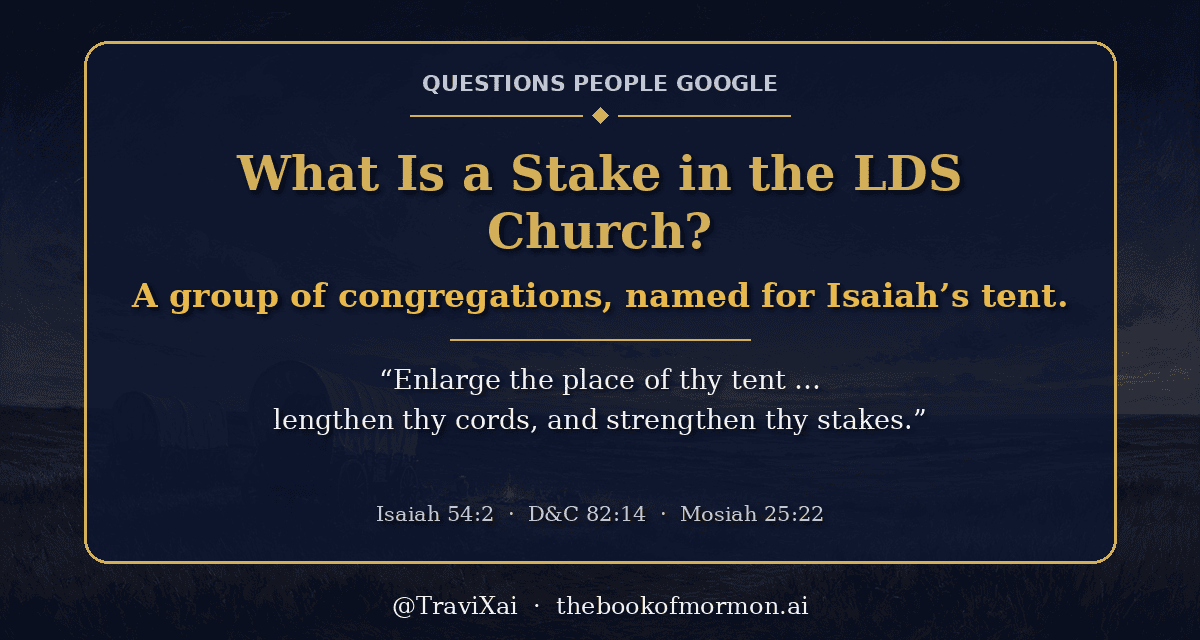

Wards, stakes, branches, districts: the vocabulary confuses visitors. Here it is in plain English, and why it’s straight out of Isaiah.
A stake is a group of local congregations in The Church of Jesus Christ of Latter-day Saints. Each congregation is a ward, led by a bishop; several wards and branches together form a stake, led by a stake president, two counselors and a high council, all unpaid volunteers. The name comes from Isaiah’s picture of Zion as a tent: “lengthen thy cords, and strengthen thy stakes” (Isaiah 54:2). The Lord said His gathering places “shall be called stakes, for the curtains or the strength of Zion” (D&C 101:21).
The short answerA group of local congregations
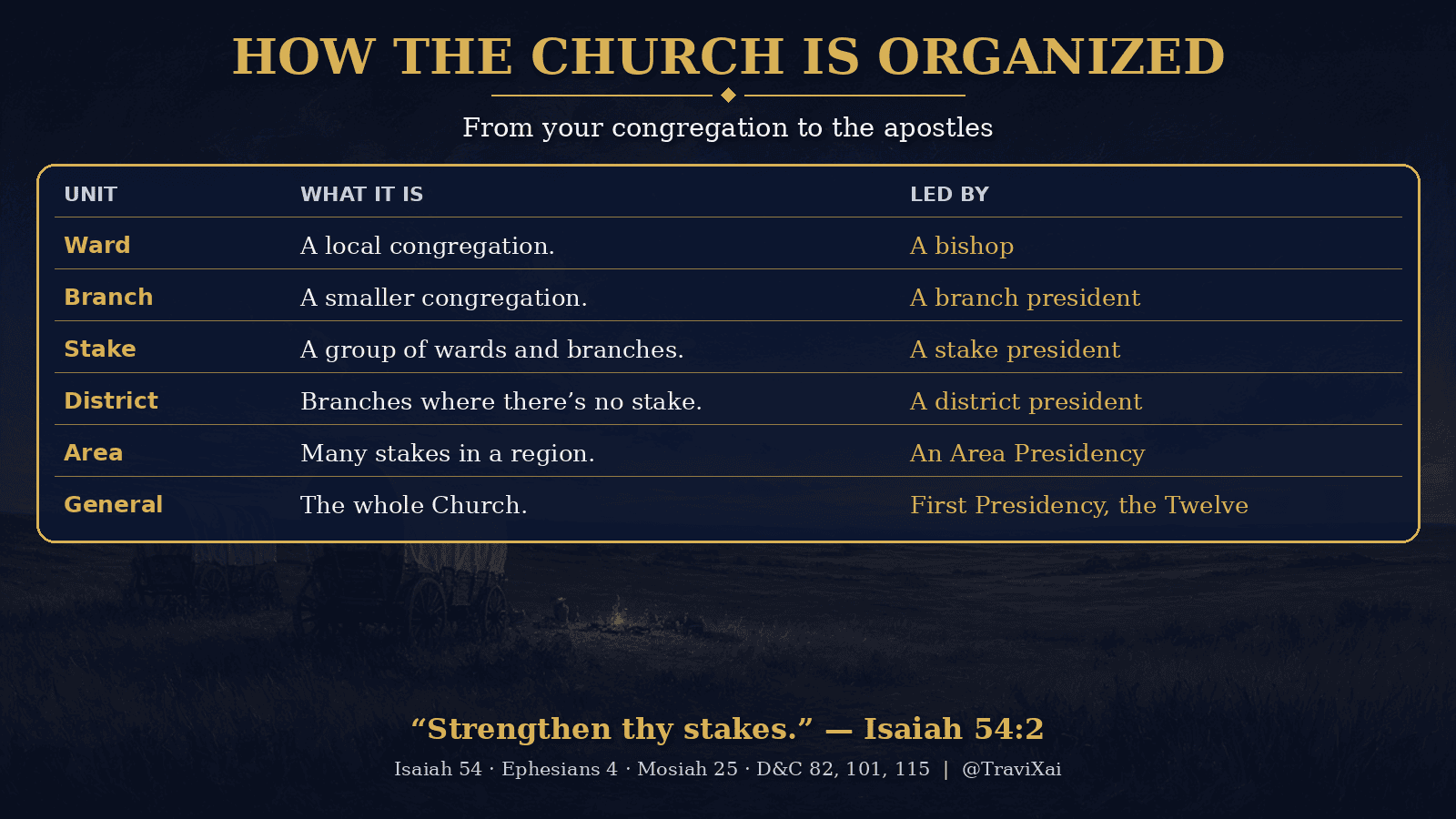
In The Church of Jesus Christ of Latter-day Saints, a local congregation is called a ward, led by a bishop. Several wards (and smaller congregations called branches) in an area make up a stake, led by a stake president, his two counselors and a high council. A stake is roughly like a diocese, though everyone who serves in it is an unpaid volunteer.
Each stake usually has a larger building called a stake center, holds a stake conference twice a year, and runs things like youth camps, family history centers and welfare help for its wards. Bishops of the wards report to the stake president, and stake presidents are supervised by Area Presidencies and, ultimately, the First Presidency and the Twelve Apostles.
Where the name comes fromIsaiah’s tent
The word comes from Isaiah, who pictured Zion as a great tent being enlarged to hold more people: “Enlarge the place of thy tent, and let them stretch forth the curtains of thine habitations: spare not, lengthen thy cords, and strengthen thy stakes” (Isaiah 54:2). He also saw “a tabernacle that shall not be taken down; not one of the stakes thereof shall ever be removed” (Isaiah 33:20).
The Lord used the same image in modern revelation: “Zion must increase in beauty, and in holiness; her borders must be enlarged; her stakes must be strengthened” (D&C 82:14). When there was no more room in one gathering place, He said, “I have other places which I will appoint unto them, and they shall be called stakes, for the curtains or the strength of Zion” (D&C 101:21). The first stake was organized in Kirtland, Ohio, in 1834.
What stakes are for“A defense, and … a refuge”
Stakes aren’t just administrative. The Lord said the gathering “upon the land of Zion, and upon her stakes, may be for a defense, and for a refuge from the storm, and from wrath when it shall be poured out” (D&C 115:6). A stake is meant to be a place of spiritual safety, where people “of one heart and one mind” care for each other, as in Enoch’s Zion, where “there was no poor among them” (Moses 7:18).
A Book of Mormon patternMany congregations, one church
The Book of Mormon describes the same structure. When Alma’s people grew too large to meet together, “they did assemble themselves together in different bodies, being called churches; every church having their priests and their teachers … And thus, notwithstanding there being many churches they were all one church, yea, even the church of God” (Mosiah 25:19–22).
Paul described the purpose of Church leaders at every level: “for the perfecting of the saints, for the work of the ministry, for the edifying of the body of Christ” (Ephesians 4:11–12). Wards and stakes exist so that no one gets lost in the crowd.
What it means for a visitorWhere you’d go on Sunday
If you visit, you’d attend a ward, usually assigned by where you live, so neighbors worship together. You might never notice the stake unless you go to stake conference. But behind every ward is a stake presidency praying for its members by name, and volunteers who teach, clean, minister and serve without pay. See Do LDS Bishops Get Paid?.
Check the premiseThe presuppositions baked into the question
Before this question can be answered fairly, the person asking has to justify a few assumptions packed inside it:
- That “stake” is a strange, made-up term. It comes from Isaiah’s image of Zion as a tent with strong stakes (Isaiah 54:2).
- That stake leaders are paid clergy. Stake presidents, bishops and high councilors serve as unpaid volunteers.
- That a stake is a building. A stake is a group of congregations; the stake center is just its main meetinghouse.
- That Latter-day Saints choose their congregation. Wards are usually assigned by where you live, so neighbors worship together.
FAQQuick answers
What is a stake in the LDS Church?
A group of local congregations (wards and branches) led by a stake president, two counselors and a high council.
What is a ward?
A local congregation, usually defined by geographic boundaries and led by a bishop.
Why is it called a stake?
From Isaiah’s image of Zion as a tent: “lengthen thy cords, and strengthen thy stakes” (Isaiah 54:2; D&C 101:21).
Is a stake president paid?
No. Like bishops, stake presidents are lay volunteers who serve while keeping their regular jobs.
What is stake conference?
A meeting held twice a year where all the wards in a stake meet together for instruction from stake and general leaders.
What is a branch in the LDS Church?
A small congregation, led by a branch president, where there aren’t yet enough members for a ward.
What is a high council?
Twelve high priests who help the stake presidency lead the stake. The first high council was organized in Kirtland, Ohio, on February 17, 1834 (D&C 102).
What does the Doctrine and Covenants say stakes are for?
Gathering “upon the land of Zion, and upon her stakes” is “for a defense, and for a refuge from the storm” (D&C 115:6).
SummaryKey takeaways
- A ward is a congregation; a stake is a group of wards and branches.
- Stakes are led by a stake president and high council, all unpaid.
- The name comes from Isaiah 54:2 and D&C 101:21.
- The Book of Mormon describes “many churches” that were “all one church” (Mosiah 25:22).
Find a ward near you and visit on Sunday. For quick, sourced answers, open Galatians18, and follow me on X at @TraviXai.
Sources
- King James Bible (churchofjesuschrist.org): Isaiah 33:20 · Isaiah 54:2 · Ephesians 4:11–12
- Book of Mormon: Mosiah 25:19–23
- Doctrine and Covenants: D&C 82:14 · D&C 101:21 · D&C 115:6
- Pearl of Great Price: Moses 7:18
- Featured image and in-article graphic: original graphics by thebookofmormon.ai (painterly backgrounds; no photographs or likenesses of real people).