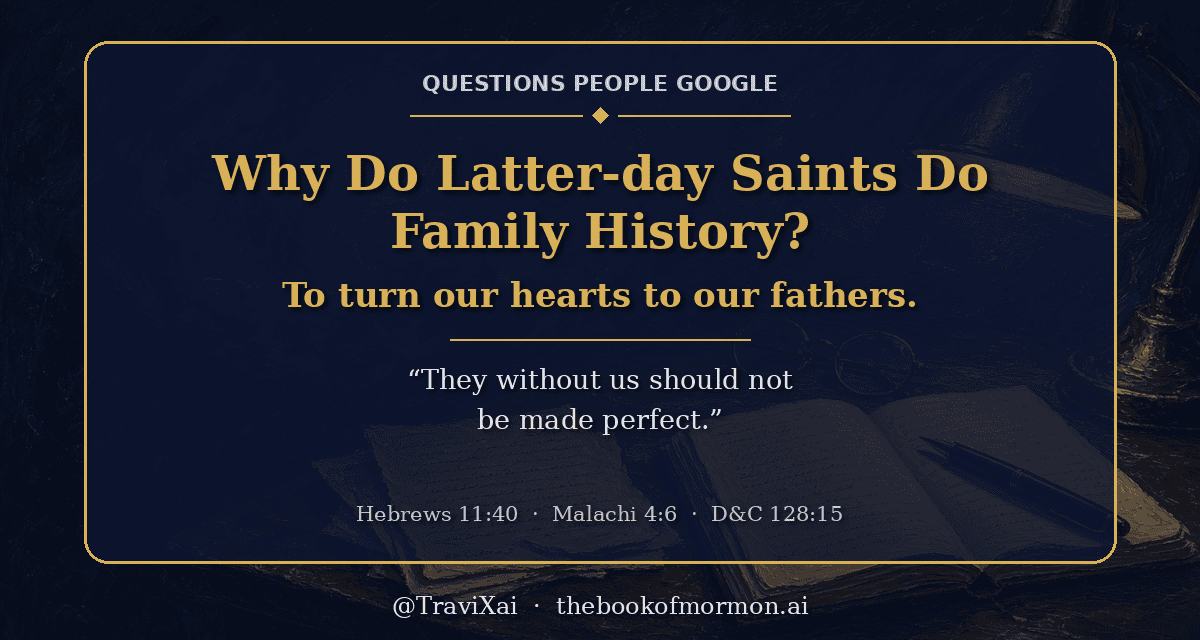

Latter-day Saints built the world’s biggest free genealogy service. Here’s the scripture that drives it.
Latter-day Saints do family history so their ancestors can receive temple ordinances by proxy and families can be bound together forever. Malachi promised Elijah would “turn the heart of the fathers to the children, and the heart of the children to their fathers” (Malachi 4:6), and Hebrews says “they without us should not be made perfect” (Hebrews 11:40). Since the gospel is preached to the dead (1 Peter 4:6), the living find names, the temple offers ordinances, and each ancestor chooses whether to accept.
The short answerOur salvation is tied to theirs
Latter-day Saints do family history because they believe God’s plan includes everyone who ever lived, and that families are meant to be bound together forever. Members research their ancestors so that temple ordinances, such as baptism and sealing, can be performed by proxy for those who died without them. Each person in the spirit world remains free to accept or reject that gift.
Joseph Smith taught that “their salvation is necessary and essential to our salvation, as Paul says concerning the fathers—that they without us cannot be made perfect—neither can we without our dead be made perfect” (D&C 128:15). That is why the Church runs FamilySearch, a free genealogy service open to everyone.
Malachi’s last promiseTurning hearts
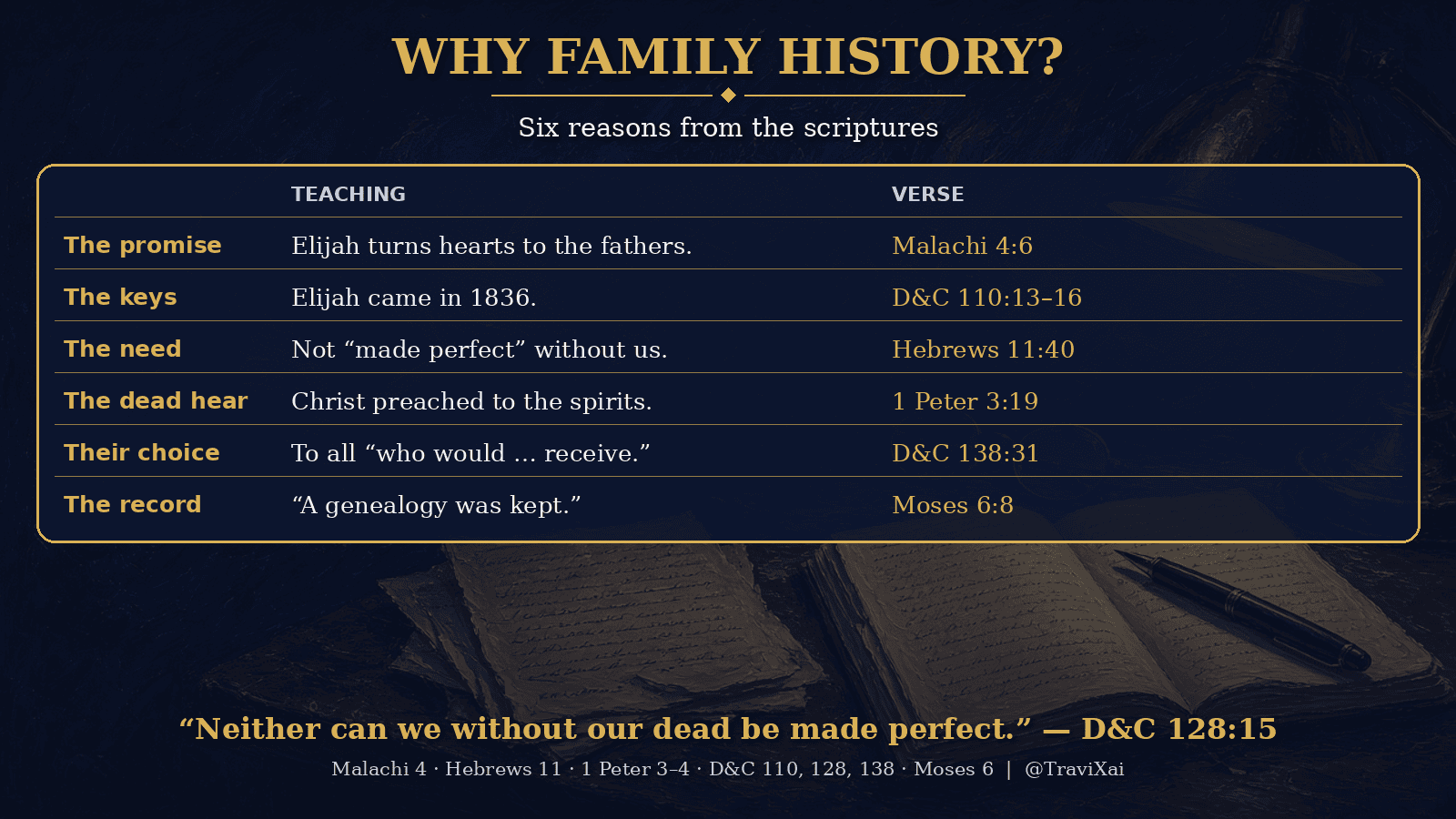
The Old Testament ends with this prophecy: “Behold, I will send you Elijah the prophet before the coming of the great and dreadful day of the Lord: and he shall turn the heart of the fathers to the children, and the heart of the children to their fathers, lest I come and smite the earth with a curse” (Malachi 4:5–6). Moroni gave Joseph Smith a fuller version in 1823: Elijah would “plant in the hearts of the children the promises made to the fathers” (D&C 2:1–3).
On April 3, 1836, Elijah came to the Kirtland Temple and committed those keys to Joseph Smith and Oliver Cowdery (D&C 110:13–16). Latter-day Saints see the worldwide explosion of interest in genealogy since then as that promise being fulfilled.
The gospel preached to the deadWhat about those who never heard?
The New Testament says Christ “went and preached unto the spirits in prison” (1 Peter 3:18–19), and “for this cause was the gospel preached also to them that are dead” (1 Peter 4:6). President Joseph F. Smith saw in vision how the Lord “organized his forces and appointed messengers … and thus was the gospel preached to the dead,” and how they were taught “faith in God, repentance from sin, vicarious baptism for the remission of sins, the gift of the Holy Ghost” (D&C 138:30–33).
This is the answer to one of the hardest questions in Christianity: what happens to billions who died without hearing of Christ? God is not unfair. Everyone gets the chance, and the living help. Paul even mentioned the practice: “why are they then baptized for the dead?” (1 Corinthians 15:29). See Baptism for the Dead and 1 Corinthians 15:29.
“They without us”A welding link
Hebrews ends its great chapter on faith with a surprising line about the ancient faithful: “God having provided some better thing for us, that they without us should not be made perfect” (Hebrews 11:40). Joseph Smith explained that “the earth will be smitten with a curse unless there is a welding link of some kind or other between the fathers and the children” (D&C 128:18).
Exaltation is a family. No one is exalted alone, and the Father’s work is to bind His children into one eternal family, generation to generation, back to Adam. That mirrors the endless line Joseph Smith described in the Sermon in the Grove, where the Father of Jesus Christ “had a Father also.” Obadiah foresaw “saviours … on mount Zion” (Obadiah 1:21): ordinary people doing for their ancestors what they could not do for themselves. See What Is Eternal Marriage?.
Keeping records is scripturalFrom Adam to Lehi
Record-keeping goes back to the beginning: “a book of remembrance was kept,” and “a genealogy was kept of the children of God” (Moses 6:5; Moses 6:8). Lehi found “a genealogy of his fathers” on the brass plates and learned he was a descendant of Joseph of Egypt (1 Nephi 5:14). Family history is simply obeying that pattern with modern tools.
Check the premiseThe presuppositions baked into the question
Before this question can be answered fairly, the person asking has to justify a few assumptions packed inside it:
- That proxy ordinances force anyone into the Church. D&C 138:31 offers liberty to “all who would repent … and receive the gospel”; the dead choose.
- That the dead who never heard of Christ are simply lost. 1 Peter 3:19 and 4:6: the gospel was preached to the dead.
- That genealogy is just a hobby for Latter-day Saints. D&C 128:15: “neither can we without our dead be made perfect.”
- That baptism for the dead is unbiblical. Paul referred to it in 1 Corinthians 15:29.
FAQQuick answers
Why do Latter-day Saints do family history?
To identify ancestors so that temple ordinances can be offered to them by proxy, and to bind families together forever (D&C 128:15).
What is FamilySearch?
A free genealogy website and service run by The Church of Jesus Christ of Latter-day Saints, open to everyone.
Do proxy baptisms make the dead members of the Church?
No. Each person in the spirit world chooses whether to accept the ordinance (D&C 138:31).
What does Elijah have to do with genealogy?
Malachi 4:5–6 promised Elijah would turn hearts between fathers and children; he restored the sealing keys in 1836 (D&C 110).
Is family history in the Bible?
Hebrews 11:40, 1 Peter 3:19, 1 Peter 4:6 and Malachi 4:5–6 all point to it, and Genesis is full of genealogies.
Why does family history matter for salvation?
Joseph Smith taught that “we without them cannot be made perfect; neither can they without us be made perfect” (D&C 128:18).
When did the Church start doing genealogy work?
The Genealogical Society of Utah was founded in 1894. It grew into FamilySearch, which now holds billions of searchable records.
What did Joseph F. Smith see about the dead?
In 1918 he saw Christ visit the spirit world, where “from among the righteous, he organized his forces and appointed messengers” to teach the gospel to the dead (D&C 138:30).
SummaryKey takeaways
- Family history lets ancestors receive ordinances by proxy.
- Malachi 4:5–6 promised Elijah; he came in 1836 (D&C 110).
- The gospel is preached to the dead (1 Peter 4:6; D&C 138).
- Ancestors remain free to accept or reject (D&C 138:31).
Start your own family tree free at FamilySearch. For quick, sourced answers, open Galatians18, and follow me on X at @TraviXai.
Sources
- King James Bible (churchofjesuschrist.org): Obadiah 1:21 · Malachi 4:5–6 · 1 Corinthians 15:29 · Hebrews 11:40 · 1 Peter 3:18–19 · 1 Peter 4:6
- Book of Mormon: 1 Nephi 5:14
- Doctrine and Covenants: D&C 2:1–3 · D&C 110:13–16 · D&C 128:15–18 · D&C 138:30–33
- Pearl of Great Price: Moses 6:5–8
- Joseph Smith, Sermon in the Grove (HC 6:476), BYU Studies online edition
- Featured image and in-article graphic: original graphics by thebookofmormon.ai (painterly backgrounds; no photographs or likenesses of real people).