
Critics say baptism for the dead isn’t in the Bible. Paul used it to prove the resurrection and never said a word against it. Here’s the verse they skip, and the rest of the Bible that backs it up.
“Baptism for the dead? That’s not in the Bible.” I hear it all the time, usually from someone who also tells me the Bible is all anyone needs. So open it to 1 Corinthians 15. Paul is in the middle of the biggest argument in the New Testament, the resurrection of Jesus Christ and of everyone else, and he drops this in as evidence:
Else what shall they do which are baptized for the dead, if the dead rise not at all? why are they then baptized for the dead?
1 Corinthians 15:29
I have never seen a good dispute of 1 Corinthians 15:29. Plenty of attempts, all built the same way: decide the verse can’t mean what it says, then work backward. Let’s run through them, then see what Peter, Malachi, and Joseph Smith add.
Part IWhat Paul actually wrote
The Greek is short and plain: hoi baptizomenoi hyper tōn nekrōn, “those being baptized for the dead” (Bible Hub interlinear). Hyper is the same preposition Paul uses when he writes that “Christ died for us” (Romans 5:8). It means on behalf of. The ESV doesn’t hide it: “why are people baptized on their behalf?” (parallel translations).
Now look at where Paul puts it. Some in Corinth were denying the resurrection outright:
Now if Christ be preached that he rose from the dead, how say some among you that there is no resurrection of the dead?
1 Corinthians 15:12
Paul answers with proof after proof, and this is one of them. That argument only works if the practice was real, known to everyone reading the letter, and taken seriously. Nobody proves the resurrection with something he thinks is nonsense.
Part II“Paul was describing a heresy”
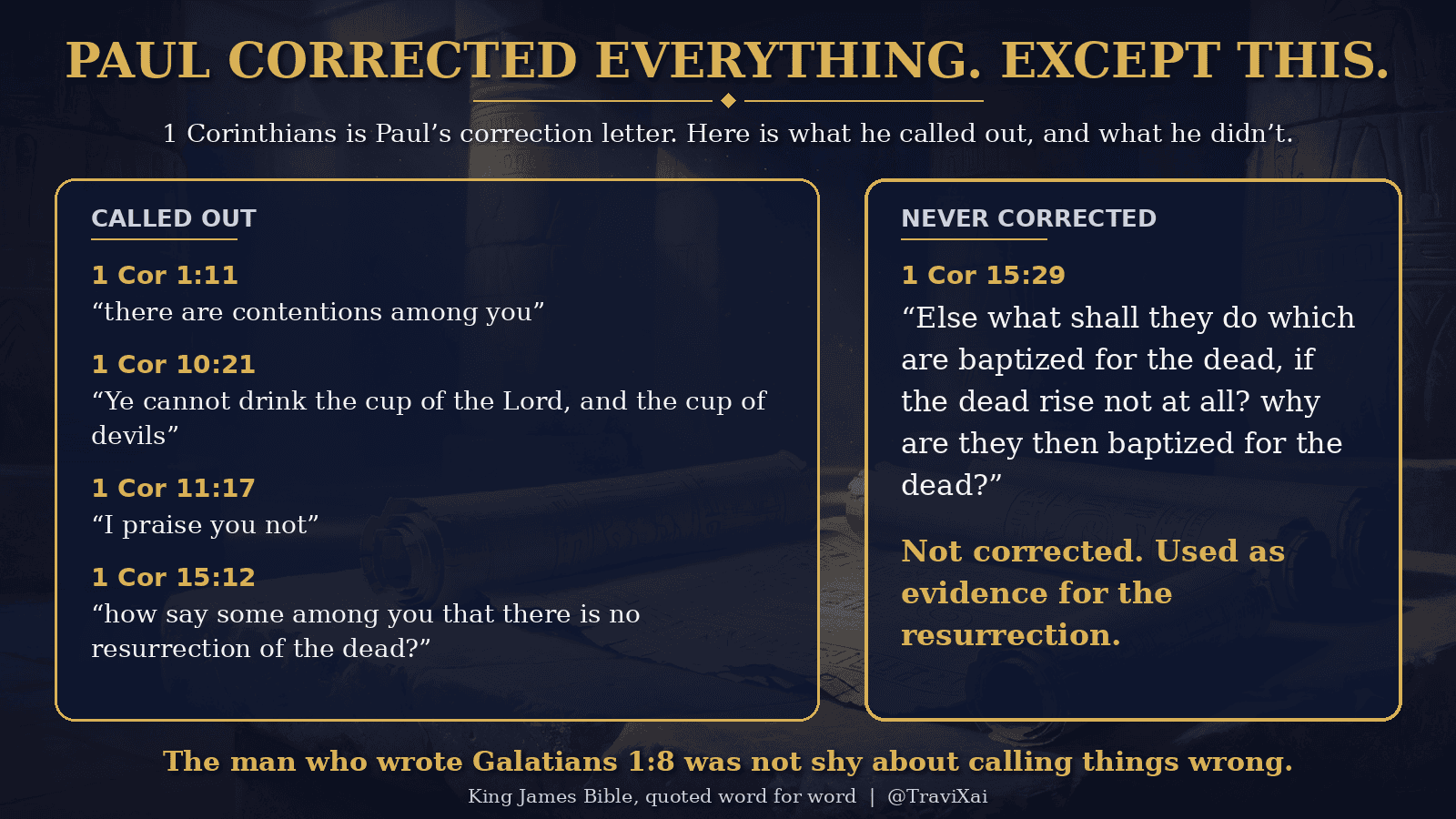
This is the go-to answer, and it falls apart the moment you remember which letter we’re reading. First Corinthians is Paul’s correction letter. He goes after their divisions: “there are contentions among you” (1 Corinthians 1:11). He goes after idol feasts: “Ye cannot drink the cup of the Lord, and the cup of devils” (10:21). He goes after the way they take the sacrament: “I praise you not” (11:17). And in this very chapter he corrects the people denying the resurrection.
So Paul corrects the Corinthians on everything, including a false doctrine in this same chapter, then cites baptism for the dead as evidence for the true doctrine without one word against it. The man who wrote Galatians 1:8 was not shy about calling things wrong.
“But he said ‘they,’ not ‘we’”
Critics point out Paul says “they” in verse 29. So does verse 18: “Then they also which are fallen asleep in Christ are perished” (15:18). Faithful Christians are “they” too. A pronoun doesn’t turn an ordinance into a heresy.
Watch the commentators work
The Catholic New American Bible’s own note says Paul “cites it as something in their experience that attests in one more way to belief in the resurrection.” The most the note can say against it is that it’s “not necessarily mentioned with approval” (USCCB, note on 15:29). Not condemned. Not corrected. Not necessarily.
Tertullian, one of the first Christian writers to comment on the verse, in the early 200s, read it for exactly what it says. The people who did it believed “the vicarious baptism (in question) would be beneficial to the flesh of another in anticipation of the resurrection” (On the Resurrection of the Flesh 48). Two centuries later John Chrysostom decided that “for the dead” meant “the dead bodies,” the person’s own body (Homily 40 on 1 Corinthians). When the plain reading is a problem, change the words. And they say we’re the ones who twist the Bible.
Part IIICan the dead hear the gospel?
Next objection: once you die, it’s over. Peter disagrees:
For Christ also hath once suffered for sins, the just for the unjust, that he might bring us to God, being put to death in the flesh, but quickened by the Spirit: By which also he went and preached unto the spirits in prison; Which sometime were disobedient, when once the longsuffering of God waited in the days of Noah …
1 Peter 3:18–20
Christ didn’t go to the spirits of Noah’s generation to gloat. He preached. And Peter tells us why a chapter later:
For for this cause was the gospel preached also to them that are dead, that they might be judged according to men in the flesh, but live according to God in the spirit.
1 Peter 4:6
Jesus said it in His own words: “The hour is coming, and now is, when the dead shall hear the voice of the Son of God: and they that hear shall live” (John 5:25). He is “not a God of the dead, but of the living: for all live unto him” (Luke 20:38).
Put Peter and Paul side by side and you have the whole pattern. The dead hear the gospel. The living are baptized on their behalf. That isn’t something bolted onto the Bible in Nauvoo. That’s two apostles.
Part IVThe question critics skip
Jesus set the requirement Himself:
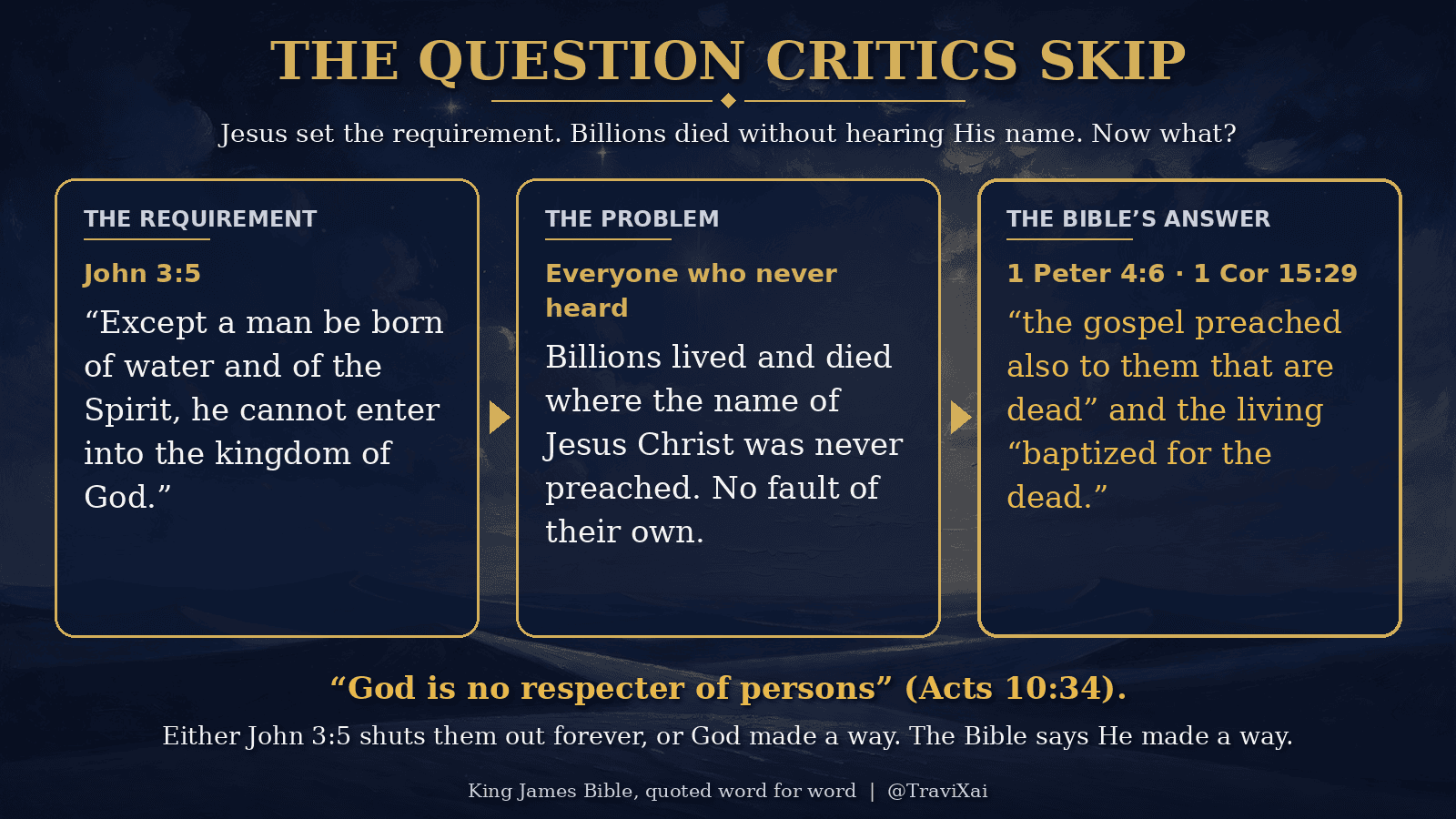
Jesus answered, Verily, verily, I say unto thee, Except a man be born of water and of the Spirit, he cannot enter into the kingdom of God.
John 3:5
And “he that believeth and is baptized shall be saved” (Mark 16:16). Now count the people who lived and died without ever hearing the name of Jesus Christ: billions of God’s children who never had a missionary, a Bible, or a baptismal font within a thousand miles. Either John 3:5 shuts every one of them out of the kingdom of God through no fault of their own, or God made a way.
Peter already told us which one: “Of a truth I perceive that God is no respecter of persons” (Acts 10:34). A God who is no respecter of persons doesn’t hand out eternity by birthplace. He sends the gospel to the dead and accepts the baptisms the living do for them. The critic’s alternative is a God who requires baptism and then makes sure most of His children never hear of it. That’s the doctrine that needs defending, not ours.
Early Christians asked the same question
The Shepherd of Hermas, a second-century book so respected that Codex Sinaiticus, one of the oldest Bibles in existence, includes part of it after the New Testament (Codex Sinaiticus), tackled this exact problem. Righteous people who died before baptism, it says, “could not in any other way enter into the kingdom of God.” So the apostles, after their own deaths, “preached it not only to those who were asleep, but themselves also gave them the seal of the preaching. Accordingly they descended with them into the water, and again ascended” (Similitude 9, chapter 16).
Baptism required. The dead taught. The dead given the ordinance. Sound familiar?
Part VElijah and the welding link
The last words of the Old Testament are a promise and a warning:
Behold, I will send you Elijah the prophet before the coming of the great and dreadful day of the Lord: And he shall turn the heart of the fathers to the children, and the heart of the children to their fathers, lest I come and smite the earth with a curse.
Malachi 4:5–6
On April 3, 1836, in the Kirtland Temple, Joseph Smith and Oliver Cowdery saw Elijah, who told them “the time has fully come, which was spoken of by the mouth of Malachi” and that “the keys of this dispensation are committed into your hands” (D&C 110:14–16).
On August 15, 1840, at the funeral of Seymour Brunson in Nauvoo, Joseph taught that the Saints “could now act for their friends who had departed this life” by being baptized in their behalf, and he cited Paul. The first recorded one was done in the Mississippi River (Church History Topics). On January 19, 1841, the Lord said where the ordinance belongs:
For a baptismal font there is not upon the earth, that they, my saints, may be baptized for those who are dead— For this ordinance belongeth to my house …
D&C 124:29–30
Then on September 7, 1842, Joseph wrote the letter that is now D&C 128. He quotes 1 Corinthians 15:29 (128:16), then Malachi 4:5–6 (128:17), and ties them together:
It is sufficient to know, in this case, that the earth will be smitten with a curse unless there is a welding link of some kind or other between the fathers and the children, upon some subject or other—and behold what is that subject? It is the baptism for the dead. For we without them cannot be made perfect; neither can they without us be made perfect.
D&C 128:18
That last line echoes Hebrews 11:40: “that they without us should not be made perfect.” Joseph didn’t build a doctrine on one obscure verse. He connected Paul, Malachi, and Hebrews into one picture, years before Carthage.
Part VITexts Joseph never saw
Here’s where it gets fun. Two early Christian texts describe Christ bringing the gospel and its ordinances to the dead. Nobody in Joseph Smith’s world had either one.
The Epistle of the Apostles
An early Christian text usually dated to the second century, written to defend orthodox teaching against the Gnostics. Christ says: “For to that end went I down unto the place of Lazarus, and preached unto the righteous and the prophets, that they might come out of the rest which is below and come up into that which is above; and I poured out upon them with my right hand the water (?) (baptism, Eth.) of life and forgiveness and salvation from all evil” (chapter 27, M. R. James translation). Where the Coptic is damaged, the Ethiopic reads “baptism.” The work was lost to the rest of the world until Carl Schmidt discovered major portions of it in a Coptic manuscript in 1895 (background).
Odes of Solomon 42
Christ speaks again: “And those who had died ran towards me; and they cried out and said, Son of God, have pity on us. … May we also be saved with You, because You are our Savior. Then I heard their voice, and placed their faith in my heart. And I placed my name upon their head, because they are free and they are mine” (Charlesworth translation). The Syriac manuscript that preserves this ode turned up in 1909, when J. Rendel Harris found its forgotten leaves on a shelf in his study (background).
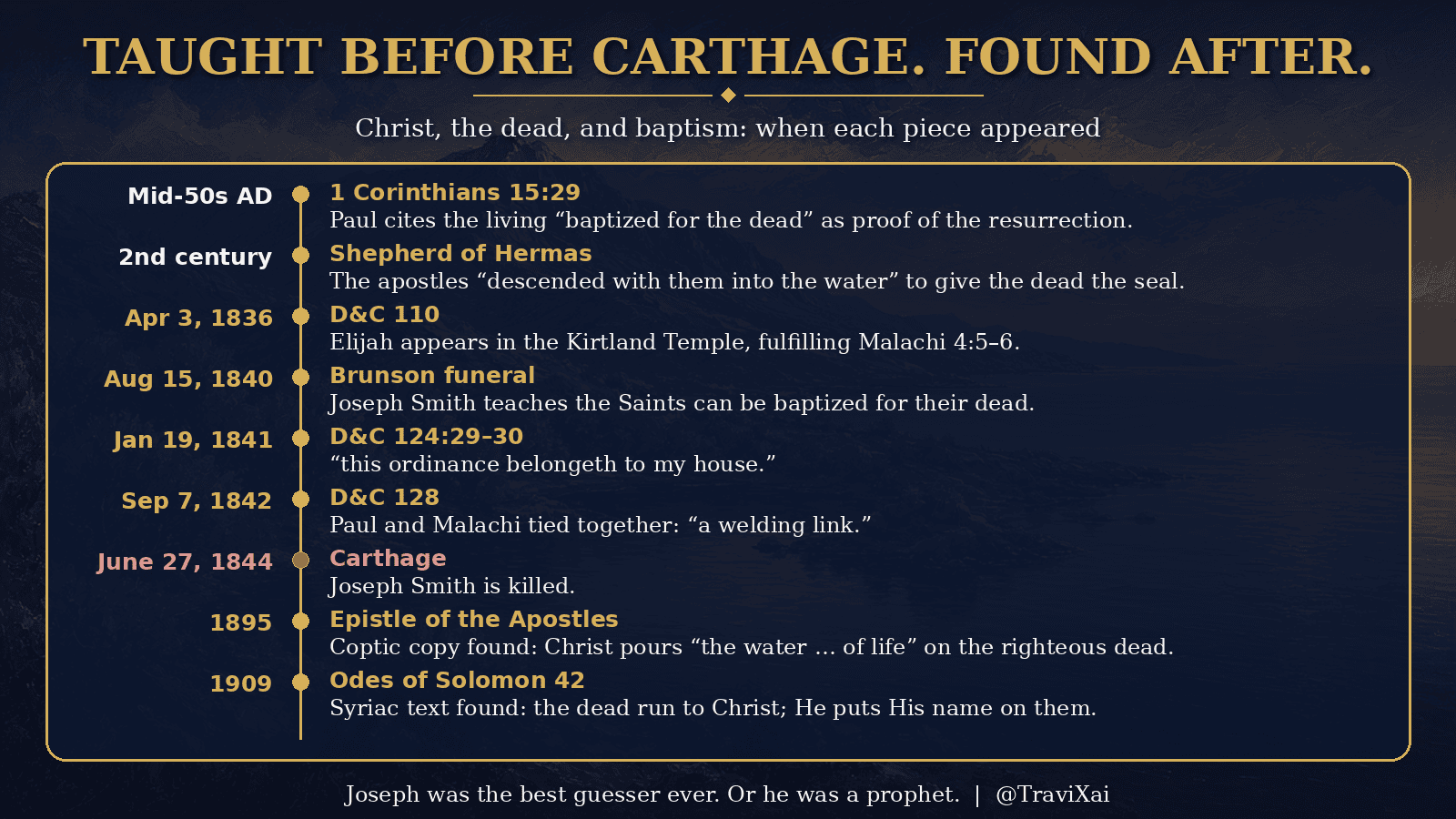
Joseph taught baptism for the dead in 1840 and wrote D&C 128 in 1842. He was killed in 1844. The first of these texts surfaced fifty-one years later and the second sixty-five years later. Joseph was the best guesser ever! Or he was a prophet. And notice he never got to point at either one and say “SEE, proof,” the same pattern I walk through in The Con Man Who Never Ran the Con.
Ask any critic which church a first-century Christian would recognize. Paul’s church baptized for the dead. Mine does too.
FAQQuick answers
Is baptism for the dead in the Bible?
Yes. Paul cites it while proving the resurrection: “Else what shall they do which are baptized for the dead, if the dead rise not at all? why are they then baptized for the dead?” (1 Corinthians 15:29).
What does “baptized for the dead” mean in the Greek?
The Greek is hoi baptizomenoi hyper tōn nekrōn. Hyper means “on behalf of,” the same word Paul uses in “Christ died for us” (Romans 5:8). The ESV renders it “baptized on their behalf.”
Did Paul condemn baptism for the dead?
No. First Corinthians corrects the Saints on divisions, idol feasts, the sacrament and the denial of the resurrection, yet Paul cites baptism for the dead as evidence for the resurrection without one word against it.
Why do Latter-day Saints baptize for the dead?
Jesus said, “Except a man be born of water and of the Spirit, he cannot enter into the kingdom of God” (John 3:5), and “God is no respecter of persons” (Acts 10:34). Baptism for the dead lets everyone who died without the gospel receive it.
Can the dead hear the gospel?
Yes. Christ “preached unto the spirits in prison” (1 Peter 3:19), and “for this cause was the gospel preached also to them that are dead” (1 Peter 4:6).
Does baptism for the dead make someone a member against their will?
No. The ordinance is offered, not imposed. Those who have died remain free to accept or reject it in the spirit world, and it does not add them to the Church’s membership records.
When did baptism for the dead begin in the restored Church?
Joseph Smith first taught it publicly on August 15, 1840, at the funeral of Seymour Brunson in Nauvoo. On January 19, 1841, the Lord said the ordinance “belongeth to my house” (D&C 124:29–30), and it is now done in temples.
What does Elijah have to do with baptism for the dead?
Malachi promised Elijah would “turn the heart of the fathers to the children, and the heart of the children to their fathers” (Malachi 4:6). Joseph Smith called baptism for the dead the “welding link” between them (D&C 128:18), echoing Hebrews 11:40: “they without us should not be made perfect.”
SummaryKey takeaways
- Paul cites people “baptized for the dead” as evidence for the resurrection (1 Corinthians 15:29), using hyper, the same word as “Christ died for us.”
- First Corinthians corrects divisions, idol feasts, sacrament abuse, and resurrection denial. It never corrects this.
- Peter says the gospel was “preached also to them that are dead” (1 Peter 4:6), and Jesus said “the dead shall hear the voice of the Son of God” (John 5:25).
- John 3:5 plus “God is no respecter of persons” (Acts 10:34) needs a way for the dead. The Bible gives one.
- Joseph tied Paul and Malachi together in 1840–1842. The Epistle of the Apostles (1895) and Odes of Solomon 42 (1909) surfaced after he died.
Next time someone says baptism for the dead isn’t biblical, ask them what Paul meant by it, then ask what happens to the billions who never heard. For quick, sourced answers on baptism for the dead, the plan of salvation, and temple worship, open Galatians18. And for more like this every day, follow me on X at @TraviXai.
Sources
- King James Bible (Church of Jesus Christ of Latter-day Saints edition): 1 Corinthians 15:29 · 15:12 · 15:18 · 15:30 · 1 Corinthians 1:11 · 10:21 · 11:17 · Galatians 1:8 · 1 Peter 3:18–20 · 1 Peter 4:6 · John 5:25 · Luke 20:38 · John 3:5 · Mark 16:16 · Acts 10:34 · Malachi 4:5–6 · Hebrews 11:40
- Doctrine and Covenants: D&C 110:13–16 (April 3, 1836) · D&C 124:29–31 (January 19, 1841) · D&C 128:15–18 (September 7, 1842)
- Bible Hub, 1 Corinthians 15:29 Greek interlinear, Romans 5:8 Greek interlinear, and 1 Corinthians 15:29 parallel translations
- United States Conference of Catholic Bishops, New American Bible (Revised Edition), 1 Corinthians 15, note on 15:29
- Tertullian, On the Resurrection of the Flesh, chapter 48 (New Advent)
- John Chrysostom, Homily 40 on First Corinthians (New Advent)
- The Shepherd of Hermas, Book III, Similitude 9, chapter 16 (New Advent); Codex Sinaiticus (Wikipedia)
- Church History Topics, “Baptism for the Dead”
- Epistle of the Apostles (Epistula Apostolorum), tr. M. R. James, The Apocryphal New Testament (1924) (Early Christian Writings); discovery history: “Epistle of the Apostles” (Wikipedia)
- Odes of Solomon 42, tr. James H. Charlesworth (Early Christian Writings); discovery history: “Odes of Solomon” (Wikipedia)
- Galatians18: Baptism for the Dead · Plan of Salvation · Temple Worship
- Featured image and in-article graphics: original graphics by thebookofmormon.ai (painterly backgrounds; no photographs or likenesses of real people).