
The “polytheist” label sounds like a knockout. Check what the word means, read Paul’s two verses in context, and watch the charge run into the critic’s own creed.
Some labels are meant to end a conversation before it starts. “Polytheist” is one of them. Say you’re a Latter-day Saint online and it arrives fast, usually with a tone that suggests the case is closed and you should go find a statue of Zeus to pray to.
So let’s actually test it. What does the word mean? Do Latter-day Saints fit it? And what did the Apostle Paul say when he lived in a city that was full of gods? He answered that last question in two verses, and they settle more than critics would like.
(If you want the deep dive on Psalm 82, the divine council, and Jesus quoting “Ye are gods” in John 10:34, that’s already here: The Gods of the Bible (2026 Edition). This post is about the label itself.)
Start with the dictionary
Merriam-Webster defines polytheism as “belief in or worship of more than one god” (Merriam-Webster). Britannica’s article, written by the comparative-religion scholar Ninian Smart, uses Greek religion with Zeus, the Hindu pantheon, and the gods of Egypt and Mesopotamia as its examples. It also separates polytheism from a related idea, monolatry: “the worship of one god as supreme and sole object of the worship of a group while not denying the existence of deities belonging to other groups” (Britannica).
In practice, polytheism means a temple for this god, an offering for that one: many gods, each with a claim on your worship.
Now put Latter-day Saint practice next to that. Our first article of faith is “We believe in God, the Eternal Father, and in His Son, Jesus Christ, and in the Holy Ghost” (Articles of Faith 1:1). We pray to one Being, the Father. The risen Christ told the Nephites exactly how: “ye must always pray unto the Father in my name” (3 Nephi 18:19). We take Jesus at His word: “Thou shalt worship the Lord thy God, and him only shalt thou serve” (Matthew 4:10).
There’s no pantheon to shop from. No Latter-day Saint prays to an angel, a prophet, or some other god “out there.” Elder Jeffrey R. Holland said it in general conference: acknowledging that the members of the Godhead are separate beings “is not to be guilty of polytheism; it is, rather, part of the great revelation Jesus came to deliver concerning the nature of divine beings” (“The Only True God and Jesus Christ Whom He Hath Sent,” October 2007). Short version: The Oneness of God.
The switch in the middle of the argument
Here’s how the charge usually gets built. Step one: “You believe there are other beings who can be called gods.” Step two: “So you worship many gods.”
Step one is true, and it’s also true of the Bible. Psalm 82 has God judging “among the gods,” and Jesus quoted it to defend Himself (full treatment here).
Step two is where the trick happens. “Gods” in step one means beings the scriptures give the title to. “Gods” in step two means objects of worship. Same word, two meanings, one sleight of hand. That’s equivocation, and the whole charge rests on it.
The polytheist label also has a second hidden step: it quietly redefines the debate. If “monotheism” means “one divine substance in three persons,” then of course anyone outside that definition is a polytheist. But that’s just declaring yourself the winner. Assuming the thing you were supposed to prove is begging the question.
What Paul was answering in Corinth
Corinth was a port city crowded with temples. The question the Corinthian Saints sent Paul was practical: can a Christian eat meat that had been sacrificed to an idol? Paul’s answer in 1 Corinthians 8 is pastoral. Mostly it’s about not wrecking a weaker brother’s conscience (verses 9–13). But on the way he lays down a doctrine of God in three sentences:
As concerning therefore the eating of those things that are offered in sacrifice unto idols, we know that an idol is nothing in the world, and that there is none other God but one. For though there be that are called gods, whether in heaven or in earth, (as there be gods many, and lords many,) But to us there is but one God, the Father, of whom are all things, and we in him; and one Lord Jesus Christ, by whom are all things, and we by him.
1 Corinthians 8:4–6 (KJV)
Look at the shape of it. Verse 5 admits there are many “called gods, whether in heaven or in earth.” Paul doesn’t stop to count them. Two chapters later he even says something real stands behind the idols: “the things which the Gentiles sacrifice, they sacrifice to devils, and not to God” (1 Corinthians 10:20). He didn’t think the unseen world was empty.
Many commentators read verse 5 as Paul describing what pagans believed, “so-called” gods. Fair enough; grant it. Either way, Paul’s answer to a world full of gods wasn’t a lecture on metaphysics. It was two words: “to us.” The line he draws is worship and allegiance. Whatever else is called god, to us there is one God, the Father.
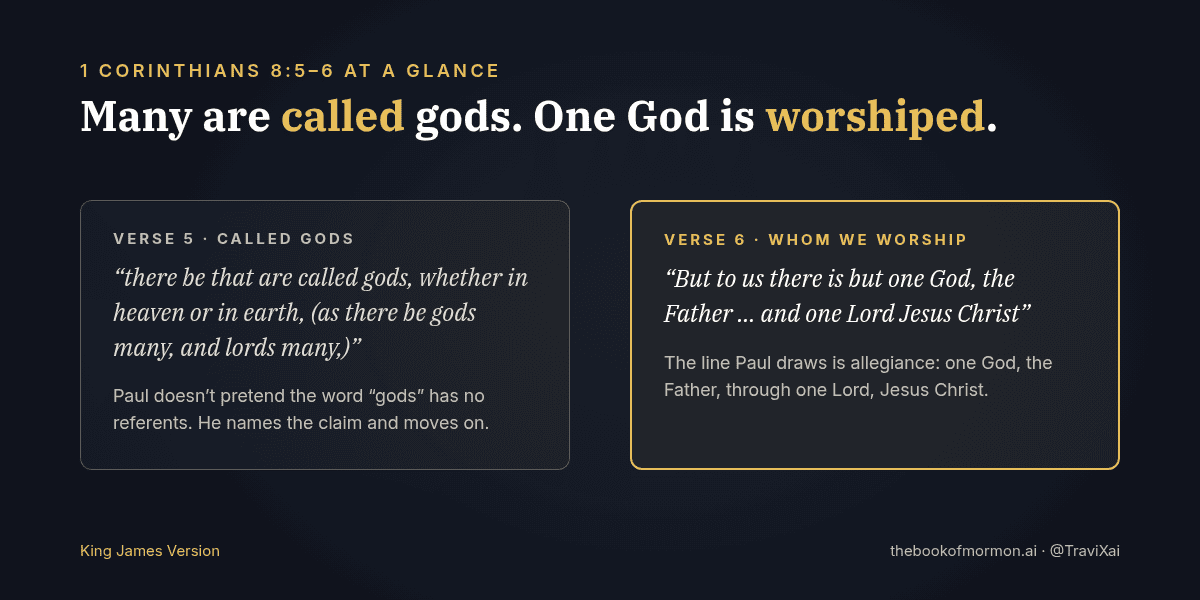
That is the Latter-day Saint position, nearly word for word. If saying “there are many called gods, but to us there is one God, the Father” makes you a polytheist, Paul goes on the list first.
“One God, the Father” and “one Lord Jesus Christ”
Verse 6 does something else worth slowing down for. It names the one God: “the Father, of whom are all things.” Then it names “one Lord Jesus Christ, by whom are all things.” Two titles, two prepositions, two persons. Paul does the same elsewhere: “One God and Father of all” (Ephesians 4:6), and “there is one God, and one mediator between God and men, the man Christ Jesus” (1 Timothy 2:5). Jesus Himself prayed to “the only true God, and Jesus Christ, whom thou hast sent” (John 17:3), and after the Resurrection He spoke of “my Father, and your Father; and … my God, and your God” (John 20:17).
None of that lowers Christ. Latter-day Saints worship Him as Lord and God, with Thomas: “My Lord and my God” (John 20:28). The Book of Mormon’s title page says its purpose is the “convincing of the Jew and Gentile that Jesus is the Christ, the Eternal God” (title page). And it calls the Father, Son, and Holy Ghost “one God, without end” (2 Nephi 31:21). Every knee bows to Jesus “to the glory of God the Father” (Philippians 2:11). One God, worshiped through one Lord.
To be fair to the other side: scholars like Richard Bauckham read 1 Corinthians 8:6 as the Shema rewritten with Jesus inside it, and that’s a serious reading worth engaging (we did in “One” in the Bible). But that is a debate about how the Father and Son are one. It isn’t evidence that anyone who disagrees worships a crowd. For how “one” works across the Bible, see also Same Divine Nature Isn’t Consubstantial and The Godhead, Not the Classical Trinity.
Now count the critic’s creed
Here’s where the label gets awkward for the person throwing it. The Westminster Confession says: “In the unity of the Godhead there be three persons, of one substance, power, and eternity: God the Father, God the Son, and God the Holy Ghost” (Westminster Confession 2.3). The Athanasian Creed puts it even more directly: “So the Father is God: the Son is God: and the Holy Ghost is God. And yet they are not three Gods: but one God” (Athanasian Creed, 15–16).
Count that the way critics count us, and you get three. Which is exactly what Islam does. The Qur’an says, “They have certainly disbelieved who say, ‘Allāh is the third of three’” (Qur’an 5:73, Sahih International), and Muslim critics have called the Trinity a form of polytheism for centuries.
What does a Trinitarian say back? “You don’t understand what we mean by one. We worship one God.” That’s a reasonable answer. Latter-day Saints have the same right to explain what we mean. Demanding charity for “three persons, one God” while refusing it to “three persons, one Godhead” is special pleading: one rule for your creed, another for mine.
The point isn’t “you’re a polytheist too.” Neither of us is. But a label you’d reject from a Muslim shouldn’t be the first thing you throw at your neighbor.
“But you think people can become gods”
Yes, Latter-day Saints believe God’s children can become like Him. So does the New Testament: “if children, then heirs; heirs of God, and joint-heirs with Christ” (Romans 8:17); “To him that overcometh will I grant to sit with me in my throne” (Revelation 3:21). Paul told the Athenians, a city full of idols, “we are the offspring of God” (we covered Acts 17:29 here), and Genesis says man was made in God’s image (Genesis 1:26 here).
But a child growing up to be like his father doesn’t become his father’s rival. No Latter-day Saint expects to stop worshiping the Father, ever. 1 Corinthians 8:6 doesn’t expire: to us there is one God, the Father. Turning “heirs of God” into “a pantheon of competing deities” is a straw man. More at Exaltation and Becoming Like God and Offspring of God.
A field guide to the fallacies
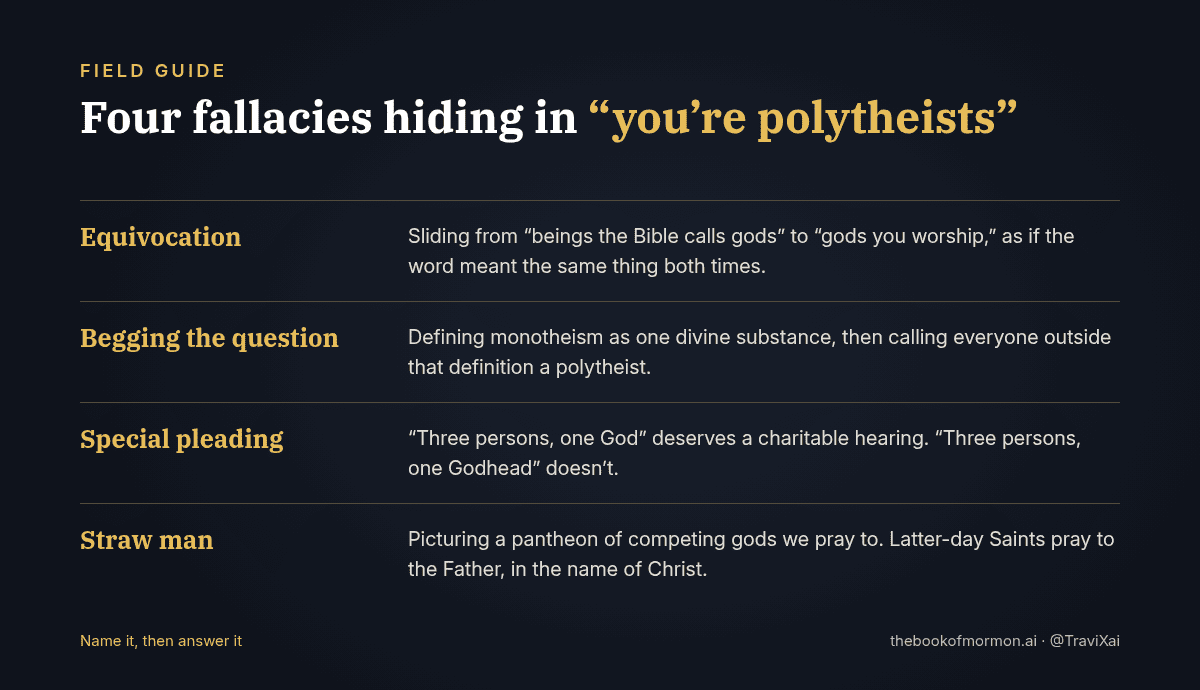
When the label shows up, it usually rides in on one of these. Name it, then answer it:
- Equivocation: “gods” as a title the Bible uses becomes “gods” you worship, as if the word meant the same thing both times.
- Begging the question: defining monotheism as one divine substance, then counting everyone outside it as a polytheist.
- Special pleading: “three persons, one God” gets a careful hearing; “three persons, one Godhead” gets a slur.
- Straw man: picturing Latter-day Saints praying to a crowd of gods, or treating “heirs of God” as rivals of God.
And a reminder for our side too. Scripture isn’t an idol, and none of this is about winning by verse count. The Bible is God speaking to His prophets, and the same God still speaks. Read it honestly and you find what Paul found: plenty of things called gods, and one God we worship. (For more on how critics skip verses like these, see “You Twist the Bible”: Who’s Really Cherry-Picking?)
Key takeaways
- Polytheism means believing in or worshiping more than one god. Latter-day Saints worship one God, the Father, in the name of Jesus Christ.
- The charge works only by equivocation: sliding from “beings called gods” to “gods you worship.”
- Paul granted “gods many, and lords many,” then drew the line at worship: “to us there is but one God, the Father” (1 Corinthians 8:5–6).
- Trinitarians ask to be judged by what they mean by “one God.” Latter-day Saints deserve the same courtesy.
- Becoming heirs of God doesn’t create rivals to God. The Father stays the one God we worship.
Next time someone calls you a polytheist, don’t get defensive. Open to 1 Corinthians 8:5–6, read it out loud, and ask which part of Paul’s sentence you got wrong. For quick, sourced answers on the Godhead and the verses critics throw, open Galatians18. And for daily answers to common attacks, follow me on X at @TraviXai.
Sources
- Scripture quotations: King James Version and the Book of Mormon, churchofjesuschrist.org: Matthew 4:10; John 17:3; 20:17, 28; Romans 8:17; 1 Corinthians 8:4–13; 10:20; Ephesians 4:6; Philippians 2:11; 1 Timothy 2:5; Revelation 3:21; Book of Mormon title page; 2 Nephi 31:21; 3 Nephi 18:19; Articles of Faith 1:1.
- “Polytheism,” Merriam-Webster Dictionary.
- Ninian Smart, “Polytheism,” Encyclopaedia Britannica.
- Jeffrey R. Holland, “The Only True God and Jesus Christ Whom He Hath Sent,” October 2007 general conference, churchofjesuschrist.org.
- Westminster Confession of Faith, ch. 2.3, in Philip Schaff, The Creeds of Christendom, vol. 3, CCEL.
- Athanasian Creed, in Philip Schaff, The Creeds of Christendom, vol. 2, CCEL.
- Qur’an 5:73, Sahih International translation, quran.com.
- Gospel Topics, “Godhead,” churchofjesuschrist.org.
- Galatians18 topic pages: The Oneness of God, The Godhead, Not the Classical Trinity, Exaltation and Becoming Like God, Offspring of God.
- Related on this blog: The Gods of the Bible (2026 Edition), We Are God’s Offspring, Made in His Image, Same Divine Nature Isn’t Consubstantial, “One” in the Bible.
- Featured image and cards: original graphics by thebookofmormon.ai (no photographs or likenesses of real people).