

The Shema says God is one. Jesus said, “I and my Father are one.” Here’s what the Hebrew and Greek words for “one” actually mean, and how Jesus defined His own oneness.
Home › Scripture Study › Start here: Are Latter-day Saints Christian? · The CES Letter: A Faithful Response
“I and my Father are one” (John 10:30) does not say “one being.” The Greek word is hen, a neuter form meaning one in unity or purpose, not the masculine “one person.” Jesus defined it Himself in John 17:21–22, praying that His disciples “may be one, even as we are one.” The Hebrew echad in the Shema works the same way: husband and wife become “one flesh” (Genesis 2:24).
Few words in the Bible carry more theological weight than the word “one.” Christians of every tradition confess that God is one. Jews have recited the Shema for thousands of years. Jesus said, “I and my Father are one.” Wars of words, and sometimes worse, have been fought over what that small word means.
Latter-day Saints are often told they don’t believe in one God, because we believe the Father, the Son, and the Holy Ghost are three distinct persons. So it’s worth asking a simple question: when the Bible says “one,” what does the word actually mean?
The answer is more interesting than most people expect. In both Hebrew and Greek, the Bible’s word for “one” regularly describes a unity of distinct parts. And when Jesus explains His own oneness with the Father, He uses an example that settles a lot.
This post walks through the Hebrew, the Greek, how the verses sort out, what scholars on different sides say, and the strongest case for the Latter-day Saint reading.
Part 1: The Hebrew word echad
The most famous statement of God’s oneness in the Old Testament is Deuteronomy 6:4:
“Hear, O Israel: The Lord our God is one Lord.”
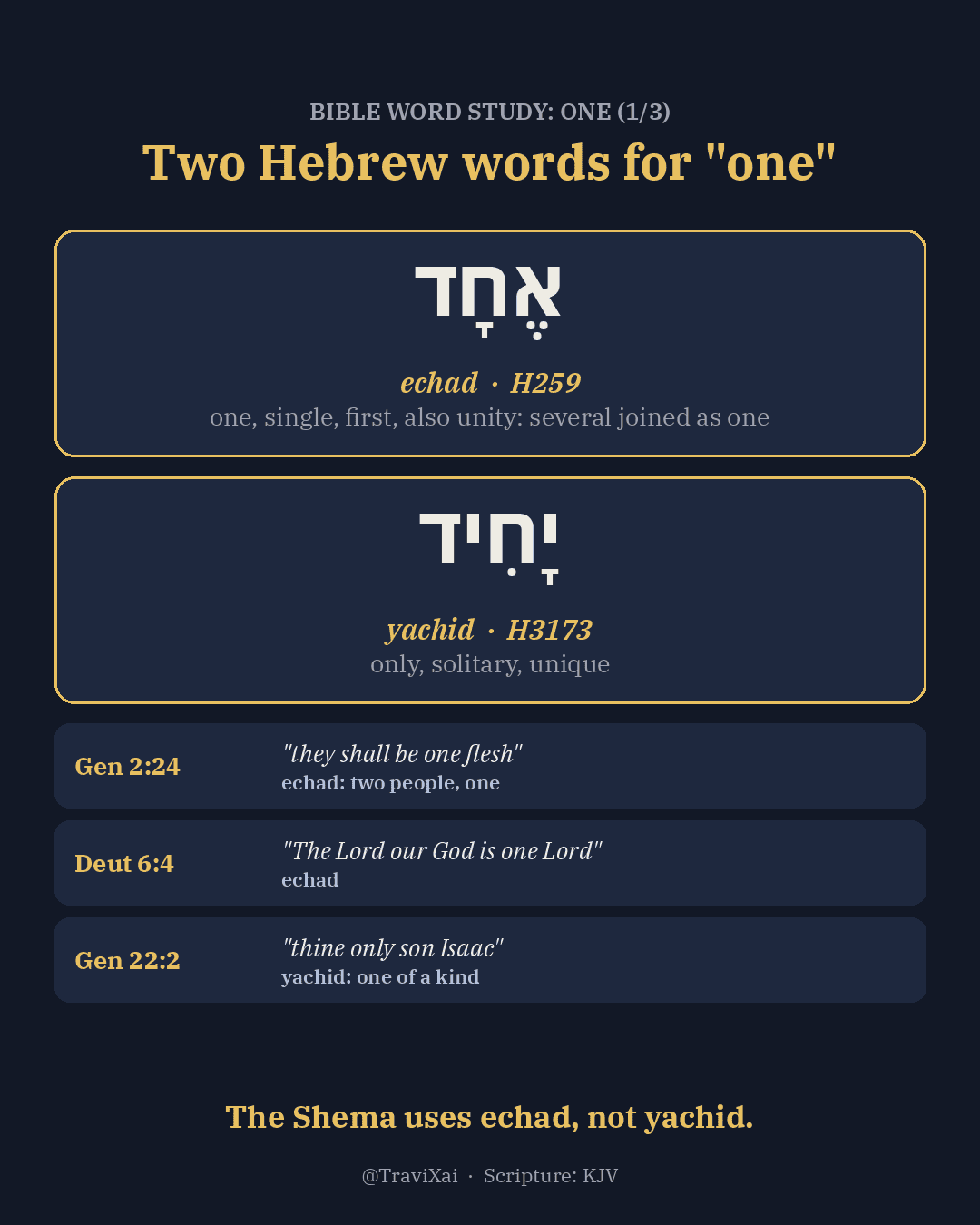
The Hebrew word for “one” here is echad (אֶחָד, Strong’s H259). BibleHub’s lexicon entries give its range: one, a single thing, first, and also a unity, as when several things are joined together.
That second use matters. Look at Genesis 2:24, where God describes marriage:
“Therefore shall a man leave his father and his mother, and shall cleave unto his wife: and they shall be one flesh.”
Two people. One flesh. The word is echad. Nobody reads this verse and concludes the husband and wife stop being two persons. They are one in a covenant union.
The Old Testament uses echad this way elsewhere too. Many people can act “as one man.” Several pieces can be joined into one whole. The word can count to one, and it can describe a unity.
The word Moses didn’t use
Hebrew had another word available if a writer wanted to stress “only one, alone, solitary”: yachid (יָחִיד, Strong’s H3173). It means only, unique, solitary. It shows up in Genesis 22:2, where God tells Abraham:
“Take now thy son, thine only son Isaac, whom thou lovest…”
Isaac was Abraham’s yachid, his one and only son of promise.
The Shema doesn’t use yachid. It uses echad.
We should be careful here. Some writers overstate this point, as if echad must mean a compound unity. It doesn’t. Echad is the ordinary Hebrew word for “one,” and it often just means one. The fair conclusion is narrower but still important: the Hebrew word in the Shema does not require “one being with no distinct persons in it.” It is fully compatible with a unity of more than one. The text alone doesn’t settle the question in favor of a single undivided being.
What the Shema clearly demands is loyalty. Israel was surrounded by nations with many gods. The verse that follows says, “And thou shalt love the Lord thy God with all thine heart.” The Shema is a call to covenant loyalty to one God, not a lecture on metaphysics.
Jesus quotes it in Mark 12:29: “The first of all the commandments is, Hear, O Israel; The Lord our God is one Lord.” Latter-day Saints affirm that verse completely.
Part 2: The Greek word hen in John 10:30
Now to the New Testament. In John 10:30 Jesus says:
“I and my Father are one.”
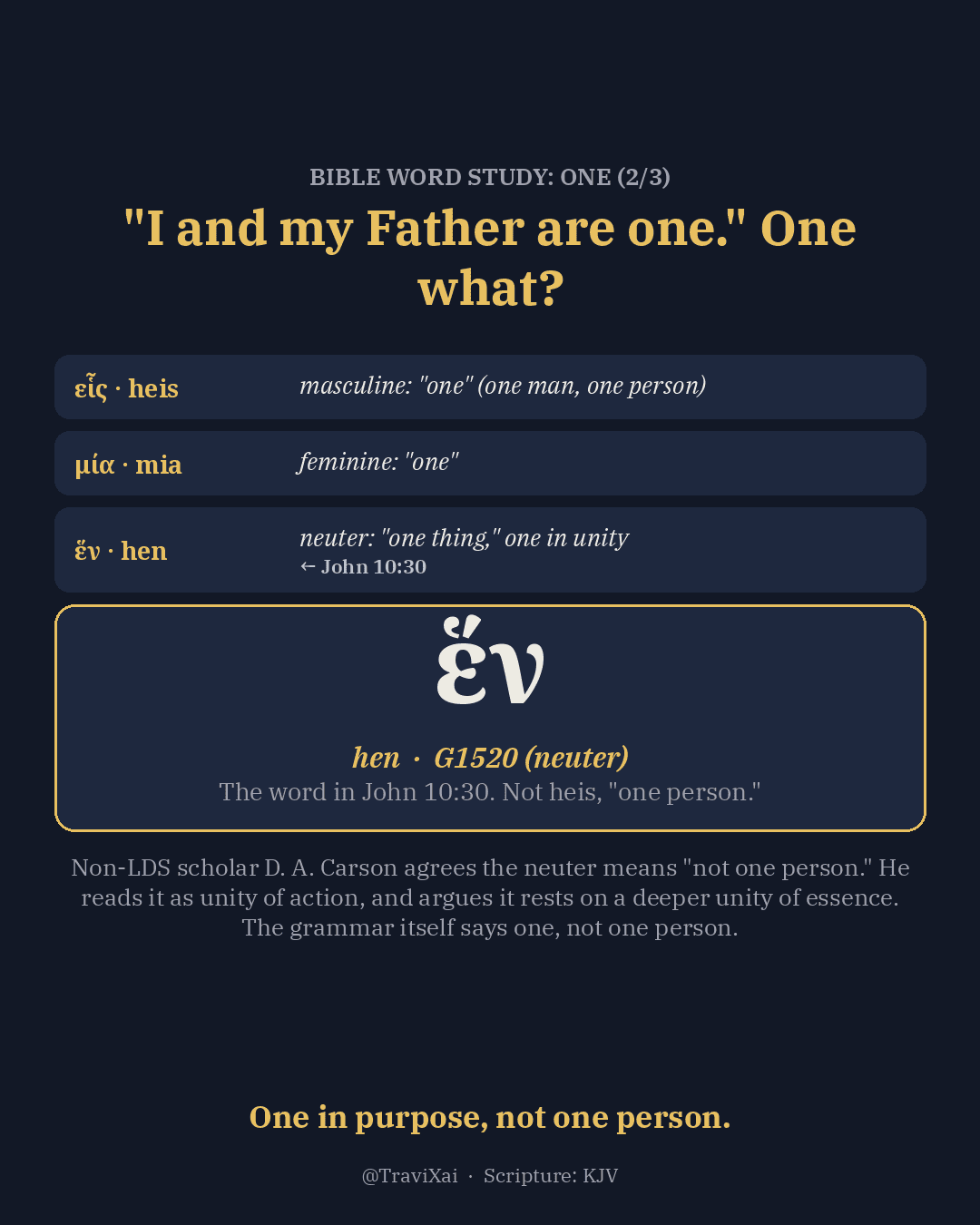
Greek “one” is heis (εἷς, Strong’s G1520), and like many Greek words it changes form depending on gender:
- heis (εἷς): masculine. Used for one man, one person.
- mia (μία): feminine.
- hen (ἕν): neuter. One thing, one in unity.
John 10:30 uses hen, the neuter.
Why does that matter? If John had wanted to say “the Father and I are one person,” the natural word would be the masculine heis. He didn’t use it. He used the neuter, which points to a unity, not to a single individual.
This isn’t a Latter-day Saint invention. D. A. Carson, a respected evangelical New Testament scholar, makes the same grammatical point in his commentary The Gospel According to John (Pillar, 1991). He notes the neuter means the Father and Son are not “one person.” In context, he reads the verse as a unity of will and action: the Son does what the Father does, and no one can snatch the sheep out of either one’s hand (John 10:28–29).
To be fair to Carson, he goes further than that. He argues that this unity of action presupposes a deeper unity of essence, and he reads the verse in a way that supports traditional Christian belief. We should say so plainly. Carson is not on our side of the doctrinal question.
But notice what both sides agree on: the grammar says one, and it says not one person. Whatever more you believe about the Godhead, you have to bring it from somewhere other than the word hen.
The crowd in John 10 did take Jesus’ words as a claim to be divine, and they picked up stones (John 10:31–33). Latter-day Saints agree that Jesus was claiming divinity. Jesus is God, the Son, fully divine. The question isn’t whether He is God. It’s whether “one” here means one substance or one perfect unity of divine persons.
Part 3: Jesus defines His own “one”
We don’t have to guess what Jesus meant by “one.” A few chapters later, in His great intercessory prayer, He uses the same word, hen, again and again, and this time about His disciples.
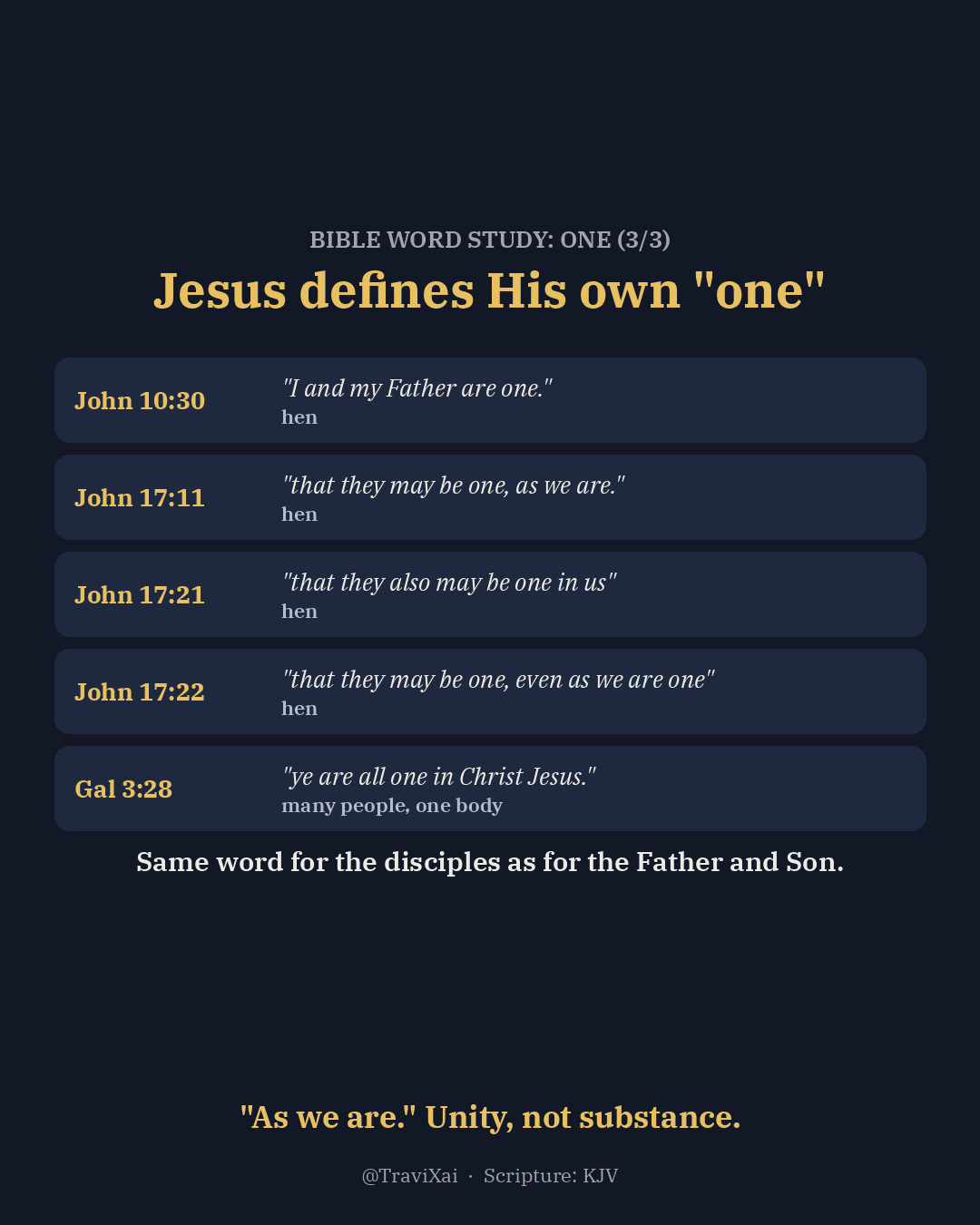
John 17:11:
“Holy Father, keep through thine own name those whom thou hast given me, that they may be one, as we are.”
John 17:21:
“That they all may be one; as thou, Father, art in me, and I in thee, that they also may be one in us: that the world may believe that thou hast sent me.”
John 17:22:
“And the glory which thou gavest me I have given them; that they may be one, even as we are one:”
Read those slowly. Jesus prays that His disciples will be one “as we are.” The same oneness He shares with the Father is the oneness He wants for them.
The disciples were never going to merge into a single substance. Peter and John stayed Peter and John. What they could have was unity: one heart, one purpose, one love, one will, all centered in God. That’s the oneness Jesus prays for, and He says it’s the same kind He has with His Father.
Paul uses the word the same way. Galatians 3:28:
“There is neither Jew nor Greek, there is neither bond nor free, there is neither male nor female: for ye are all one in Christ Jesus.”
Many people. One in Christ. Distinct persons in perfect unity.
How the Bible uses “one”
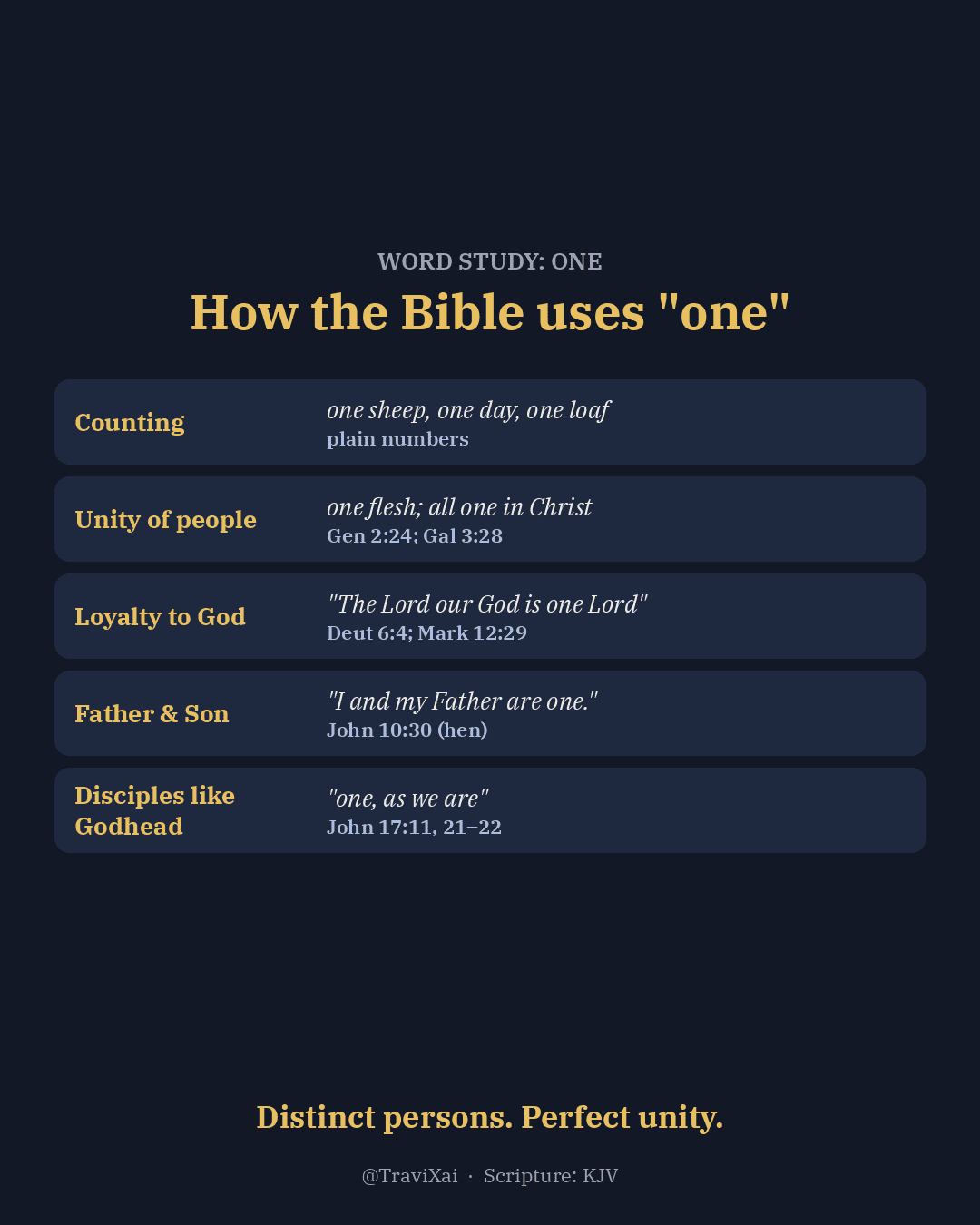
If you sort the uses, a clear pattern shows up:
| Category | Example | Reference |
|---|---|---|
| Simple counting | one day, one loaf | many places |
| Unity of people | “they shall be one flesh”; “all one in Christ” | Gen 2:24; Gal 3:28 |
| Loyalty to God | “The Lord our God is one Lord” | Deut 6:4; Mark 12:29 |
| Father and Son | “I and my Father are one.” | John 10:30 |
| Disciples like the Godhead | “one, as we are” | John 17:11, 21–22 |
What’s missing from that list is any verse where “one” is defined as “one substance in three persons.” That language exists, but it doesn’t come from the Bible.
Where “one substance” came from
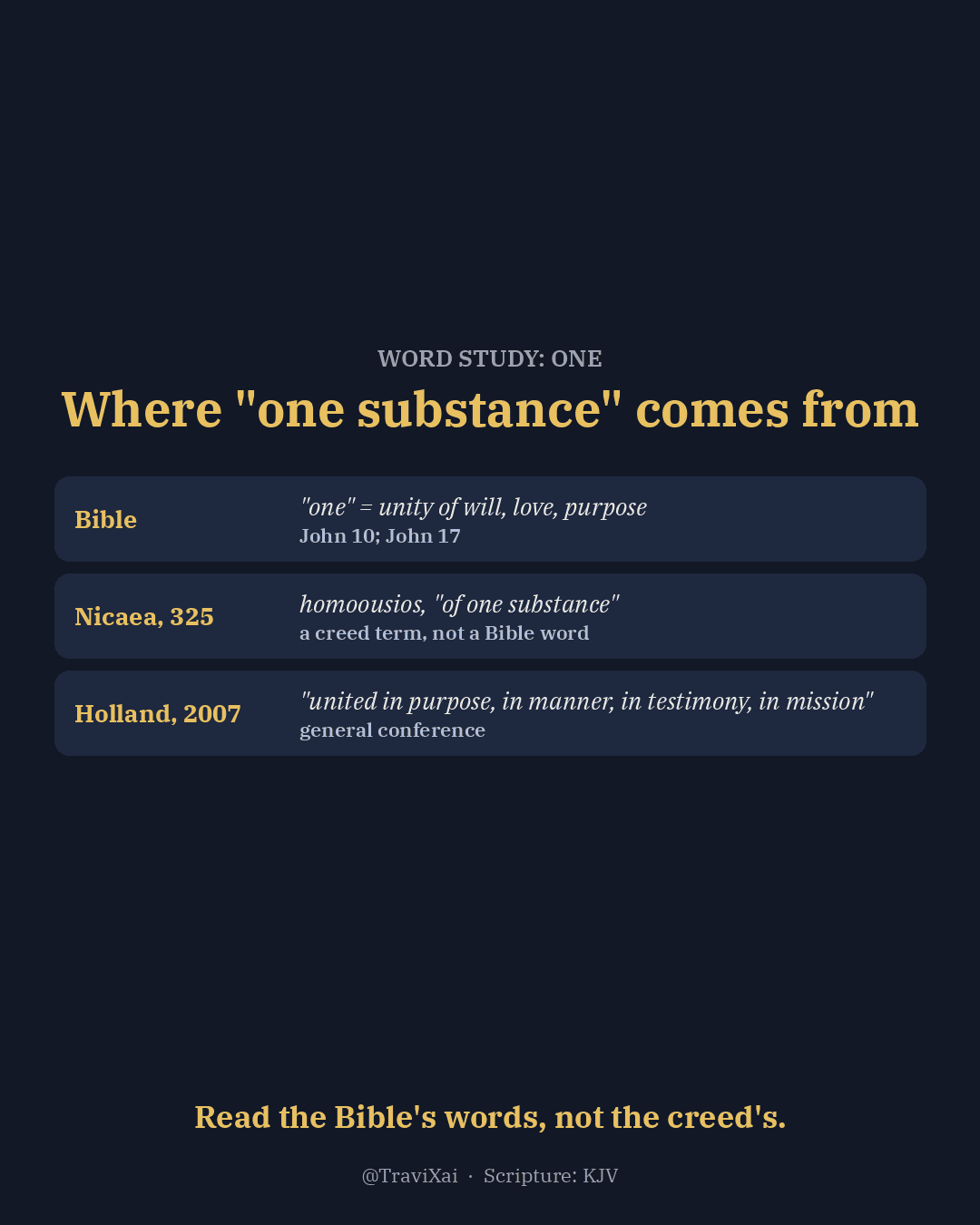
The phrase “of one substance” (Greek homoousios) comes from the Nicene Creed, written at the Council of Nicaea in AD 325, nearly three centuries after Jesus. The council used a philosophical term to answer the theological debates of its time. Many sincere Christians accept that creed, and we respect their faith. But homoousios is a creed word, not a Bible word. It never appears in the New Testament.
Elder Jeffrey R. Holland of the Quorum of the Twelve Apostles explained the Latter-day Saint view in his October 2007 general conference address, “The Only True God and Jesus Christ Whom He Hath Sent”:
“We believe these three divine persons constituting a single Godhead are united in purpose, in manner, in testimony, in mission.”
He went on to say that Latter-day Saints believe the Father and Son are one “in every significant and eternal aspect imaginable except believing Them to be three persons combined in one substance, a Trinitarian notion never set forth in the scriptures because it is not true.”
That’s a strong statement, and it shows the real line of disagreement. It isn’t about whether God is one. It’s about what kind of one.
What scholars on different sides say
Honest study means listening to people who disagree.
Richard Bauckham (Jesus and the God of Israel, Eerdmans, 2008), a leading non-LDS scholar, argues that the earliest Christians included Jesus within the identity of the one God of Israel. He reads texts like 1 Corinthians 8:6 as a Christian rewriting of the Shema with Jesus inside it. His work is a serious counterpoint to the Latter-day Saint reading, and it’s worth reading. Notice, though, that his argument is about Jesus sharing the divine identity, which Latter-day Saints also affirm in their own way. Jesus is Jehovah, the God of Israel, and fully divine.
D. A. Carson, as noted above, agrees on the grammar of hen while drawing traditional conclusions from it.
Stephen E. Robinson, a Latter-day Saint scholar, discussed these questions in Are Mormons Christians? (Bookcraft, 1991) and in his dialogue with evangelical scholar Craig Blomberg, How Wide the Divide? A Mormon and an Evangelical in Conversation (InterVarsity Press, 1997). That book is a model of charitable disagreement. The two scholars find more common ground than many expect, and they’re honest about where they still differ.
The strongest case for the Latter-day Saint view
Here’s the case, step by step.
- The Hebrew word allows unity. The Shema uses echad, the same word for husband and wife becoming “one flesh.” It doesn’t require a single undivided being.
- The Greek word says “not one person.” John 10:30 uses the neuter hen. Even scholars who reject our conclusions agree on that.
- Jesus defined His oneness by comparison. In John 17 He prayed for His disciples to be one “as we are.” Whatever unity the Father and Son share, Jesus believed His disciples could share it too. That fits unity of heart, will, and purpose. It doesn’t fit one substance.
- The Bible shows the Father and Son as distinct persons. At Jesus’ baptism, the Son is in the water, the Spirit descends like a dove, and the Father speaks from heaven (Matthew 3:16–17). In Gethsemane, the Son prays to the Father, “not my will, but thine” (Luke 22:42). Stephen sees the Son standing at the right hand of God (Acts 7:55–56). These are relationships between persons.
- “One substance” is a later word. It comes from a fourth-century creed, not from the apostles. Latter-day Saints simply decline to make a post-biblical term the test of who is Christian.
- The Latter-day Saint view is a high view of unity, not a low one. We don’t believe in three gods competing or acting separately. We believe in three divine persons so perfectly united that they are rightly called one God, the Godhead. As Elder Holland said, one in purpose, manner, testimony, and mission.
The bottom line
The Bible’s “one” is a rich word. It can count, and it can unite. When Jesus wanted to explain how He and His Father were one, He didn’t reach for philosophy. He prayed that His friends would be one “as we are.”
That’s an invitation, not just a doctrine. The oneness of the Godhead is the pattern for marriages, families, and the Church. God is one. And He wants us to become one with Him.
Check the assumptions first
When someone cites John 10:30 to prove the Father and the Son are one being, several assumptions come along with the verse. None of them comes from the verse itself:
- That “one” always means one being. The Bible uses the same word for a husband and wife who become “one flesh” (Genesis 2:24) and for disciples who are to be “one” (John 17:22). The meaning of “one” has to come from context, and Jesus supplies it.
- That John 10:30 must be read through the Nicene Creed. The creed’s “one substance” language was adopted in AD 325, almost three centuries after Jesus spoke. Reading it back into His words is an anachronism.
- That distinct persons means polytheism. Paul said “to us there is but one God, the Father” while acknowledging others called gods (1 Corinthians 8:6). Worship, not vocabulary, is the test. See “You’re Polytheists”.
- That oneness means equality in every respect. Jesus also said, “my Father is greater than I” (John 14:28). The Son is perfectly one with the Father in will and work, and He always honors His Father as greater.
- That the question was settled by the Bible alone. It wasn’t. Christians debated it for centuries and settled it by councils and votes. Latter-day Saints believe God settled it again by revelation, when the Father and the Son appeared to Joseph Smith together.
For how Latter-day Saints answer whether they are Christian at all, see Are Latter-day Saints Christian? and Do Latter-day Saints believe Jesus is God?.
What all four standard works say about “one”
All four standard works use “one” the same way Jesus did in John 17: perfect unity among distinct persons.
The Bible
That they all may be one; as thou, Father, art in me, and I in thee, that they also may be one in us.
John 17:21
The Book of Mormon
the Father, and the Son, and the Holy Ghost are one; and I am in the Father, and the Father in me, and the Father and I are one.
3 Nephi 11:27
The same risen Christ then prays to His Father for the Nephite disciples, “that I may be in them as thou, Father, art in me, that we may be one” (3 Nephi 19:23). The Son praying to the Father is two persons, perfectly one.
The Doctrine and Covenants
The Father has a body of flesh and bones as tangible as man’s; the Son also; but the Holy Ghost has not a body of flesh and bones, but is a personage of Spirit.
D&C 130:22
And the Lord applies the same oneness to His Church: “I say unto you, be one; and if ye are not one ye are not mine” (D&C 38:27).
The Pearl of Great Price
I saw two Personages, whose brightness and glory defy all description, standing above me in the air.
Joseph Smith—History 1:17
Two Personages, one of whom introduced the other as His Beloved Son. And Enoch’s city shows what “one” means for people: “the Lord called his people Zion, because they were of one heart and one mind” (Moses 7:18).
John 10:30 questions, answered
What does “I and my Father are one” mean?
Jesus and the Father are perfectly united in will, purpose, and work. In John 17:21–22 He asks that believers be one “as we are one,” and nobody thinks that makes the disciples a single being.
What is the Greek word for “one” in John 10:30?
Hen, the neuter form of heis. If John meant one person he would have used the masculine. Many Trinitarian scholars grant this and argue for one essence instead, which is a later philosophical category, not the text.
Does Deuteronomy 6:4 (the Shema) mean God is a single person?
The Shema uses echad, the same word for two becoming “one flesh” and for many tribes acting “as one man.” It declares Israel’s loyalty to one God; it doesn’t define His substance.
Do Latter-day Saints believe in one God?
Yes: one Godhead of three distinct persons, perfectly one in purpose, and we worship the Father in the name of the Son. See same divine nature isn’t consubstantial and Are Latter-day Saints Christian?.
What does 3 Nephi 11:27 mean when it says the Father and Son “are one”?
The same thing John 17 means. The risen Christ says “the Father and I are one,” then prays to the Father that He may be in His disciples “as thou, Father, art in me, that we may be one” (3 Nephi 19:23). That is unity between distinct persons.
Is the Father greater than the Son?
Jesus said, “my Father is greater than I” (John 14:28). The Son shares the Father’s divine nature and is one with Him in purpose, and He always honors and obeys His Father.
Do Latter-day Saints believe the Father and Son are separate beings?
Yes. Joseph Smith saw “two Personages” (Joseph Smith—History 1:17), and D&C 130:22 teaches that the Father and the Son each have a body of flesh and bones. They are one God in the sense Jesus prayed for in John 17.
Does “one” mean the same thing in John 10:30 and John 17:22?
The Greek is the same word, hen, in both verses. In John 17:22 Jesus prays that the disciples “may be one, even as we are one,” so His own oneness with the Father is the pattern for theirs.
Next time someone says Latter-day Saints don’t believe in one God, ask them which “one” the Bible means: the one of “one flesh,” or the one of “one, as we are.” For quick, sourced answers on the Godhead, open Galatians18. And for more word studies like this, follow me on X at @TraviXai.
Sources
- Strong’s H259 (echad), H3173 (yachid), G1520 (heis/hen). BibleHub.
- D. A. Carson, The Gospel According to John, Pillar New Testament Commentary (Grand Rapids: Eerdmans, 1991). Non-LDS.
- Richard Bauckham, Jesus and the God of Israel (Grand Rapids: Eerdmans, 2008). Non-LDS.
- Craig L. Blomberg and Stephen E. Robinson, How Wide the Divide? A Mormon and an Evangelical in Conversation (Downers Grove, IL: InterVarsity Press, 1997). Evangelical and LDS.
- Stephen E. Robinson, Are Mormons Christians? (Salt Lake City: Bookcraft, 1991). LDS.
- Jeffrey R. Holland, “The Only True God and Jesus Christ Whom He Hath Sent,” general conference, October 2007 (Ensign, November 2007). LDS.
- Scripture quotations: King James Version, churchofjesuschrist.org.
- Featured image, word cards, and charts: original graphics by thebookofmormon.ai (no photographs or likenesses of real people).