

Latter-day Saints treasure a blessing most Christians have never heard of, yet it comes straight out of Genesis.
A patriarchal blessing is a once-in-a-lifetime priesthood blessing that declares your lineage in the house of Israel and gives personal counsel from God. An ordained stake patriarch lays his hands on your head and speaks by inspiration, as Jacob did when he told his sons “that which shall befall you in the last days” (Genesis 49:1). It names the tribe through which you inherit the promises made to Abraham, and it is recorded so you can study it all your life.
The short answerA personal blessing from God, given once
A patriarchal blessing is a special priesthood blessing that a member of The Church of Jesus Christ of Latter-day Saints receives, usually once in a lifetime, from an ordained patriarch. The Church’s Gospel Topics entry explains: “A vital part of a patriarchal blessing is to declare a person’s lineage within the house of Israel. It also offers spiritual guidance, reassurance, and comfort throughout our life.”
The patriarch lays his hands on the person’s head and speaks as the Spirit directs. The blessing is recorded, transcribed, and a copy is given to the member and kept in Church records. Members are taught to treat it as sacred and personal, sharing it with close family but not publicly.
The pattern begins in GenesisJacob blesses his sons
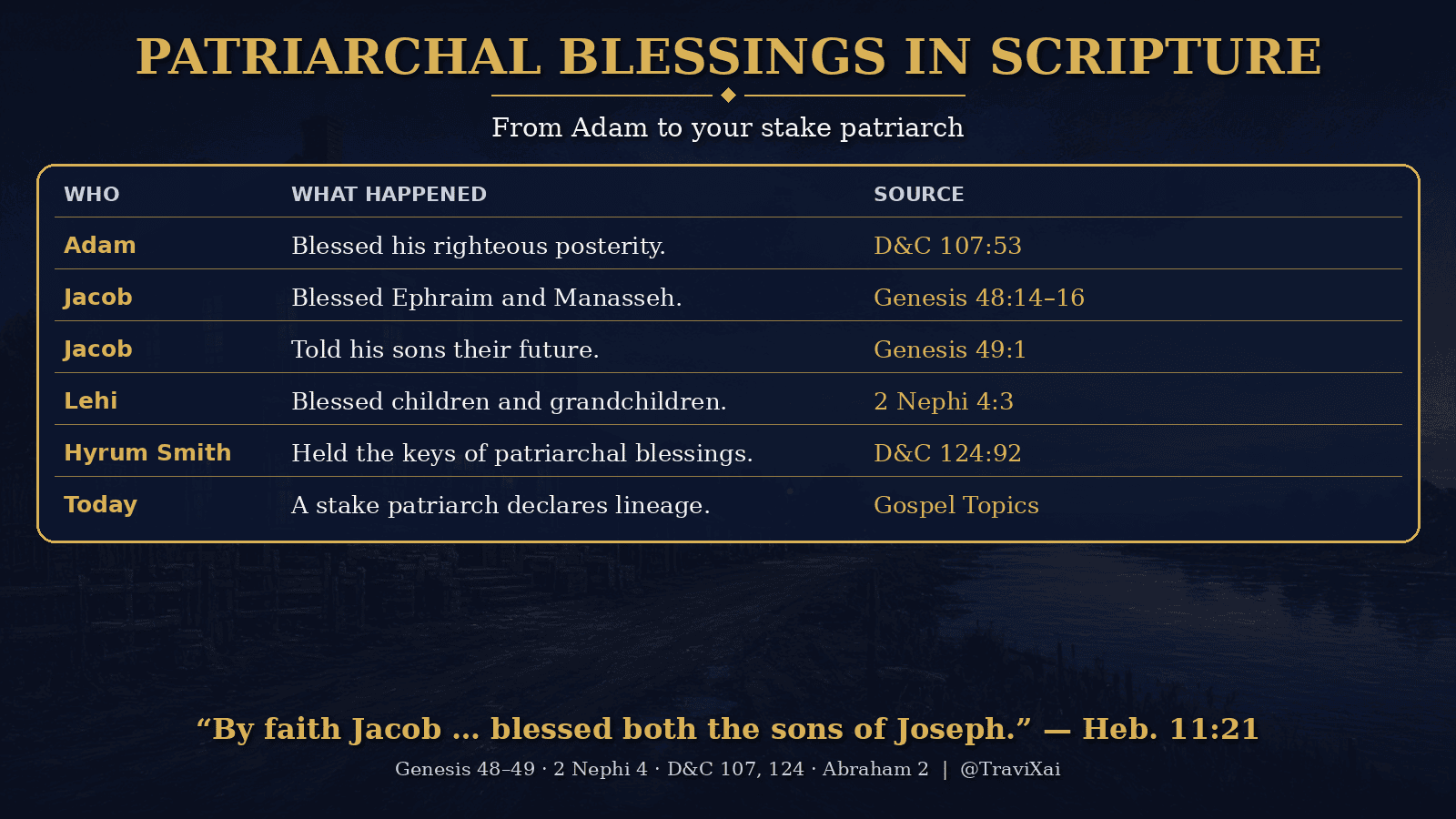
Patriarchal blessings are as old as the Bible. Before he died, Jacob (Israel) “called unto his sons, and said, Gather yourselves together, that I may tell you that which shall befall you in the last days” (Genesis 49:1), and then pronounced a specific blessing on each, including “Joseph is a fruitful bough, even a fruitful bough by a well; whose branches run over the wall” (Genesis 49:22).
He laid his right hand on Ephraim and his left on Manasseh and said, “let my name be named on them, and the name of my fathers Abraham and Isaac” (Genesis 48:14–16). Hebrews counts it as an act of faith: “By faith Isaac blessed Jacob and Esau concerning things to come. By faith Jacob, when he was a dying, blessed both the sons of Joseph” (Hebrews 11:20–21).
Lehi did the same2 Nephi 1–4
In the Book of Mormon, Lehi, a descendant of “that Joseph who was the son of Jacob” (1 Nephi 5:14), gathered his family before his death and blessed each son and even his grandchildren: “Behold, my sons, and my daughters, who are the sons and the daughters of my firstborn, I would that ye should give ear unto my words” (2 Nephi 4:3). He taught them about Joseph of Egypt’s prophecy of a “righteous branch unto the house of Israel” (2 Nephi 3:5). Restoration scripture even records Adam gathering his righteous posterity “and there bestowed upon them his last blessing” (D&C 107:53).
The office restored“The keys of the patriarchal blessings”
The Lord directed the Twelve “to ordain evangelical ministers” in the branches of the Church (D&C 107:39). Joseph Smith’s brother Hyrum was called to “take the office of Priesthood and Patriarch,” so that “he shall hold the keys of the patriarchal blessings upon the heads of all my people” (D&C 124:91–92). Today each stake has a patriarch, an ordained Melchizedek Priesthood holder set apart to give these blessings.
Why lineage mattersHeirs of Abraham
The declaration of lineage names the tribe of Israel (often Ephraim, Manasseh or Judah) through which a person receives the blessings God promised Abraham. The Gospel Topics entry notes that those who aren’t literal descendants “are adopted into the house of Israel,” and that “all Church members are considered descendants of Abraham and heirs to all the promises and blessings of the Abrahamic covenant.” Paul taught the same: “if ye be Christ’s, then are ye Abraham’s seed, and heirs according to the promise” (Galatians 3:29).
God told Abraham, “as many as receive this Gospel shall be called after thy name, and shall be accounted thy seed, and shall rise up and bless thee, as their father,” and that through his seed “all the families of the earth” would be blessed “with the blessings of the Gospel, which are the blessings of salvation, even of life eternal” (Abraham 2:9–11). A patriarchal blessing places you inside that covenant by name, as an heir of the promises that lead to exaltation: “all that my Father hath” (D&C 84:38).
How to receive one, and how to read itAsk your bishop
Members who want a blessing meet with their bishop or branch president for a recommend, then schedule a time with the stake patriarch. Many receive theirs as teenagers, but adults are encouraged too. The Church teaches that the blessing “will not answer all our questions or list all that will happen in our life,” and that promises not fulfilled in this life “will be fulfilled in the next life” if we are faithful. Read it often, and follow its counsel. See What Is the Priesthood?.
Check the premiseThe presuppositions baked into the question
Before this question can be answered fairly, the person asking has to justify a few assumptions packed inside it:
- That a patriarchal blessing is fortune-telling. It is personal counsel from God through priesthood authority, conditioned on faithfulness, like Jacob’s blessings in Genesis 49.
- That lineage means genetic ancestry. Gospel Topics: those who accept the gospel “are adopted into the house of Israel” (compare Galatians 3:29).
- That every promise must happen in this life. Gospel Topics: blessings not fulfilled in this life “will be fulfilled in the next life.”
- That this practice has no biblical basis. Isaac, Jacob and Lehi all gave such blessings (Hebrews 11:20–21; 2 Nephi 4:3).
FAQQuick answers
What is a patriarchal blessing?
A priesthood blessing from an ordained patriarch that declares a person’s lineage in the house of Israel and gives personal guidance from God.
What does a patriarchal blessing tell you?
Your tribe in the house of Israel, plus counsel, promises and sometimes warnings for your life.
Who can get a patriarchal blessing?
Worthy members of the Church, usually after meeting with their bishop for a recommend.
Can I share my patriarchal blessing?
It is sacred and personal; it may be shared with immediate family but not compared or shared publicly.
What tribes are most common?
Lineage may be through any tribe; Gospel Topics names Ephraim, Manasseh and Judah as examples.
What did Jacob do for his sons in Genesis 49?
He blessed each one: “All these are the twelve tribes of Israel: and this is it that their father spake unto them, and blessed them” (Genesis 49:28).
Who gives patriarchal blessings?
A patriarch, an ordained office in the Melchizedek Priesthood, usually one in each stake. The first in this dispensation was Joseph Smith Sr., ordained in December 1833.
Are the promises in a patriarchal blessing guaranteed?
They depend on faithfulness: “when we obtain any blessing from God, it is by obedience to that law upon which it is predicated” (D&C 130:21).
SummaryKey takeaways
- A patriarch gives the blessing by the laying on of hands.
- It declares your lineage in Israel and offers personal counsel.
- The pattern comes from Jacob (Genesis 48–49) and Lehi (2 Nephi 4).
- All members are heirs of Abraham’s covenant (Galatians 3:29).
If you’re a member and haven’t received yours, talk to your bishop. For quick, sourced answers, open Galatians18, and follow me on X at @TraviXai.
Sources
- King James Bible (churchofjesuschrist.org): Genesis 48:14–16 · Genesis 49:1 · Genesis 49:22 · Galatians 3:29 · Hebrews 11:20–21
- Book of Mormon: 1 Nephi 5:14 · 2 Nephi 3:5 · 2 Nephi 4:3
- Doctrine and Covenants: D&C 84:38 · D&C 107:39 · D&C 107:53 · D&C 124:91–92
- Pearl of Great Price: Abraham 2:9–11
- Gospel Topics, “Patriarchal Blessings”
- Featured image and in-article graphic: original graphics by thebookofmormon.ai (painterly backgrounds; no photographs or likenesses of real people).