
It’s the darkest chapter in Latter-day Saint history. Here it is told straight, from the Church’s own published record, with no excuses.
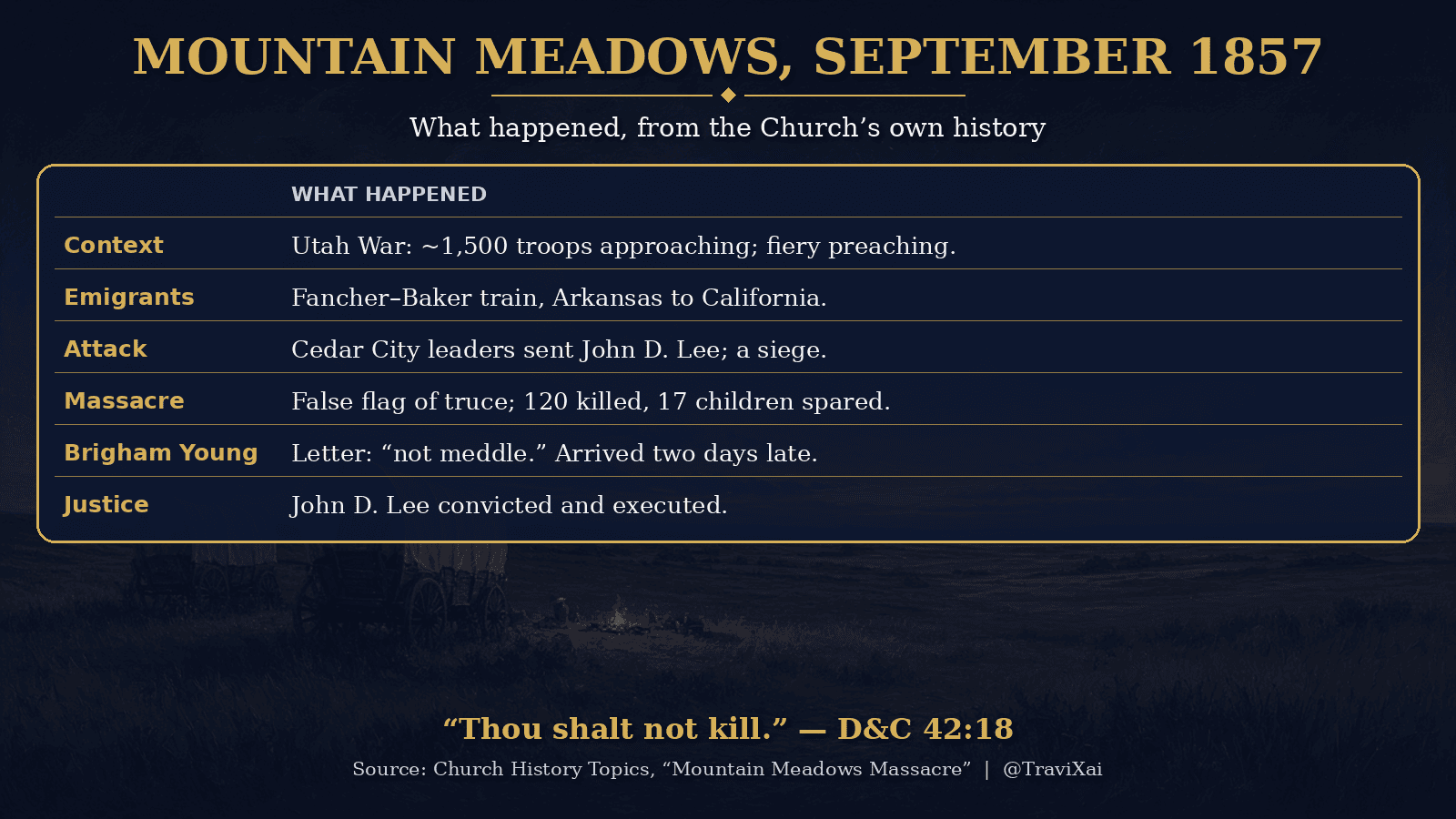
The Mountain Meadows Massacre was the killing of 120 emigrants by Latter-day Saint militiamen in southern Utah in September 1857. During the Utah War, local Church and militia leaders in Cedar City attacked an Arkansas wagon train, then lured the survivors out under a false flag of truce and killed all but 17 small children. Brigham Young’s letter telling them to “not meddle” with the emigrants arrived two days too late. The Church calls it “perhaps the most tragic episode in the history of the Church” and “a terrible and inexcusable departure from Christian teaching.”
The short answerA terrible crime committed by Latter-day Saints
The Church’s own history states it without softening: “In September 1857, a branch of territorial militia in southern Utah composed entirely of Latter-day Saints, along with some American Indians they recruited, laid siege to a wagon train of emigrants traveling from Arkansas to California. The militiamen carried out a deliberate massacre, killing 120 men, women, and children in a valley known as Mountain Meadows. Only 17 small children … were spared. This event is perhaps the most tragic episode in the history of the Church” (Church History Topics, “Mountain Meadows Massacre”).
There is no defending it, and the Church doesn’t try. In 2007, President Henry B. Eyring said: “What was done here long ago by members of our Church represents a terrible and inexcusable departure from Christian teaching and conduct.”
How it happenedWar fear, fiery rhetoric and local leaders
In 1857 President James Buchanan sent an army to Utah to replace Brigham Young as governor, in what became known as the Utah War. Latter-day Saints, driven from Missouri and Illinois at gunpoint only years earlier, feared it would happen again. Apostle Parley P. Pratt had just been murdered in Arkansas. A period of “reformation” preaching, with what the Church’s history calls “fiery rhetoric” against dissenters and opponents, added to “an environment of fear and suspicion.”
The Fancher–Baker wagon train from Arkansas passed through during that tension. There were verbal clashes over grazing and supplies, and some emigrants threatened to join the incoming troops. In Cedar City, stake president and militia leader Isaac C. Haight sent militia major John D. Lee to attack. When Haight reported the plan, other local leaders objected and insisted on sending an express rider to Brigham Young for instructions, but the attack had already begun. After a siege of several days, militiamen lured the emigrants out under a false flag of truce and, with Paiutes they had recruited, killed them. Afterward they tried to blame the Paiutes.
Did Brigham Young order it?What the record shows
No. The express rider returned two days after the massacre carrying Brigham Young’s letter, which told local leaders to “not meddle” with the emigrants and to let them pass through southern Utah in peace. A major study by historians Ronald W. Walker, Richard E. Turley Jr. and Glen M. Leonard, published by Oxford University Press in 2008 after every Church record was opened to scrutiny, concluded that Young did not order the massacre.
That same study did not let leaders off the hook. As the Church’s history summarizes it, the authors concluded that “intemperate preaching about outsiders by Brigham Young, George A. Smith, and other leaders contributed to a climate of hostility,” and that “a series of tragic decisions by local Church leaders—who also held key civic and militia leadership roles in southern Utah—led to the massacre.” Telling the truth includes that.
What the scriptures say about itMurder, cover-up and the gospel of peace
Every standard work condemns what those men did. “Thou shalt not kill” (Exodus 20:13). To the Church in 1831 the Lord repeated: “Thou shalt not kill; and he that kills shall not have forgiveness in this world, nor in the world to come” (D&C 42:18). Jesus taught, “Love your enemies, bless them that curse you” (Matthew 5:44; 3 Nephi 12:44), and “all they that take the sword shall perish with the sword” (Matthew 26:52).
The Book of Mormon’s heroes of peace are the Anti-Nephi-Lehies, who buried their weapons, “covenanting with God, that rather than shed the blood of their brethren they would give up their own lives” (Alma 24:18). Its gravest warnings are against secret combinations that murder and then hide it, from Cain, who said, “I may murder and get gain” (Moses 5:31), to Ether’s warning that the Lord will not let “the blood of his saints” cry from the ground unanswered (Ether 8:22). The men at Mountain Meadows broke their own scriptures. The Lord commanded His people to “renounce war and proclaim peace” (D&C 98:16).
Accountability and reconciliationExcommunication, a trial and a memorial
Two participants were excommunicated, a grand jury that included Latter-day Saints indicted nine men, and John D. Lee was convicted and executed. In the early 2000s the Church opened its archives to historians. In 1990, descendants of the emigrants, the Paiute Nation, local Saints and Church leaders dedicated a memorial together, and BYU president Rex E. Lee, a descendant of John D. Lee, thanked the victims’ descendants “for your Christian-like willingness to forgive.” The Lord asks the same of all of us: “of you it is required to forgive all men” (D&C 64:10).
Does it disprove the Church?The gospel is judged by Christ, not by its worst members
A crime committed by members, against the explicit teachings of their own scriptures and the written instructions of their prophet, condemns those men. It doesn’t refute the Book of Mormon or the Restoration, any more than the Crusades refute the Bible or Peter’s denial refutes Christ. The fair question about any church is whether it tells the truth about its history and repents. On Mountain Meadows, the Church has published the record, named the guilty and called it inexcusable. See Is the LDS Church True? and Your Church Changes? The Double Standard.
Check the premiseThe presuppositions baked into the question
Before this question can be answered fairly, the person asking has to justify a few assumptions packed inside it:
- That Brigham Young ordered the massacre. His letter told local leaders to “not meddle” with the emigrants; it arrived two days too late. Historians concluded he did not order it, though his rhetoric contributed to the hostility.
- That the Church hides this history. It opened every record to historians and publishes the story in its own Church History Topics.
- That Latter-day Saint teaching justified it. “Thou shalt not kill … he that kills shall not have forgiveness” (D&C 42:18).
- That members’ sins disprove the gospel. By that standard, Peter’s denial would disprove Christ. Scripture condemns these men by its own words.
FAQQuick answers
What was the Mountain Meadows Massacre?
In September 1857, Latter-day Saint militiamen in southern Utah, with Paiutes they recruited, killed 120 emigrants from Arkansas; 17 small children were spared.
Did Brigham Young order the Mountain Meadows Massacre?
No. His letter told local leaders to “not meddle” with the emigrants; it arrived two days after the massacre. Historians found his and others’ rhetoric contributed to the climate of hostility.
Who was responsible?
Local Church and militia leaders in southern Utah, including Isaac C. Haight and John D. Lee, who was convicted and executed.
What does the Church say about it today?
It calls it “perhaps the most tragic episode in the history of the Church” and “a terrible and inexcusable departure from Christian teaching and conduct.”
Why did it happen?
Fear of an approaching federal army in the Utah War, fiery rhetoric, clashes with the emigrants and a series of tragic decisions by local leaders.
Has the Church expressed regret for the massacre?
Yes. At the 150th anniversary in 2007, Elder Henry B. Eyring expressed the Church’s “profound regret” for the massacre and the suffering of the victims and their families.
What happened to John D. Lee?
He was excommunicated in 1870, convicted for his role in the massacre, and executed at Mountain Meadows on March 23, 1877.
Where can I read the full history?
Massacre at Mountain Meadows (Oxford University Press, 2008) by Ronald W. Walker, Richard E. Turley Jr. and Glen M. Leonard, written with full access to Church archives.
SummaryKey takeaways
- 120 emigrants were killed by Latter-day Saint militiamen in September 1857.
- Brigham Young’s letter said “not meddle”; it arrived two days too late.
- Historians found leaders’ rhetoric contributed; local leaders made the decisions.
- The Church calls it inexcusable and has opened its records.
Read the Church’s own account at Church History Topics. For quick, sourced answers, open Galatians18, and follow me on X at @TraviXai.
Sources
- King James Bible (churchofjesuschrist.org): Exodus 20:13 · Matthew 5:44 · Matthew 26:52
- Book of Mormon: Alma 24:18 · 3 Nephi 12:44 · Ether 8:22
- Doctrine and Covenants: D&C 42:18 · D&C 64:10 · D&C 98:16
- Pearl of Great Price: Moses 5:31
- Church History Topics, “Mountain Meadows Massacre” (includes the Henry B. Eyring 2007 statement and the 1990 memorial)
- Ronald W. Walker, Richard E. Turley Jr. and Glen M. Leonard, Massacre at Mountain Meadows (Oxford University Press, 2008)
- Featured image and in-article graphic: original graphics by thebookofmormon.ai (painterly backgrounds; no photographs or likenesses of real people).