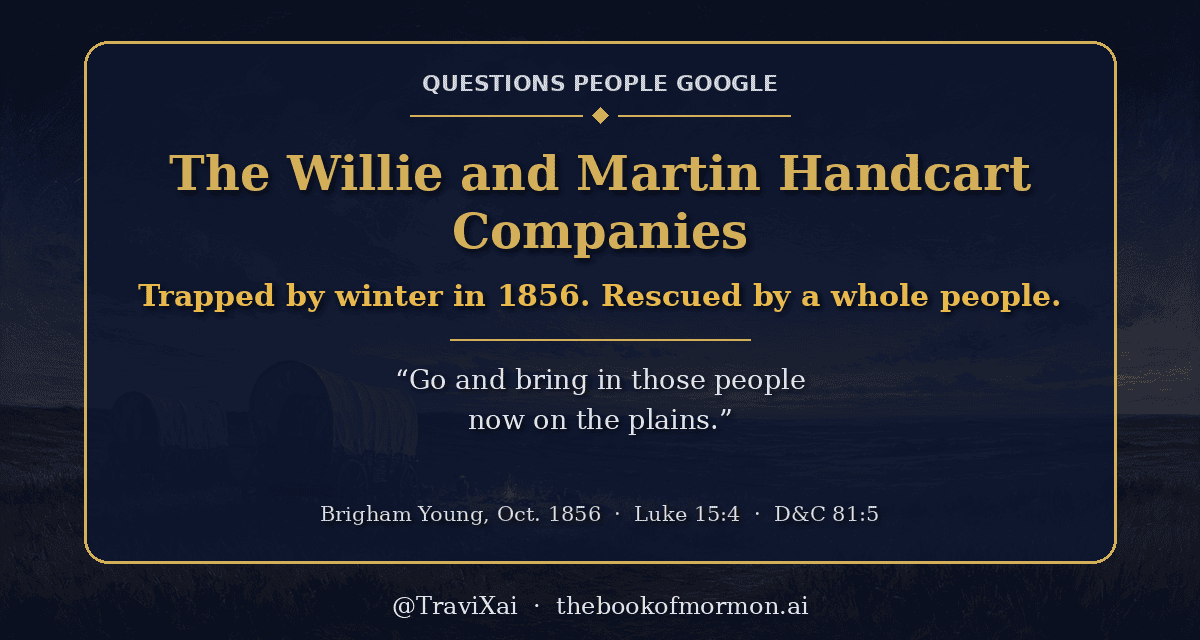

Two companies of poor converts started too late, and winter caught them in Wyoming. About 250 died. What happened next, a whole people turning out to rescue them, is the part critics leave out.
The question often assumes handcarts were a deadly scheme and Church leaders left people to die. Both are wrong. In 1856 the Willie and Martin handcart companies, mostly European converts, started far too late and were trapped by early winter storms in present-day Wyoming, along with two wagon companies. Of close to 1,500 people stranded, about 250 died. When Brigham Young learned of it in October, he turned general conference into a rescue: “Go and bring in those people now on the plains.” Over 300 rescuers went out and over 1,200 were saved. The other handcart companies had death rates no worse than wagon companies.
What happenedHandcarts, and the two companies caught by winter
By the mid-1850s thousands of converts, many of them poor British and Scandinavian Saints, wanted to gather to Utah. Wagons and oxen were expensive, so Brigham Young had leaders organize handcart companies: emigrants pulled their belongings in two-wheeled wooden carts, using loans from the Perpetual Emigrating Fund. From 1856 to 1860, 10 of the more than 350 Latter-day Saint emigrating companies traveled by handcart, about 3,000 people in all, and most made it without major incident.
Two did not. The companies led by James G. Willie and Edward Martin, mostly European converts, started from Iowa City in July 1856, far too late in the season, and had to wait for carts to be built, some from green wood that cracked in the dry plains air. At Florence, Nebraska, in August, the companies debated whether to winter there. Levi Savage, one of the few men who had crossed the plains, warned them that a mixed company of old people, women and children could not cross the mountains that late without suffering and death. He was voted down. According to John Chislett’s account, Savage answered: “what I have said I know to be true; but, seeing you are to go forward, I will go with you, will help you all I can, will work with you, will rest with you, will suffer with you, and, if necessary, I will die with you.”
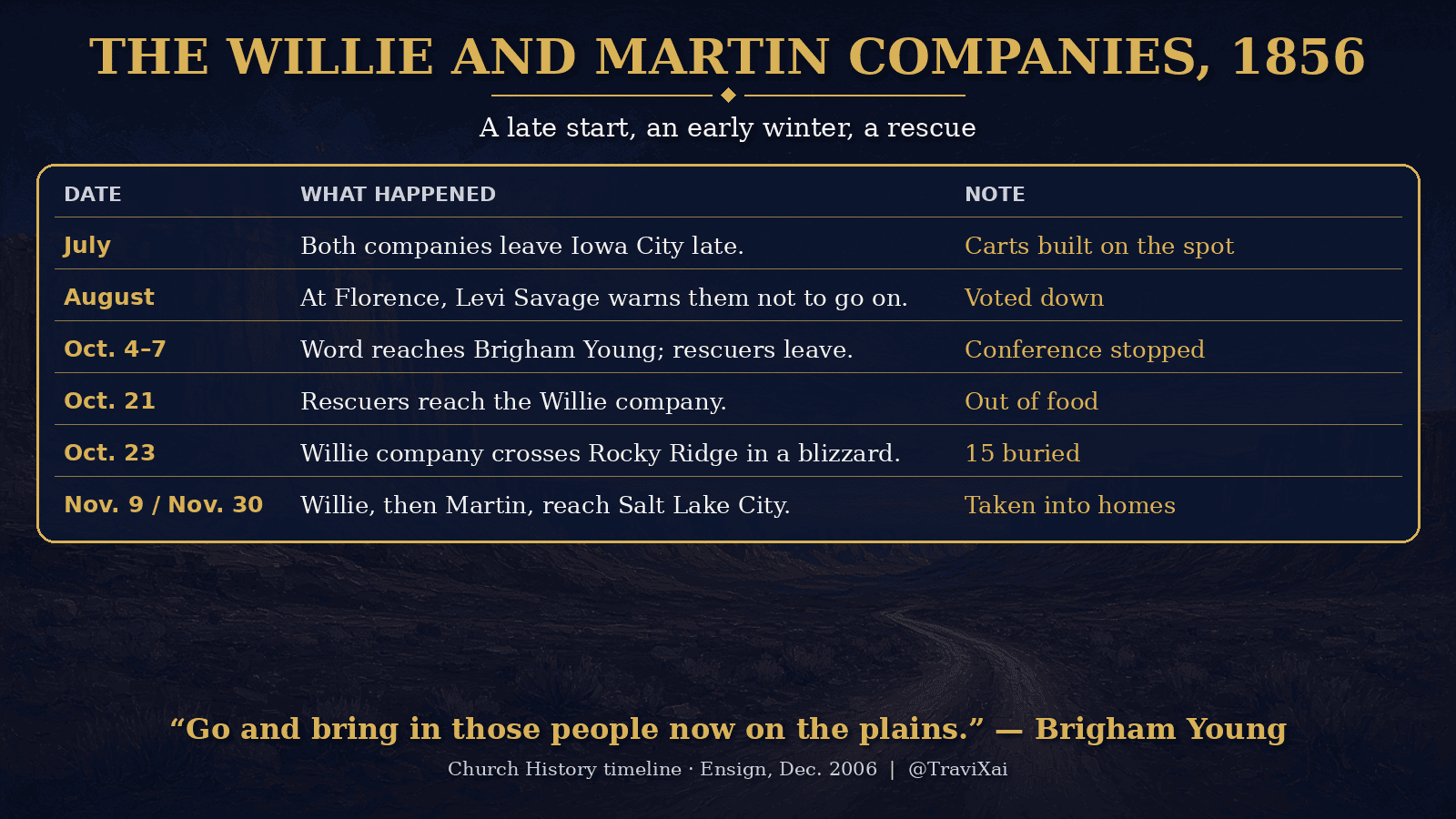
Early winter storms caught them in present-day Wyoming in October, along with the Hunt and Hodgetts wagon companies behind them. Close to 1,500 people were stranded on the trail. Rations were cut again and again. The Willie company crossed Rocky Ridge in a blizzard on October 23 and buried 15 people at Rock Creek Hollow. The Martin company, after a freezing crossing of the Platte, took shelter from November 4 to 9 in what is now called Martin’s Cove. In the words of the Church’s history, “approximately 250 of whom died after suffering exposure, frostbite, and starvation.”
The rescue“Go and bring in those people”
On October 4, 1856, Franklin D. Richards and returning missionaries reached Salt Lake City and told Brigham Young that the last companies were still far out on the trail. The next morning, at the Sunday meeting before general conference, Brigham Young set aside the planned sermons: “The text will be, ‘to get them here.’ I want the brethren who may speak to understand that their text is the people on the plains, and the subject matter for this community is to send for them and bring them in before the winter sets in.” He called for mule teams, wagons, flour and teamsters that same day, and then said: “I will tell you all, that your faith, religion, and profession of religion, will never save one soul of you in the celestial kingdom of our God, unless you carry out just such principles as I am now teaching you. Go and bring in those people now on the plains.”
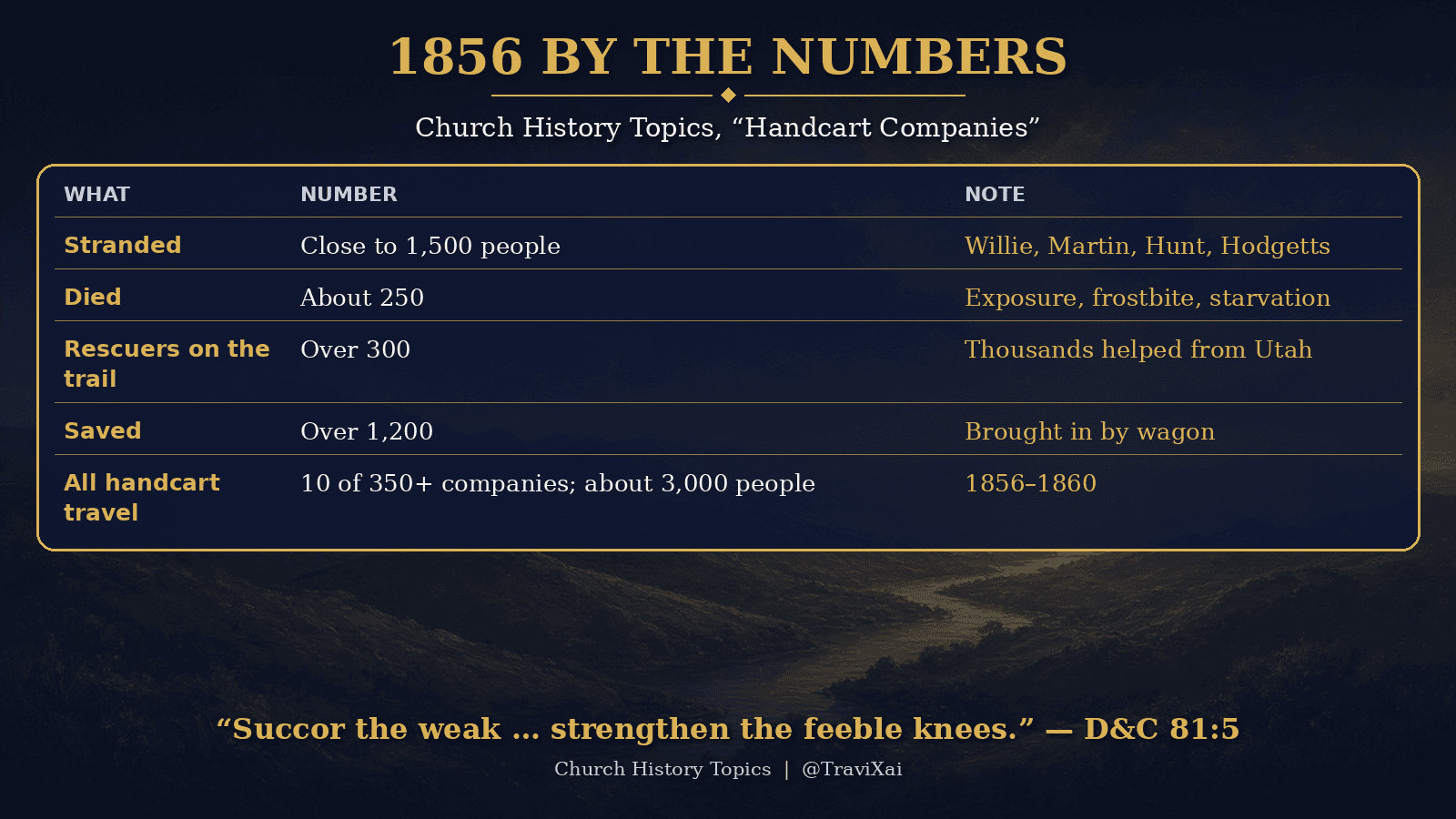
Within two days the first rescue wagons were rolling east. Rescuers reached the starving Willie company on October 21 and the Martin company soon after. Thousands in Utah gave food, clothing and bedding; over 300 men went out on the trail in the snow. The Willie company reached Salt Lake City on November 9 and the Martin company on November 30. While the Martin company was still on the way, Brigham Young told the Saints in the Tabernacle to go home and prepare to help: “Prayer is good, but when baked potatoes and pudding and milk are needed, prayer will not supply their place.” Bishops took every survivor into homes. Over 1,200 lives were saved.
Who was at fault?Honest about the mistakes
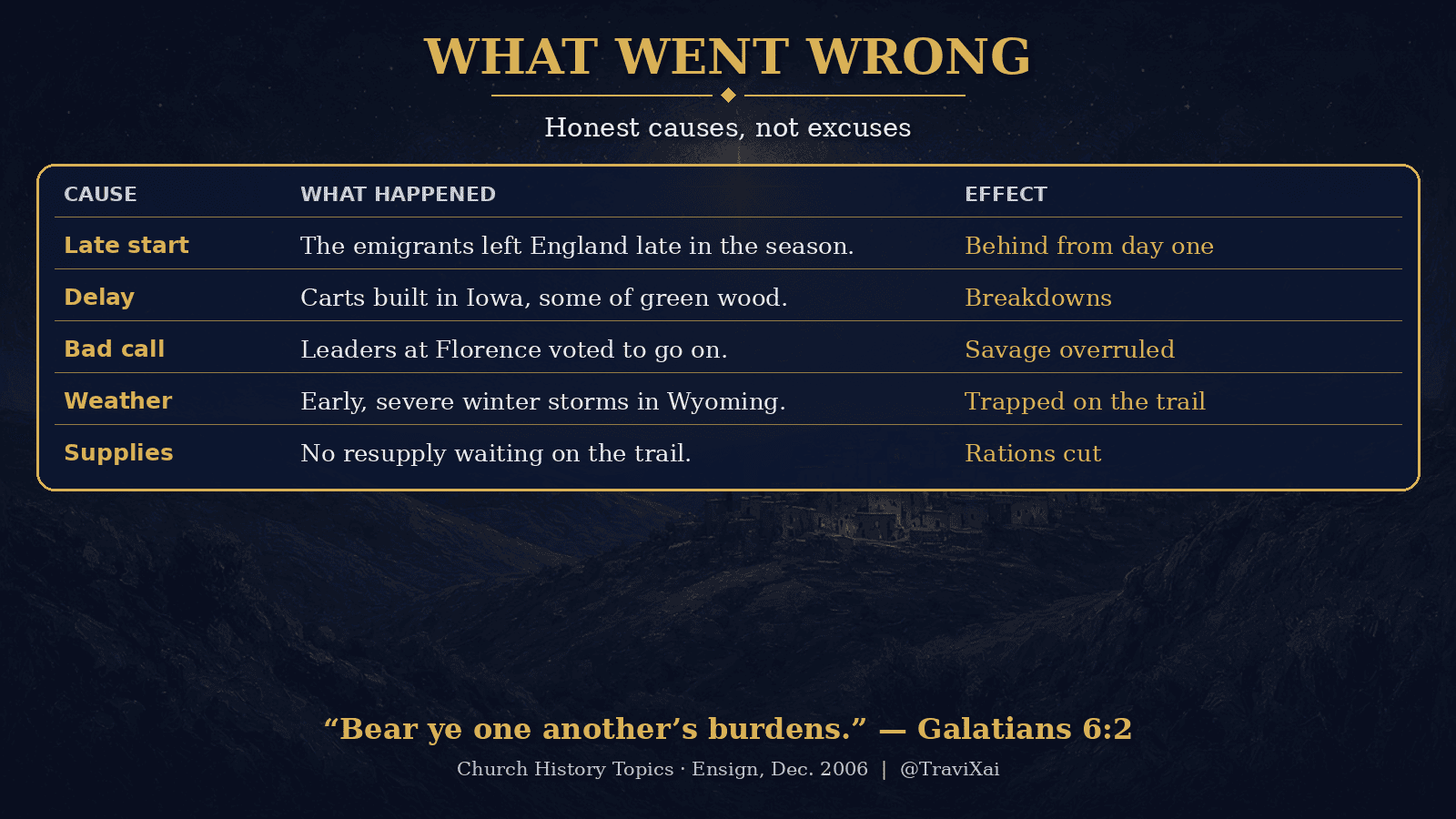
This is not a story where everyone did everything right, and I won’t tell it that way. The emigrants left England late. Agents let them start from Iowa and then from Florence far too late in the year. The majority overruled Levi Savage’s warning. Resupply was not waiting on the trail. Brigham Young himself publicly criticized the decision to start them so late. Those were human errors, and people died because of them.
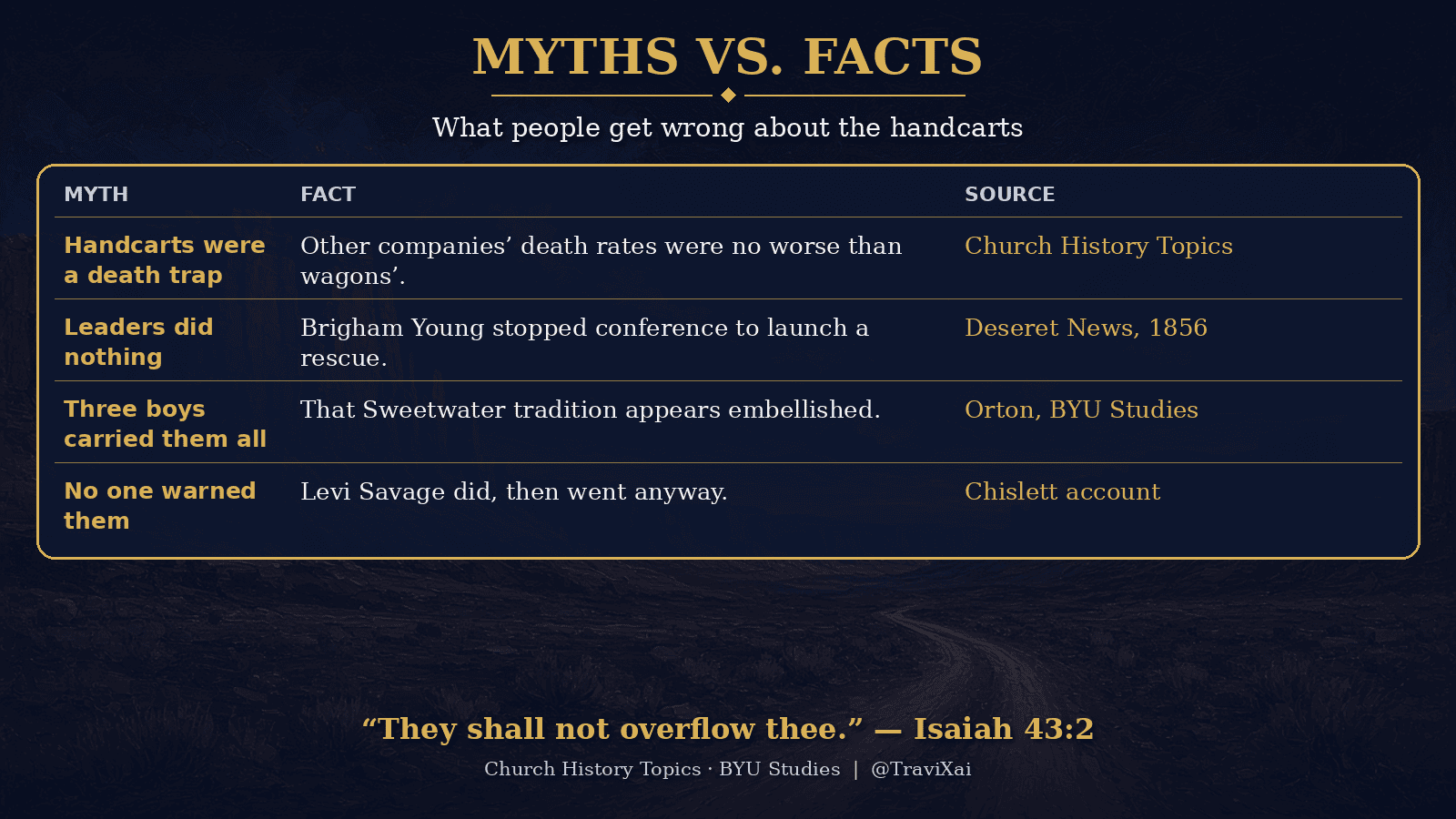
But notice what the critics usually leave out. The handcart system was not a death trap: the Church’s history notes that the fatality rate of the other handcart companies “did not exceed that of wagon companies.” And when the danger became known, the Church did not shrug. It stopped general conference and sent its young men into a Wyoming winter. Some of the rescue stories were later embellished; the Church’s own historians say the famous story of three young men carrying an entire company across the Sweetwater and dying from it “appears to have been embellished.” The true story does not need the help. See Who Was Brigham Young?.
The BibleLeave the ninety and nine
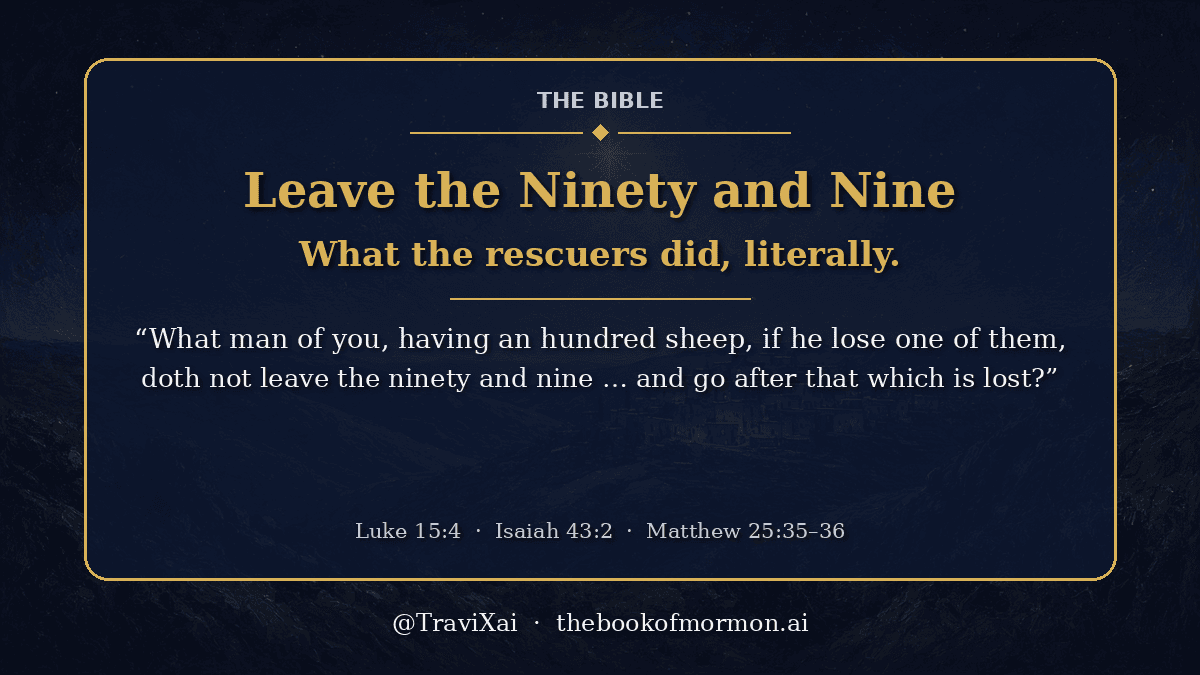
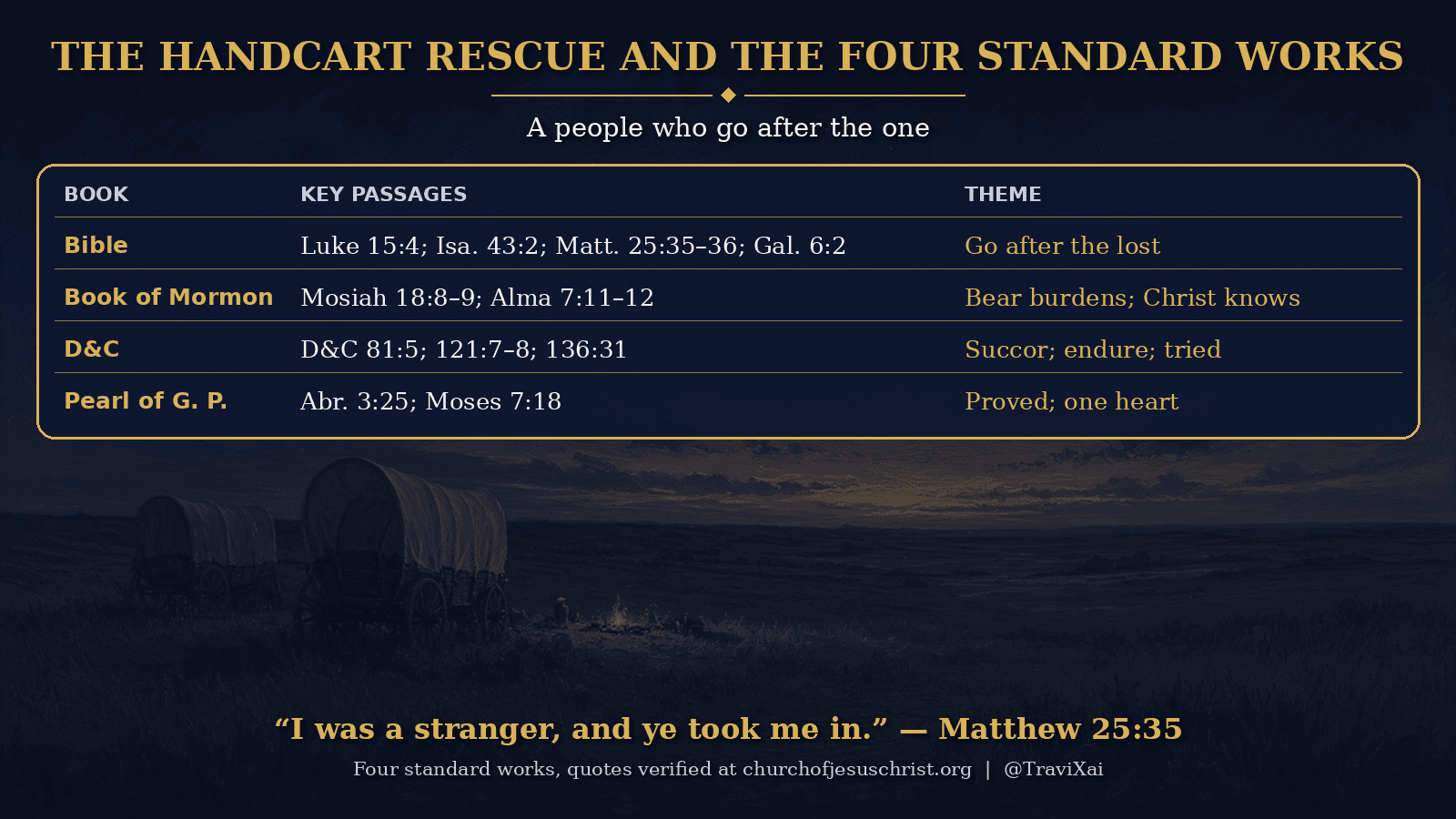
The rescue was the parable of the lost sheep played out in snow: “What man of you, having an hundred sheep, if he lose one of them, doth not leave the ninety and nine in the wilderness, and go after that which is lost, until he find it?” (Luke 15:4). The survivors crossed freezing rivers and clung to Isaiah: “When thou passest through the waters, I will be with thee; and through the rivers, they shall not overflow thee” (Isaiah 43:2).
And the Saints in the valley who opened their homes were doing what Jesus said the sheep on His right hand do: “For I was an hungred, and ye gave me meat: I was thirsty, and ye gave me drink: I was a stranger, and ye took me in: Naked, and ye clothed me: I was sick, and ye visited me” (Matthew 25:35–36). Paul’s summary: “Bear ye one another’s burdens, and so fulfil the law of Christ” (Galatians 6:2).
The Book of MormonThe covenant to bear burdens
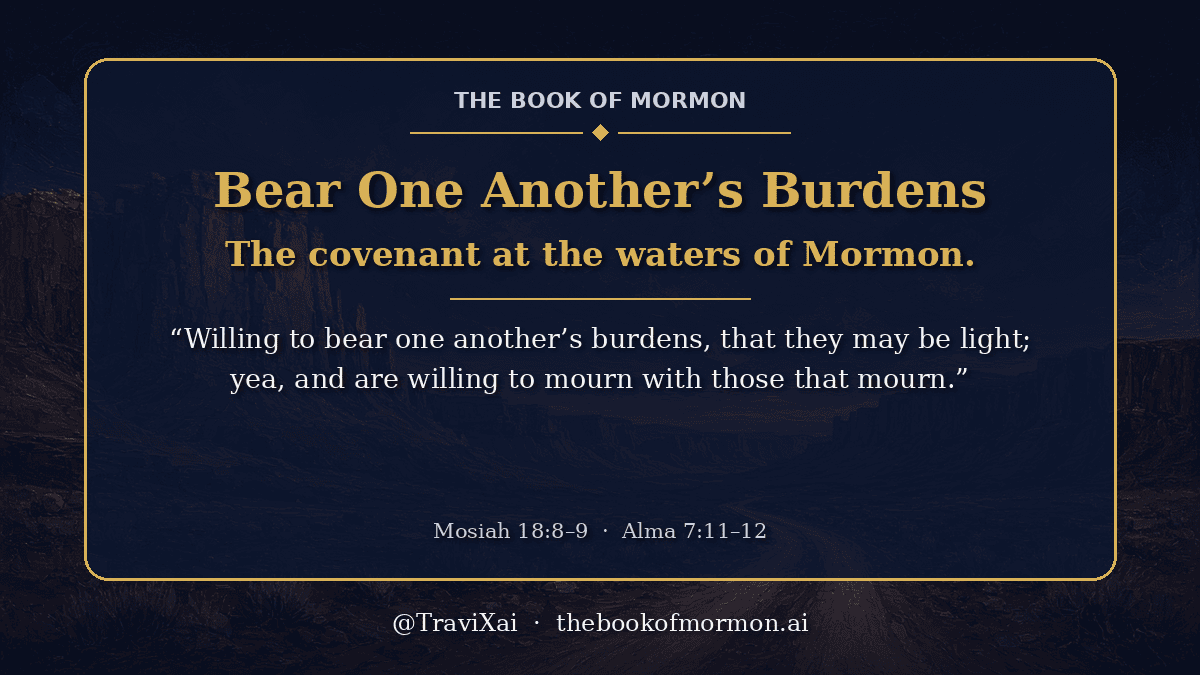
Every one of those rescuers had made the covenant Alma described at the waters of Mormon: to “bear one another’s burdens, that they may be light; Yea, and are willing to mourn with those that mourn; yea, and comfort those that stand in need of comfort, and to stand as witnesses of God at all times and in all things” (Mosiah 18:8–9). In 1856 that covenant meant a wagon, a team and a winter on the Sweetwater.
And for the people who lost children in the snow, Alma’s testimony of Christ is the answer: “he will take upon him their infirmities, that his bowels may be filled with mercy, according to the flesh, that he may know according to the flesh how to succor his people according to their infirmities” (Alma 7:11–12). There is no frozen night on Rocky Ridge that He does not understand.
The Doctrine and CovenantsSuccor the weak
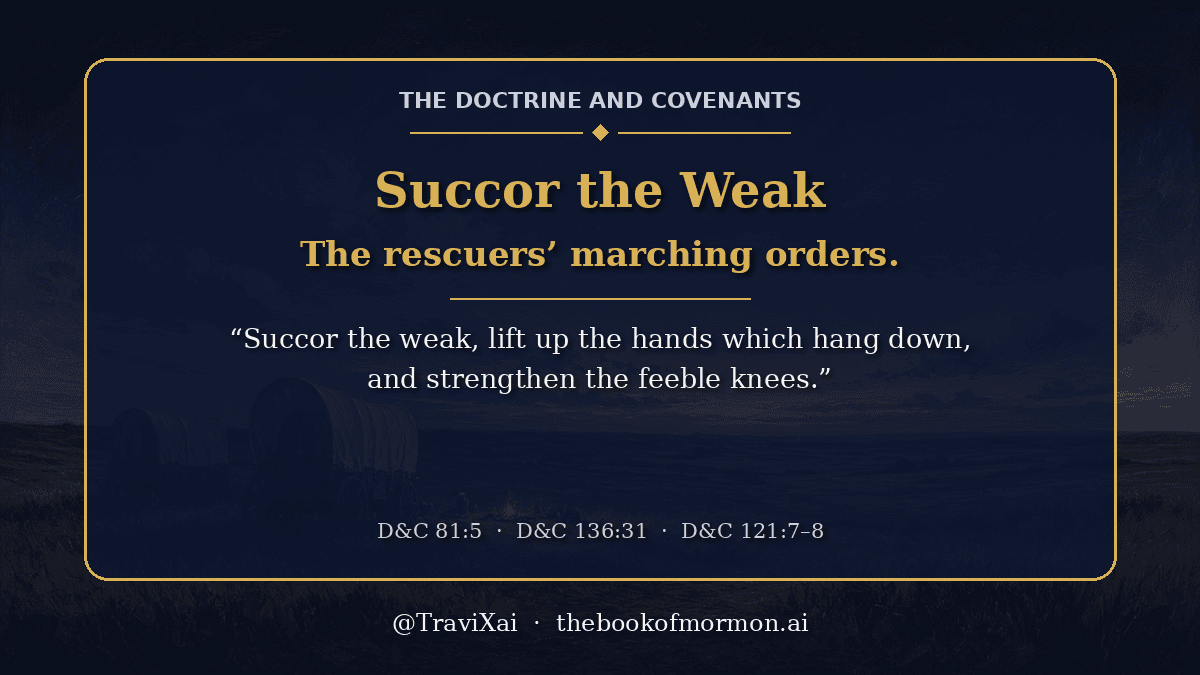
The Lord’s instruction is short enough to fit on a wagon box: “succor the weak, lift up the hands which hang down, and strengthen the feeble knees” (D&C 81:5). The pioneers had also been told what the trail would cost: “My people must be tried in all things, that they may be prepared to receive the glory that I have for them, even the glory of Zion” (D&C 136:31). And to Joseph in a worse winter: “thine adversity and thine afflictions shall be but a small moment; And then, if thou endure it well, God shall exalt thee on high” (D&C 121:7–8). Read the survivors’ later accounts and you find people who believed exactly that. See Why Did the Saints Settle in Utah?.
The Pearl of Great PriceProved, and of one heart
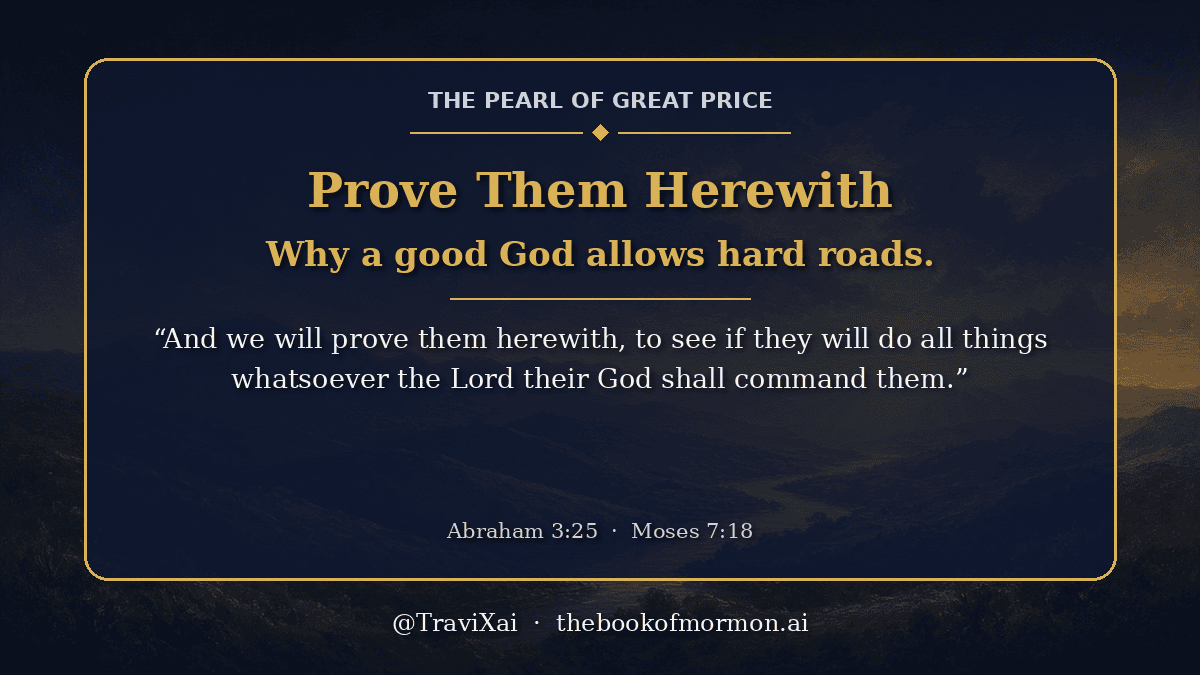
Why would a loving Father allow a road like that? Abraham saw the answer in the council before the world: “we will prove them herewith, to see if they will do all things whatsoever the Lord their God shall command them” (Abraham 3:25). Mortality is a proving ground, not a padded room. What the rescue showed is the other half of Zion: “the Lord called his people Zion, because they were of one heart and one mind, and dwelt in righteousness; and there was no poor among them” (Moses 7:18). For a few weeks in 1856, a whole territory acted like it. See What Is the Law of Consecration?.
Check the premiseThe presuppositions baked into the question
Before this question can be answered fairly, the person asking has to justify a few assumptions packed inside it:
- That handcart travel itself was a deadly scheme. Only the Willie and Martin companies met disaster; the Church’s history says the other handcart companies’ fatality rates did not exceed wagon companies’.
- That Church leaders abandoned the emigrants. Mistakes in timing were real, but when Brigham Young learned of the danger he turned general conference into a rescue, and over 300 rescuers went out.
- That the faithful version of the story is a myth. The deaths, the warning, the rescue and the dates are documented in diaries and the Church’s own timeline. The Church’s historians are the ones who flagged the embellished Sweetwater tradition.
- That suffering proves God was absent. Scripture says life is a proving (Abraham 3:25), Christ knows our infirmities “according to the flesh” (Alma 7:12), and the rescue itself was the Lord’s hand through His people.
FAQQuick answers
What happened to the Willie and Martin handcart companies?
Starting too late in 1856, they were trapped by early winter storms in present-day Wyoming. About 250 people in those and two wagon companies died before rescuers brought them in.
How many people died in the Willie and Martin handcart companies?
The Church’s history says about 250 of the close to 1,500 stranded in the Willie, Martin, Hunt and Hodgetts companies died.
Why did the handcart companies start so late?
The emigrants left England late, carts had to be built in Iowa, and leaders at Florence voted to continue despite Levi Savage’s warning.
Who rescued the handcart pioneers?
Over 300 rescuers sent by Brigham Young in October 1856, supplied by thousands of Saints in Utah.
When did the Willie and Martin companies reach Salt Lake City?
The Willie company arrived November 9, 1856, and the Martin company November 30, 1856.
What is Martin’s Cove?
The place in Wyoming where the Martin company sheltered from November 4 to 9, 1856. It is now a Church historic site.
Were all handcart companies a disaster?
No. Of 10 handcart companies from 1856 to 1860, carrying about 3,000 people, the others had death rates no worse than wagon companies.
Is the story of three boys carrying people across the Sweetwater true?
The Church’s history says that well-known tradition appears to have been embellished.
SummaryKey takeaways
- Handcarts carried about 3,000 Saints west from 1856 to 1860; 10 of 350+ companies.
- The Willie and Martin companies started too late in 1856 and were caught by winter.
- About 250 of close to 1,500 stranded people died; over 1,200 were saved.
- Brigham Young turned general conference into a rescue; over 300 men went out.
- Real mistakes, real heroism; the Church’s own historians flag the embellishments.
Read Luke 15 tonight. For quick, sourced answers, open Galatians18, and follow me on X at @TraviXai.
Sources
- King James Bible (churchofjesuschrist.org): Isaiah 43:2 · Matthew 25:35–36 · Luke 15:4 · Galatians 6:2
- Book of Mormon: Mosiah 18:8–9 · Alma 7:11–12
- Doctrine and Covenants: D&C 81:5 · D&C 121:7–8 · D&C 136:31
- Pearl of Great Price: Abraham 3:25 · Moses 7:18
- Church History Topics, “Handcart Companies” · Church History, rescue timeline · “Go and Bring Them In,” Ensign, Dec. 2006
- Gordon B. Hinckley, “The Faith to Move Mountains,” Oct. 2006 (Deseret News, Oct. 15, 1856) · “Remembering the Rescue,” Ensign, Aug. 1997 · The Willie Handcart Company, ch. 4 (BYU Studies; Chislett account)
- Featured image and in-article graphic: original graphics by thebookofmormon.ai (painterly backgrounds; no photographs or likenesses of real people).