
Seventeen Latter-day Saints, boys among them, were killed at a Missouri mill in 1838 and no one was ever punished. Here is what happened, why, and how scripture answers it.
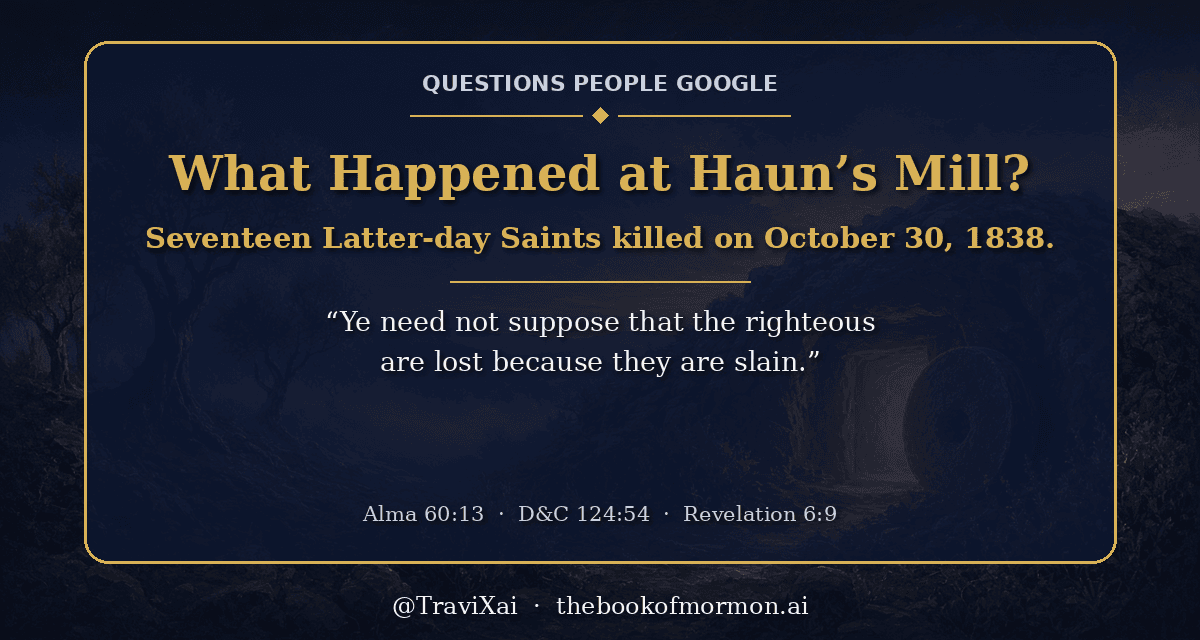
The question often assumes it was a battle, or that it was a story the Saints exaggerated. It was neither. On October 30, 1838, more than 200 armed men attacked the Latter-day Saint settlement at Haun’s Mill in Caldwell County, Missouri, three days after Governor Boggs’s extermination order. Men and boys who took shelter in a blacksmith shop were shot through the log walls, and boys found hiding were executed. Seventeen Latter-day Saints were killed and 12 to 15 wounded. No one was ever punished. The Lord later promised He “will save all those … slain in the land of Missouri” (D&C 124:54).
What happenedThe afternoon of October 30, 1838
Haun’s Mill (Jacob Hawn spelled it several ways) was a small settlement on Shoal Creek in eastern Caldwell County, Missouri, about a day’s walk from the main Latter-day Saint city of Far West. Hawn was not a member of the Church, but he was friendly to the 30 to 40 Latter-day Saint families who lived near his mill, and several families just arrived from Ohio were camped there that week.
In the late afternoon of October 30, 1838, a force of more than 200 armed men on horseback, mostly from Livingston County under Colonel Thomas Jennings, rode in on the settlement. The residents thought a local truce was holding. The women and most of the children ran across the creek into the woods. A group of men and boys took shelter in the blacksmith shop, which turned out to be a death trap: the attackers surrounded it and fired through the wide gaps between the logs, killing the people inside and those who tried to surrender.
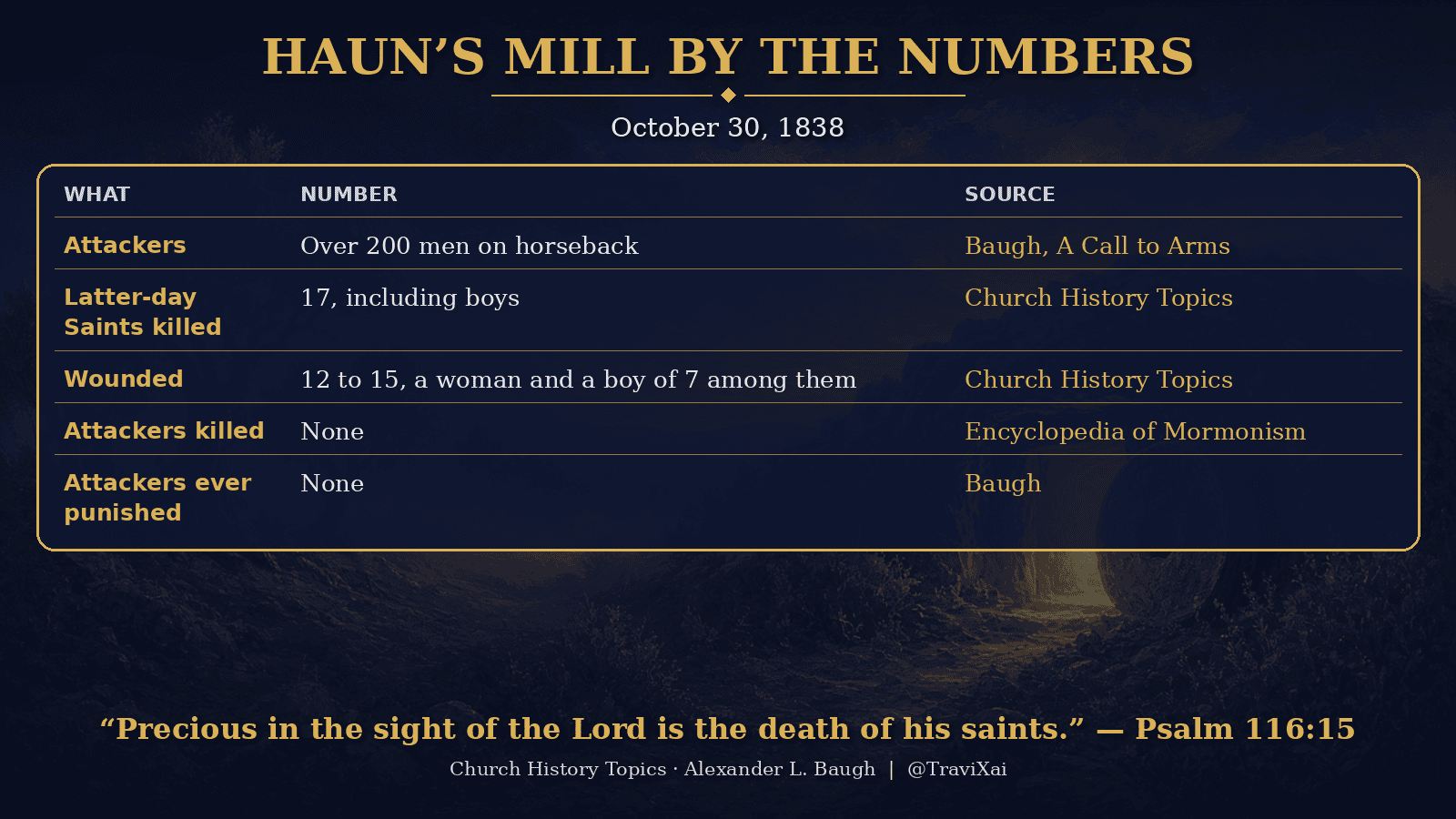
Then it got worse. Thomas McBride, an old Revolutionary War veteran, surrendered his gun and was shot, and his body was hacked with a corn knife. After the shooting stopped, the attackers dragged out young boys who had hidden under the bellows and shot them at point-blank range. Ten-year-old Sardius Smith was one of them. In the Church’s own summary: “Seventeen Latter-day Saints were killed and another 12 to 15 were wounded.” The attackers plundered homes and wagons, and the next day the survivors put most of the dead into an unfinished well and covered them with straw and dirt. No attacker was ever punished for it.
Why it happenedMissouri in 1838
Haun’s Mill did not come out of nowhere. The Saints had already been driven out of Jackson County in 1833. By 1838 tension in northern Missouri had turned into open conflict: vigilantes harassed Latter-day Saint settlements, and in October some Latter-day Saints raided and burned non-member settlements in Daviess County. That last part is true, and saying it is not a concession; it is just history. On October 25 came the skirmish at Crooked River, and on October 27, Governor Lilburn W. Boggs issued his order that the Saints “must be treated as enemies, and must be exterminated or driven from the State if necessary for the public peace.”
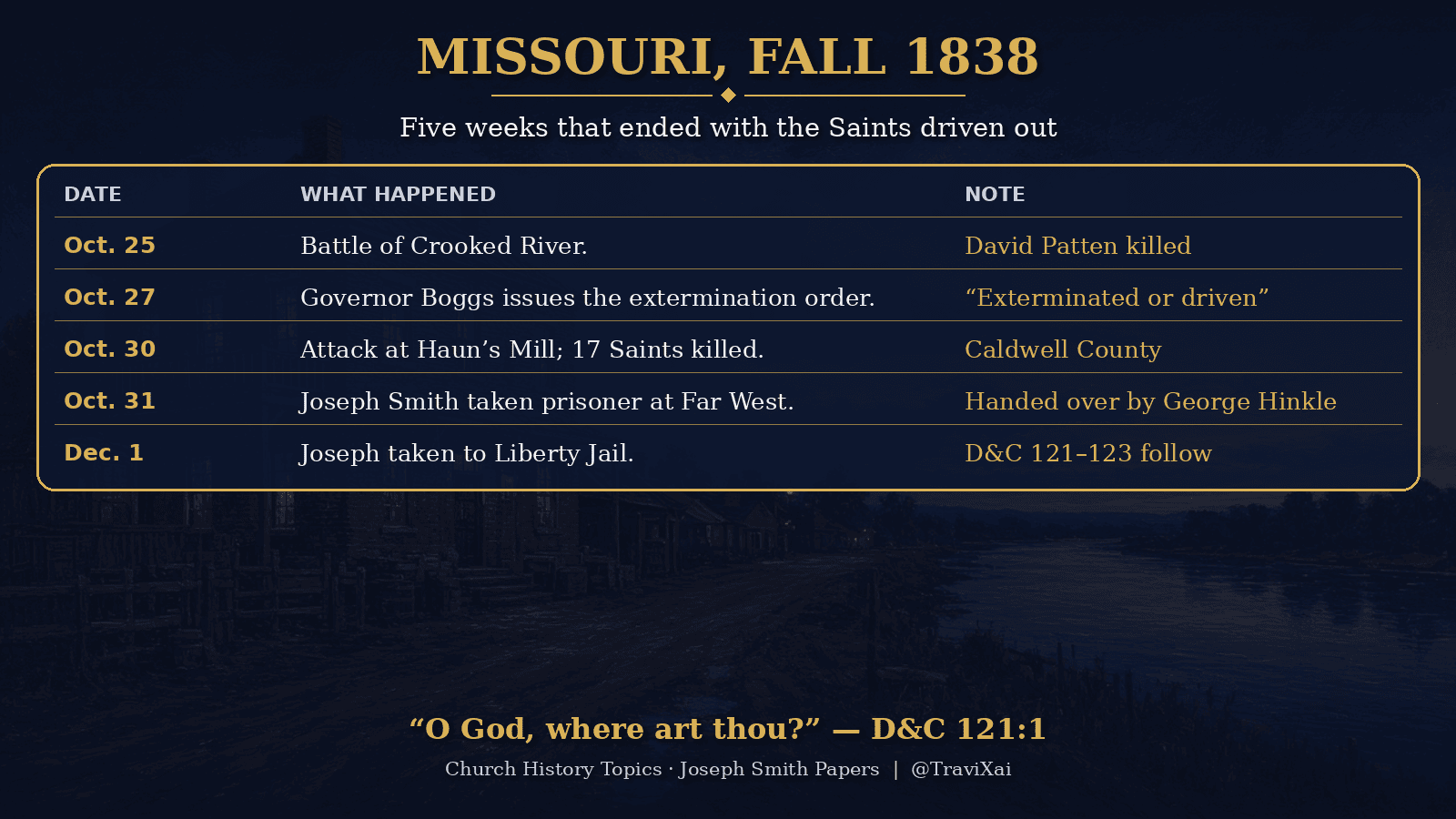
Because the massacre came three days after the order, it is often blamed on it. The Church’s history is more careful: “Some evidence suggests that the attackers were unaware of the order, and that the massacre was an act of vigilante violence, perhaps in retaliation for Latter-day Saint raids in Daviess County.” Either way, the order did not have to be read aloud to work. It told the state that the Saints were fair game, and within days Joseph Smith was a prisoner. See Why Was Joseph Smith in Liberty Jail?.
Retaliation for a raid in another county is not a defense for shooting a ten-year-old under a bellows. The people at Haun’s Mill were farmers, wives, children and families still unloading their wagons from Ohio, several of whom had already been stopped and disarmed by armed men on the road.
CounselDid Joseph Smith tell them to leave?
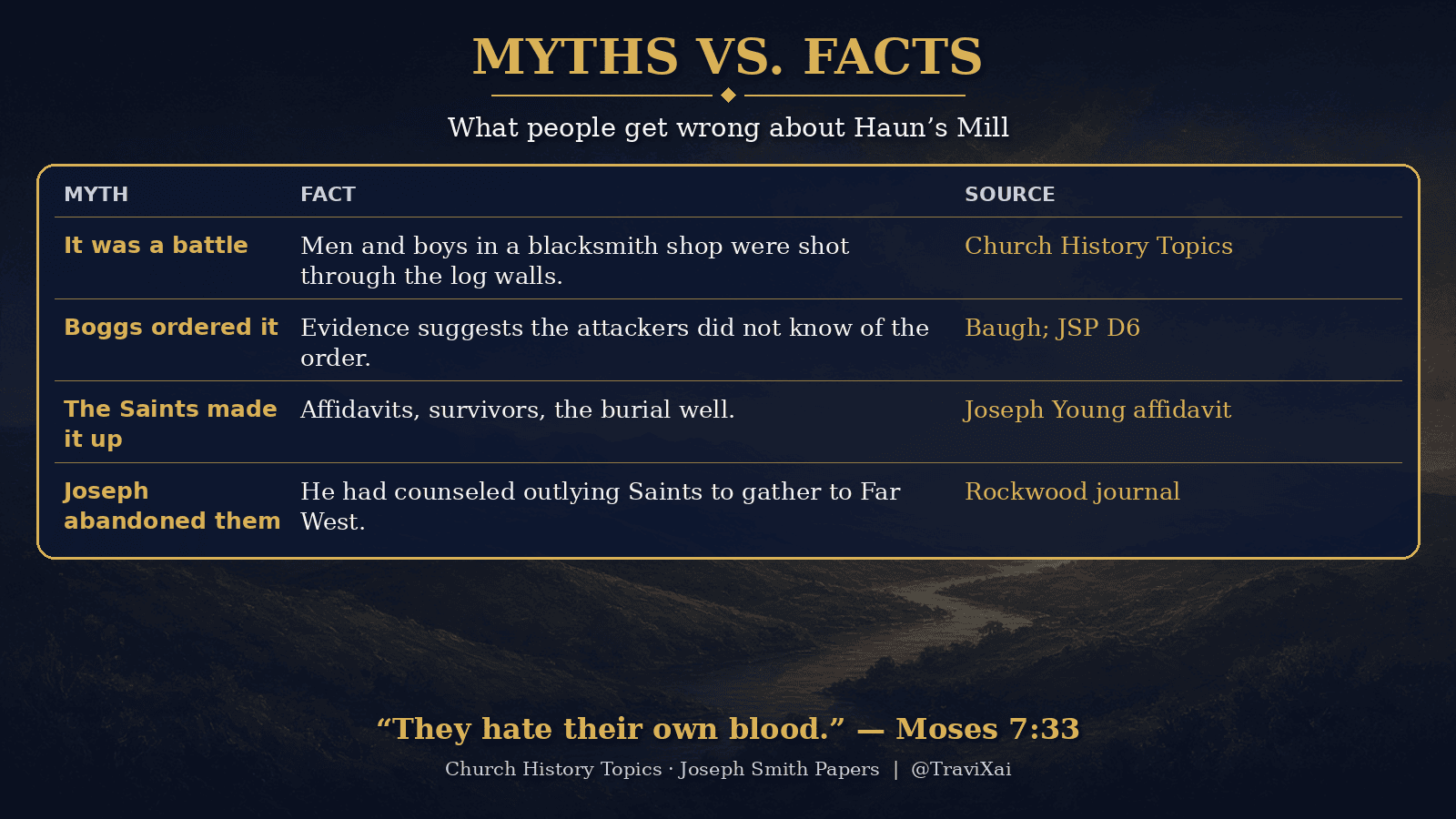
Yes. Before the violence, Joseph Smith counseled Saints in outlying settlements such as Haun’s Mill to gather to Far West, and some leaders at the mill decided to stay. Years later in Nauvoo, Joseph wondered whether the massacre could have been prevented if they had followed that counsel.
But the Church’s history refuses to turn that into blaming the victims, and so do I: “It is difficult to say whether the Saints attacked at Hawn’s Mill could have avoided violence. Those who had only recently arrived from Ohio had already been harassed and disarmed by mob members along the way. There may not have been a safe opportunity to reach the appointed gathering place at Far West.” Prophetic counsel is a protection. It is not a guarantee that wicked men will stay home.
Amanda Barnes SmithA widow, a wounded boy and a prayer
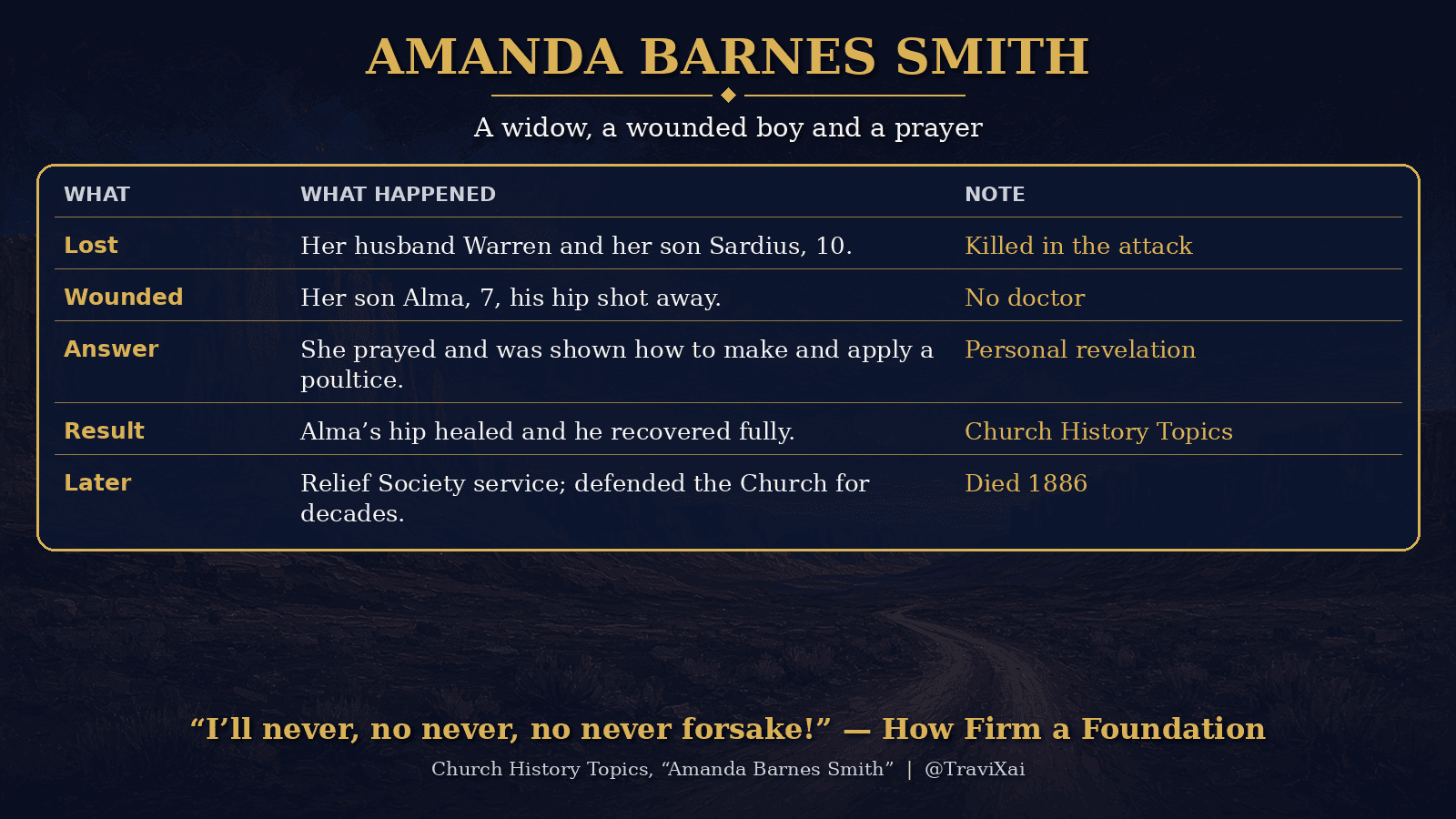
The most remembered account of Haun’s Mill comes from Amanda Barnes Smith. Her family had stopped there that week on their way from Kirtland. Her husband Warren and her son Sardius were killed. Her seven-year-old son Alma had his hip shot away. There was no doctor. Amanda prayed and, in the words of the Church’s history, “received inspiration on how to create and apply a poultice to the wound. The joint was miraculously healed, and Alma made a full recovery.”
Alone in a cornfield, she prayed aloud and later recorded that a voice repeated to her the seventh verse of “How Firm a Foundation”: “The soul that on Jesus hath leaned for repose I will not, I cannot, desert to his foes.” She got to Illinois, then to Utah, served in the Relief Society for decades and died a defender of the faith in 1886. See What Is the Relief Society?.
The BibleThe martyrs under the altar
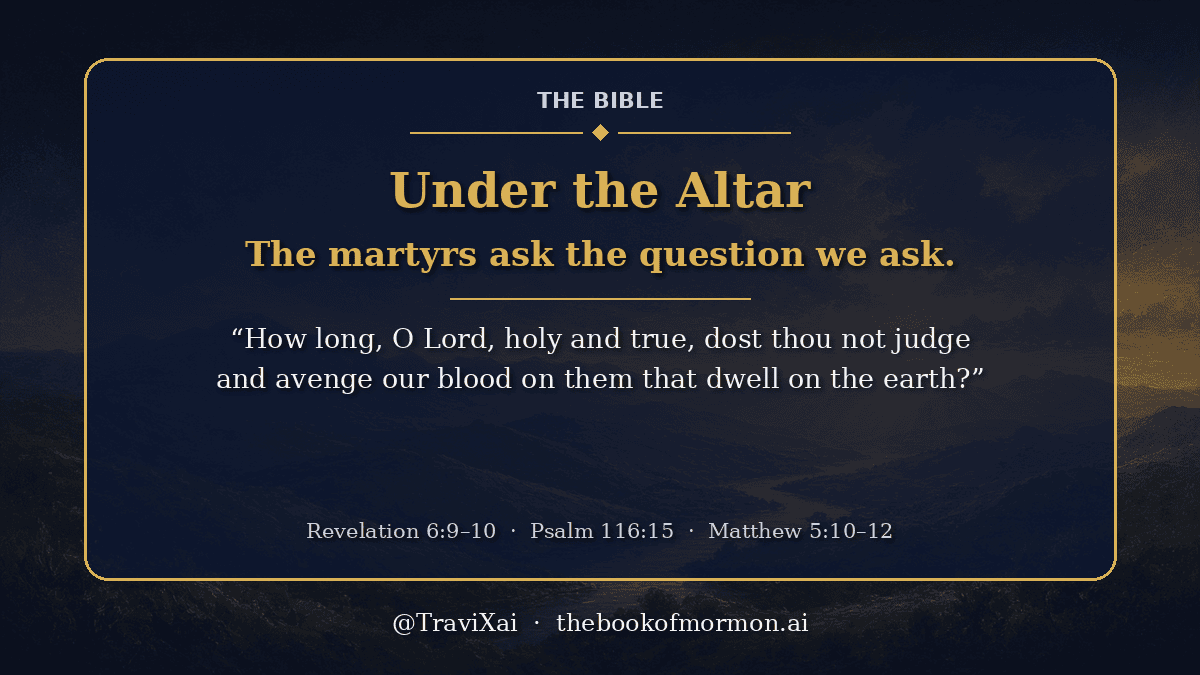
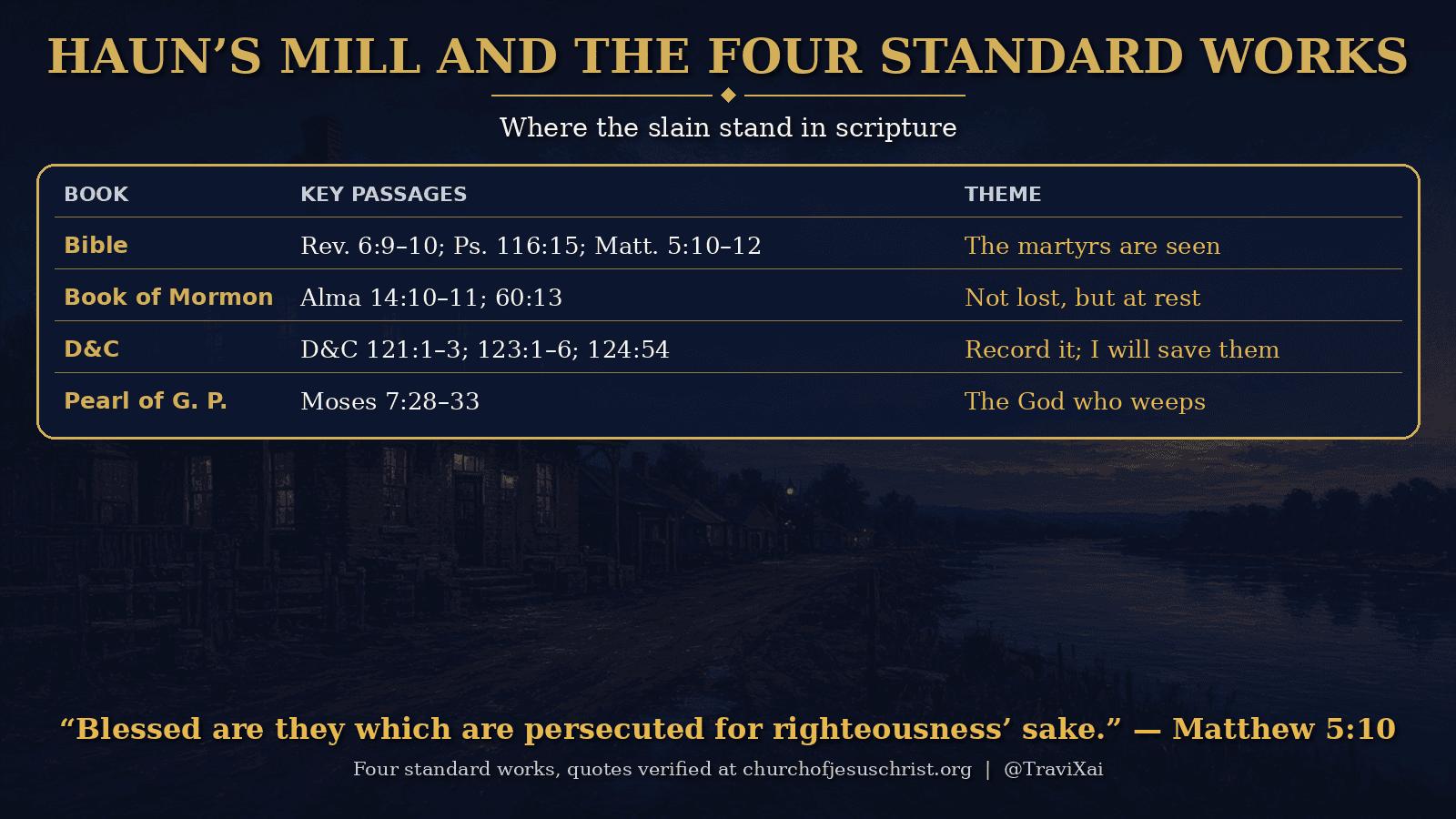
Haun’s Mill raises the oldest question in religion: why does God let it happen? The Bible does not pretend the question is out of bounds. John saw the slain asking it: “I saw under the altar the souls of them that were slain for the word of God, and for the testimony which they held: And they cried with a loud voice, saying, How long, O Lord, holy and true, dost thou not judge and avenge our blood on them that dwell on the earth?” (Revelation 6:9–10).
Jesus had already told His disciples what to expect: “Blessed are they which are persecuted for righteousness’ sake: for theirs is the kingdom of heaven … for so persecuted they the prophets which were before you” (Matthew 5:10–12). And the Psalmist gave the answer the survivors clung to: “Precious in the sight of the Lord is the death of his saints” (Psalm 116:15).
The Book of MormonAmmonihah and the rest of the Lord
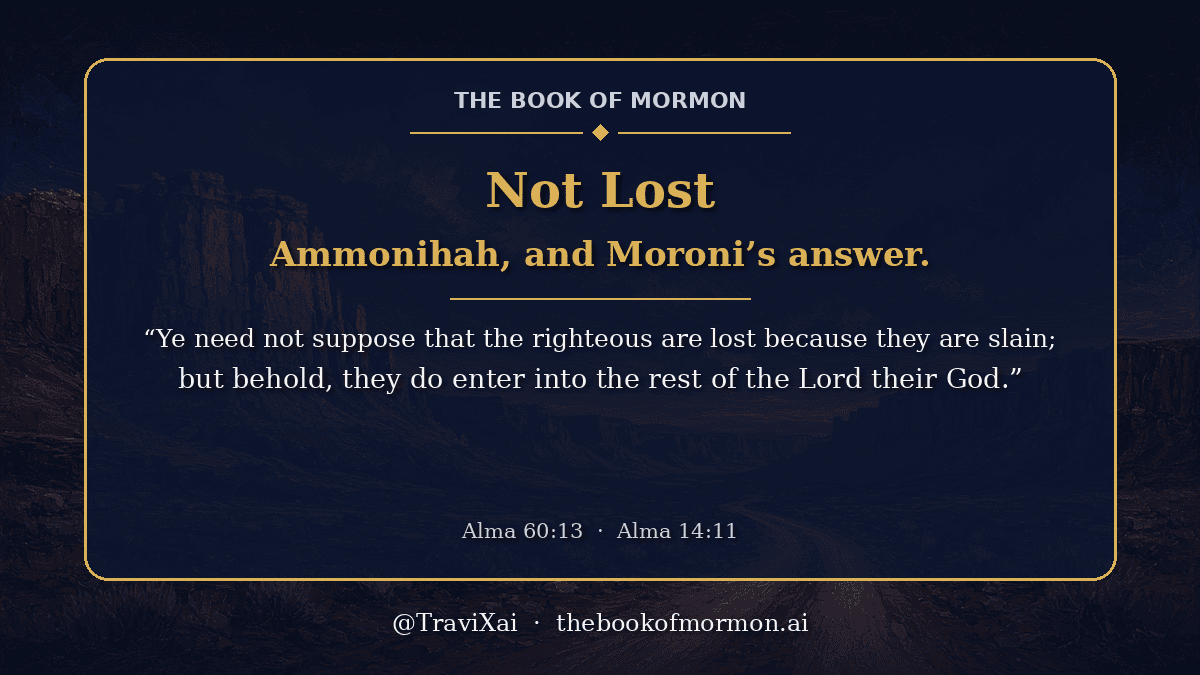
The Book of Mormon has its own Haun’s Mill. At Ammonihah, believers and their children were burned while Alma and Amulek were forced to watch. Amulek begged to use the power of God to stop it. Alma answered: “the Lord receiveth them up unto himself, in glory; and he doth suffer that they may do this thing … that the judgments which he shall exercise upon them in his wrath may be just; and the blood of the innocent shall stand as a witness against them, yea, and cry mightily against them at the last day” (Alma 14:10–11).
Captain Moroni later put it in one sentence: “the Lord suffereth the righteous to be slain that his justice and judgment may come upon the wicked; therefore ye need not suppose that the righteous are lost because they are slain; but behold, they do enter into the rest of the Lord their God” (Alma 60:13). Agency is real for the murderer too. God does not cancel it; He judges it.
The Doctrine and Covenants“O God, where art thou?”
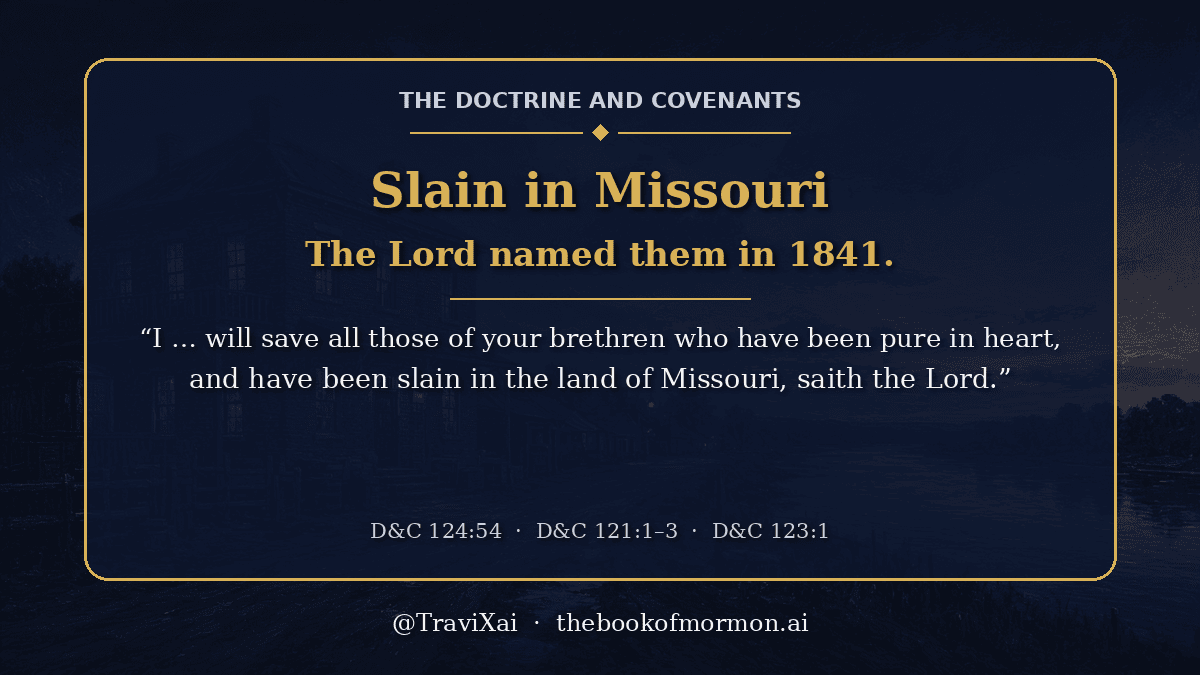
Five months later Joseph Smith, still in Liberty Jail, prayed the question for all of them: “O God, where art thou? … How long shall thy hand be stayed, and thine eye, yea thy pure eye, behold from the eternal heavens the wrongs of thy people and of thy servants, and thine ear be penetrated with their cries?” (D&C 121:1–3). In the same letter he told the Saints to gather “a knowledge of all the facts, and sufferings and abuses put upon them by the people of this State” and “take statements and affidavits” (D&C 123:1–6). That is why we have sworn accounts of Haun’s Mill, including Joseph Young’s.
And in 1841 the Lord answered about the dead specifically: “I am the Lord your God, and will save all those of your brethren who have been pure in heart, and have been slain in the land of Missouri, saith the Lord” (D&C 124:54).
The Pearl of Great PriceThe God who weeps
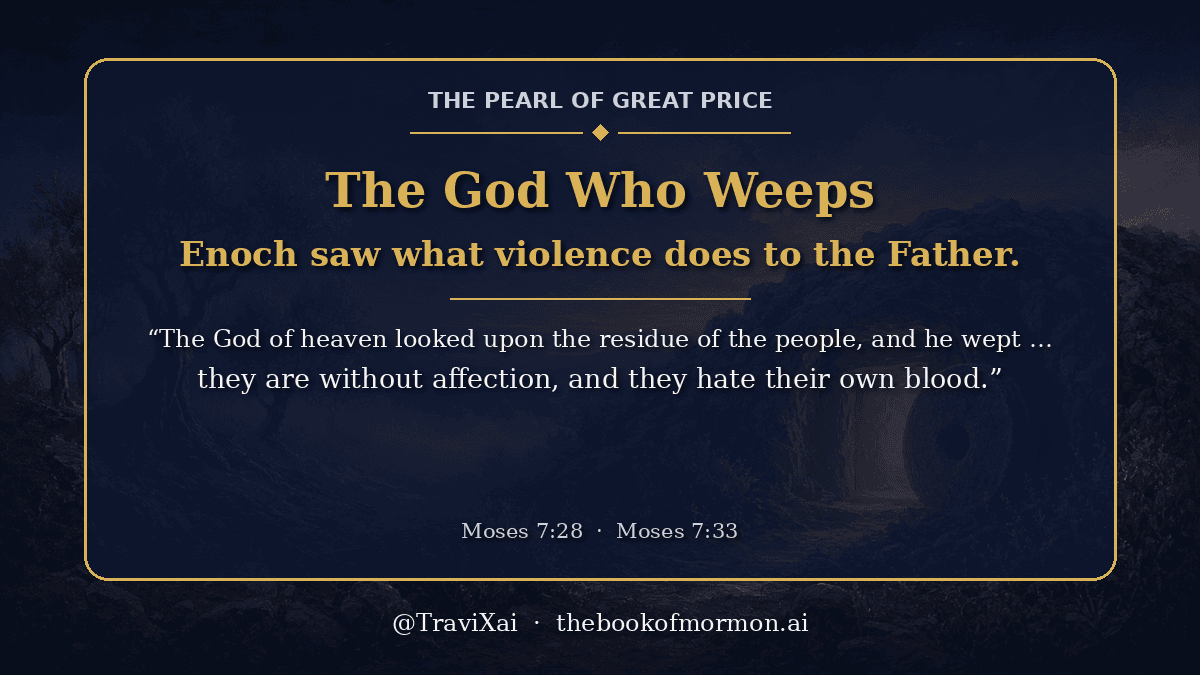
Enoch saw the Father weep over His children, and was stunned: “the God of heaven looked upon the residue of the people, and he wept.” Enoch knew the scale of who was weeping: “were it possible that man could number the particles of the earth, yea, millions of earths like this, it would not be a beginning to the number of thy creations … how is it thou canst weep?” The answer: “unto thy brethren have I said, and also given commandment, that they should love one another, and that they should choose me, their Father; but behold, they are without affection, and they hate their own blood” (Moses 7:28–33).
The God of worlds without number is still a Father, and He still weeps when His children murder each other. That is not weakness. That is what it means for Him to be our Father and not a distant force.
AfterwardWhat became of the site
Within months every Latter-day Saint was out of Missouri, and the survivors of Haun’s Mill went with them to Illinois. The site itself is now farmland with a marker. Community of Christ sold the Haun’s Mill site to the Church in 2012, according to Church Newsroom. See Why Did the Saints Settle in Utah? and Carthage: Like a Lamb to the Slaughter.
Check the premiseThe presuppositions baked into the question
Before this question can be answered fairly, the person asking has to justify a few assumptions packed inside it:
- That it was a battle between two armed sides. It was an attack by more than 200 armed horsemen on a settlement of families; men and boys were shot through the walls of a blacksmith shop and boys were executed after the shooting stopped.
- That the extermination order directly commanded it. The order came three days earlier, but evidence suggests the attackers did not know of it. It was vigilante violence in a state whose governor had just declared the Saints enemies.
- That the Saints exaggerated it. The death toll comes from survivors, sworn affidavits gathered under D&C 123, and the burial itself; historians treat the massacre as established fact.
- That if God were real, He would have stopped it. Scripture says the opposite plainly: “the Lord suffereth the righteous to be slain that his justice and judgment may come upon the wicked” (Alma 60:13). Agency is not suspended for murderers; it is judged.
FAQQuick answers
What happened at Haun’s Mill?
On October 30, 1838, more than 200 armed men attacked the Latter-day Saint settlement at Haun’s Mill, Missouri, killing 17 Latter-day Saints and wounding 12 to 15 others.
How many people died at Haun’s Mill?
Seventeen Latter-day Saints were killed, including boys. Between 12 and 15 were wounded, among them a woman and a 7-year-old boy.
Who led the attack on Haun’s Mill?
The force was mostly from Livingston County, led by Colonel Thomas Jennings, with men from several neighboring counties.
Did the extermination order cause the Haun’s Mill massacre?
It came three days after Governor Boggs’s October 27 order, but evidence suggests the attackers did not know of it and acted as vigilantes.
Was anyone punished for Haun’s Mill?
No. None of the attackers was ever punished.
Who was Amanda Barnes Smith?
A survivor whose husband and 10-year-old son were killed. She prayed, was shown how to treat her son Alma’s shattered hip, and he fully recovered.
Did Joseph Smith warn the Saints at Haun’s Mill?
Yes. He had counseled Saints in outlying settlements to gather to Far West, though recent arrivals may have had no safe way to get there.
What does the Doctrine and Covenants say about those killed in Missouri?
D&C 124:54: “I … will save all those of your brethren who have been pure in heart, and have been slain in the land of Missouri.”
SummaryKey takeaways
- October 30, 1838: over 200 armed men attacked Haun’s Mill.
- Seventeen Latter-day Saints were killed, boys among them; no one was punished.
- It came three days after the extermination order, likely as vigilante violence.
- Amanda Barnes Smith’s son Alma was healed after she prayed for help.
- Scripture: the righteous slain are not lost (Alma 60:13; D&C 124:54).
Read D&C 121 tonight. For quick, sourced answers, open Galatians18, and follow me on X at @TraviXai.
Sources
- King James Bible (churchofjesuschrist.org): Psalm 116:15 · Matthew 5:10–12 · Revelation 6:9–10
- Book of Mormon: Alma 14:10–11 · Alma 60:13
- Doctrine and Covenants: D&C 121:1–3 · D&C 123:1–6 · D&C 124:54
- Pearl of Great Price: Moses 7:28–33
- Church History Topics, “Hawn’s Mill Massacre” · “Amanda Barnes Smith”
- Alexander L. Baugh, A Call to Arms, ch. 9 · Joseph Young’s affidavit (BYU Studies) · Church Newsroom FAQ, March 5, 2024
- Featured image and in-article graphic: original graphics by thebookofmormon.ai (painterly backgrounds; no photographs or likenesses of real people).