
An upper room above a store, a covenant greeting, washed feet, Hebrew lessons and pipe smoke. Out of it came the Word of Wisdom and a pattern for Latter-day Saint learning.
The question often assumes the School of the Prophets was a secret clergy seminary, or that faith and study pull in opposite directions. Neither holds up. The School of the Prophets was a school for unpaid elders that Joseph Smith opened in Kirtland on January 22, 1833, at the Lord’s command in D&C 88. Section 90 put it under the First Presidency. It taught doctrine, history, current events, geography and languages, and it received members by the washing of feet. The Word of Wisdom (D&C 89) was revealed during one of its meetings.
What it wasA school for unpaid elders
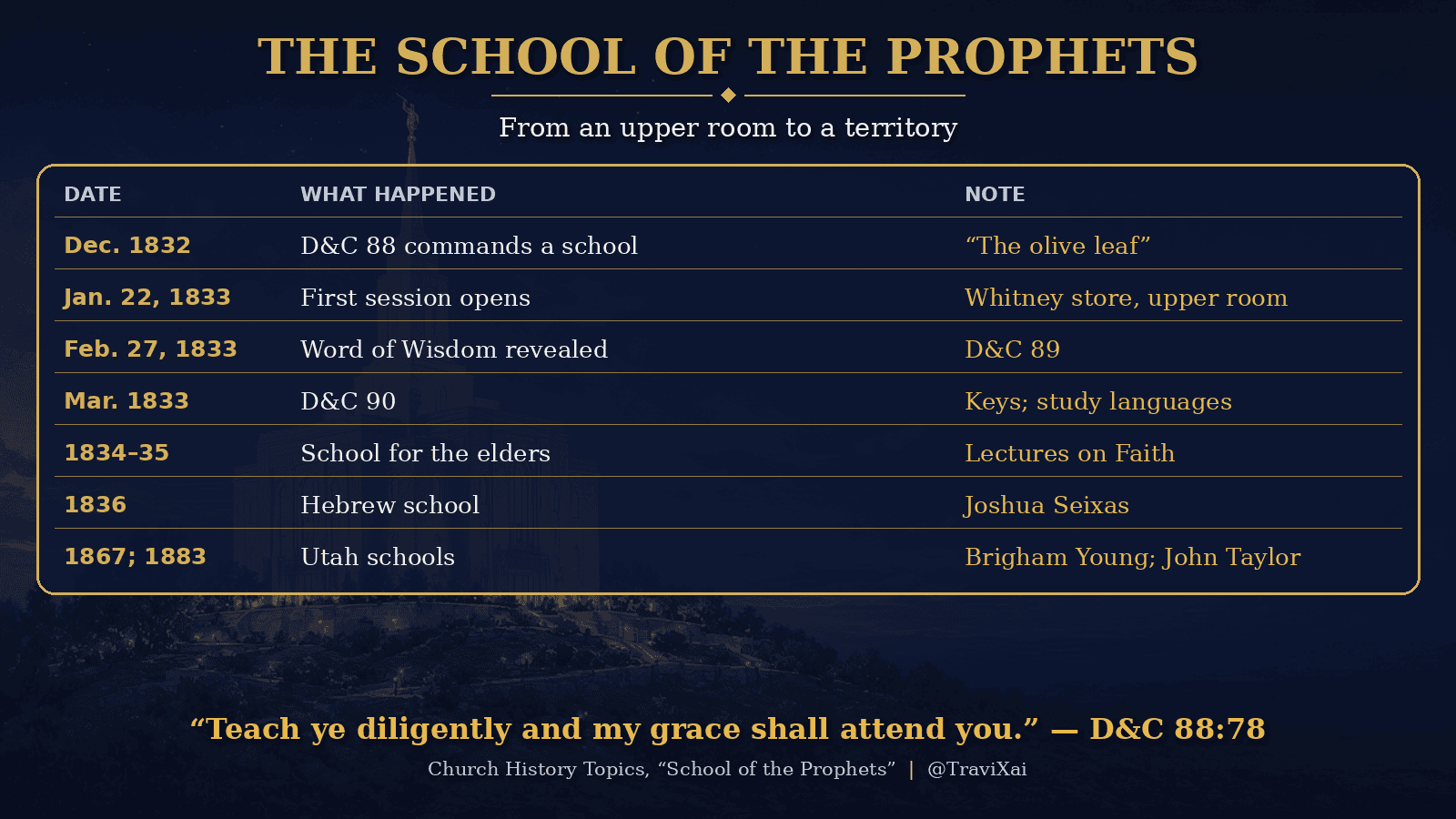
The School of the Prophets was a school for the elders of the Church that Joseph Smith organized in Kirtland, Ohio, at the Lord’s command in Doctrine and Covenants 88. It opened on January 22, 1833, in an upper room of Newel K. Whitney’s store and met each winter through 1836. It taught doctrine alongside history, current events, geography, languages and more, to prepare men for missions and for the endowment of power promised in the Kirtland Temple. The Word of Wisdom was revealed during one of its meetings.
“School of the prophets” was a common phrase at the time. People used it for the divinity schools at Harvard and Yale, and it echoed the “company of the prophets” around Samuel and the “sons of the prophets” around Elijah and Elisha. The difference: the Kirtland school trained no paid clergy. Its students were farmers, craftsmen and merchants who would preach without pay. See Do LDS Bishops Get Paid?.
D&C 88 and 90The olive leaf and the keys
Section 88 was received December 27–28, 1832, and January 3, 1833. Joseph Smith called it “the olive leaf,” the Lord’s message of peace. It commands: “I give unto you a commandment that you shall teach one another the doctrine of the kingdom. Teach ye diligently and my grace shall attend you” (D&C 88:77–78), and lists the subjects: “things both in heaven and in the earth, and under the earth; things which have been, things which are, things which must shortly come to pass; things which are at home, things which are abroad; the wars and the perplexities of the nations … and a knowledge also of countries and of kingdoms” (D&C 88:79). The reason: “That ye may be prepared in all things when I shall send you again to magnify the calling whereunto I have called you” (D&C 88:80).
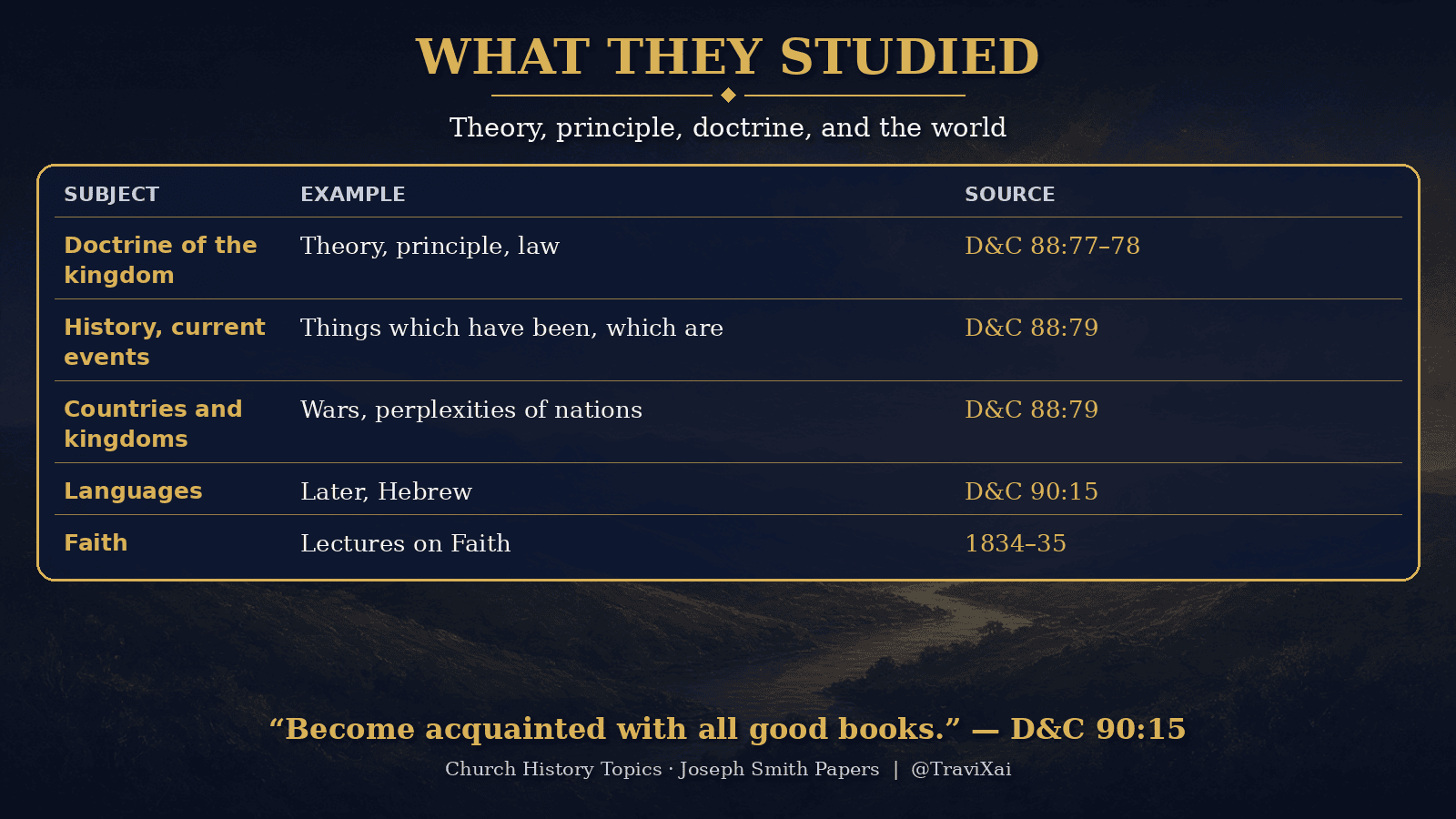
Section 90, received March 8, 1833, confirmed the keys of the kingdom on Joseph, named his counselors in the presidency, and gave them charge of the school. It repeats the curriculum in one line: “study and learn, and become acquainted with all good books, and with languages, tongues, and people” (D&C 90:15). That verse is why the 1836 session hired Joshua Seixas, a Jewish scholar, to teach Hebrew. Lorenzo Snow had studied under him at Oberlin. See What Is the Doctrine and Covenants?.
The order of the schoolGreeting, feet, and one voice at a time
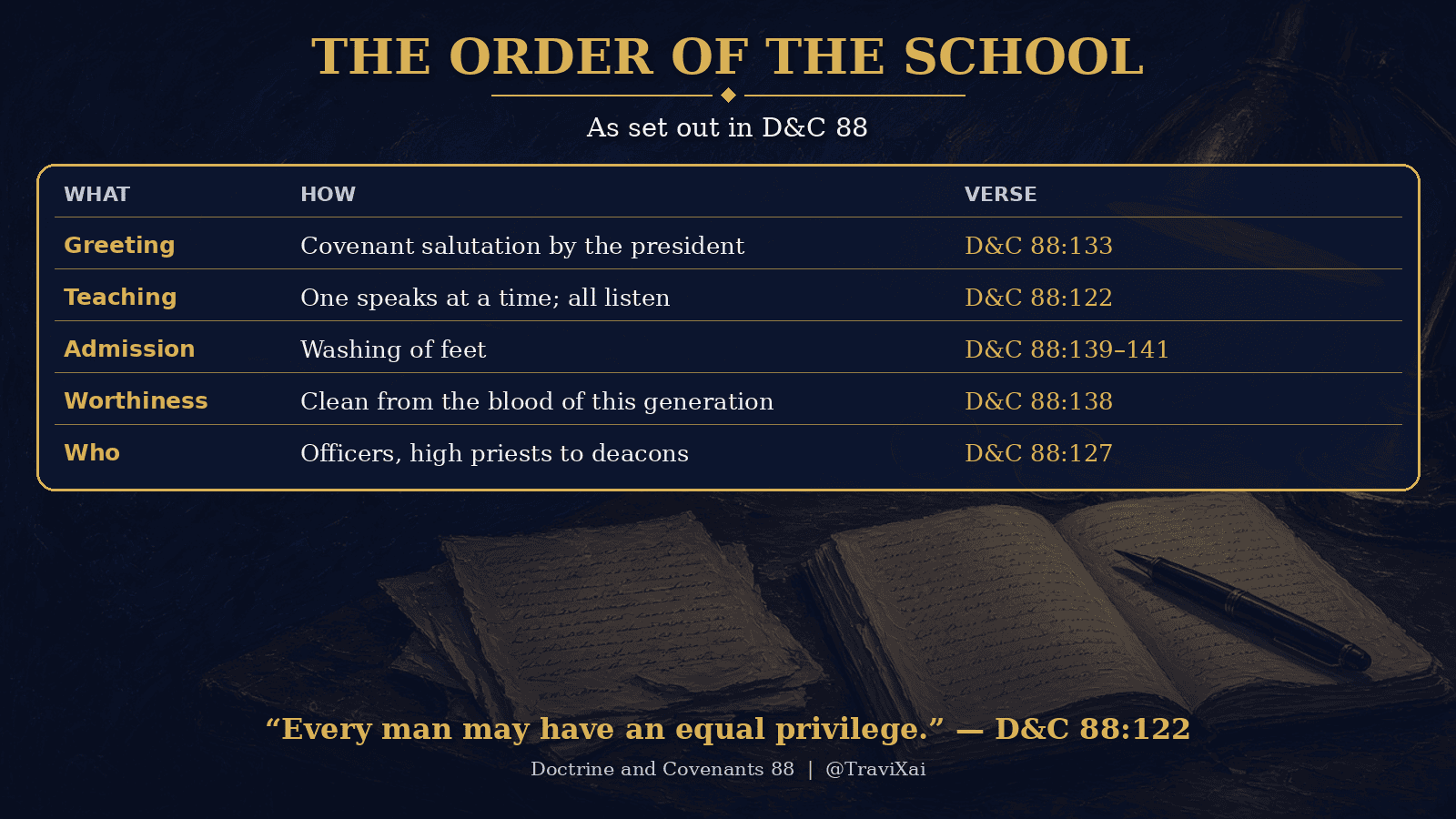
The Lord set the order. The president greeted members with a covenant: “I salute you in the name of the Lord Jesus Christ, in token or remembrance of the everlasting covenant, in which covenant I receive you to fellowship, in a determination that is fixed, immovable, and unchangeable, to be your friend and brother through the grace of God in the bonds of love” (D&C 88:133). Class was orderly: “let not all be spokesmen at once; but let one speak at a time and let all listen unto his sayings, that when all have spoken that all may be edified of all, and that every man may have an equal privilege” (D&C 88:122). New members were received “by the ordinance of the washing of feet” (D&C 88:139). At the first sessions, January 22–23, 1833, the minutes record speaking in tongues and a strong outpouring of the Spirit, and women attended the first meeting too. Joseph washed the feet of the brethren.
The Word of WisdomRevealed in the school
On February 27, 1833, during a meeting of the school, Joseph received the revelation now in Section 89. The Church’s history says it was “prompted in part by questions Emma Smith had raised.” Brigham Young, who was not yet in Kirtland at that time, later recalled what he had heard: men lit their pipes and chewed tobacco while they discussed the kingdom, and Emma was troubled by the state of the room. Joseph asked the Lord. The answer was much bigger than a floor: “A Word of Wisdom, for the benefit of the council of high priests, assembled in Kirtland, and the church … showing forth the order and will of God in the temporal salvation of all saints in the last days” (D&C 89:1–2). Critics like to say the Word of Wisdom was a housekeeping rule. It came with promises of health, “wisdom and great treasures of knowledge” to a school whose whole point was knowledge. See What Is the Word of Wisdom?.
What came afterLectures, Hebrew, a temple, and Utah
The school resumed in the winter of 1834 as the “school for the elders,” and in 1835 Joseph Smith and Sidney Rigdon taught the theological lectures later called the Lectures on Faith. They were printed in the Doctrine and Covenants from 1835 until 1921, when the Church removed them because they were never presented as revelation. The school also pointed at the temple: D&C 88 commands the Saints to “establish a house, even a house of prayer, a house of fasting, a house of faith, a house of learning, a house of glory, a house of order, a house of God” (D&C 88:119). That house was the Kirtland Temple. See What Is the Kirtland Temple?.
When the first session ended in April 1833, Parley P. Pratt led a school for elders in Missouri, and the Lord said He was pleased with it (D&C 97:3). Brigham Young organized a School of the Prophets in Utah in 1867, and John Taylor convened it again in 1883–84. Seminaries, institutes, missionary training centers and BYU carry the same aim today. See Who Was Parley P. Pratt? and Who Was John Taylor?.
The BibleThe company of the prophets
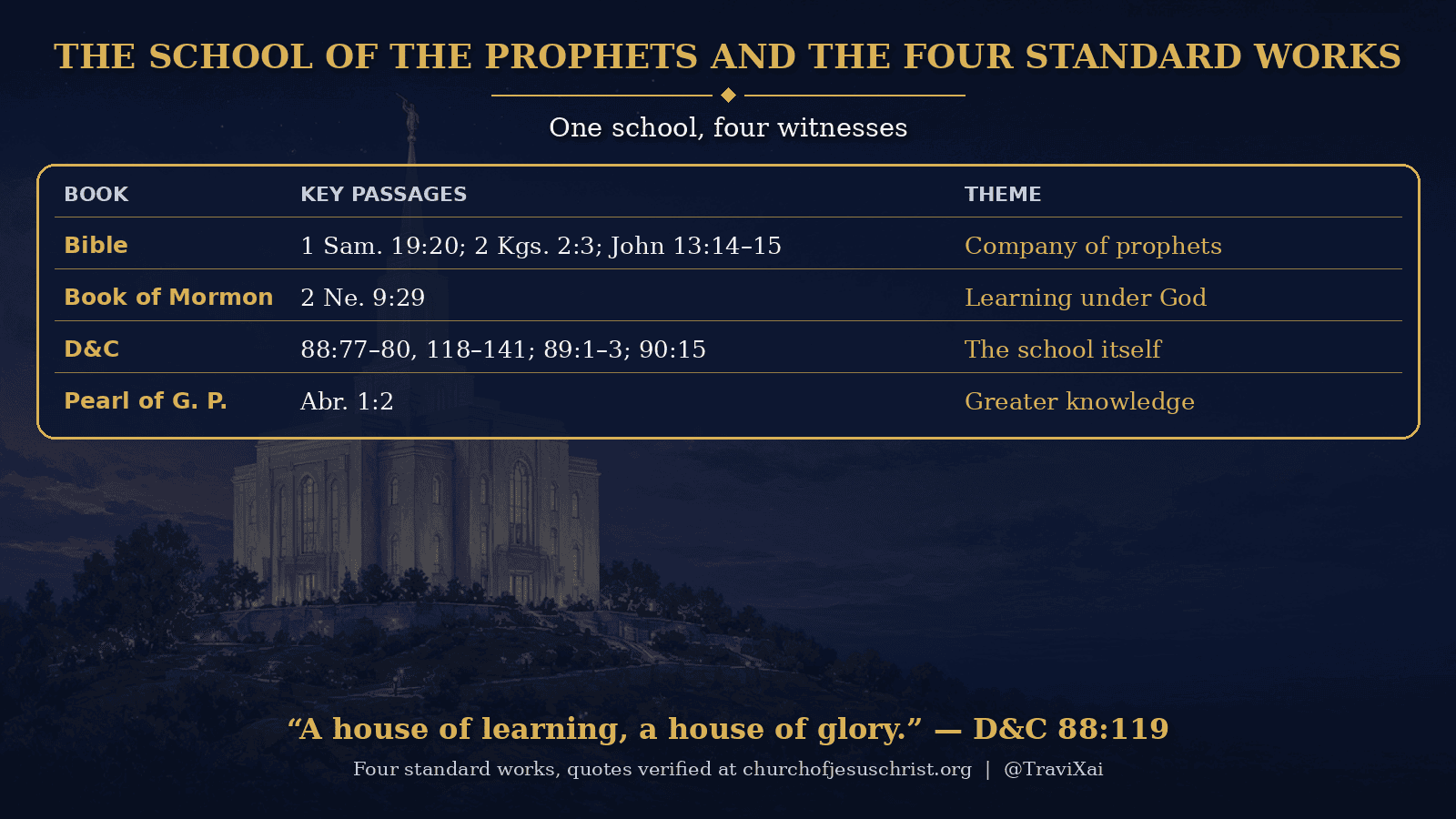
Israel had schools of prophets. When Saul sent men to take David, “they saw the company of the prophets prophesying, and Samuel standing as appointed over them, the Spirit of God was upon the messengers of Saul, and they also prophesied” (1 Samuel 19:20). Later, “the sons of the prophets that were at Beth-el came forth to Elisha” (2 Kings 2:3). The washing of feet came from the Savior at the Last Supper: “If I then, your Lord and Master, have washed your feet; ye also ought to wash one another’s feet. For I have given you an example, that ye should do as I have done to you” (John 13:14–15). D&C 88:141 points straight at that chapter. Most Christian churches turned it into a once-a-year gesture or dropped it. The Restoration put it back as an ordinance.
The Book of MormonLearned and humble
Jacob warned against the learned who “think they are wise, and they hearken not unto the counsel of God,” and then gave the balance the school was built on: “But to be learned is good if they hearken unto the counsels of God” (2 Nephi 9:29). The Kirtland elders were mostly men with little formal schooling. The Lord did not tell them learning was dangerous. He told them to get it, under Him. See Is the Book of Mormon True?.
The Doctrine and CovenantsBy study and also by faith
The line Latter-day Saints quote most comes from this revelation: “And as all have not faith, seek ye diligently and teach one another words of wisdom; yea, seek ye out of the best books words of wisdom; seek learning, even by study and also by faith” (D&C 88:118). Note the order of the argument. Not everyone has faith yet, so study. Study is not the enemy of faith; it is one of the ways God feeds it. People who assume religion means checking your brain at the door have not read the founding charter of Latter-day Saint education.
The Pearl of Great PriceAbraham’s ambition
Abraham describes himself the way the school wanted its students to be: “having been myself a follower of righteousness, desiring also to be one who possessed great knowledge, and to be a greater follower of righteousness, and to possess a greater knowledge … and desiring to receive instructions, and to keep the commandments of God” (Abraham 1:2). Knowledge and righteousness, together. That is the school in one verse, and it fits a gospel where intelligence rises with us in the resurrection and our Father has walked that path ahead of us. See What Is the Book of Abraham?.
Check the premiseThe presuppositions baked into the question
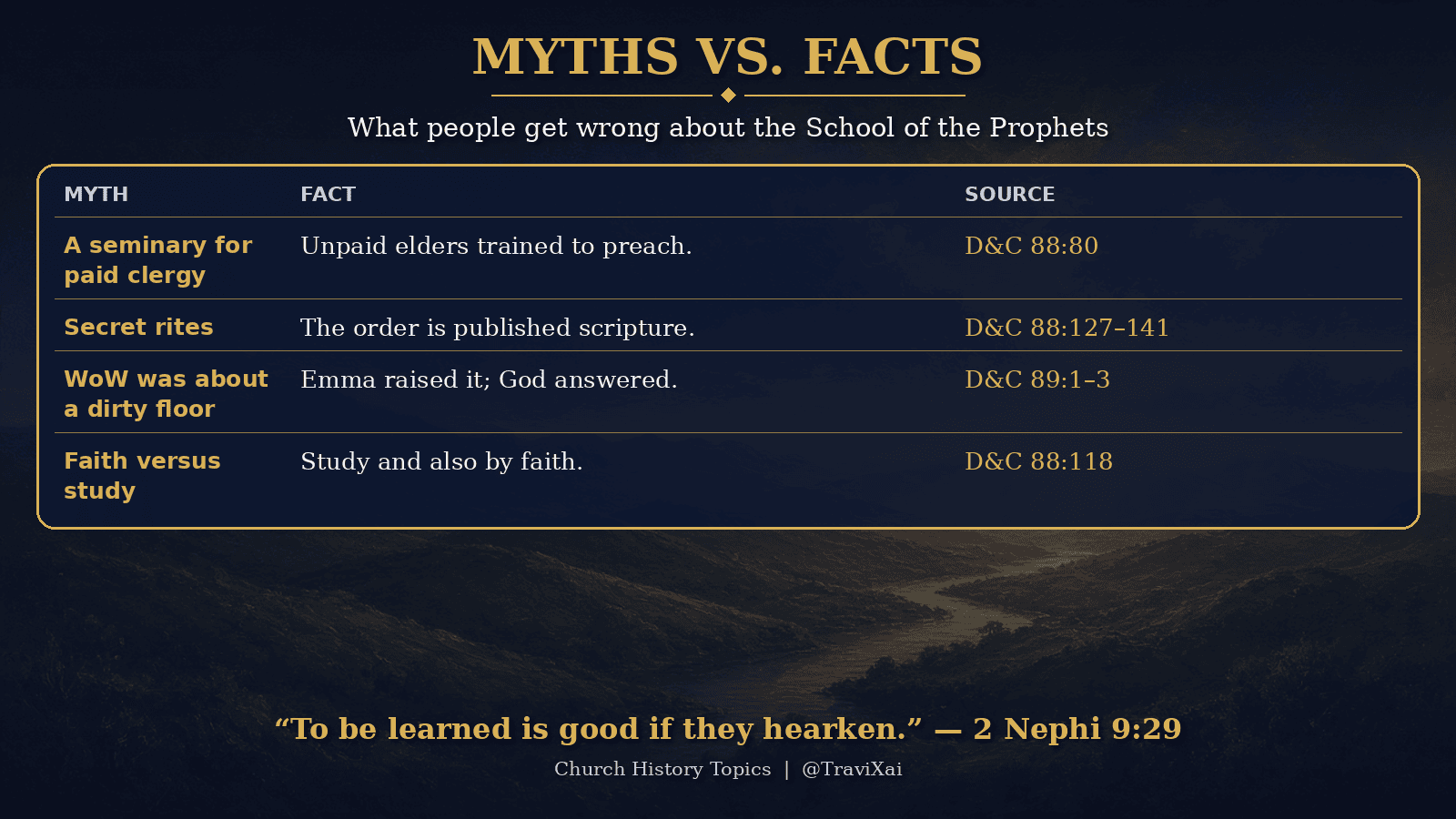
Before this question can be answered fairly, the person asking has to justify a few assumptions packed inside it:
- That the School of the Prophets was a seminary for professional clergy. Its students were unpaid elders, farmers and tradesmen, being prepared to preach (D&C 88:80).
- That it was a secret society with hidden rites. Its order, from the greeting to the washing of feet, is printed in the Doctrine and Covenants (D&C 88:122–141).
- That the Word of Wisdom was just a housekeeping rule about a dirty floor. Emma’s concerns prompted the question. The answer was a revelation “showing forth the order and will of God” with promised blessings (D&C 89:1–3).
- That faith and study are opposites. The Lord told the school to “seek learning, even by study and also by faith” (D&C 88:118).
FAQQuick answers
What was the School of the Prophets?
A school for elders organized by Joseph Smith in Kirtland, Ohio, in 1833 by revelation (D&C 88), teaching doctrine and secular subjects to prepare missionaries.
Where did the School of the Prophets meet?
In an upper room of Newel K. Whitney’s store in Kirtland, beginning January 22, 1833.
What sections of the Doctrine and Covenants relate to the School of the Prophets?
Mainly D&C 88, which commanded it and set its order, and D&C 90, which gave the presidency charge of it. D&C 89 was revealed during it.
Was the Word of Wisdom given at the School of the Prophets?
Yes. Joseph Smith received D&C 89 on February 27, 1833, during a meeting of the school, prompted in part by Emma Smith’s concerns.
What did they study in the School of the Prophets?
Doctrine, history, current events, geography, languages including Hebrew, and in 1835 the Lectures on Faith.
Why did the School of the Prophets wash feet?
D&C 88:139–141 made the washing of feet the ordinance for receiving members, following John 13.
Does the Church still have a School of the Prophets?
Not by that name since the late 1800s. Seminaries, institutes and missionary training centers carry on its aims.
What does “seek learning, even by study and also by faith” mean?
From D&C 88:118: God expects His people to learn through study and through revelation, not one without the other.
SummaryKey takeaways
- Commanded in D&C 88; opened January 22, 1833, in the Whitney store.
- D&C 90 put the First Presidency over it and told them to study languages and “all good books.”
- Members were received by the washing of feet (D&C 88:139–141).
- The Word of Wisdom was revealed during the school on February 27, 1833.
- “Seek learning, even by study and also by faith” (D&C 88:118).
Read D&C 88:118–126 tonight and pick one good book to start. For quick, sourced answers, open Galatians18, and follow me on X at @TraviXai.
Sources
- King James Bible (churchofjesuschrist.org): 1 Samuel 19:20 · 2 Kings 2:3 · John 13:14–15
- Book of Mormon: 2 Nephi 9:29
- Doctrine and Covenants: D&C 88:77–80 · D&C 88:118–119 · D&C 88:122 · D&C 88:133 · D&C 88:138–141 · D&C 89:1–3 · D&C 90:15 · D&C 97:3
- Pearl of Great Price: Abraham 1:2
- Church History Topics, “School of the Prophets” · Joseph Smith Papers, “School of the Prophets”
- Nathan Waite, “A School and an Endowment: D&C 88, 90, 95, 109, 110,” Revelations in Context (2016) · Brigham Young, Journal of Discourses 12:158
- Featured image and in-article graphic: original graphics by thebookofmormon.ai (painterly backgrounds; no photographs or likenesses of real people).