
It’s the least known of the four Latter-day Saint scriptures, and the most direct. Here’s what it is and where to start.
The Doctrine and Covenants is a book of modern revelations, mostly given through Joseph Smith, and one of four Latter-day Saint books of scripture. Its introduction calls it “a collection of divine revelations and inspired declarations given for the establishment and regulation of the kingdom of God on the earth in the last days.” It has 138 sections and two Official Declarations. Unlike the Book of Mormon, it isn’t a translation; it’s written mostly in the voice of Jesus Christ: “These words are not of men nor of man, but of me” (D&C 18:34).
The short answerA book of modern revelation
The book’s introduction explains: “The Doctrine and Covenants is a collection of divine revelations and inspired declarations given for the establishment and regulation of the kingdom of God on the earth in the last days” (Introduction). It has 138 sections and two Official Declarations. Most came through Joseph Smith; a few came through later Church Presidents.
It’s one of four books of scripture Latter-day Saints use, along with the Bible, the Book of Mormon and the Pearl of Great Price. But the introduction notes what makes it different: “the Doctrine and Covenants is unique because it is not a translation of an ancient document, but is of modern origin” (Introduction).
Whose voice it is“It is my voice which speaketh them”
Most sections are written in the first person, as the Lord speaking. The preface opens: “Hearken, O ye people of my church, saith the voice of him who dwells on high … For verily the voice of the Lord is unto all men” (D&C 1:1–2). To the first apostles He said: “These words are not of men nor of man, but of me … For it is my voice which speaketh them unto you” (D&C 18:34–36).
The introduction says that in its pages “one hears the tender but firm voice of the Lord Jesus Christ, speaking anew in the dispensation of the fulness of times.” The revelations “came out of real-life situations involving real people”: a farmer wanting to help, a missionary needing direction, a prophet in a jail cell (Introduction).
What’s insideFrom priesthood to the redemption of the dead
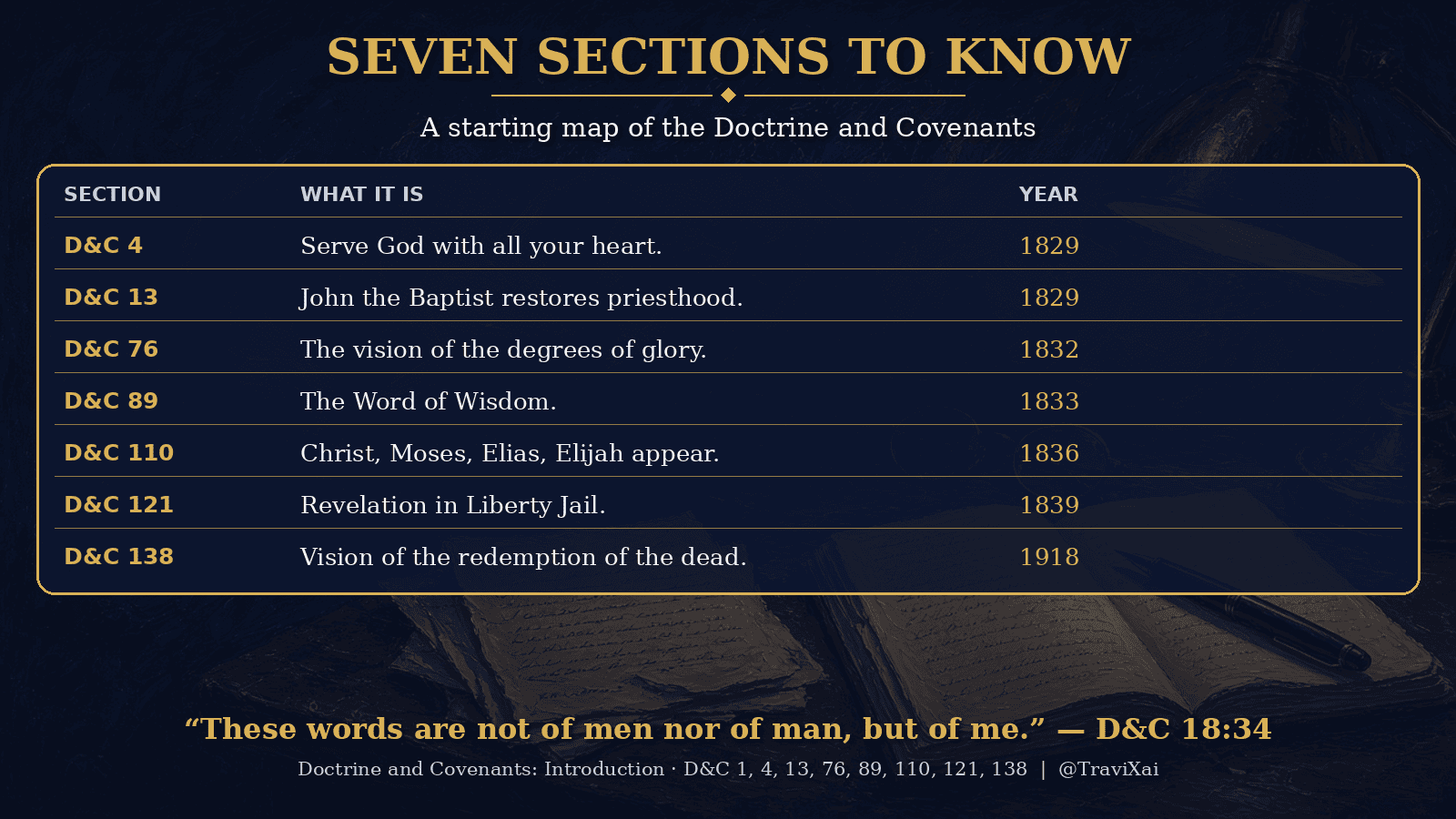
It begins in 1829 with a call to “serve him with all your heart, might, mind and strength” (D&C 4:2). Section 13 records John the Baptist conferring “the Priesthood of Aaron” on Joseph Smith and Oliver Cowdery (D&C 13:1). Section 76 is Joseph and Sidney Rigdon’s vision of Christ: “That he lives! For we saw him, even on the right hand of God,” and by Him “the worlds are and were created” (D&C 76:22–24).
Section 89 is the Word of Wisdom, with its promise that the obedient “shall run and not be weary, and shall walk and not faint” (D&C 89:18–21). In section 110, Christ appears in the Kirtland Temple, followed by Moses, Elias and Elijah. From Liberty Jail came some of the tenderest words in scripture: “My son, peace be unto thy soul; thine adversity and thine afflictions shall be but a small moment” (D&C 121:7–8), and the standard for all priesthood leadership: “only by persuasion, by long-suffering, by gentleness and meekness, and by love unfeigned” (D&C 121:41–42).
Section 138, received by President Joseph F. Smith in 1918, describes Christ’s ministry to the spirit world: “the eyes of my understanding were opened … and I saw the hosts of the dead, both small and great” (D&C 138:11).
What it revealsOur Father’s kingdom, and our destiny
The Doctrine and Covenants reveals more about God’s plan for His children than any other book. Those who receive the priesthood and Christ receive the Father, “And he that receiveth my Father receiveth my Father’s kingdom; therefore all that my Father hath shall be given unto him” (D&C 84:37–38). Of those exalted in the new and everlasting covenant, the Lord says: “Then shall they be gods, because they have no end” (D&C 132:20).
Joseph Smith taught that this is the same path our Father walked: “you have got to learn how to be gods yourselves … the same as all gods have done before you … from grace to grace, from exaltation to exaltation” (History of the Church 6:306). His children become like Him and share His work of creating worlds without number, always as His children. See Was God Once a Man? and The Three Degrees of Glory.
Why more scripture?“I have yet many things to say unto you”
Jesus told His apostles, “I have yet many things to say unto you, but ye cannot bear them now. Howbeit when he, the Spirit of truth, is come, he will guide you into all truth … and he will shew you things to come” (John 16:12–13). God told Nephi, “because that ye have a Bible ye need not suppose that it contains all my words” (2 Nephi 29:9–10).
So Latter-day Saints say: “We believe all that God has revealed, all that He does now reveal, and we believe that He will yet reveal many great and important things pertaining to the Kingdom of God” (Articles of Faith 1:9). The Lord’s promise in the preface still stands: “Search these commandments, for they are true and faithful … whether by mine own voice or by the voice of my servants, it is the same” (D&C 1:37–38). See The Canon Was Never Meant to Close.
Check the premiseThe presuppositions baked into the question
Before this question can be answered fairly, the person asking has to justify a few assumptions packed inside it:
- That the Bible forbids any more scripture. Revelation 22:18 refers to “this book,” and Deuteronomy 4:2 says the same, yet more scripture followed (see our post on Revelation 22:18).
- That the Doctrine and Covenants replaces the Bible. It stands alongside the Bible, the Book of Mormon and the Pearl of Great Price (Introduction).
- That it’s Joseph Smith’s own writings. It presents itself as the Lord’s words: “not of men nor of man, but of me” (D&C 18:34).
- That it’s only rules for Church members. Its introduction says its messages “are for the benefit of all mankind.”
FAQQuick answers
What is the Doctrine and Covenants?
A book of modern scripture containing 138 sections and two Official Declarations, mostly revelations given through Joseph Smith, for the establishment of the Church in the last days.
Who wrote the Doctrine and Covenants?
Latter-day Saints believe the revelations are the words of Jesus Christ, received mostly through Joseph Smith, with a few through later Church Presidents.
When was the Doctrine and Covenants first published?
In 1835 in Kirtland, Ohio, building on an earlier compilation, the Book of Commandments (1833).
What are the most famous sections?
Sections 76 (degrees of glory), 89 (Word of Wisdom), 110 (Kirtland Temple visions), 121 (Liberty Jail) and 138 (redemption of the dead) are among the best known.
How is it different from the Book of Mormon?
The Book of Mormon is a translation of an ancient record. The Doctrine and Covenants is modern revelation given in the 1800s and 1900s.
Does the Doctrine and Covenants treat living prophets’ words as scripture?
When they speak by the Spirit, yes. The Lord said, “whether by mine own voice or by the voice of my servants, it is the same” (D&C 1:38).
What does D&C 76 testify about Jesus Christ?
Joseph Smith and Sidney Rigdon wrote, “this is the testimony, last of all, which we give of him: That he lives! For we saw him, even on the right hand of God” (D&C 76:22–23).
What is D&C 121 about?
It comes from Joseph Smith’s letters written in Liberty Jail in 1839. The Lord comforted him: “My son, peace be unto thy soul; thine adversity and thine afflictions shall be but a small moment” (D&C 121:7).
SummaryKey takeaways
- The Doctrine and Covenants is modern revelation, mostly through Joseph Smith.
- It has 138 sections and two Official Declarations.
- Most sections are in the voice of Jesus Christ (D&C 18:34–36).
- It reveals the priesthood, temples, the degrees of glory and our eternal destiny.
Start with sections 76, 121 and 138. For quick, sourced answers, open Galatians18, and follow me on X at @TraviXai.
Sources
- King James Bible (churchofjesuschrist.org): John 16:12–13
- Book of Mormon: 2 Nephi 29:9–10
- Doctrine and Covenants: Introduction · D&C 1:1–2 · D&C 1:37–38 · D&C 4:2 · D&C 13:1 · D&C 18:34–36 · D&C 76:22–24 · D&C 84:37–38 · D&C 89:18–21 · D&C 121:7–8 · D&C 121:41–42 · D&C 132:20 · D&C 138:11
- Pearl of Great Price: Articles of Faith 1:9
- History of the Church 6:305–306 (King Follett discourse), BYU Studies
- Featured image and in-article graphic: original graphics by thebookofmormon.ai (painterly backgrounds; no photographs or likenesses of real people).