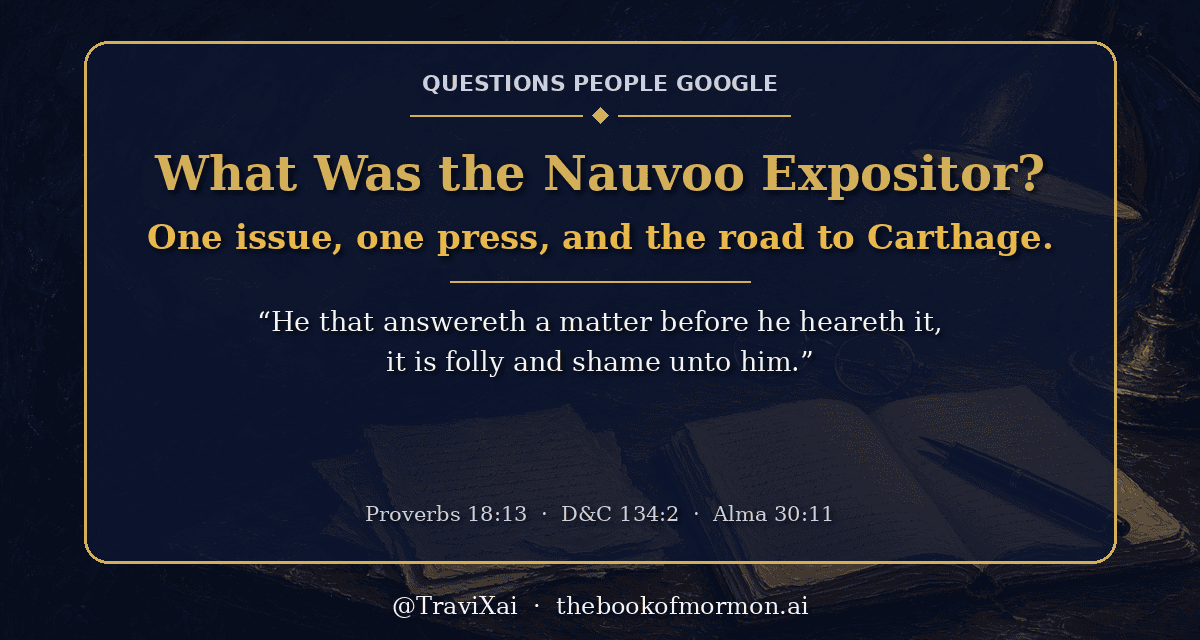

A one-issue newspaper, a city council vote, a destroyed press, and twenty days later a mob at Carthage Jail. Here is the law, the history, and an honest verdict.
The question often assumes Joseph Smith smashed a free press on a whim and brought Carthage on himself. Neither holds up. The Nauvoo Expositor was a dissenters’ newspaper that printed one issue on June 7, 1844. After hearings on June 8 and 10, the Nauvoo City Council declared it a public nuisance, citing Blackstone, and Mayor Joseph Smith had the press destroyed. Scholars judge destroying the copies defensible and destroying the press likely an overreach. It led to his arrest and to Carthage, where a mob murdered him and Hyrum before any trial.
What it wasOne issue that ended in Carthage
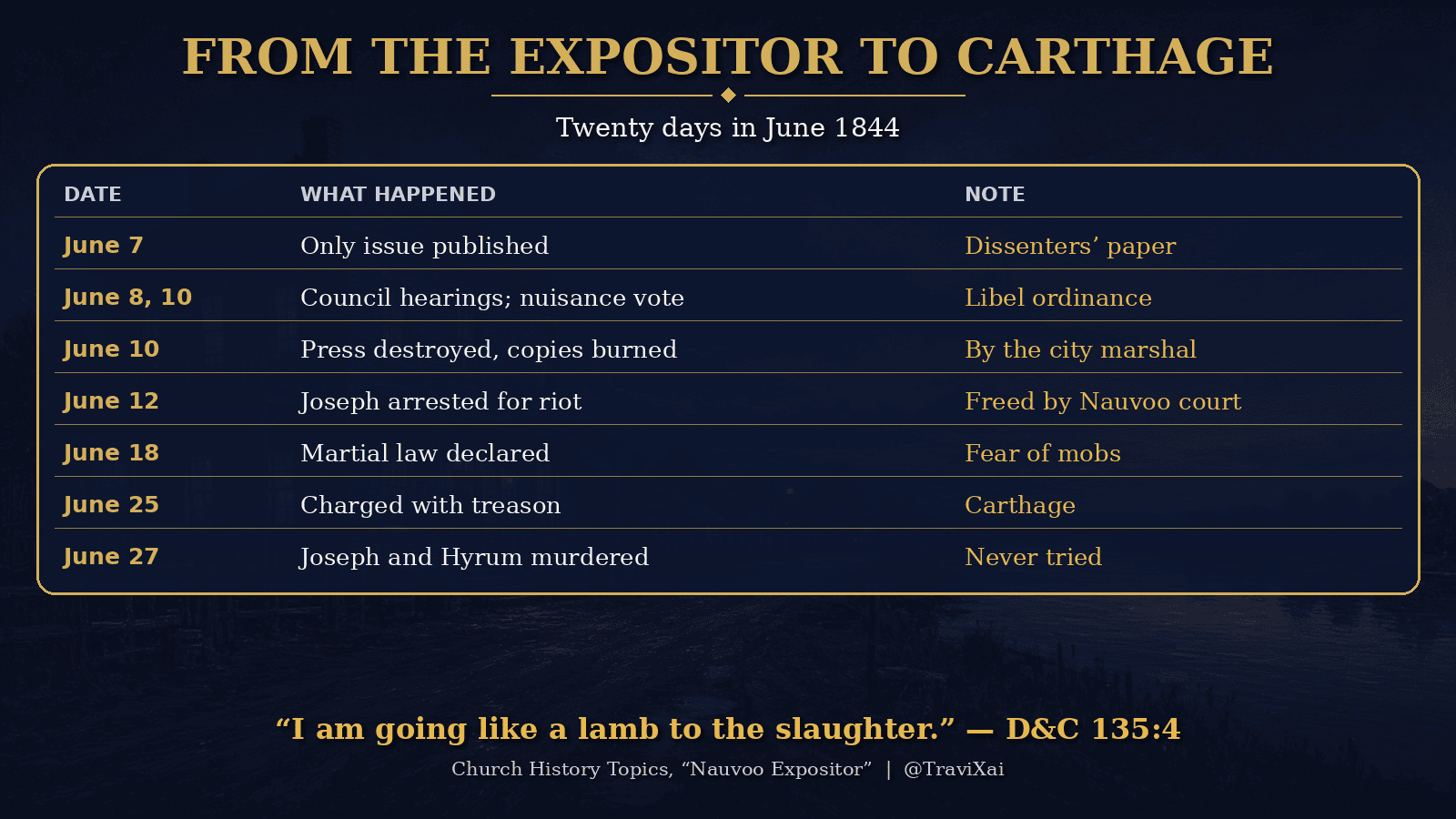
The Nauvoo Expositor was a newspaper published by dissenters from the Church in Nauvoo, Illinois. It printed one issue, on June 7, 1844. Three days later the Nauvoo City Council declared it a public nuisance, and on Joseph Smith’s order as mayor the city marshal and a posse destroyed the press, scattered the type and burned the remaining copies. That act led to Joseph’s arrest, his surrender at Carthage, and his murder with his brother Hyrum on June 27, 1844.
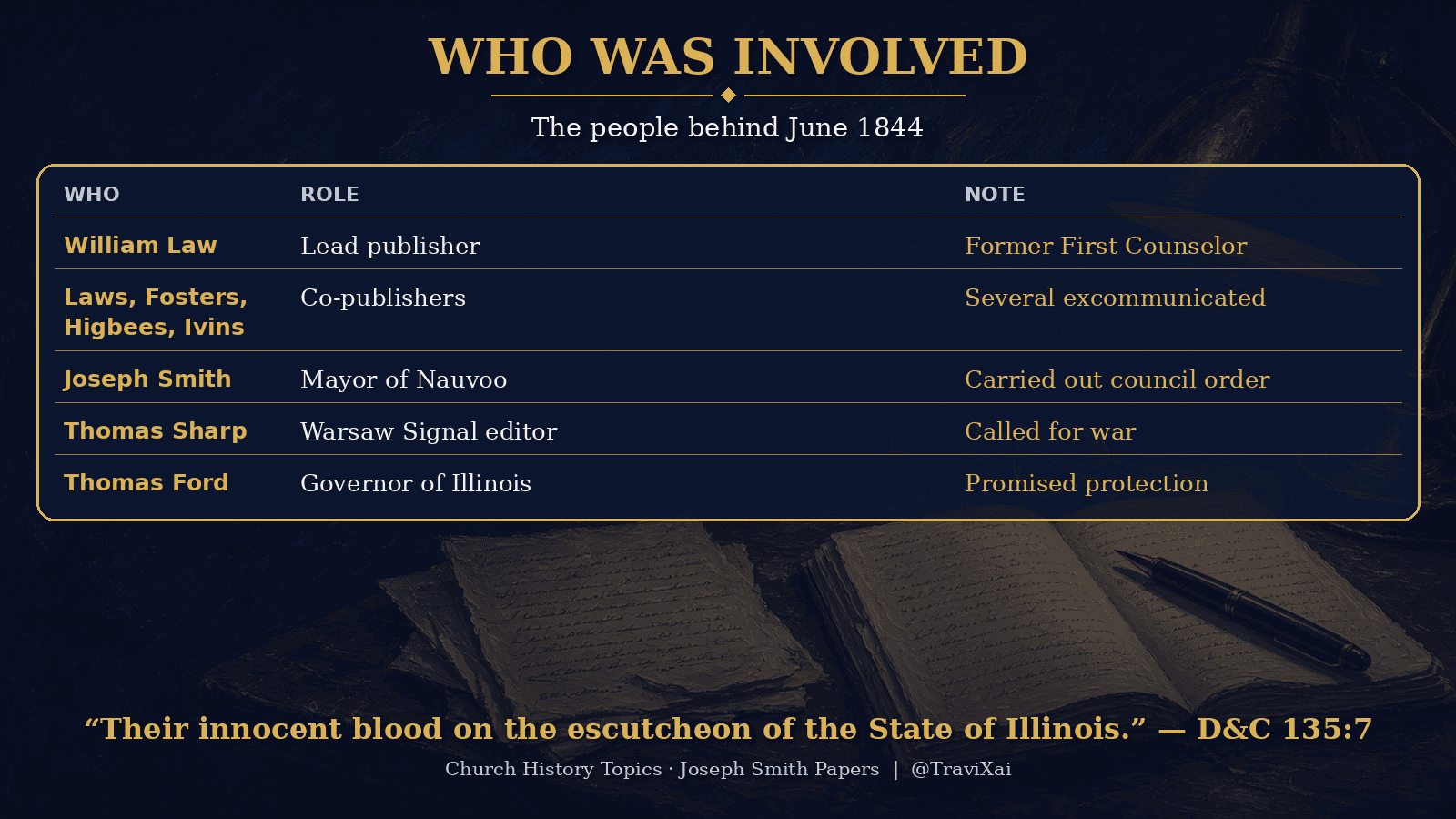
The publishers were William Law, who had been First Counselor in the First Presidency, his brother Wilson Law, Charles Ivins, Charles and Robert Foster, and Francis and Chauncey Higbee. Several had recently been excommunicated. In inflammatory language the paper attacked plural marriage, Joseph Smith’s teaching about God in the King Follett sermon, and his combining of church and civic power in Nauvoo. See Was God Once a Man? and Does the LDS Church Still Practice Polygamy?.
The council’s decisionTwo days of hearings
The city council met on Saturday, June 8, and Monday, June 10. It heard testimony about the publishers’ character, and on June 10 it unanimously passed an ordinance concerning libels. Then, at Joseph’s suggestion, it took up suppressing the paper. Most members agreed; the one non-member councilor, Benjamin Warrington, urged a more cautious course. The council resolved that the Expositor’s printing office was a public nuisance and directed the mayor to remove it. Joseph ordered the marshal to do it that evening. About 100 men removed the press, pied the type and burned the copies. Nobody was hurt.
Why act at all? The Church’s history gives two reasons. First and most important, the Saints had been driven out of Missouri by mobs only five years earlier, and the council feared the paper would incite the same against Nauvoo, and against the publishers too. Second, in the honor culture of 19th-century America, men were expected to answer public attacks on their character. Neither reason made the decision wise.
The legal reasoningBlackstone and the nuisance doctrine
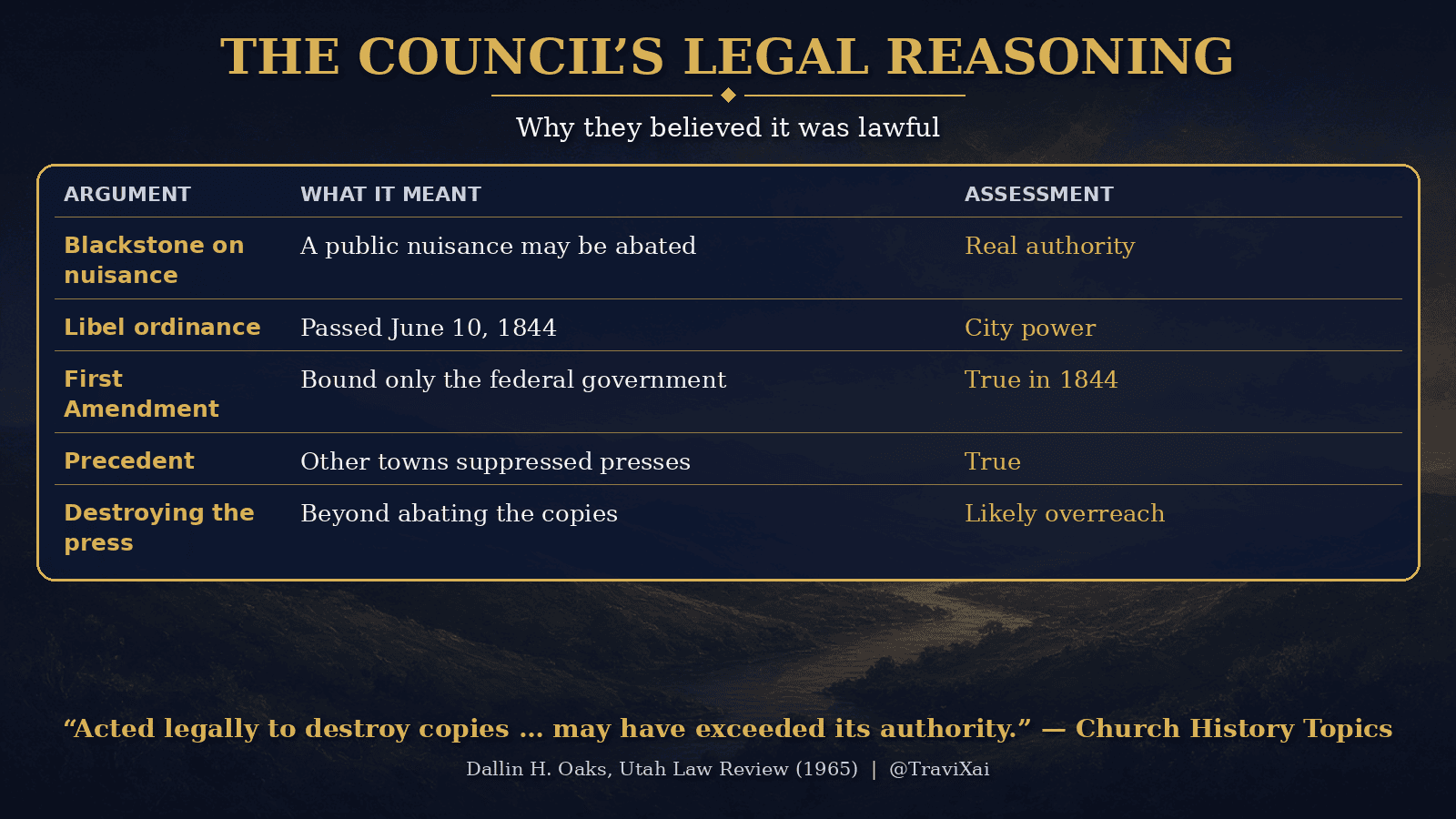
The council believed it was acting lawfully, and it had more of a case than most people assume. In the meetings Joseph cited American precedent and William Blackstone’s Commentaries on the Laws of England, the standard common-law treatise of the day, which allowed a public nuisance, something that endangered the safety of the community, to be abated, meaning removed. In 1844 the First Amendment restrained only the federal government. It did not bind states and cities until after the Fourteenth Amendment of 1868, and its press clause was not applied to the states until well into the 20th century. Local suppression of unpopular presses was not unheard of. As late as 1929 a state supreme court approved closing a newspaper as a nuisance; the U.S. Supreme Court reversed it in 1931 (Near v. Minnesota).
The careful legal verdict comes from Dallin H. Oaks, then a law professor, in a 1965 Utah Law Review article. The Church’s history summarizes it: “Scholars have concluded that the Nauvoo City Council acted legally to destroy copies of the newspaper but may have exceeded its authority by destroying the press itself.” Illinois’s own constitution also protected the right to print, with responsibility for abuse. So the council had a real legal theory, and it went further than that theory supported.
The road to CarthageRiot, martial law, treason
The reaction was immediate. In nearby Warsaw, Thomas Sharp, editor of the Warsaw Signal and a long-time enemy of the Church, called for war and extermination of the Saints. Francis Higbee swore a complaint, and on June 12 a constable from Carthage arrested Joseph and others for riot. The Nauvoo municipal court released them on a writ of habeas corpus, and a non-member justice of the peace later heard the case and discharged them. To their enemies, that looked like Nauvoo protecting its own. Armed men gathered in the county. On June 18 Joseph declared martial law and called out the Nauvoo Legion to defend the city.
Governor Thomas Ford came to Carthage, reviewed the council’s reasoning and insisted Joseph stand trial in Carthage, the county seat, on the riot charge, promising protection. Joseph briefly crossed the Mississippi to head west, then returned. On June 24 he left for Carthage: “I am going like a lamb to the slaughter; but I am calm as a summer’s morning; I have a conscience void of offense towards God, and towards all men” (D&C 135:4). He posted bail on the riot charge and was then held on a new charge of treason for declaring martial law. On June 27 a mob with blackened faces stormed the jail and killed him and Hyrum. He never stood trial for anything connected with the Expositor. In 1845 five men were tried for the murders, and all were acquitted. See Carthage: Like a Lamb to the Slaughter, Who Was Hyrum Smith? and Who Was John Taylor?.
An honest assessmentDefensible in theory, disastrous in practice
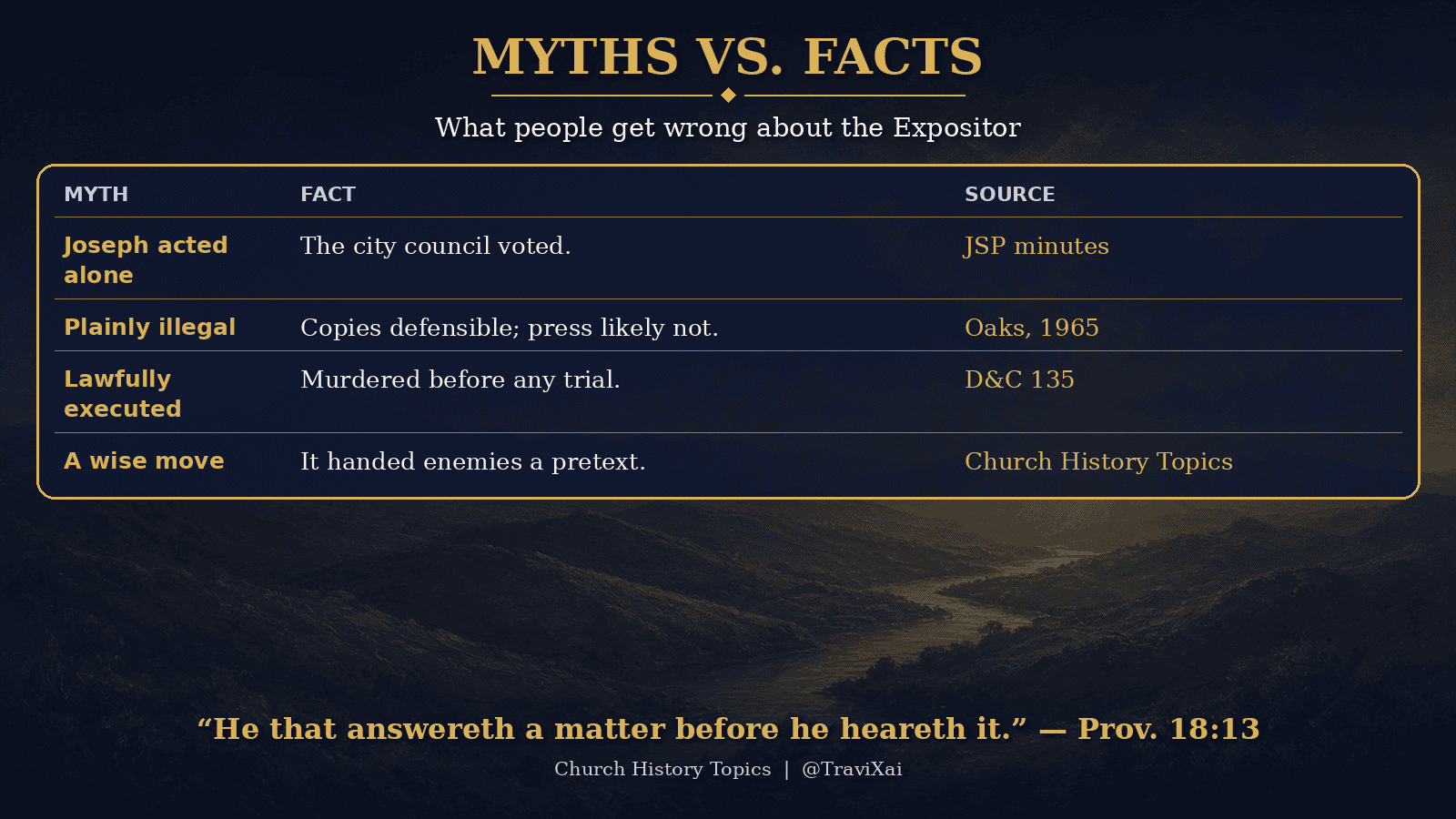
Here is the honest summary. The council had real fears and a real legal argument. It voted after hearings, and nobody was injured. But destroying the press went beyond what even its own nuisance theory clearly allowed, and politically it was a disaster: it handed men who already wanted the Saints gone exactly the pretext they needed, and it was used to rally a county against Nauvoo. Joseph Smith was a prophet, not an infallible city official. The Church does not claim otherwise. See Was Joseph Smith a Prophet? and Why Did Joseph Smith Run for President?.
What the honest summary does not allow is the leap critics often make, from “the press was destroyed” to “so he deserved what happened.” A disputed act by a city council is a matter for a court. Joseph went to the court. The state promised to protect him. A mob murdered him in its jail before any trial, and the men charged went free. Whatever you think of June 10, June 27 was murder.
The BibleAccusers face to face
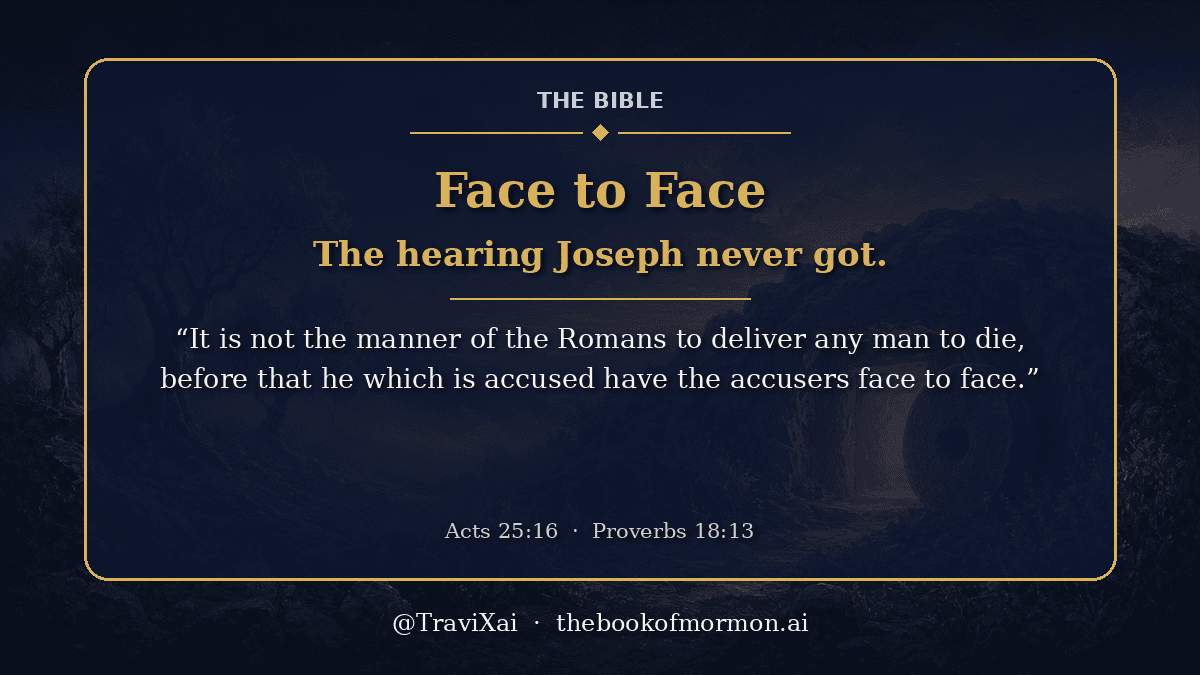
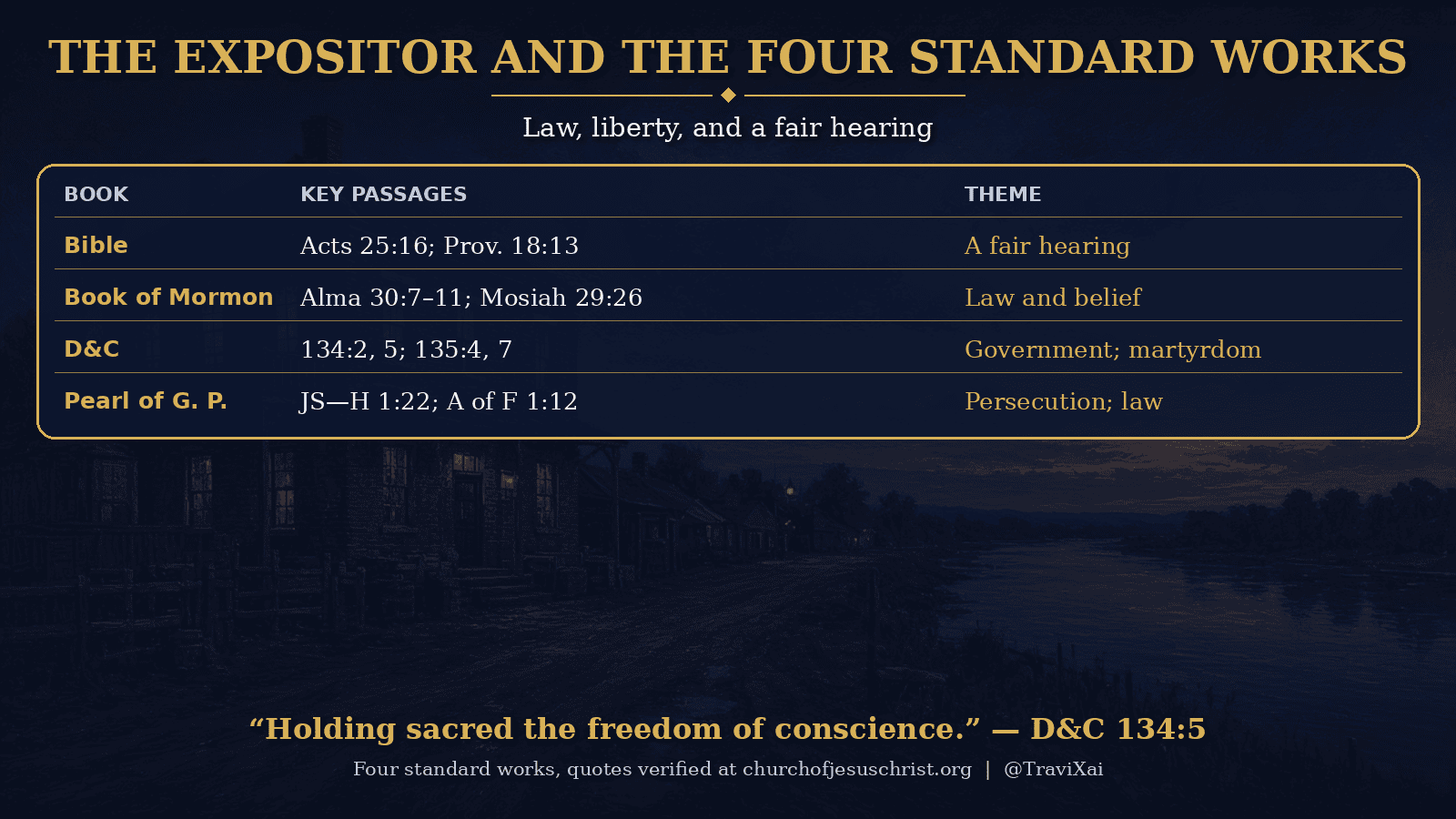
Even Roman law, as Festus described it, demanded more than Carthage gave: “It is not the manner of the Romans to deliver any man to die, before that he which is accused have the accusers face to face, and have licence to answer for himself concerning the crime laid against him” (Acts 25:16). The mob answered the question before it was heard, which Proverbs calls “folly and shame” (Proverbs 18:13). The same proverb is a fair warning to anyone, then or now, who judges the council’s decision without reading what it was facing.
The Book of MormonPunish crimes, not beliefs
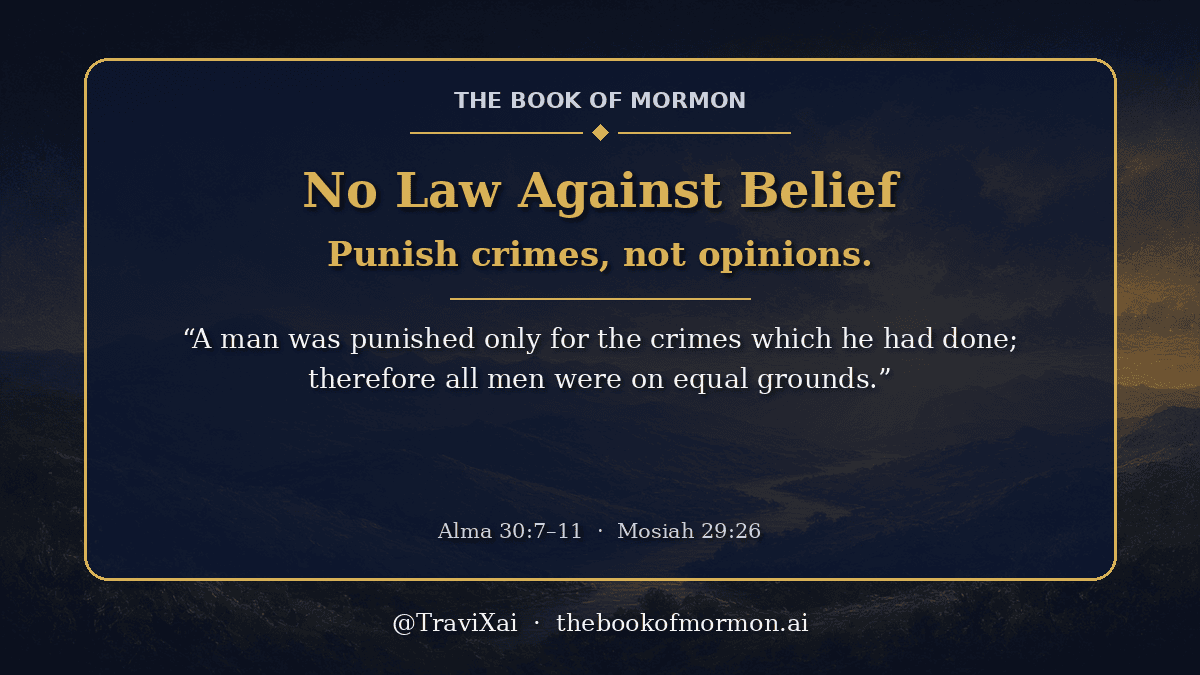
The Book of Mormon’s legal ideal is the right test for both sides of June 1844: “there was no law against a man’s belief … But if he murdered he was punished unto death; and if he robbed he was also punished … For there was a law that men should be judged according to their crimes. Nevertheless, there was no law against a man’s belief; therefore, a man was punished only for the crimes which he had done; therefore all men were on equal grounds” (Alma 30:7–11). The dissenters had the right to disbelieve and to publish. Joseph had the right to be tried for what he did, not killed for what he believed. Mosiah warns why the minority of a community so often desires “that which is not right” (Mosiah 29:26).
The Doctrine and CovenantsThe Saints’ own creed on government
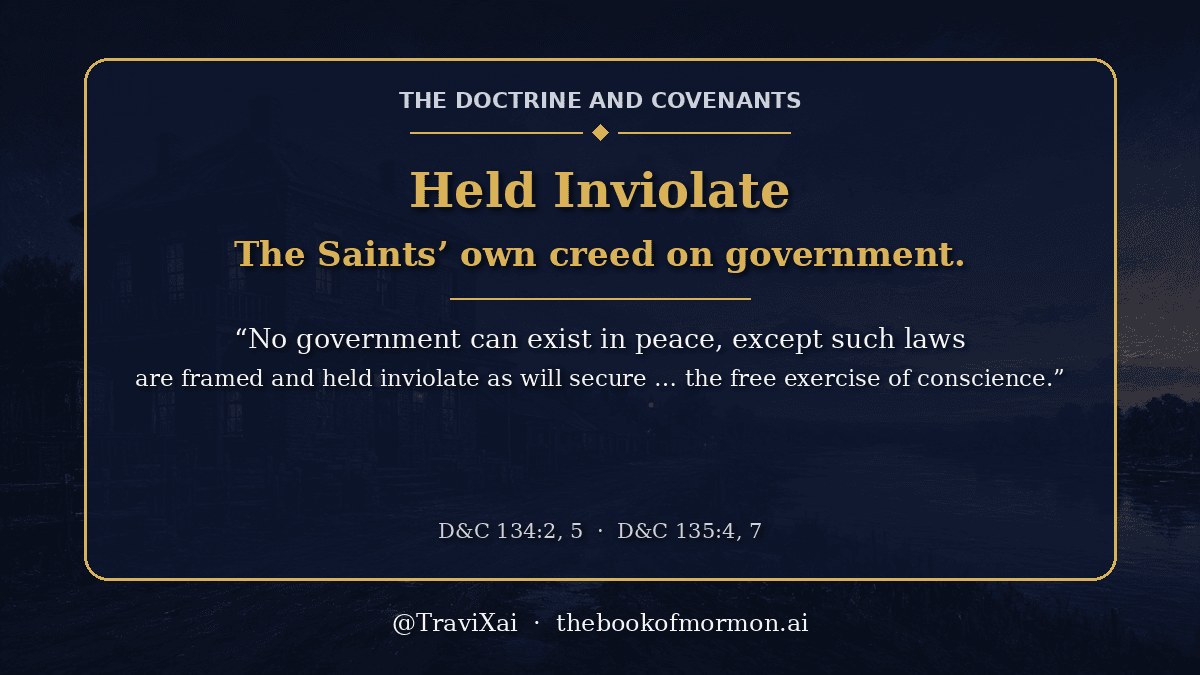
Section 134, adopted in 1835, states the Church’s position on government: “We believe that no government can exist in peace, except such laws are framed and held inviolate as will secure to each individual the free exercise of conscience, the right and control of property, and the protection of life” (D&C 134:2), and that governments may make laws for the public interest “at the same time, however, holding sacred the freedom of conscience” (D&C 134:5). By that standard the destruction of the press is open to criticism, and the Saints can admit it. By the same standard, what Illinois did is far worse: “their innocent blood on the escutcheon of the State of Illinois, with the broken faith of the State as pledged by the governor, is a witness to the truth of the everlasting gospel” (D&C 135:7).
The Pearl of Great PriceExciting the public mind
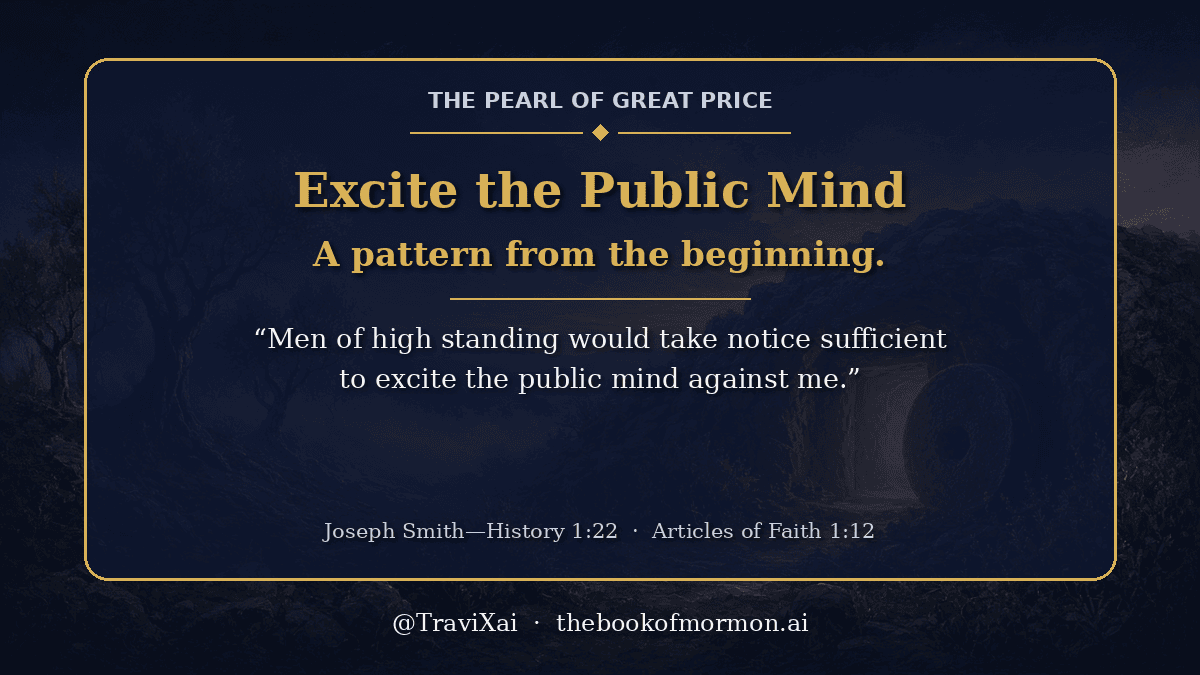
The pattern began with a fourteen-year-old boy: “men of high standing would take notice sufficient to excite the public mind against me, and create a bitter persecution” (Joseph Smith—History 1:22). In 1844 Thomas Sharp did exactly that with the Expositor. And Joseph’s own creed explains why he went to Carthage instead of fighting: “We believe in being subject to kings, presidents, rulers, and magistrates, in obeying, honoring, and sustaining the law” (Articles of Faith 1:12). He submitted to the law. The law failed to protect him. See What Are the Articles of Faith?.
Check the premiseThe presuppositions baked into the question
Before this question can be answered fairly, the person asking has to justify a few assumptions packed inside it:
- That Joseph Smith single-handedly destroyed a free press on a whim. The Nauvoo City Council voted after hearings on June 8 and 10, under a nuisance theory drawn from Blackstone; Joseph carried out the order as mayor.
- That the destruction was obviously illegal under the First Amendment. In 1844 the First Amendment bound only the federal government. Scholars, including Dallin H. Oaks, conclude destroying the copies was defensible but destroying the press likely exceeded the council’s authority.
- That the Expositor justified what happened at Carthage. Joseph surrendered to the law, was promised protection, and was murdered in jail before any trial (D&C 135:7).
- That admitting the council overreached undermines Joseph’s prophetic calling. Prophets are not infallible city officials. The Church’s own history calls the press destruction a likely overreach.
FAQQuick answers
What was the Nauvoo Expositor?
A newspaper published by dissenters from the Church in Nauvoo, Illinois, which printed only one issue, on June 7, 1844.
Who published the Nauvoo Expositor?
William Law, Wilson Law, Charles Ivins, Charles and Robert Foster, and Francis and Chauncey Higbee.
Why was the Nauvoo Expositor destroyed?
The city council declared it a public nuisance, fearing it would incite mob violence against Nauvoo, and directed Mayor Joseph Smith to remove it.
Who destroyed the Nauvoo Expositor press?
The city marshal and a posse of about 100 men, on Joseph Smith’s order as mayor, on the evening of June 10, 1844.
Was destroying the Nauvoo Expositor legal?
Partly arguable. The First Amendment did not yet bind cities, and nuisance law allowed abatement, but scholars conclude destroying the press itself likely exceeded the council’s authority.
What did Blackstone have to do with the Nauvoo Expositor?
Joseph Smith cited Blackstone’s Commentaries, which allowed a public nuisance to be abated, as legal support for the council’s action.
How did the Nauvoo Expositor lead to Joseph Smith’s death?
It led to riot charges, martial law, a treason charge and his jailing at Carthage, where a mob murdered him and Hyrum on June 27, 1844.
Was Joseph Smith ever tried for the Nauvoo Expositor?
No. He was killed in Carthage Jail before any trial took place.
SummaryKey takeaways
- One issue, June 7, 1844, published by dissenters led by William Law.
- The city council declared it a nuisance on June 10; the press was destroyed that night.
- Legal theory: Blackstone’s nuisance doctrine; the First Amendment did not yet bind cities.
- Honest verdict: copies defensible, press likely an overreach, politically disastrous.
- Joseph surrendered, was promised protection, and was murdered before any trial.
Read D&C 134 and 135 back to back. For quick, sourced answers, open Galatians18, and follow me on X at @TraviXai.
Sources
- King James Bible (churchofjesuschrist.org): Proverbs 18:13 · Acts 25:16
- Book of Mormon: Alma 30:7–11 · Mosiah 29:26
- Doctrine and Covenants: D&C 134:2 · D&C 134:5 · D&C 135:4 · D&C 135:7
- Pearl of Great Price: Joseph Smith—History 1:22 · Articles of Faith 1:12
- Church History Topics, “Nauvoo Expositor” · Joseph Smith Papers, “Order to Destroy Nauvoo Expositor Press”
- Dallin H. Oaks, “The Suppression of the Nauvoo Expositor,” Utah Law Review 9, no. 4 (1965) · Dallin H. Oaks and Marvin S. Hill, Carthage Conspiracy (1975)
- Featured image and in-article graphic: original graphics by thebookofmormon.ai (painterly backgrounds; no photographs or likenesses of real people).