
He handled the plates, sat in Liberty Jail, held the keys as patriarch and was called a prophet, seer and revelator. Then he died first at Carthage.
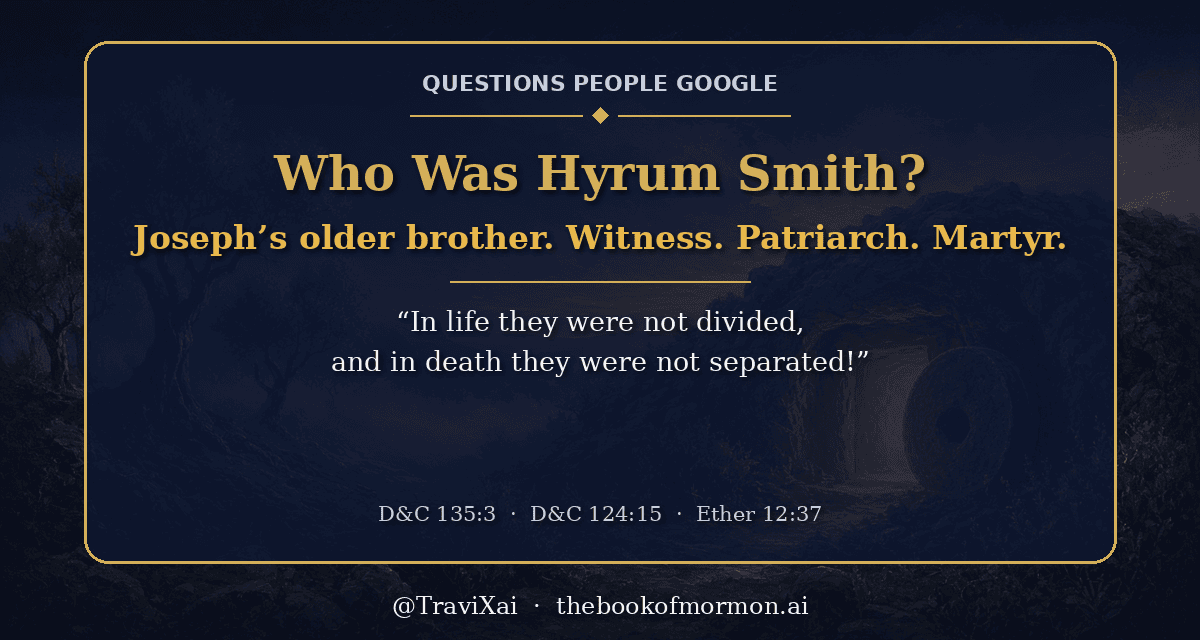
The question often assumes Hyrum Smith was only Joseph’s loyal shadow, or that family witnesses prove nothing. Neither holds up. Hyrum Smith (1800–1844) was Joseph Smith’s older brother, one of the Eight Witnesses of the plates and one of the Church’s six original members. He served in the First Presidency, became Presiding Patriarch in 1841, and was appointed by revelation “a prophet, and a seer, and a revelator” as Assistant President (D&C 124:94). He was shot first when a mob stormed Carthage Jail on June 27, 1844.
Who he wasJoseph’s older brother
Hyrum Smith (1800–1844) was the older brother of the Prophet Joseph Smith, one of the Eight Witnesses of the Book of Mormon plates, one of the six original members of the Church, Second Counselor in the First Presidency, Presiding Patriarch, and Assistant President of the Church. He was shot to death beside Joseph at Carthage Jail on June 27, 1844. Joseph described him this way in 1835: “I could pray in my heart that all my brethren were like unto my beloved brother Hyrum, who possesses the mildness of a lamb, and the integrity of a Job, and in short, the meekness and humility of Christ; and I love him with that love that is stronger than death.”
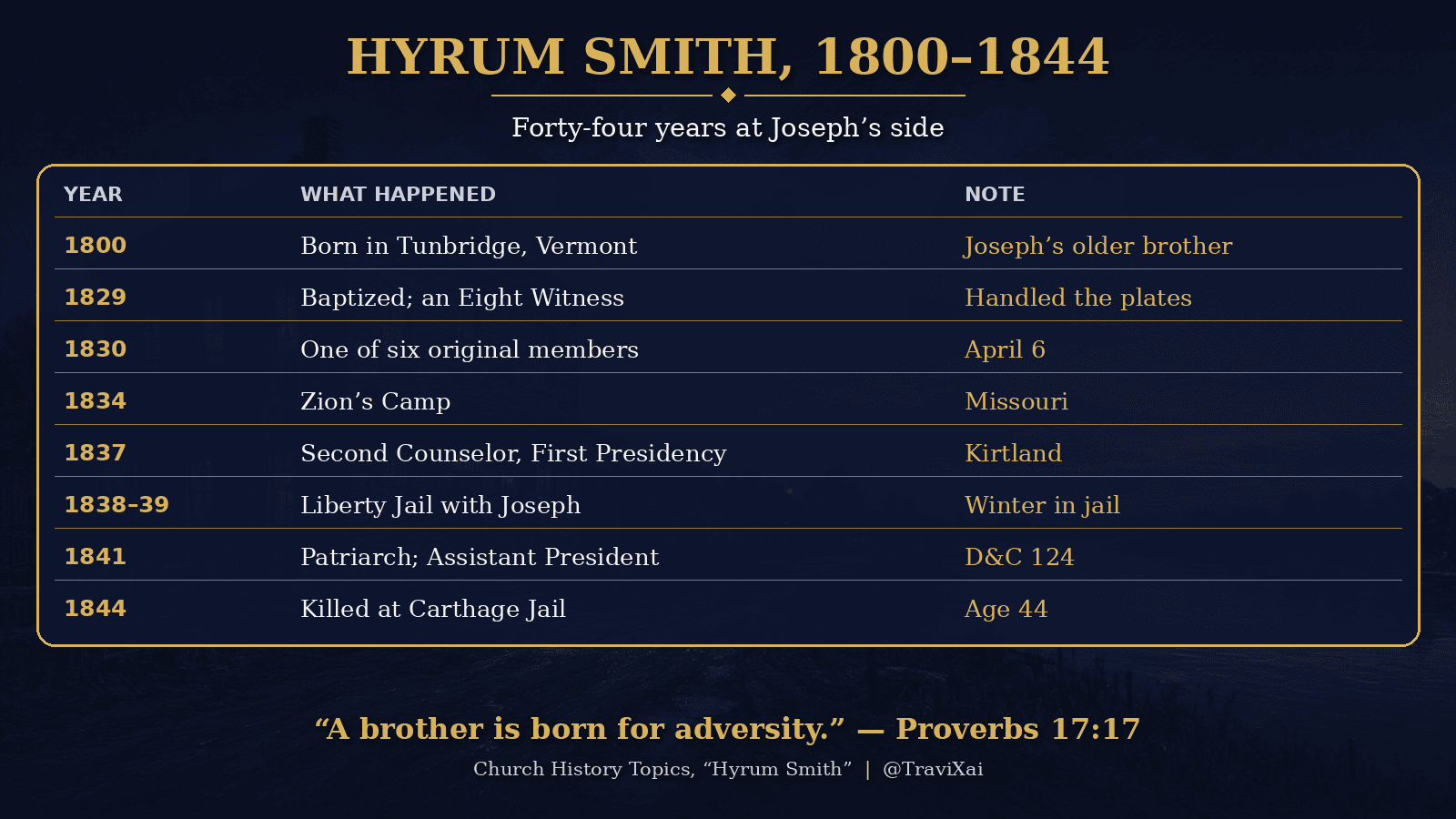
He was born February 9, 1800, in Tunbridge, Vermont. At 11 he attended Moor’s Charity School, connected with Dartmouth, and received more formal schooling than any of the Smith children. In Palmyra he served as a school trustee and helped interview Oliver Cowdery for a teaching job. After Alvin died in 1823, Hyrum carried much of the family’s farm and finances. See Who Was Oliver Cowdery?.
WitnessHe handled the plates
Hyrum believed early. In May 1829 a revelation told him to slow down: “Seek not to declare my word, but first seek to obtain my word, and then shall your tongue be loosed” (D&C 11:21). That June he was baptized and was one of the Eight Witnesses, who testified they had “seen and hefted” the plates. He helped arrange the printing of the Book of Mormon and was one of the six original members when the Church was organized on April 6, 1830.
Critics say the Eight Witnesses were mostly family and friends, so their testimony is worthless. Notice what that objection admits: these were the people best placed to know if Joseph was running a hoax, and they were the ones who saw the plates. Hyrum never denied what he saw. Not in Missouri, not in Liberty Jail, not at Carthage. See Is the Book of Mormon True?.
ServiceKirtland, Missouri, Nauvoo
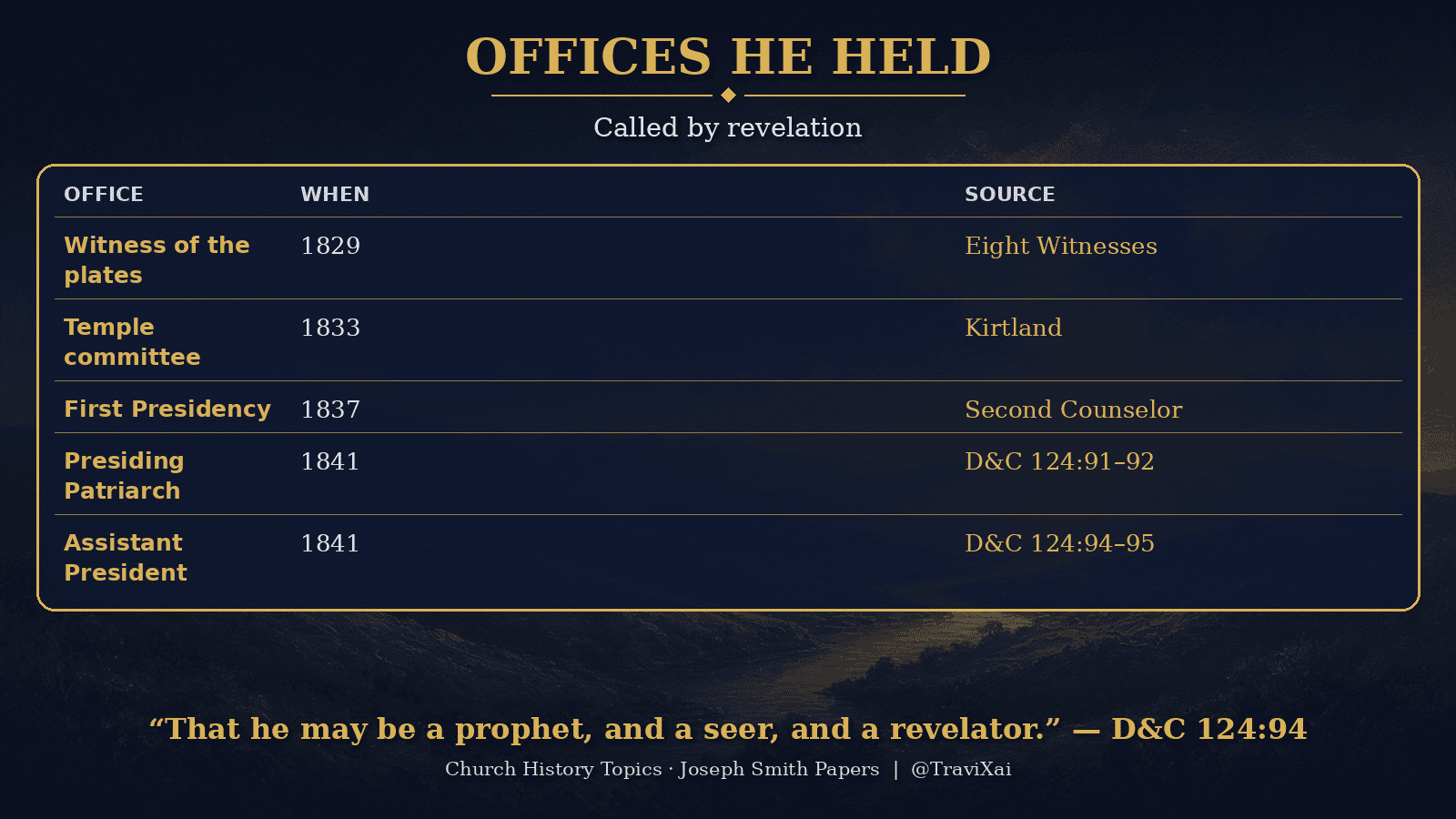
In Kirtland he served on the committee that built the temple, marched with Zion’s Camp in 1834 and sat on the high council. In 1837 he became Second Counselor in the First Presidency. In Missouri he was jailed with Joseph in Liberty Jail through the winter of 1838–39. His son Joseph F. Smith was born that November while Hyrum was a prisoner. See What Is the Kirtland Temple?, What Was Zion’s Camp? and Why Was Joseph Smith in Liberty Jail?.
In January 1841 the Lord made him Presiding Patriarch in place of his father, Joseph Smith Sr., and gave him the office Oliver Cowdery had held as Assistant President: “from this time forth I appoint unto him that he may be a prophet, and a seer, and a revelator unto my church, as well as my servant Joseph” (D&C 124:94). In Nauvoo he was also vice mayor, a member of the city council and the Nauvoo Temple committee. See What Is a Patriarchal Blessing?.
FamilySorrow, plural marriage, and a line of Presidents
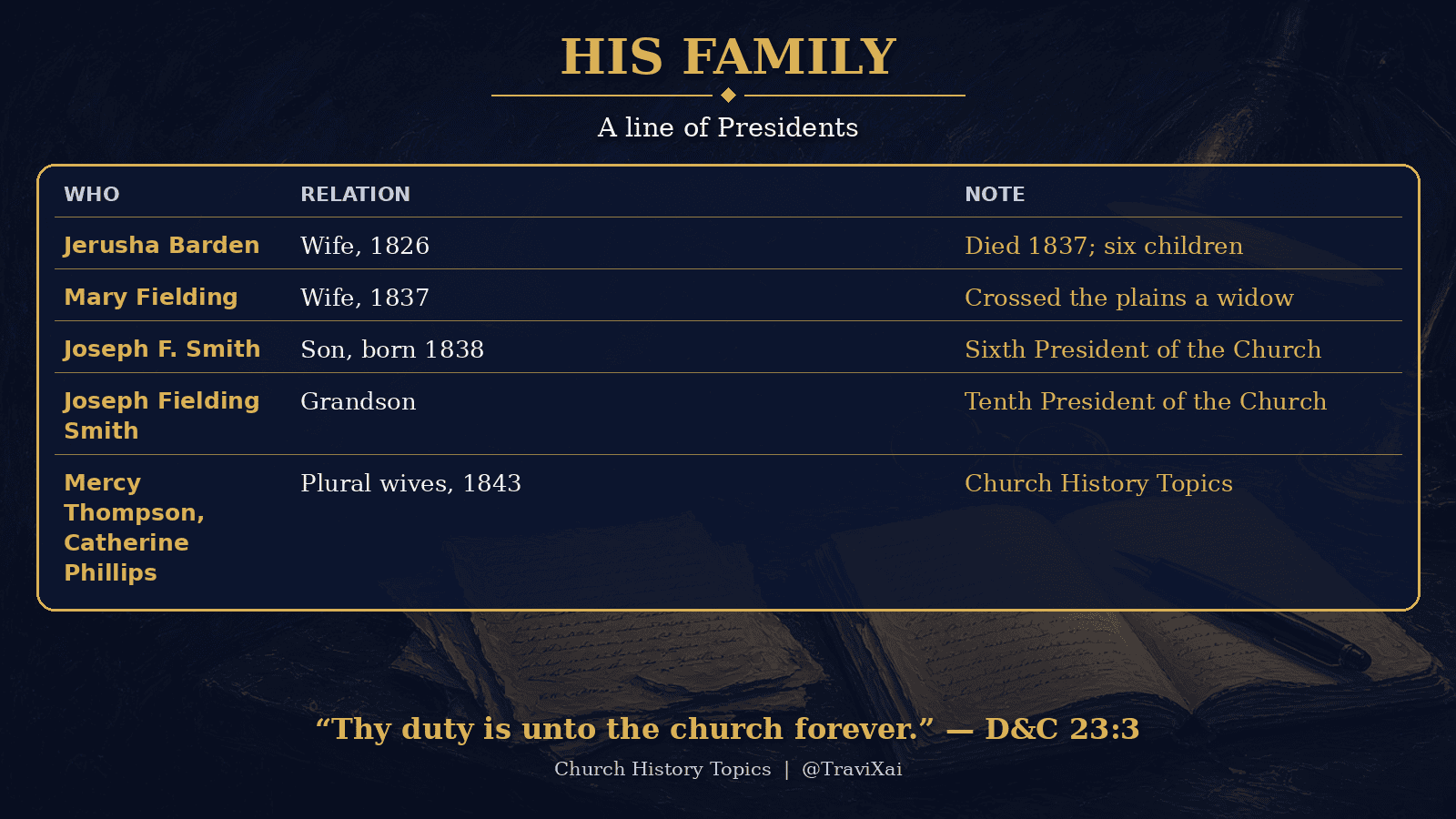
Hyrum married Jerusha Barden in 1826. They had six children. Their daughter Mary died in his arms at two years old in 1832: “Such a day I never before experienced and O may God grant that we may meet her again at the great day of redemption to part no more.” Jerusha died in 1837 after giving birth. A few months later he married Mary Fielding, a convert from Canada. Their son Joseph F. Smith became the sixth President of the Church, and their grandson Joseph Fielding Smith the tenth.
He is honest history on plural marriage too. Hyrum resisted it at first, then accepted it, and in 1843 married Catherine Phillips and Mary’s widowed sister, Mercy Fielding Thompson. He was the one who carried the written revelation now in D&C 132 to Emma in July 1843. That is a fact critics like to frame as Joseph forcing a doctrine on reluctant followers. The more natural reading: a man whose brother said he had the integrity of Job did not accept it until he was convinced it was from God. See Does the LDS Church Still Practice Polygamy? and Who Was Emma Smith?.
CarthageI am a dead man
In June 1844 the Nauvoo City Council had the Nauvoo Expositor press destroyed, and Joseph and Hyrum declared martial law to protect the city from mobs. They were charged with treason and went to Carthage. Joseph urged Hyrum to take his family and leave; Hyrum would not leave him. The morning they left, Hyrum read from Ether 12 and “turned down the leaf upon it” (D&C 135:4).
On June 27, a mob of 150 to 200 men with blackened faces stormed the jail. “Hyrum was shot first and fell calmly, exclaiming: I am a dead man! Joseph leaped from the window, and was shot dead in the attempt” (D&C 135:1). They were never tried. They were murdered while held for a hearing, under the governor’s pledge of protection (D&C 135:7). The verdict scripture gives: “In life they were not divided, and in death they were not separated!” (D&C 135:3). See Carthage: Like a Lamb to the Slaughter.
The BibleA brother born for adversity
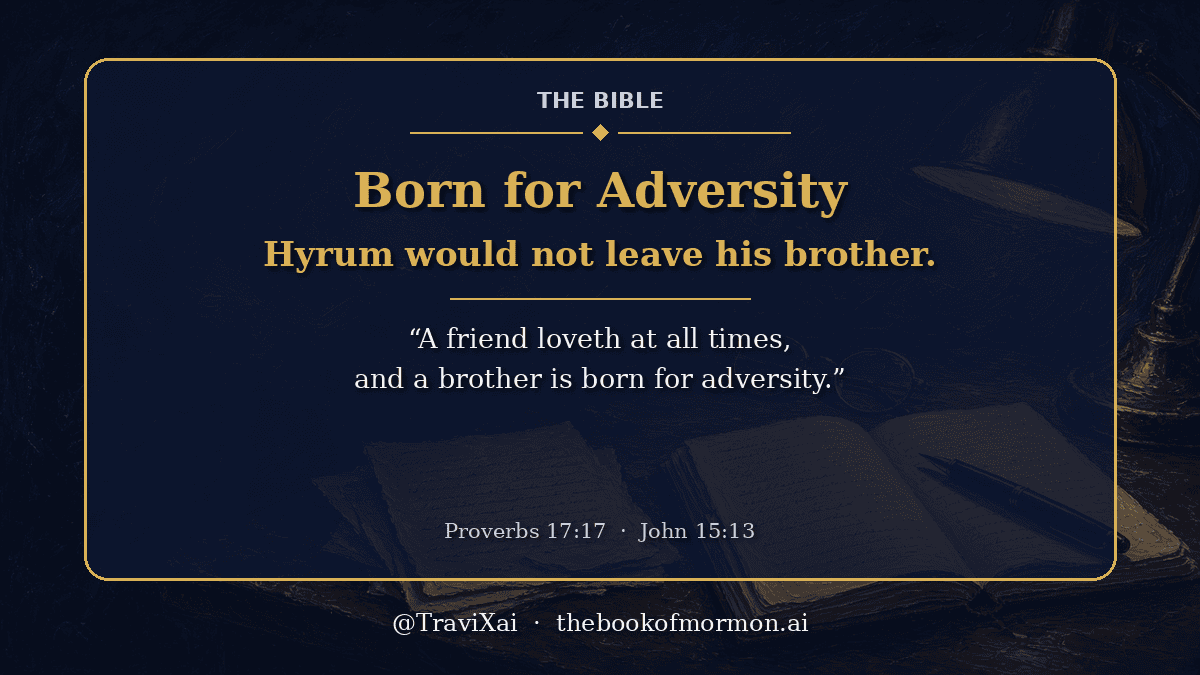
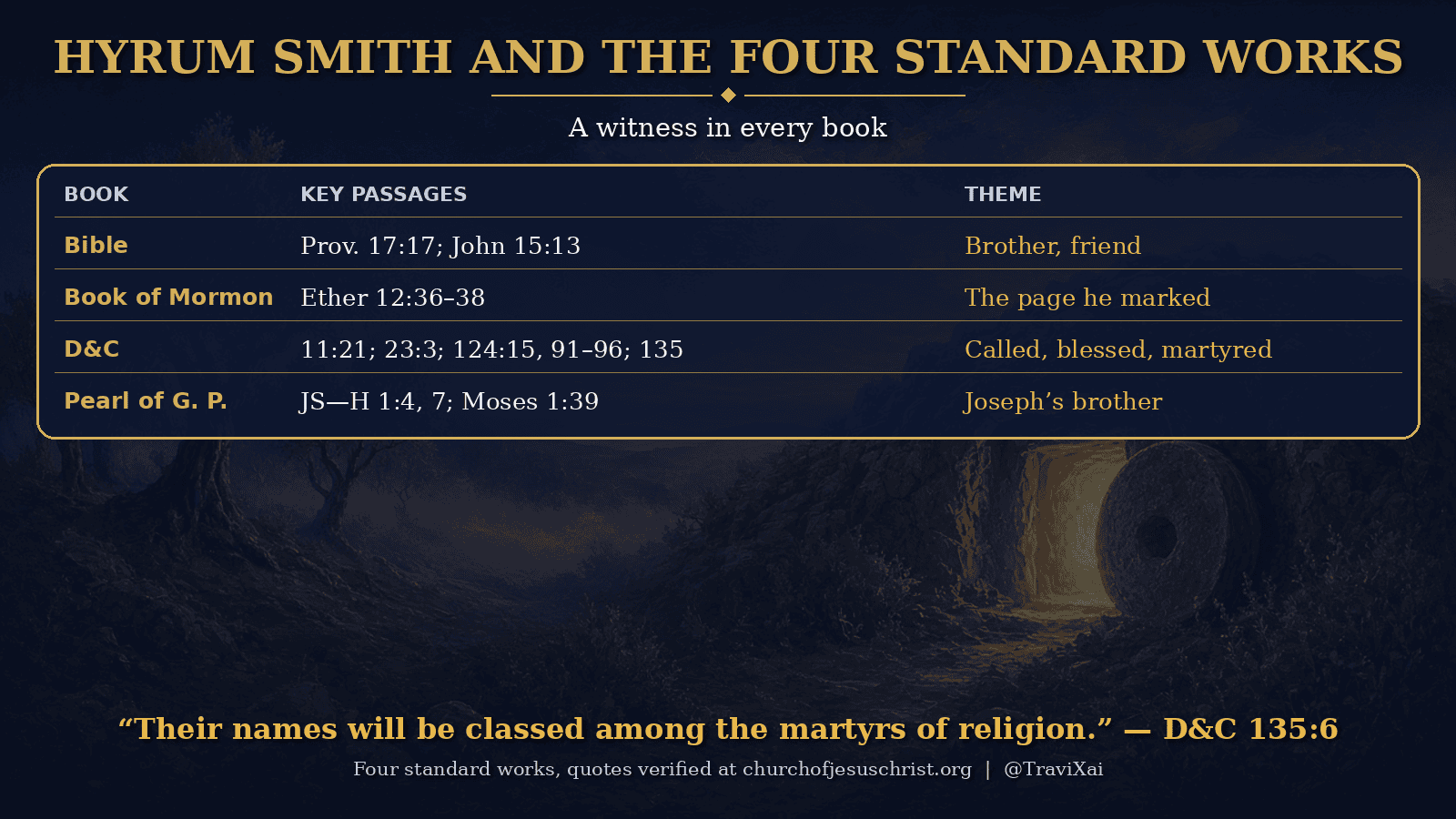
Proverbs could have been written about Hyrum: “A friend loveth at all times, and a brother is born for adversity” (Proverbs 17:17). Hyrum was Joseph’s brother in prison, in court, in exile and in death. And the Savior set the standard Hyrum met at Carthage: “Greater love hath no man than this, that a man lay down his life for his friends” (John 15:13).
The Book of MormonThe page he turned down
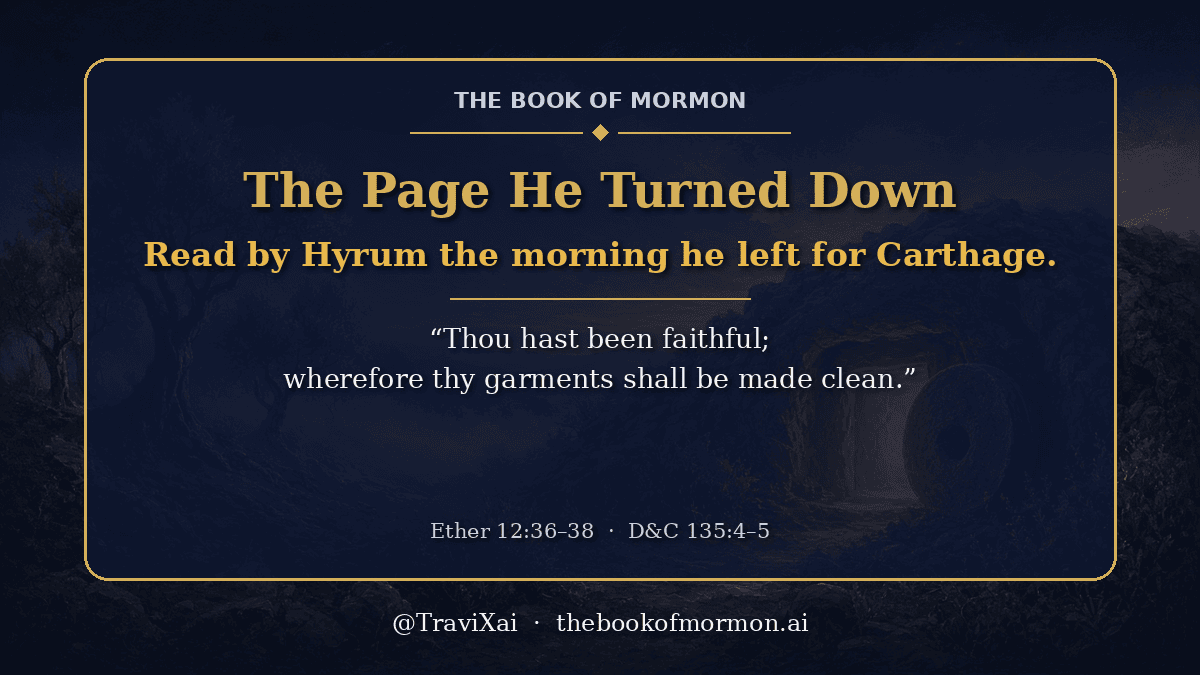
The passage Hyrum marked is Moroni’s farewell: “And it came to pass that the Lord said unto me: If they have not charity it mattereth not unto thee, thou hast been faithful; wherefore, thy garments shall be made clean. And because thou hast seen thy weakness thou shalt be made strong, even unto the sitting down in the place which I have prepared in the mansions of my Father. And now I, Moroni, bid farewell unto the Gentiles, yea, and also unto my brethren whom I love, until we shall meet before the judgment-seat of Christ, where all men shall know that my garments are not spotted with your blood” (Ether 12:37–38). A witness of the plates, reading the record from the plates, on the way to die for it. That is what a witness looks like.
The Doctrine and CovenantsThe integrity of his heart
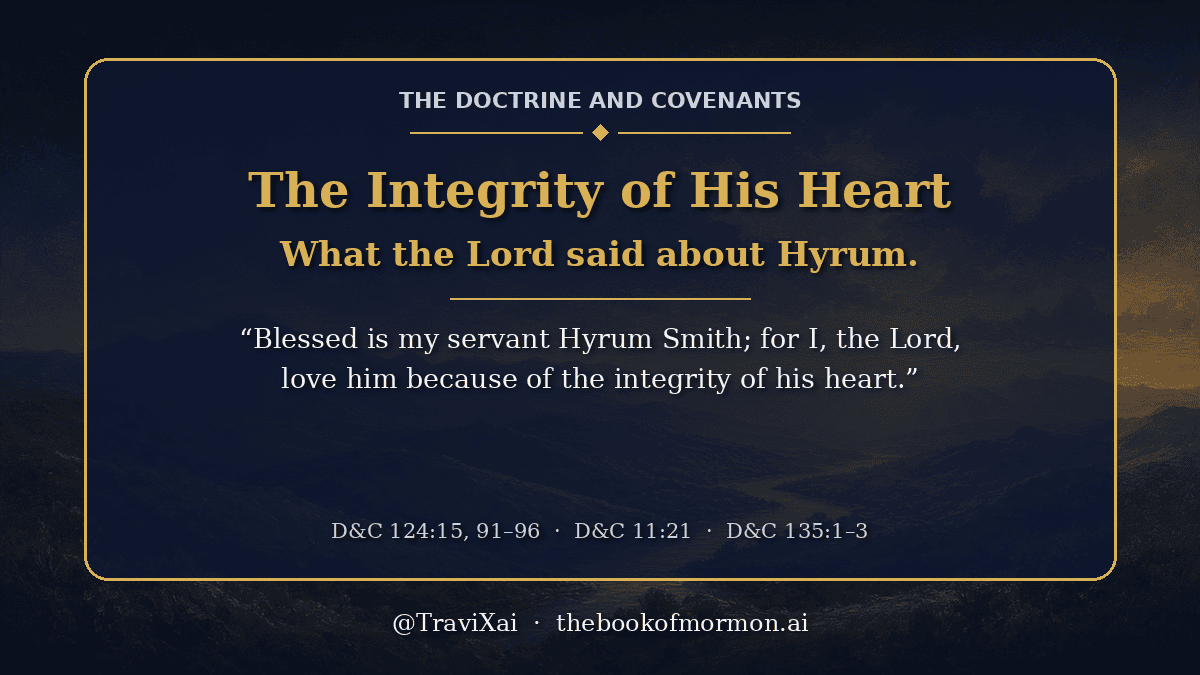
The Lord’s own assessment: “blessed is my servant Hyrum Smith; for I, the Lord, love him because of the integrity of his heart, and because he loveth that which is right before me, saith the Lord” (D&C 124:15). His calling as patriarch carried the sealing language: “whatsoever he shall bind on earth shall be bound in heaven” (D&C 124:93), and the promise “that his name may be had in honorable remembrance from generation to generation, forever and ever” (D&C 124:96). In 1830 the Lord told him “thy calling is to exhortation, and to strengthen the church continually” (D&C 23:3). He did exactly that for fourteen years.
The Pearl of Great PriceIn Joseph’s own history
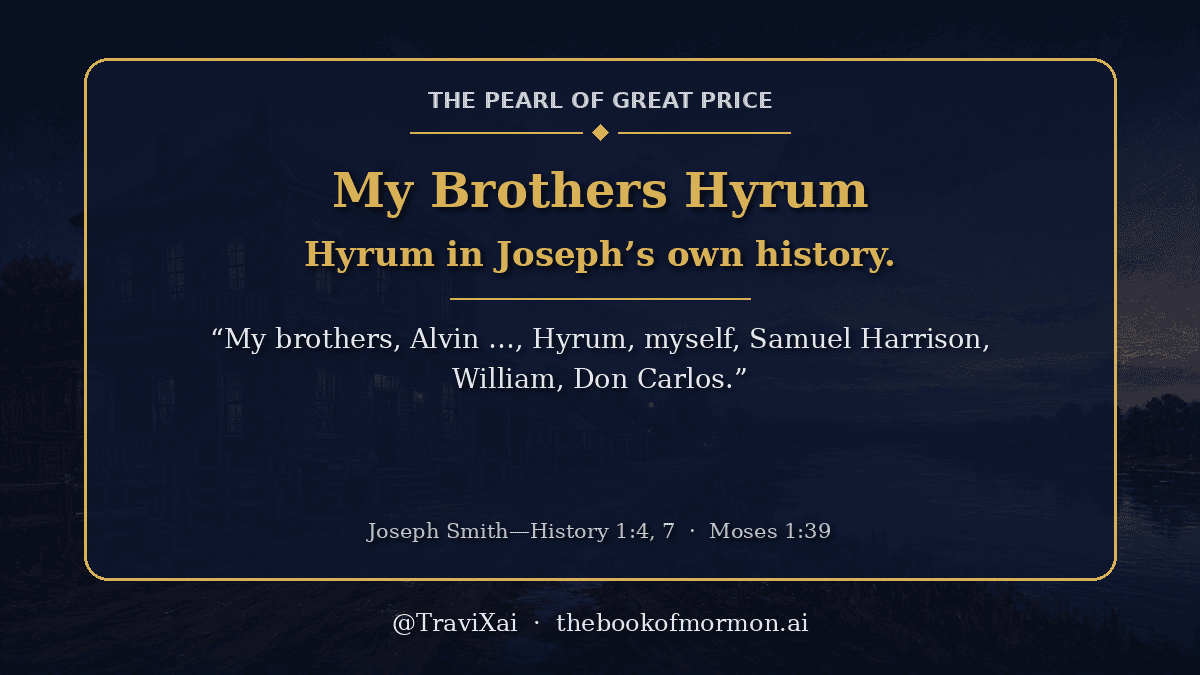
Hyrum appears in Joseph’s canonized history, listed among the family: “my brothers, Alvin (who died November 19th, 1823, in the 26th year of his age), Hyrum, myself, Samuel Harrison, William, Don Carlos” (Joseph Smith—History 1:4). During the revivals before the First Vision, “four of them joined that church, namely, my mother, Lucy; my brothers Hyrum and Samuel Harrison; and my sister Sophronia” (Joseph Smith—History 1:7). Hyrum went from a Presbyterian pew to the patriarch’s chair because he believed his little brother. Everything he did after served the purpose the Lord stated to Moses: “to bring to pass the immortality and eternal life of man” (Moses 1:39). See What Is the Pearl of Great Price?.
Check the premiseThe presuppositions baked into the question
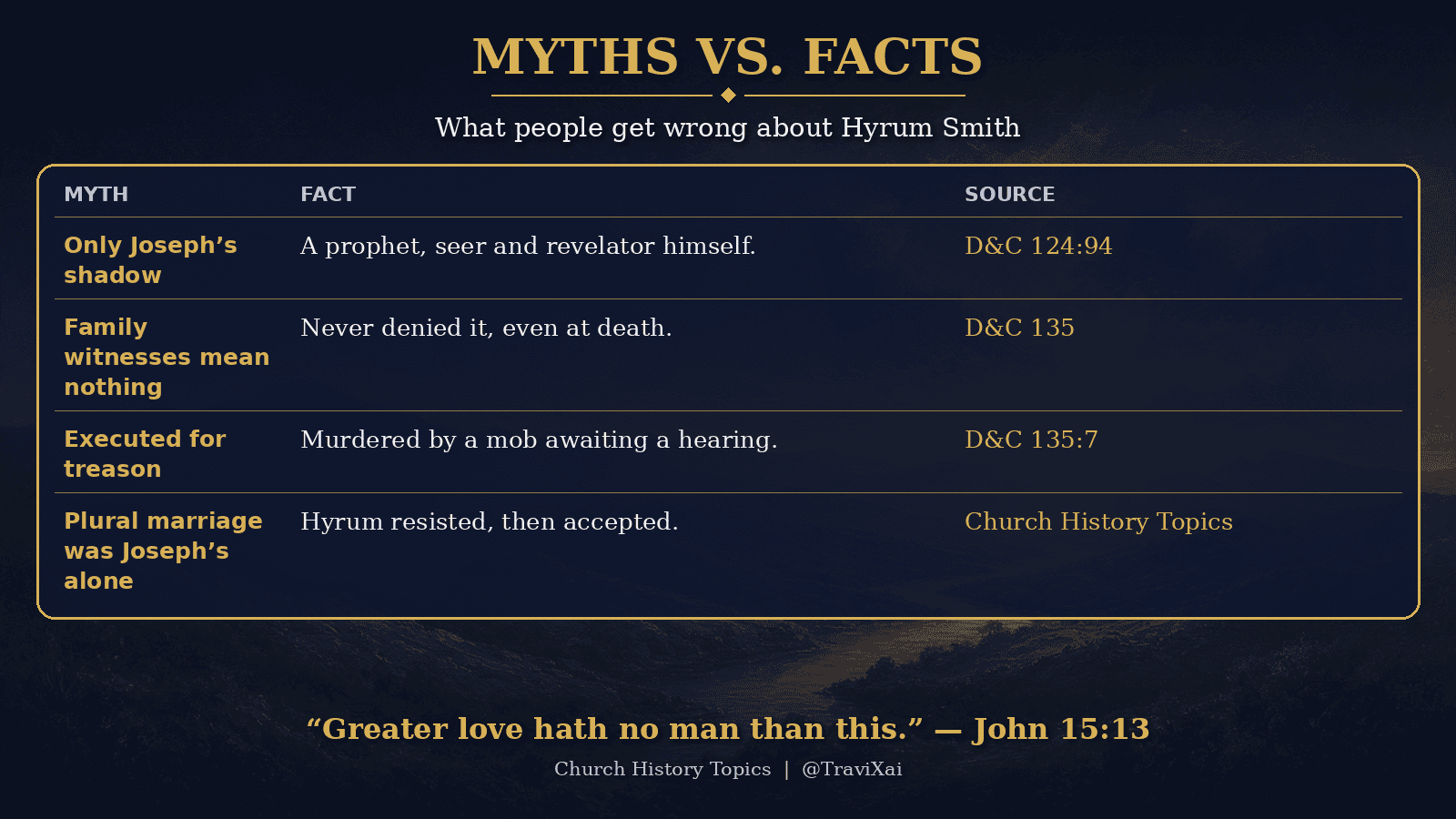
Before this question can be answered fairly, the person asking has to justify a few assumptions packed inside it:
- That Hyrum was only Joseph’s loyal shadow. The Lord appointed him “a prophet, and a seer, and a revelator unto my church, as well as my servant Joseph” (D&C 124:94).
- That family witnesses of the plates prove nothing. Family were the people best placed to expose a hoax. Hyrum saw the plates and never denied it, all the way to Carthage.
- That Joseph and Hyrum were lawfully executed for treason. They were never tried. A mob with blackened faces murdered them in jail, under the governor’s pledge of protection (D&C 135:1, 7).
- That plural marriage was Joseph’s private invention his brother opposed. Hyrum resisted at first, then accepted it, married plural wives in 1843 and carried the revelation to Emma.
FAQQuick answers
Who was Hyrum Smith?
Joseph Smith’s older brother, one of the Eight Witnesses, Presiding Patriarch and Assistant President of the Church, killed at Carthage Jail in 1844.
Was Hyrum Smith a witness of the Book of Mormon?
Yes. He was one of the Eight Witnesses who saw and handled the plates in 1829, and he never denied it.
Was Hyrum Smith older than Joseph Smith?
Yes. Hyrum was born February 9, 1800; Joseph was born December 23, 1805.
What offices did Hyrum Smith hold?
Second Counselor in the First Presidency, Presiding Patriarch, and Assistant President of the Church, called a prophet, seer and revelator in D&C 124.
How did Hyrum Smith die?
He was shot first when a mob stormed Carthage Jail on June 27, 1844, exclaiming, “I am a dead man!” He was 44.
What did Hyrum Smith read before going to Carthage?
Ether 12:36–38, Moroni’s farewell. He turned down the page, as D&C 135:4–5 records.
Who are Hyrum Smith’s famous descendants?
His son Joseph F. Smith and grandson Joseph Fielding Smith were each President of the Church.
Who were Hyrum Smith’s wives?
Jerusha Barden (died 1837), Mary Fielding, and from 1843 the plural wives Mercy Fielding Thompson and Catherine Phillips.
SummaryKey takeaways
- Joseph’s older brother, born 1800; one of the Eight Witnesses.
- One of six original members of the Church in 1830.
- Liberty Jail with Joseph; Second Counselor in the First Presidency.
- Presiding Patriarch and Assistant President by revelation (D&C 124).
- Killed at Carthage on June 27, 1844, at 44.
Read Ether 12 tonight, the page Hyrum turned down. For quick, sourced answers, open Galatians18, and follow me on X at @TraviXai.
Sources
- King James Bible (churchofjesuschrist.org): Proverbs 17:17 · John 15:13
- Book of Mormon: Ether 12:36–38
- Doctrine and Covenants: D&C 11:21 · D&C 23:3 · D&C 124:15 · D&C 124:91–96 · D&C 135:1–7
- Pearl of Great Price: Joseph Smith—History 1:4 · Joseph Smith—History 1:7 · Moses 1:39
- Church History Topics, “Hyrum Smith” · Joseph Smith journal, December 18, 1835 (History of the Church 2:338)
- M. Russell Ballard, “Hyrum Smith: ‘Firm as the Pillars of Heaven,’” Ensign, Nov. 1995 · Ronald K. Esplin, “Hyrum Smith: The Mildness of a Lamb, the Integrity of Job,” Ensign, Feb. 2000
- Featured image and in-article graphic: original graphics by thebookofmormon.ai (painterly backgrounds; no photographs or likenesses of real people).