
The first 116 pages of the Book of Mormon vanished in 1828. Here is what they were, what replaced them, and why the Lord said not to redo them.
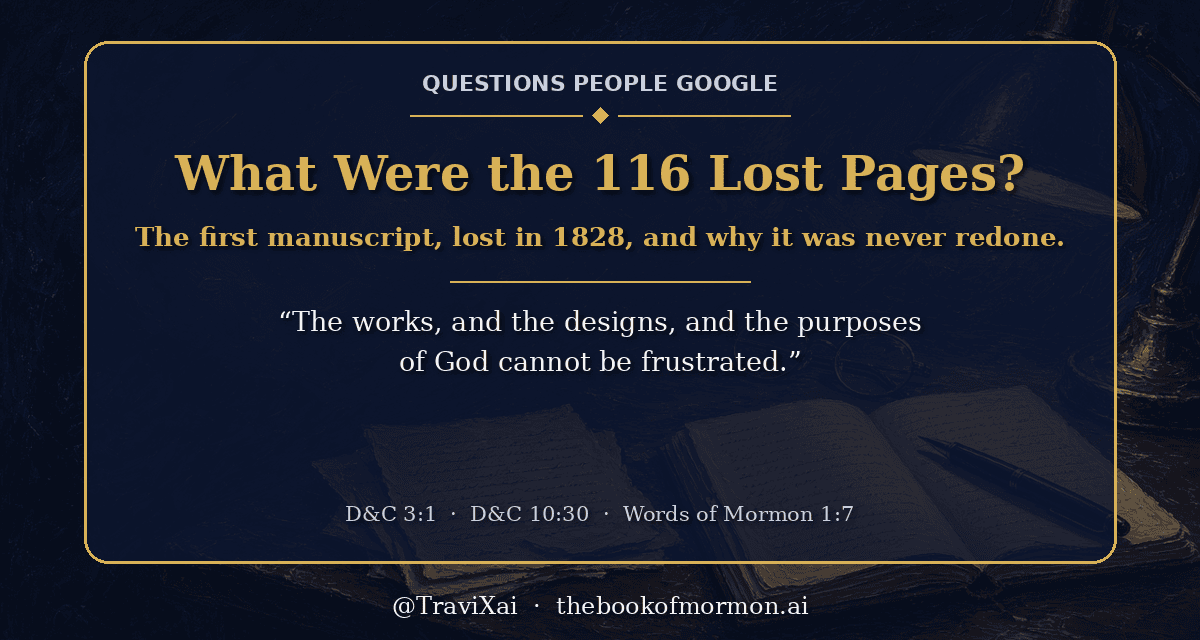
The question usually assumes a real prophet could simply retranslate the pages, and that not doing so proves fraud. Both assumptions miss what the record says. The 116 pages were the first manuscript of the Book of Mormon, the book of Lehi, lost by Martin Harris in June 1828. The Lord forbade retranslating them because the stolen copy had been altered to trap Joseph: “you shall not translate again those words which have gone forth out of your hands” (D&C 10:30). Instead he translated the small plates of Nephi, which Nephi had made “for a wise purpose” about 2,400 years earlier (1 Nephi 9:5).
What happenedSummer 1828
Joseph Smith began translating the gold plates in earnest in April 1828 in Harmony, Pennsylvania, with Martin Harris, a prosperous Palmyra farmer, as his scribe. By mid-June they had 116 manuscript pages, the opening of Mormon’s abridgment, which the D&C calls “the book of Lehi.” Martin wanted to show the pages to his wife and family, who doubted the work. Joseph asked the Lord, was refused, asked again and was refused, and on the third request was allowed to let Martin take them on strict conditions.
Martin took the pages home to Palmyra in June 1828. Shortly after, on June 15, Emma gave birth to their first son, Alvin, who died, and Emma nearly died with him. When Joseph finally went to Palmyra in July, Martin admitted the pages were gone. They have never been found. Who took them is unknown; many at the time suspected people in Martin’s own household who opposed the work.
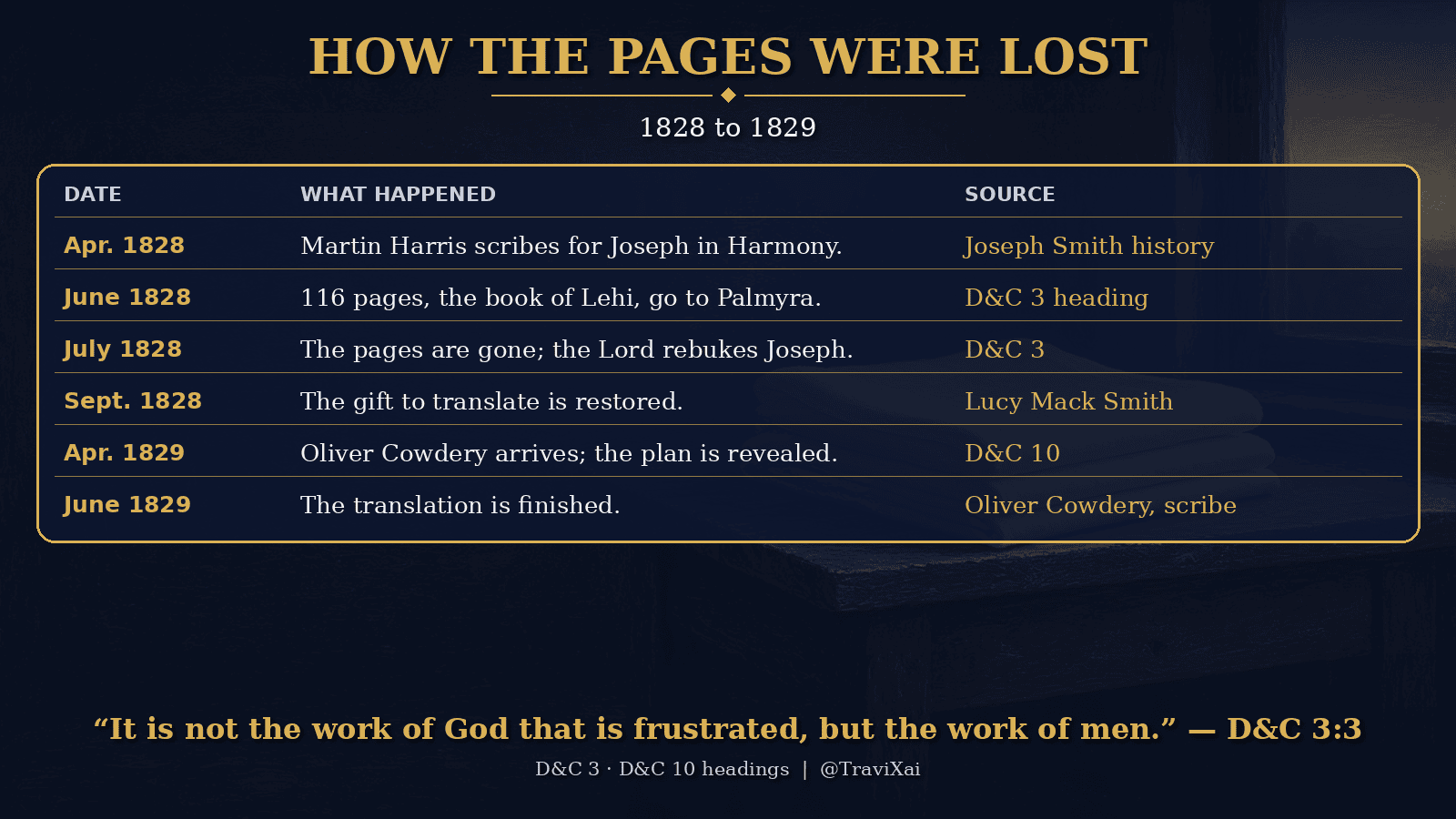
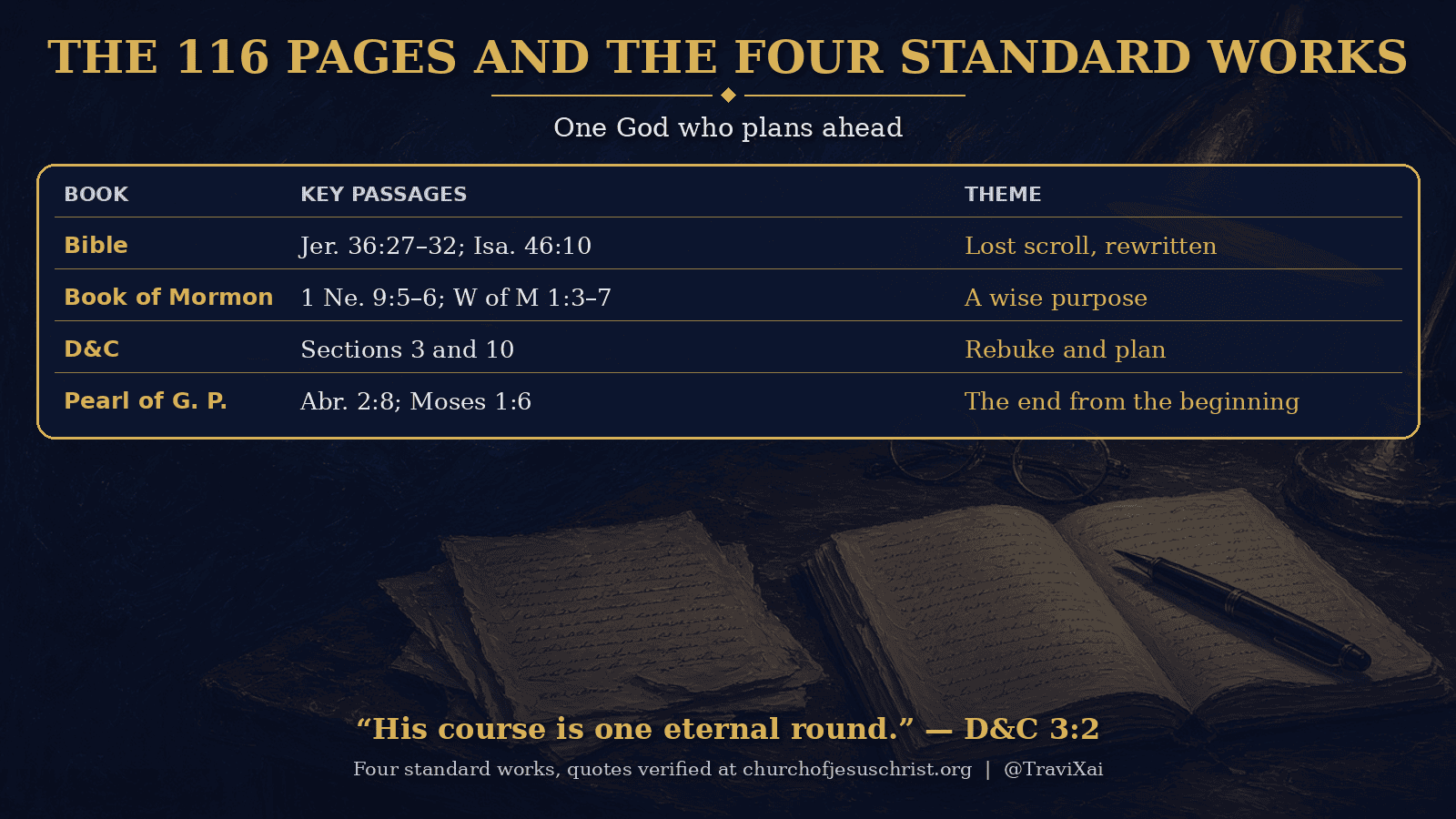
The Lord’s response, section 3, came that July. It does not spare Joseph: “although a man may have many revelations, and have power to do many mighty works, yet if he boasts in his own strength, and sets at naught the counsels of God, and follows after the dictates of his own will and carnal desires, he must fall” (D&C 3:4). Joseph lost the gift for a time and received it again that fall. Then in 1829, with Oliver Cowdery as scribe, the work went on, and it was finished by the end of June. See How the Book of Mormon Was Translated.
What replaced themThe small plates of Nephi
Here is the striking part. The 116 pages covered roughly 600 to 130 B.C., from Lehi to King Benjamin. But a second, independent record of those same years was already on the plates. Around 570 B.C., Nephi wrote that the Lord commanded him to make a second set of plates “for a wise purpose in him, which purpose I know not. But the Lord knoweth all things from the beginning; wherefore, he prepareth a way to accomplish all his works” (1 Nephi 9:5–6).
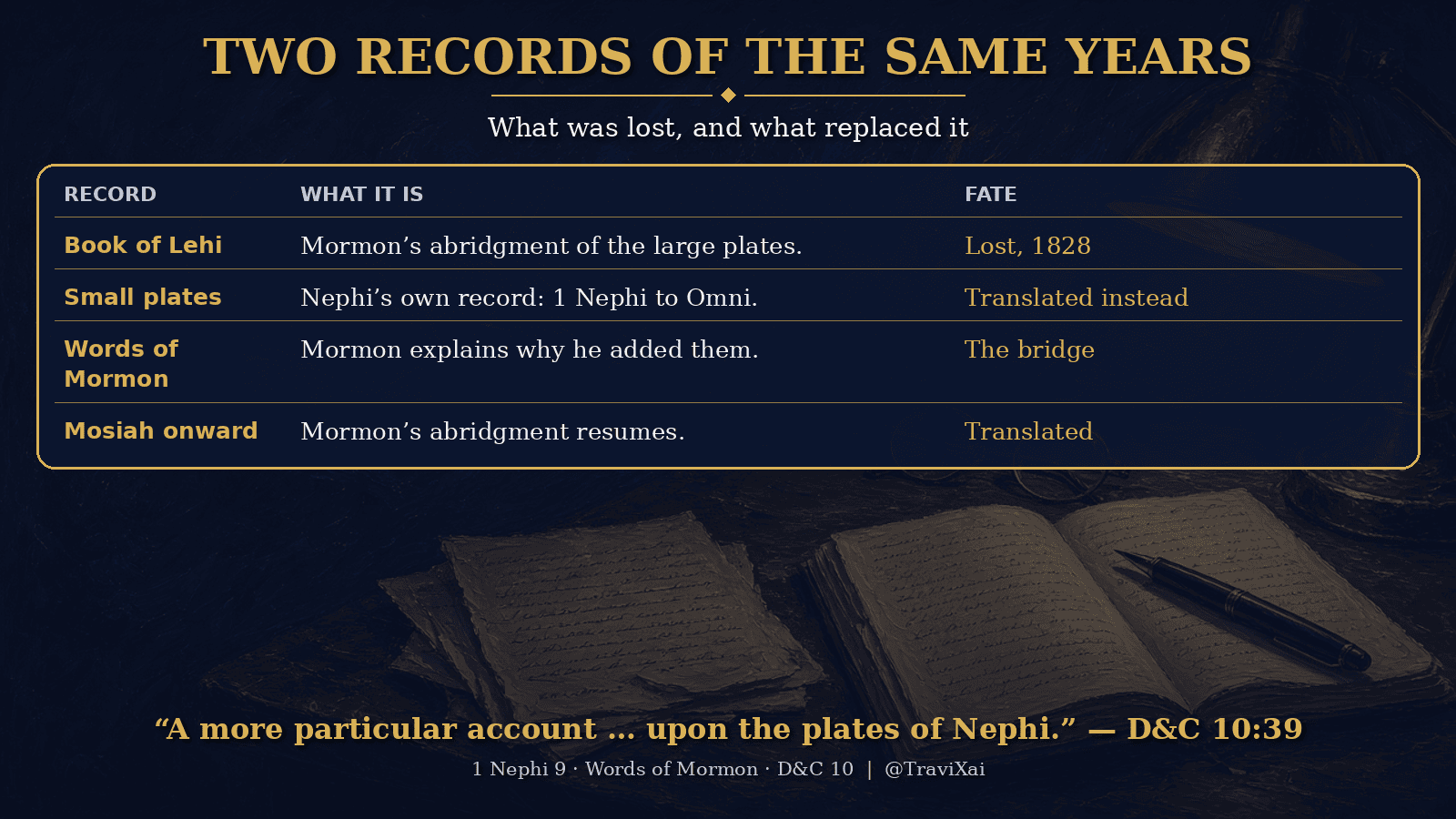
About a thousand years later, Mormon found those small plates while abridging and decided to include them, also without knowing why: “I do this for a wise purpose; for thus it whispereth me, according to the workings of the Spirit of the Lord which is in me. And now, I do not know all things; but the Lord knoweth all things which are to come” (Words of Mormon 1:3–7). The books of 1 Nephi through Omni in your Book of Mormon today are those small plates. Most Latter-day Saints would say they are the better trade: Nephi’s own first-person spiritual record instead of an abridged history. See What Is the Book of Mormon About?.
The BibleGod has done this before
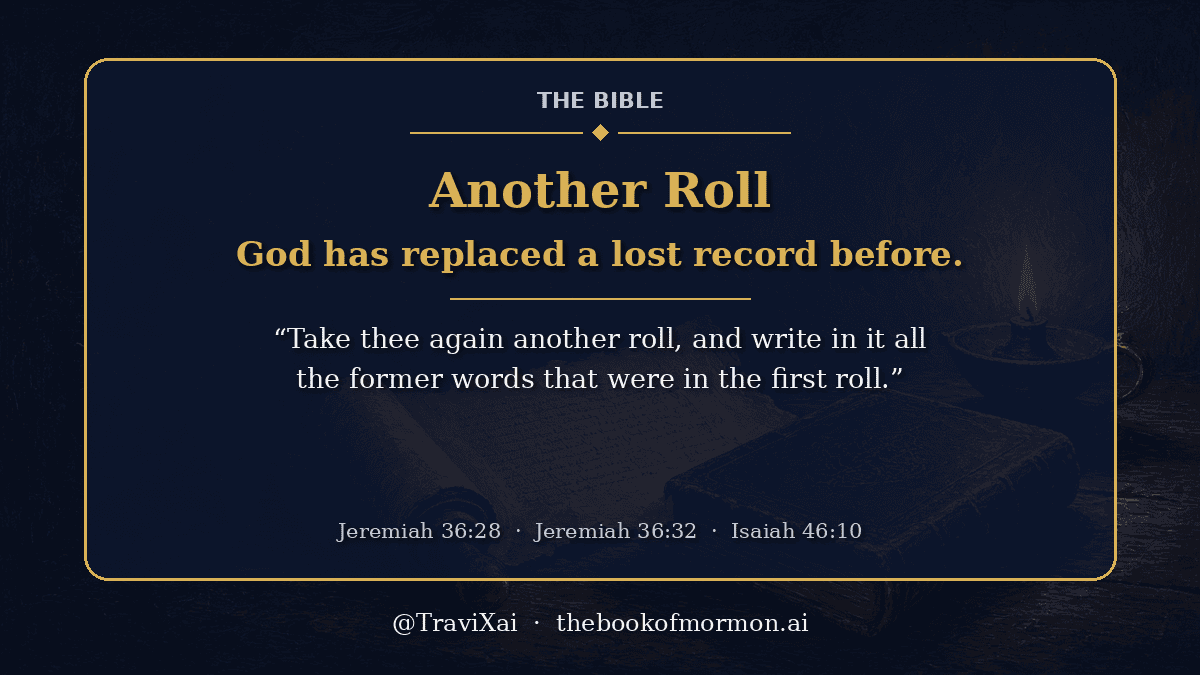
A lost scripture is not a new problem. When King Jehoiakim burned Jeremiah’s scroll, “the word of the Lord came to Jeremiah … saying, Take thee again another roll, and write in it all the former words that were in the first roll” (Jeremiah 36:27–28). The second scroll was not even identical: “there were added besides unto them many like words” (Jeremiah 36:32). Moses broke the first tablets too, and nobody treats Exodus as a fraud for it. See Moses Broke the Tablets. The God who is “declaring the end from the beginning” (Isaiah 46:10) plans for human failure.
The Doctrine and CovenantsWhy he didn’t just retranslate
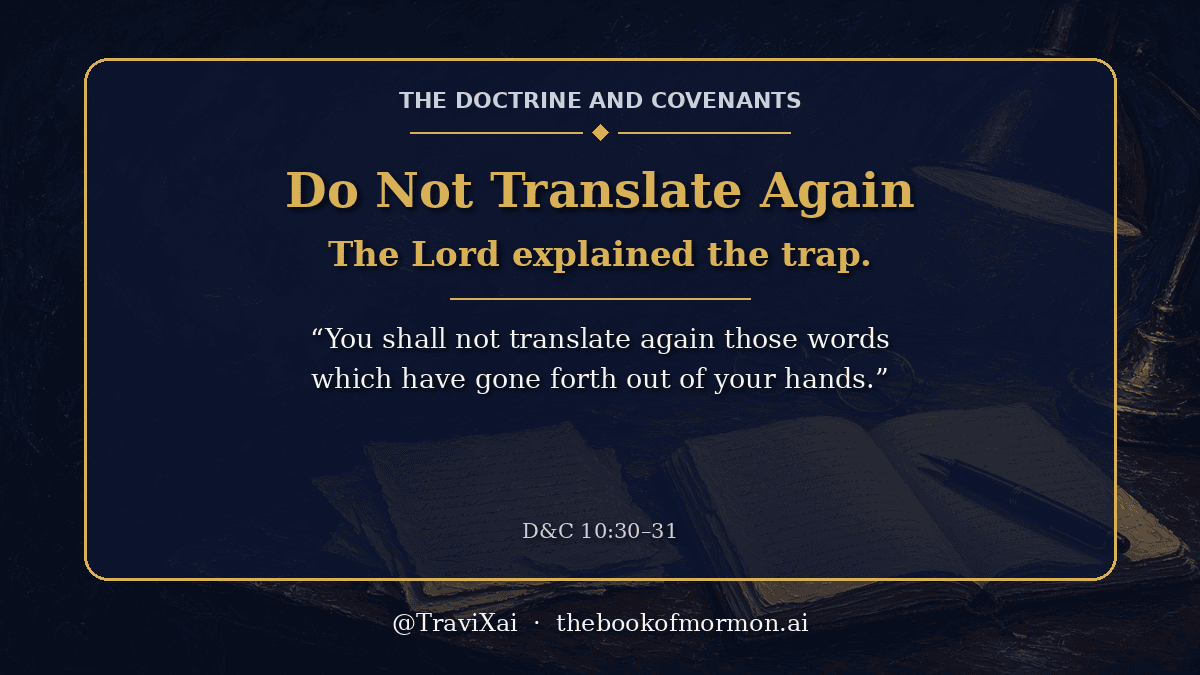
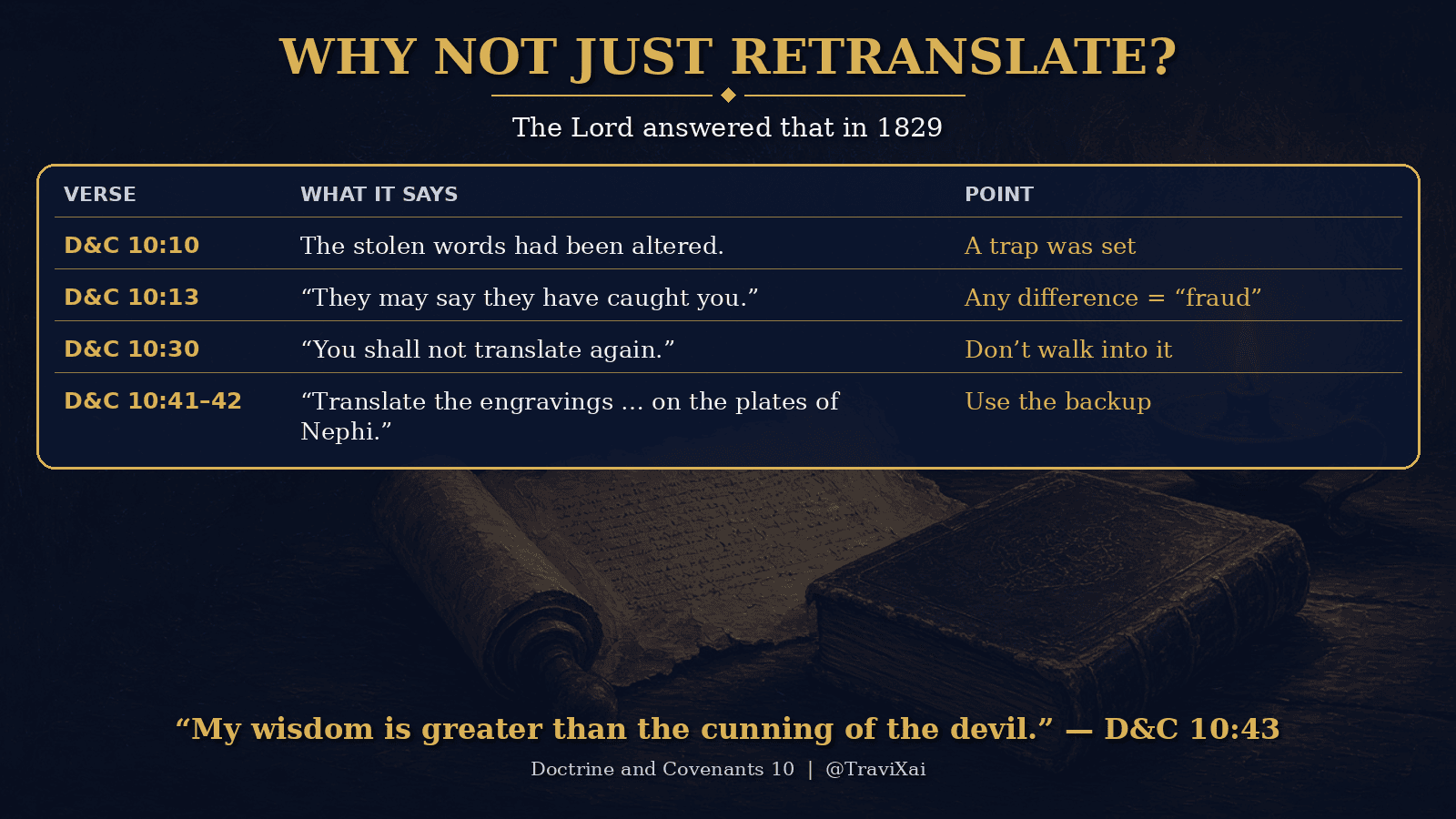
The obvious question, then and now, is why Joseph didn’t simply translate the same part again. Section 10 answers it directly. Those holding the pages had “altered the words,” so that “they read contrary from that which you translated,” and “by lying they may say they have caught you in the words which you have pretended to translate” (D&C 10:10–13). So: “you shall not translate again those words which have gone forth out of your hands … if you should bring forth the same words they will say that you have lied and that you have pretended to translate, but that you have contradicted yourself” (D&C 10:30–31).
Instead: “you shall translate the engravings which are on the plates of Nephi, down even till you come to the reign of king Benjamin … and thus I will confound those who have altered my words. I will not suffer that they shall destroy my work; yea, I will show unto them that my wisdom is greater than the cunning of the devil” (D&C 10:38–43).
The Pearl of Great PriceThe end from the beginning
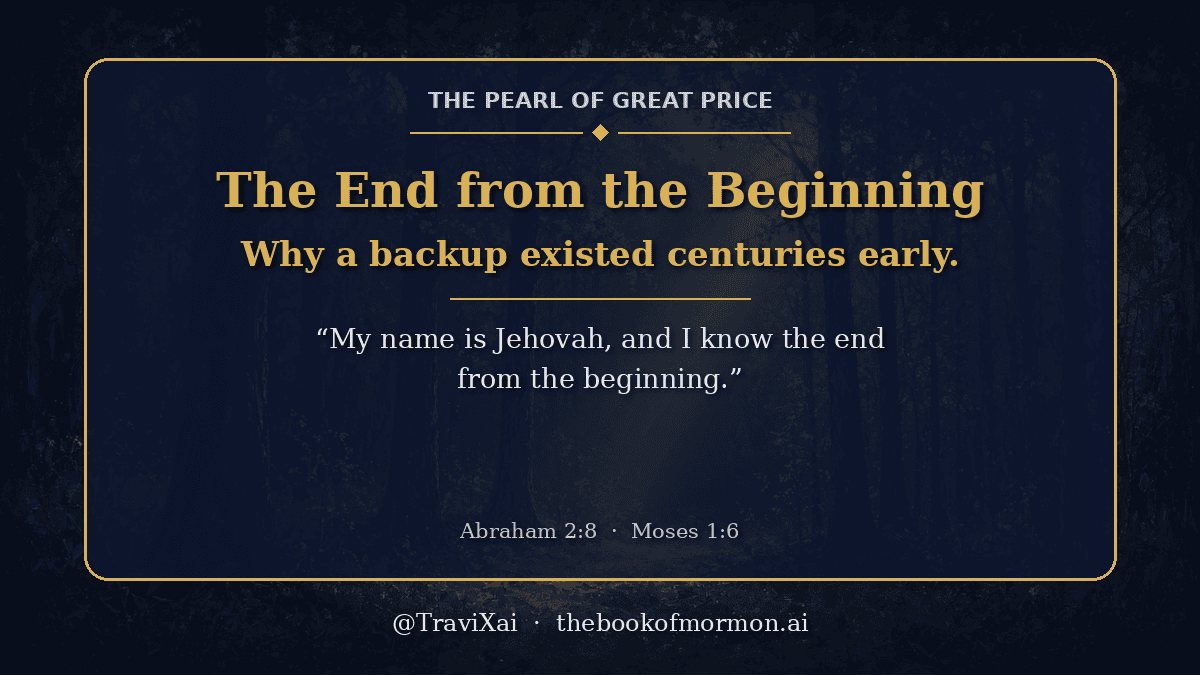
The Lord told Abraham, “My name is Jehovah, and I know the end from the beginning; therefore my hand shall be over thee” (Abraham 2:8), and told Moses, “all things are present with me, for I know them all” (Moses 1:6). That is the whole story of the 116 pages in one line. A Father who sees the end prepared a backup through Nephi about 2,400 years before Martin Harris lost the pages. See What Is the Pearl of Great Price?.
What critics sayAnd why it doesn’t hold
The usual critic’s claim is that Joseph couldn’t reproduce the text because he made it up, so he invented a convenient excuse. Three things work against that.
- The excuse is in the text Joseph had already dictated. Nephi’s statement about a second set of plates “for a wise purpose” sits in 1 Nephi 9, and the Words of Mormon explain the plates’ inclusion. The book’s structure explains the loss from the inside.
- The replacement is not a copy. The small plates are first-person, prophetic and doctrinal, in a different voice from Mormon’s abridgment. A forger in a panic would be more likely to rewrite the same history than to invent a new record with a different narrator.
- Joseph published his own rebuke. Section 3 tells him, “how oft you have transgressed the commandments and the laws of God, and have gone on in the persuasions of men” (D&C 3:6). A con man hides his failures; Joseph put this one in scripture. See Was Joseph Smith a Con Man?.
Historian Don Bradley’s The Lost 116 Pages (2019) reconstructs much of what the book of Lehi likely contained from early sources. Whatever it said, the Lord’s point stands: “it is not the work of God that is frustrated, but the work of men” (D&C 3:1–3).
Check the premiseThe presuppositions baked into the question
Before this question can be answered fairly, the person asking has to justify a few assumptions packed inside it:
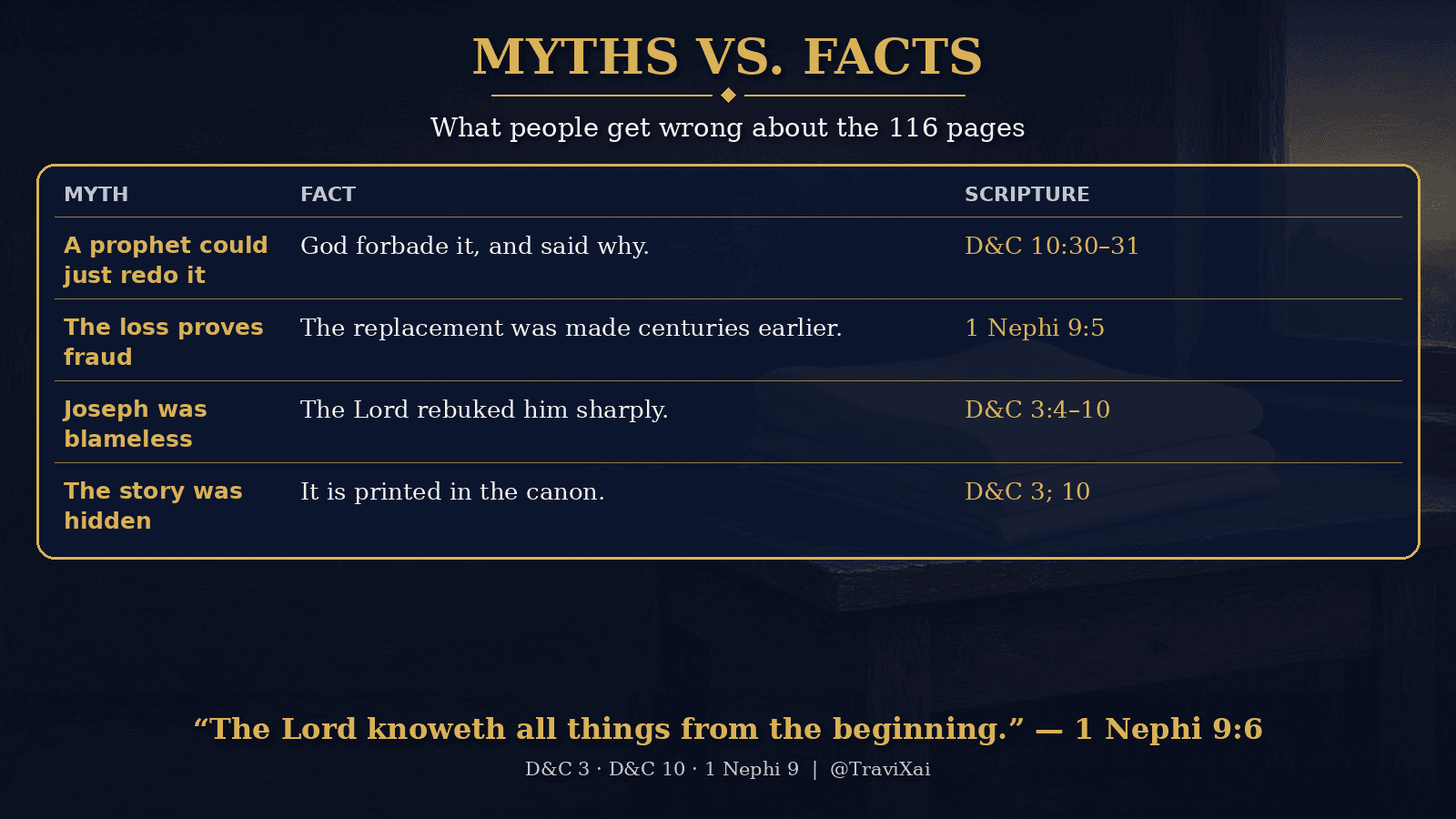
- That a real prophet should be able to reproduce the same text on demand. The Lord forbade it and said why: the stolen copy had been altered to trap him (D&C 10:10–13, 30–31).
- That the loss proves the book was made up. The replacement record was described in 1 Nephi 9 and Words of Mormon as made “for a wise purpose” long before.
- That Joseph Smith was presented as flawless. He wasn’t. D&C 3 rebukes him in the strongest terms, and the Church prints it.
- That something essential was lost. The small plates cover the same years in more spiritual depth (D&C 10:39–40).
FAQQuick answers
What were the 116 pages?
The first 116 manuscript pages of the Book of Mormon translation, called the book of Lehi, dictated by Joseph Smith to Martin Harris in 1828.
How were the 116 pages lost?
Joseph let Martin Harris take them to show his family in Palmyra in June 1828. They disappeared from his possession and have never been found.
Who stole the 116 pages?
No one knows. Many at the time suspected people in Martin Harris’s household who opposed the work, but it was never proven.
Why didn’t Joseph Smith retranslate the 116 pages?
The Lord told him not to, because the stolen copy had been altered so critics could claim he contradicted himself (D&C 10:10–13, 30–31).
What replaced the 116 pages?
The small plates of Nephi, which became 1 Nephi through Omni, covering the same years from Lehi to King Benjamin.
What does “for a wise purpose” mean in the Book of Mormon?
Nephi (1 Nephi 9:5) and Mormon (Words of Mormon 1:7) both said they kept the small plates for a reason they did not know. The loss of the 116 pages shows the reason.
Which sections of the Doctrine and Covenants are about the 116 pages?
Section 3 (July 1828), which rebukes Joseph, and section 10 (likely April 1829), which explains the plan.
Did Martin Harris leave the Church over the 116 pages?
No. He remained a friend of the work, mortgaged his farm to pay for printing, and was one of the Three Witnesses.
SummaryKey takeaways
- The 116 pages were the book of Lehi, lost from Martin Harris in June 1828.
- D&C 3 rebuked Joseph; D&C 10 explained the trap and the plan.
- The stolen copy had been altered to make any retranslation look like a contradiction.
- The small plates of Nephi, 1 Nephi to Omni, replaced them.
- Nephi and Mormon both kept those plates “for a wise purpose” they did not understand.
Read 1 Nephi 9 and Words of Mormon tonight, side by side with D&C 10. For quick, sourced answers, open Galatians18, and follow me on X at @TraviXai.
Sources
- King James Bible (churchofjesuschrist.org): Jeremiah 36:27–28 · Jeremiah 36:32 · Isaiah 46:10
- Book of Mormon: 1 Nephi 9:5–6 · Words of Mormon 1:3–7
- Doctrine and Covenants: D&C 3:1–10 · D&C 3:12–13 · D&C 10:10–14 · D&C 10:30–31 · D&C 10:38–43
- Pearl of Great Price: Abraham 2:8 · Moses 1:6
- Section headings to D&C 3 and 10 (churchofjesuschrist.org) · The Joseph Smith Papers · Don Bradley, The Lost 116 Pages (Greg Kofford Books, 2019)
- Featured image and in-article graphic: original graphics by thebookofmormon.ai (painterly backgrounds; no photographs or likenesses of real people).