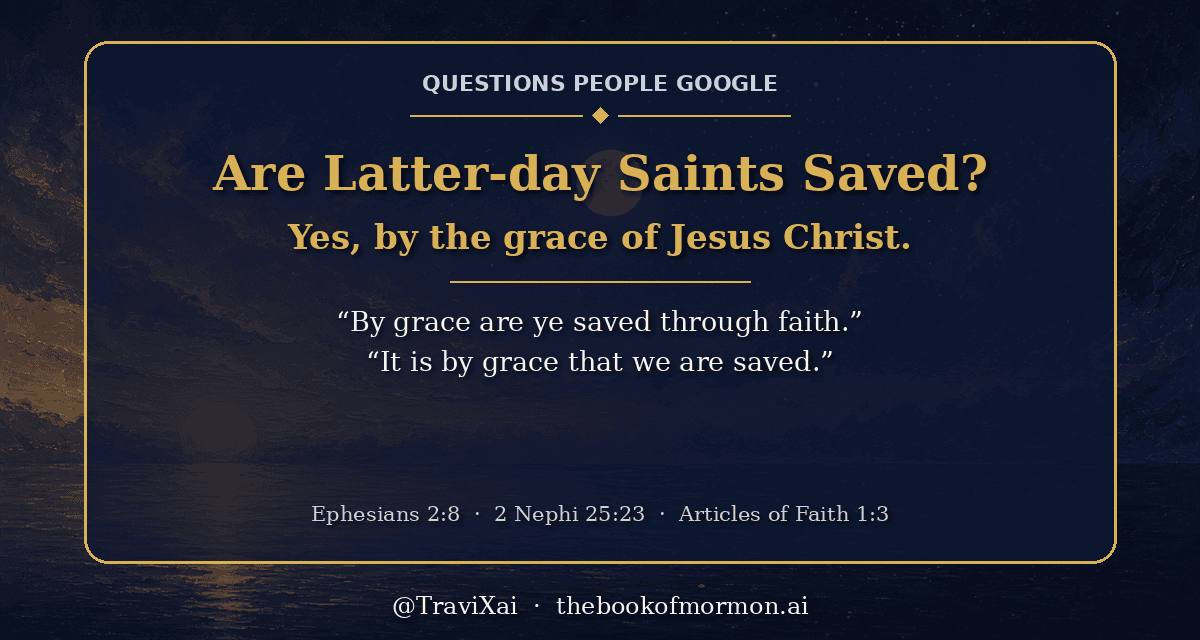

“Are you saved?” is one of the first questions evangelical friends ask. Here’s the Latter-day Saint answer, from the Bible and all four standard works.
Yes. Latter-day Saints believe we are saved by the grace of Jesus Christ. “By grace are ye saved through faith” (Ephesians 2:8), and “it is by grace that we are saved” (2 Nephi 25:23). There is “none other name … whereby we must be saved” (Acts 4:12; Mosiah 3:17). The Church notes that “saved” has six meanings. Everyone will be resurrected as a free gift (1 Corinthians 15:22). Salvation from sin comes through faith, repentance and baptism as we follow Christ. Exaltation, the fullest salvation, means becoming like our Father while remaining His children forever (D&C 76:59; 84:38).
The short versionYes, by grace, and it depends what you mean
When an evangelical friend asks, “Are you saved?”, a Latter-day Saint can honestly answer yes. Paul wrote, “if thou shalt confess with thy mouth the Lord Jesus, and shalt believe in thine heart that God hath raised him from the dead, thou shalt be saved” (Romans 10:9–10). Latter-day Saints confess Jesus as Lord and believe He rose from the dead.
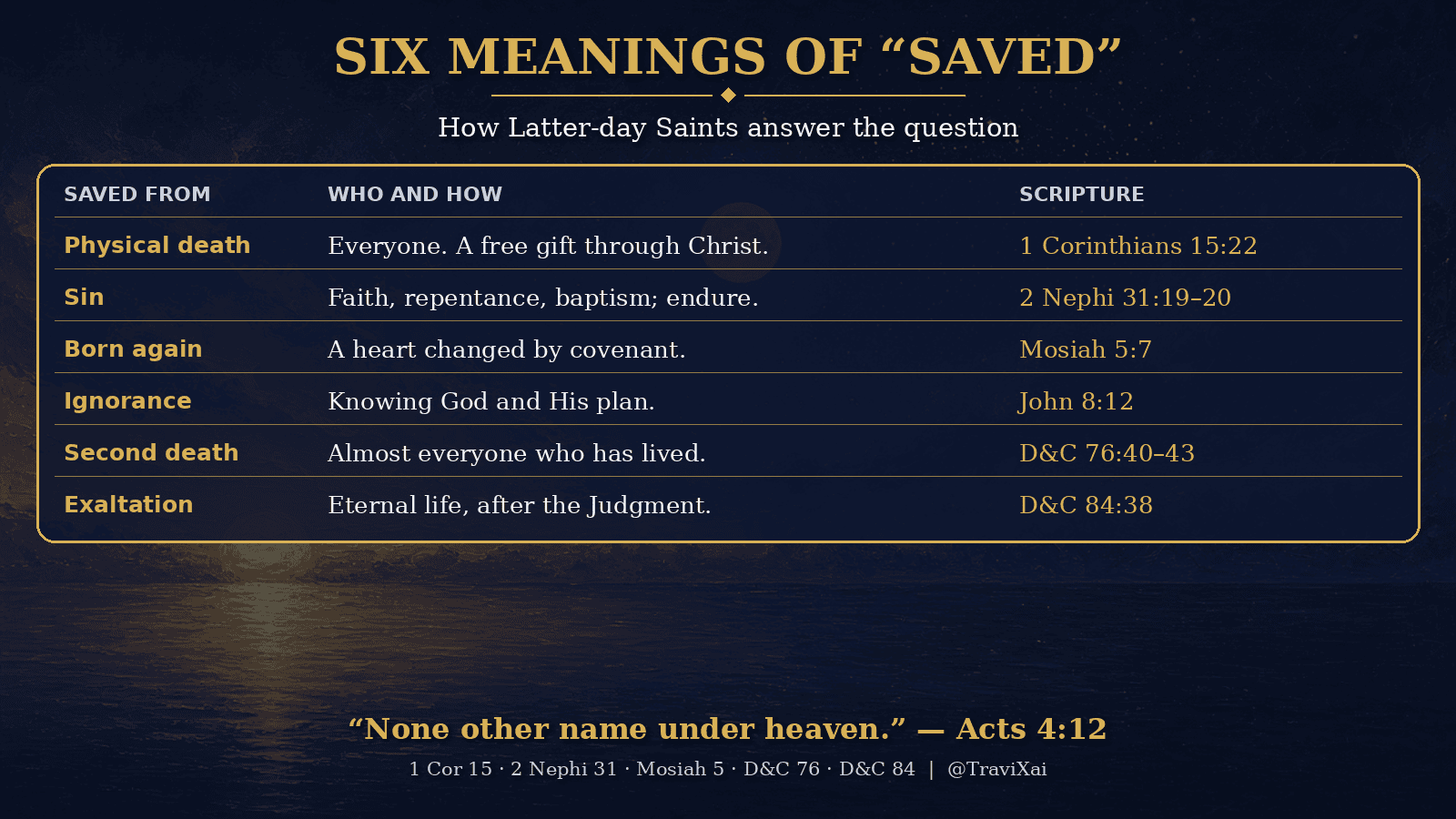
But the Church points out that the word has more than one meaning: “In the doctrine of The Church of Jesus Christ of Latter-day Saints, the terms ‘saved’ and ‘salvation’ have various meanings … If someone were to ask if another person had been saved, the answer would depend on the sense in which the word is used. The answer might be ‘Yes’ or perhaps it might be ‘Yes, but with conditions’” (Salvation). It then lists six meanings.
GraceSaved by grace, not by earning it
The Bible is clear: “For by grace are ye saved through faith; and that not of yourselves: it is the gift of God: Not of works, lest any man should boast” (Ephesians 2:8–9). The Book of Mormon says the same: “there is no flesh that can dwell in the presence of God, save it be through the merits, and mercy, and grace of the Holy Messiah” (2 Nephi 2:8). King Benjamin taught that there is “no other name given nor any other way nor means whereby salvation can come unto the children of men, only in and through the name of Christ, the Lord Omnipotent” (Mosiah 3:17), echoing Peter: “there is none other name under heaven given among men, whereby we must be saved” (Acts 4:12).
Nephi wrote, “we talk of Christ, we rejoice in Christ, we preach of Christ, we prophesy of Christ … that our children may know to what source they may look for a remission of their sins” (2 Nephi 25:26). Even after entering the covenant path, he said, we have come this far only “relying wholly upon the merits of him who is mighty to save” (2 Nephi 31:19).
2 Nephi 25:23“After all we can do” and James 2
Critics often quote one verse: “it is by grace that we are saved, after all we can do” (2 Nephi 25:23). It doesn’t say we earn grace by doing everything first. It says grace is what saves us, and that we’re still asked to respond to it. Paul said the same in his own way: “we are his workmanship, created in Christ Jesus unto good works” (Ephesians 2:10), and “work out your own salvation with fear and trembling. For it is God which worketh in you both to will and to do” (Philippians 2:12–13). For more, see Works and Grace: 2 Nephi 25:23 and James 2.
James adds: “faith, if it hath not works, is dead, being alone” (James 2:17–18). And Jesus said, “Not every one that saith unto me, Lord, Lord, shall enter into the kingdom of heaven; but he that doeth the will of my Father” (Matthew 7:21). That’s why the third article of faith reads: “We believe that through the Atonement of Christ, all mankind may be saved, by obedience to the laws and ordinances of the Gospel” (Articles of Faith 1:3). Through the Atonement first, then obedience.
Moroni put the two together: “come unto Christ, and be perfected in him … then is his grace sufficient for you, that by his grace ye may be perfect in Christ” (Moroni 10:32–33).
Six meaningsHow “saved” is used
From physical death. “As in Adam all die, even so in Christ shall all be made alive” (1 Corinthians 15:22). The Church explains, “In this sense, everyone is saved, regardless of choices made during this life. This is a free gift from the Savior to all human beings.”
From sin. This comes through faith in Christ, repentance, baptism and the gift of the Holy Ghost, and it is “conditional, depending on an individual’s continuing in faithfulness.” The Church adds: “through the grace of God, all can be saved from their sins … as they repent and follow Jesus Christ.” Nephi: “if ye shall press forward, feasting upon the word of Christ, and endure to the end, behold, thus saith the Father: Ye shall have eternal life” (2 Nephi 31:20).
Born again. Those who have made covenants and felt Christ’s influence “can say that they have been born again” (see Mosiah 5:7; John 3:5).
From ignorance. Knowing God, Christ and His plan saves us from darkness (John 8:12).
From the second death. Christ came “to bear the sins of the world … That through him all might be saved whom the Father had put into his power and made by him; Who glorifies the Father, and saves all the works of his hands, except those sons of perdition” (D&C 76:40–43). The Church notes that “almost every person who has ever lived on the earth is assured salvation from the second death.”
Eternal life, or exaltation. “If the word salvation is used in this sense, no one is saved in mortality. That glorious gift comes only after the Final Judgment” (Salvation).
ExaltationBecoming like our Father, forever His children
Exaltation is the fullest meaning of salvation. Jesus promised, “To him that overcometh will I grant to sit with me in my throne, even as I also overcame, and am set down with my Father in his throne” (Revelation 3:21). Paul taught that God’s children are “heirs of God, and joint-heirs with Christ” (Romans 8:16–17), and the Lord revealed that “he that receiveth my Father receiveth my Father’s kingdom; therefore all that my Father hath shall be given unto him” (D&C 84:38).
Latter-day Saints believe this means becoming like our Heavenly Father and sharing in His eternal work. The God who says “worlds without number have I created” (Moses 1:33) also says, “this is my work and my glory—to bring to pass the immortality and eternal life of man” (Moses 1:39). Those who are exalted are called “gods, even the sons of God” (D&C 76:58).
Exalted children never outgrow or replace their Father. The same revelation ends, “all are theirs and they are Christ’s, and Christ is God’s” (D&C 76:59). They always remain His children and always below Him, worshipping Him through Christ forever. For more, see Do Latter-day Saints Get Their Own Planet? and The Three Degrees of Glory.
Check the premiseThe presuppositions baked into the question
Before this question can be answered fairly, the person asking has to justify a few assumptions packed inside it:
- That Latter-day Saints believe they earn salvation. “It is by grace that we are saved” (2 Nephi 25:23). We come to Christ “relying wholly upon the merits of him who is mighty to save” (2 Nephi 31:19).
- That “saved” has only one meaning. The Church’s Topics and Questions entry lists six: from physical death, from sin, born again, from ignorance, from the second death, and exaltation.
- That faith and obedience are opposites. Paul says we are “created in Christ Jesus unto good works” (Ephesians 2:10), and James says faith without works “is dead” (James 2:17).
- That becoming like God means replacing God. The exalted “are Christ’s, and Christ is God’s” (D&C 76:59). They remain the Father’s children and below Him forever.
FAQQuick answers
Are Latter-day Saints saved?
Yes. Latter-day Saints confess Jesus as Lord and believe God raised Him from the dead (Romans 10:9). The Church teaches that we are saved by the grace of Jesus Christ, and that “saved” can mean several things, from resurrection to exaltation.
Do Latter-day Saints believe in salvation by grace?
Yes. “By grace are ye saved through faith” (Ephesians 2:8), and “it is by grace that we are saved, after all we can do” (2 Nephi 25:23). No one can dwell with God “save it be through the merits, and mercy, and grace of the Holy Messiah” (2 Nephi 2:8).
Are Latter-day Saints saved by works?
No one earns salvation. Latter-day Saints believe obedience and covenants are how we receive and keep Christ’s grace: “through the Atonement of Christ, all mankind may be saved, by obedience to the laws and ordinances of the Gospel” (Articles of Faith 1:3).
What does “after all we can do” mean in 2 Nephi 25:23?
It teaches that grace is what saves us, while we keep doing our part to follow Christ. It doesn’t say we earn grace by being perfect first. Moroni says it is “by his grace” that we “may be perfect in Christ” (Moroni 10:32).
What is the difference between salvation and exaltation?
Resurrection and salvation from the second death come to nearly everyone through Christ. Exaltation, or eternal life, means becoming like our Father and receiving “all that my Father hath” (D&C 84:38), while always remaining His children (D&C 76:59).
What is eternal life?
Jesus defined it: “this is life eternal, that they might know thee the only true God, and Jesus Christ, whom thou hast sent” (John 17:3). Latter-day Saints believe eternal life means living as our Father lives, forever as His children.
Can anyone be saved without Jesus Christ?
No. “Neither is there salvation in any other: for there is none other name under heaven given among men, whereby we must be saved” (Acts 4:12).
Do Latter-day Saints believe in being born again?
Yes. Alma the Younger was told that “all mankind … must be born again; yea, born of God” (Mosiah 27:25), and Jesus taught that we must be “born of water and of the Spirit” (John 3:5).
SummaryKey takeaways
- Latter-day Saints are saved by the grace of Jesus Christ and no other name (Ephesians 2:8; Mosiah 3:17).
- “Saved” has six meanings; resurrection is a free gift to everyone (1 Corinthians 15:22).
- Obedience doesn’t earn grace; it’s how we receive and keep it (Articles of Faith 1:3; Philippians 2:12–13).
- Exaltation is becoming like our Father while remaining His children forever (D&C 76:59; 84:38).
Next time someone asks, “Are you saved?”, answer yes and point them to 2 Nephi 25:26. For quick, sourced answers, open Galatians18, and follow me on X at @TraviXai.
Sources
- King James Bible (churchofjesuschrist.org): Matthew 7:21 · Acts 4:12 · Romans 8:16–17 · Romans 10:9–10 · 1 Corinthians 15:22 · Ephesians 2:8–10 · Philippians 2:12–13 · James 2:17–18 · Revelation 3:21
- Book of Mormon: 2 Nephi 2:8 · 2 Nephi 25:23 · 2 Nephi 25:26 · 2 Nephi 31:19–21 · Mosiah 3:17 · Moroni 10:32–33
- Doctrine and Covenants: D&C 76:40–43 · D&C 76:58–59 · D&C 84:38
- Pearl of Great Price: Moses 1:33 · Moses 1:39 · Articles of Faith 1:3
- “Salvation,” Topics and Questions, churchofjesuschrist.org
- Featured image and in-article graphic: original graphics by thebookofmormon.ai (painterly backgrounds; no photographs or likenesses of real people).