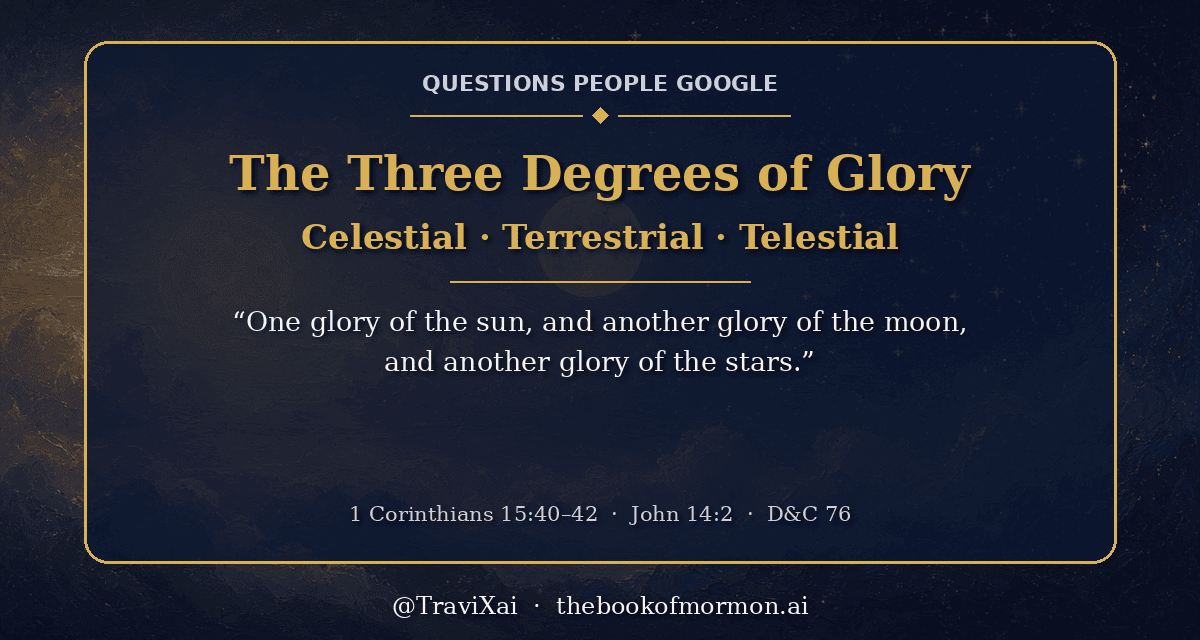

Latter-day Saints believe heaven has more than one level. Here’s what that means, where it comes from in the Bible, and what Doctrine and Covenants 76 adds.
The three degrees of glory are the celestial, terrestrial and telestial kingdoms. Latter-day Saints believe nearly everyone will be resurrected into one of them, with glories Paul compared to the sun, moon and stars (1 Corinthians 15:40–42). The celestial kingdom, where the faithful “dwell in the presence of God and his Christ forever,” is the goal (D&C 76:62). Only those who know God’s power and defy it receive no kingdom of glory (D&C 76:31–38).
1 Corinthians 15 · John 14It starts in the Bible
Paul, writing about the resurrection, said: “There are also celestial bodies, and bodies terrestrial: but the glory of the celestial is one, and the glory of the terrestrial is another. There is one glory of the sun, and another glory of the moon, and another glory of the stars: for one star differeth from another star in glory. So also is the resurrection of the dead” (1 Corinthians 15:40–42).
Paul also spoke of “a man in Christ” who was “caught up to the third heaven” (2 Corinthians 12:2). A third heaven implies more than one. And Jesus said, “In my Father’s house are many mansions: if it were not so, I would have told you. I go to prepare a place for you” (John 14:2).
Most Christians read these verses as poetry about rewards. Latter-day Saints read them as a real description of the resurrection: different glories, like the sun, moon and stars.
D&C 76The vision of February 1832
Section 76 of the Doctrine and Covenants records a vision given to Joseph Smith and Sidney Rigdon while they were working on Joseph’s inspired translation of the Bible. They had reached John 5:29, which in their translation read: “they who have done good, in the resurrection of the just; and they who have done evil, in the resurrection of the unjust.” “Now this caused us to marvel,” they wrote, “and while we meditated upon these things, the Lord touched the eyes of our understandings and they were opened” (D&C 76:15–19).
Jesus’ words in the King James Version are, “they that have done good, unto the resurrection of life; and they that have done evil, unto the resurrection of damnation” (John 5:28–29). The vision answered a question every Bible reader eventually asks: is it really just two outcomes, with nearly everyone who ever lived in the second?
Like the sunThe celestial kingdom
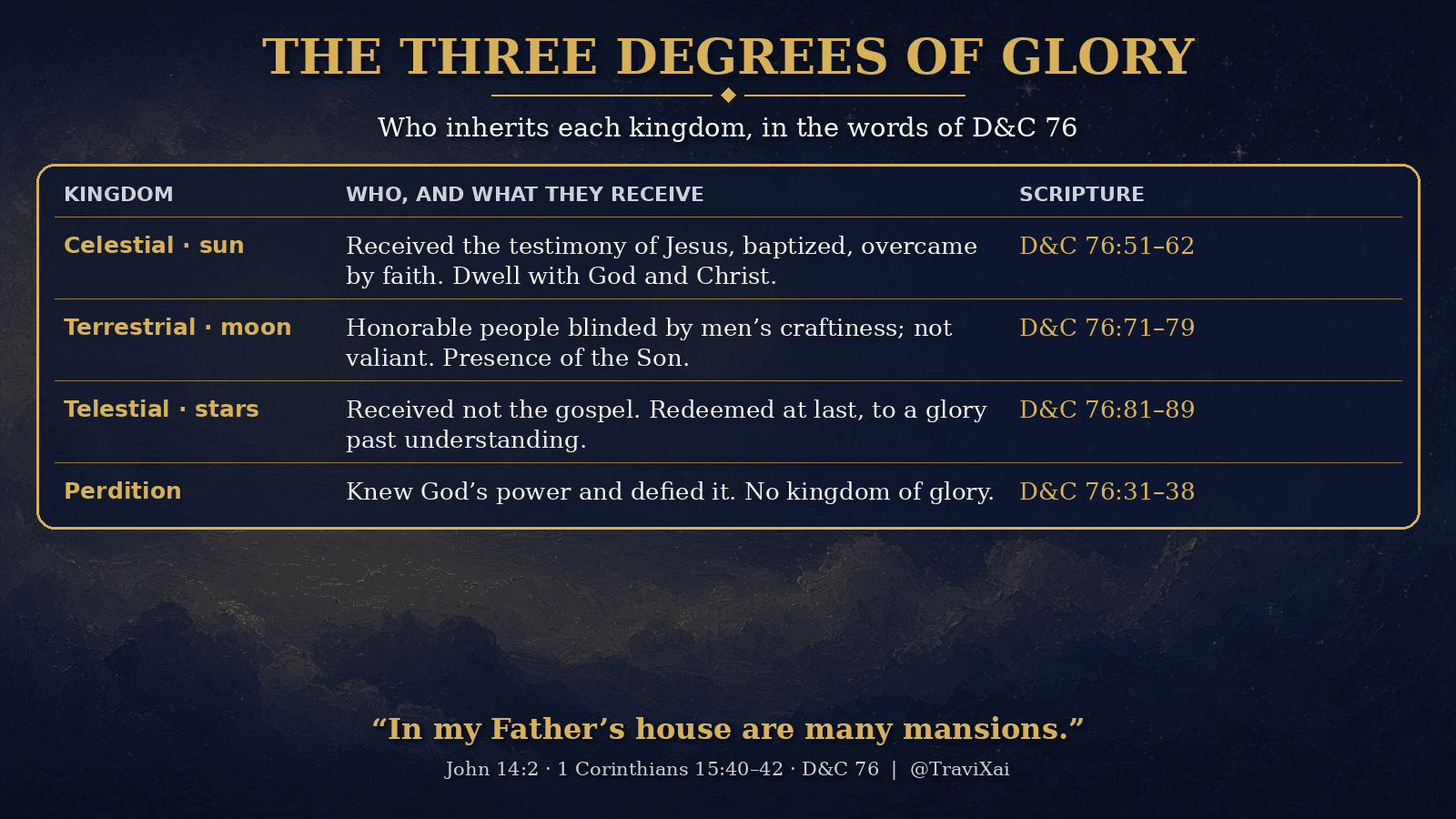
The celestial kingdom is for those “who received the testimony of Jesus, and believed on his name and were baptized … and who overcome by faith, and are sealed by the Holy Spirit of promise” (D&C 76:51–53). Their glory “is that of the sun, even the glory of God, the highest of all” (D&C 76:70), and “these shall dwell in the presence of God and his Christ forever and ever” (D&C 76:62).
The Church’s topic page “Kingdoms of Glory” says it plainly: “This should be your goal: to inherit celestial glory and to help others receive that great blessing as well” (Kingdoms of Glory). That matches the Lord’s own statement of purpose to Moses: “this is my work and my glory—to bring to pass the immortality and eternal life of man” (Moses 1:39).
Those who never heard
In 1836 Joseph saw his older brother Alvin, who had died before he could be baptized, in the celestial kingdom. The Lord explained: “All who have died without a knowledge of this gospel, who would have received it if they had been permitted to tarry, shall be heirs of the celestial kingdom of God … For I, the Lord, will judge all men according to their works, according to the desire of their hearts.” Joseph added, “all children who die before they arrive at the years of accountability are saved in the celestial kingdom of heaven” (D&C 137:7–10). This is why Latter-day Saints take the Bible’s teaching seriously that “the gospel [was] preached also to them that are dead” (1 Peter 4:6; see 1 Peter 3:18–20).
Three degrees within the celestial
A later revelation adds: “In the celestial glory there are three heavens or degrees; And in order to obtain the highest, a man must enter into this order of the priesthood [meaning the new and everlasting covenant of marriage]” (D&C 131:1–2). The Church’s topic page adds that “all who are worthy to enter into the new and everlasting covenant of marriage will have that opportunity, whether in this life or the next” (Kingdoms of Glory).
Like the moonThe terrestrial kingdom
The terrestrial glory “differs … even as that of the moon differs from the sun” (D&C 76:71). It includes “honorable men of the earth, who were blinded by the craftiness of men” (D&C 76:75), those who “received not the testimony of Jesus in the flesh, but afterwards received it” (D&C 76:74), and those “who are not valiant in the testimony of Jesus” (D&C 76:79). That last group can include Church members. Membership alone doesn’t decide it.
“These are they who receive of the presence of the Son, but not of the fulness of the Father” (D&C 76:77).
Like the starsThe telestial kingdom
The telestial glory is “even as the glory of the stars differs from that of the glory of the moon” (D&C 76:81). These “received not the gospel of Christ, neither the testimony of Jesus” (D&C 76:82), and the revelation lists “liars, and sorcerers, and adulterers, and whoremongers, and whosoever loves and makes a lie” (D&C 76:103).
They are “thrust down to hell” and “shall not be redeemed from the devil until the last resurrection” (D&C 76:84–85). Sin has real consequences. But then comes one of the most surprising verses in scripture: “thus we saw, in the heavenly vision, the glory of the telestial, which surpasses all understanding” (D&C 76:89). Even the lowest kingdom of glory is glory. And echoing Paul, “as one star differs from another star in glory, even so differs one from another in glory in the telestial world” (D&C 76:98).
Yet it has a limit: “they shall be servants of the Most High; but where God and Christ dwell they cannot come, worlds without end” (D&C 76:112).
No kingdom of gloryOuter darkness and the sons of perdition
The only ones who receive no kingdom of glory are those “who know my power, and have been made partakers thereof, and suffered themselves through the power of the devil to be overcome, and to deny the truth and defy my power” (D&C 76:31). They are “the only ones on whom the second death shall have any power” (D&C 76:37). Christ “saves all the works of his hands, except those sons of perdition who deny the Son after the Father has revealed him” (D&C 76:43).
This isn’t a doctrine that excuses sin. Whoever “is not able to abide the law of a celestial kingdom cannot abide a celestial glory” (D&C 88:22). Each person receives the glory he or she is prepared to live in.
Book of MormonThe Book of Mormon’s witness
The Book of Mormon doesn’t lay out the three kingdoms, but it teaches the same foundations. Moroni prayed, “thou hast prepared a house for man, yea, even among the mansions of thy Father” (Ether 12:32), and Enos looked forward to hearing Christ say, “there is a place prepared for you in the mansions of my Father” (Enos 1:27).
Alma taught that men “should be judged according to their works; and if their works were good in this life, and the desires of their hearts were good, that they should also, at the last day, be restored unto that which is good” (Alma 41:3). John saw the same: “the dead were judged … according to their works” (Revelation 20:12).
Check the premiseThe presuppositions baked into the question
Before this question can be answered fairly, the person asking has to justify a few assumptions packed inside it:
- That the Bible teaches only two final destinations with nothing in between. Paul describes different resurrection glories like the sun, moon and stars (1 Corinthians 15:40–42), a “third heaven” (2 Corinthians 12:2), and Jesus speaks of “many mansions” (John 14:2).
- That Latter-day Saints believe almost everyone gets the same reward. D&C 76 describes very different outcomes. Only the celestial dwell in the presence of the Father; telestial inheritors “cannot come” where God and Christ dwell (D&C 76:62, 112).
- That this doctrine makes sin unimportant. Telestial inheritors are “thrust down to hell” until the last resurrection (D&C 76:84–85). Judgment is “according to their works” (Revelation 20:12).
- That being a Church member guarantees the celestial kingdom. D&C 76:79 puts those “not valiant in the testimony of Jesus” in the terrestrial kingdom. It’s about conversion, not a membership record.
FAQQuick answers
What are the three degrees of glory?
The celestial, terrestrial and telestial kingdoms. Latter-day Saints believe resurrected people inherit one of them, with glories compared to the sun, moon and stars (1 Corinthians 15:40–42; D&C 76:70, 71, 81).
Who goes to the celestial kingdom?
Those who receive the testimony of Jesus, are baptized, overcome by faith and are sealed by the Holy Spirit of promise (D&C 76:51–53), plus those who died without the gospel but would have received it, and children who die before accountability (D&C 137:7–10).
Who goes to the terrestrial kingdom?
Honorable people “blinded by the craftiness of men,” those who accepted Christ’s testimony only after this life, and those “not valiant in the testimony of Jesus” (D&C 76:74–79). They receive the presence of the Son.
Is the telestial kingdom hell?
No. Telestial inheritors suffer in spirit prison, which the Church’s “Kingdoms of Glory” page says is “sometimes called hell,” until the last resurrection (D&C 76:84–85). After that they receive a kingdom whose glory “surpasses all understanding” (D&C 76:89).
Where does the Bible talk about the three degrees of glory?
1 Corinthians 15:40–42 (glories of the sun, moon and stars in the resurrection), 2 Corinthians 12:2 (the “third heaven”) and John 14:2 (“many mansions”). D&C 76 expands on them.
What is outer darkness?
The state of the “sons of perdition,” who knew God’s power and then denied and defied it (D&C 76:31–38). They receive “a kingdom which is not a kingdom of glory” (D&C 88:24).
What is eternal progression?
God’s work is “to bring to pass the immortality and eternal life of man” (Moses 1:39). Those exalted in the celestial kingdom go on progressing forever, becoming like our Father in Heaven, in the endless line of Fathers and Sons, while He always remains our Father. As the King Follett Sermon taught, “God himself was once as we are now.”
Who goes to the telestial kingdom?
Those who “received not the gospel of Christ, neither the testimony of Jesus,” and did not repent in this life, including “liars, and sorcerers, and adulterers, and whoremongers.” Even they receive a glory that “surpasses all understanding” (D&C 76:82, 103, 89).
SummaryKey takeaways
- Paul taught different resurrection glories: sun, moon and stars (1 Corinthians 15:40–42).
- D&C 76 names them celestial, terrestrial and telestial, and says who inherits each.
- Only the celestial kingdom has the presence of the Father; it’s the goal Latter-day Saints work toward.
- God judges by works and the desires of the heart, including for those who never heard the gospel (D&C 137).
Read D&C 76 next to 1 Corinthians 15 and see if it answers questions you’ve had about heaven. For quick, sourced answers, open Galatians18, and follow me on X at @TraviXai.
Sources
- King James Bible (churchofjesuschrist.org): John 5:28–29 · John 14:2 · 1 Corinthians 15:40–42 · 2 Corinthians 12:2 · 1 Peter 3:18–20 · 1 Peter 4:6 · Revelation 20:12
- Book of Mormon: Enos 1:27 · Alma 41:3–4 · Ether 12:32–34
- Doctrine and Covenants: D&C 76:15–19 · D&C 76:31–38 · D&C 76:43–44 · D&C 76:50–70 · D&C 76:71–79 · D&C 76:81–89 · D&C 76:98–112 · D&C 88:22–24 · D&C 131:1–4 · D&C 137:7–10
- Pearl of Great Price: Moses 1:39
- “Kingdoms of Glory,” Topics and Questions (2023), churchofjesuschrist.org
- Featured image and in-article graphic: original graphics by thebookofmormon.ai (painterly backgrounds; no photographs or likenesses of real people).