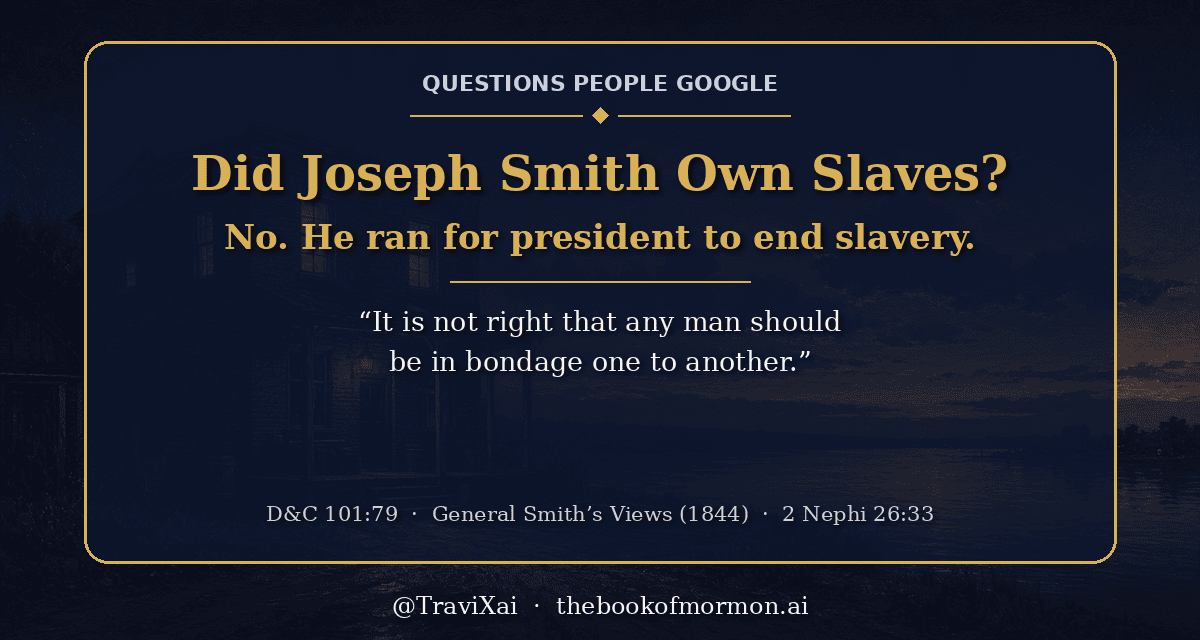

The answer is no. But the full record is more interesting than a one-word answer, so here it is, hard parts included.
No. There is no record that Joseph Smith ever owned a slave, and he ran for president in 1844 on a plan to end slavery. His platform urged slave states “to abolish slavery by the year 1850,” with Congress paying owners from public land sales, and said: “Break off the shackles from the poor black man” (General Smith’s Views, 1844). A revelation to him in 1833 declared, “it is not right that any man should be in bondage one to another” (D&C 101:79). He also saw black men ordained to the priesthood, including Elijah Abel.
The short answerNo, and he campaigned to end slavery
There is no record that Joseph Smith ever owned, bought or sold a slave. He lived in free states his whole life: Vermont, New York, Pennsylvania, Ohio and Illinois, apart from the years in Missouri, where the Saints were driven out partly because Missourians suspected them of abolitionist sympathies.
In 1844, when he ran for president of the United States, his platform called for ending slavery: “Petition also, ye goodly inhabitants of the slave states, your legislators to abolish slavery by the year 1850, or now … Pray Congress to pay every man a reasonable price for his slaves out of the surplus revenue arising from the sale of public lands … Break off the shackles from the poor black man, and hire him to labor like other human beings” (General Smith’s Views, 1844, Joseph Smith Papers). The Church’s Gospel Topics essay states plainly: “Toward the end of his life, Church founder Joseph Smith openly opposed slavery” (Race and the Priesthood).
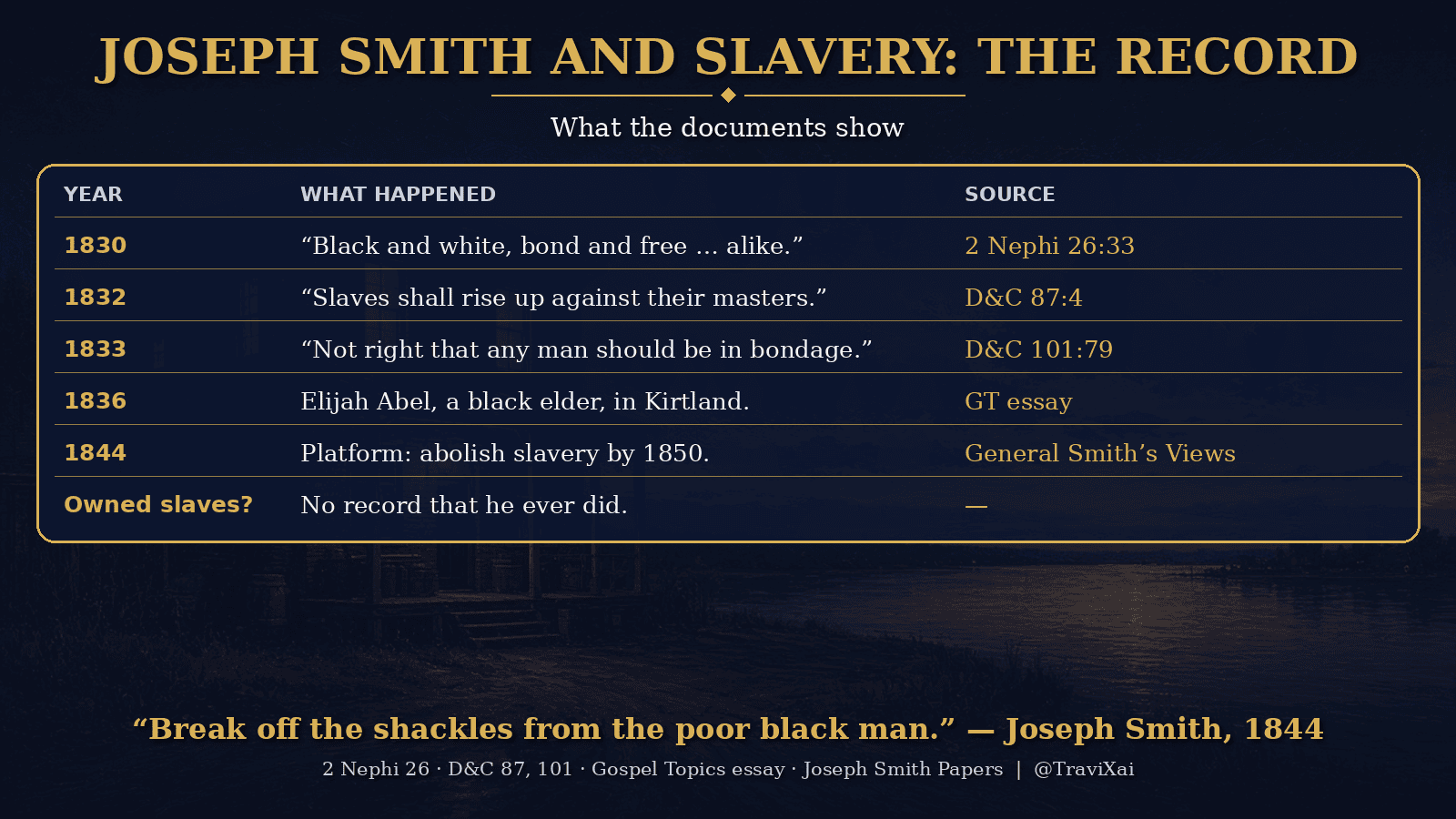
What his scriptures say“It is not right that any man should be in bondage”
The Book of Mormon, published in 1830, condemns slavery repeatedly. King Benjamin told his people, “Neither have I suffered that ye should be confined in dungeons, nor that ye should make slaves one of another” (Mosiah 2:13). Ammon said, “It is against the law of our brethren … that there should be any slaves among them” (Alma 27:9). Nephi taught that the Lord “denieth none that come unto him, black and white, bond and free, male and female … and all are alike unto God” (2 Nephi 26:33).
In 1833, a revelation to Joseph Smith declared: “Therefore, it is not right that any man should be in bondage one to another” (D&C 101:79). The Bible agrees: “he that stealeth a man, and selleth him … shall surely be put to death” (Exodus 21:16), and in Christ “there is neither bond nor free … for ye are all one in Christ Jesus” (Galatians 3:28).
A prophecy about slaveryD&C 87
On Christmas Day 1832, Joseph Smith prophesied the Civil War, beginning “at the rebellion of South Carolina,” and added: “And it shall come to pass, after many days, slaves shall rise up against their masters, who shall be marshaled and disciplined for war” (D&C 87:4). Nearly 30 years later, formerly enslaved men joined the Union army in large numbers and fought for their freedom. See Was Joseph Smith a Prophet?.
Black members in Joseph’s dayElijah Abel and others
The Gospel Topics essay records: “From the beginnings of the Church, people of every race and ethnicity could be baptized and received as members … During the first two decades of the Church’s existence, a few black men were ordained to the priesthood. One of these men, Elijah Abel, also participated in temple ceremonies in Kirtland, Ohio … There is no reliable evidence that any black men were denied the priesthood during Joseph Smith’s lifetime” (Race and the Priesthood).
The restriction came later, in 1852 under Brigham Young, and was lifted by revelation in 1978. We cover that history in The Priesthood Ban and the 1978 Revelation.
The hard partsWhat critics point to
Joseph Smith’s views grew over time. In the mid-1830s, with the Saints in danger in slaveholding Missouri, Church writings kept a careful distance from abolitionists. An 1835 declaration on government, adopted by a Church assembly in Kirtland, said the Church would not preach to or baptize slaves “contrary to the will and wish of their masters” (D&C 134:12). In 1836 Joseph also wrote a letter criticizing abolitionist agitation.
Those were the views of a young church trying to survive in a violent, divided country. By 1844 Joseph had moved to open opposition, running for president on a plan to end slavery entirely. Even then, the revealed word was already ahead of the culture: “it is not right that any man should be in bondage one to another” (D&C 101:79), and the gospel is for “all mankind” (Articles of Faith 1:3).
Check the premiseThe presuppositions baked into the question
Before this question can be answered fairly, the person asking has to justify a few assumptions packed inside it:
- That Joseph Smith owned slaves. There is no record he ever did, and he lived almost entirely in free states.
- That early Latter-day Saints were pro-slavery. Missourians drove them out partly because they suspected them of opposing slavery, and Joseph ran for president on abolition in 1844.
- That the priesthood ban began with Joseph Smith. The essay says there is “no reliable evidence” black men were denied the priesthood in his lifetime; it began in 1852.
- That Latter-day Saint scripture supports slavery. The Book of Mormon and D&C 101:79 condemn it.
FAQQuick answers
Did Joseph Smith own slaves?
No. There is no record that he ever owned, bought or sold a slave.
What did Joseph Smith think about slavery?
By 1844 he openly opposed it. His presidential platform called for abolishing slavery by 1850, paying owners from the sale of public lands.
Did Joseph Smith ordain black men to the priesthood?
Yes. Elijah Abel was ordained during Joseph’s lifetime and took part in temple ceremonies in Kirtland, Ohio.
Does the Book of Mormon condemn slavery?
Yes. King Benjamin forbade making “slaves one of another” (Mosiah 2:13), and Ammon said slavery was against Nephite law (Alma 27:9).
What does D&C 101:79 say?
“Therefore, it is not right that any man should be in bondage one to another.” It was revealed to Joseph Smith in 1833.
Who was Jane Manning James?
A free Black convert who, in 1843, walked hundreds of miles with family members to Nauvoo and then lived in Joseph and Emma Smith’s home. She stayed faithful to the end of her life in 1908.
What does the Book of Mormon say about race?
That the Lord “denieth none that come unto him, black and white, bond and free, male and female” and that “all are alike unto God” (2 Nephi 26:33).
Were early Latter-day Saints suspected of opposing slavery?
Yes. In 1833 an article in the Church’s Missouri newspaper about free Black people fed suspicions that the Saints were abolitionists, which helped stir the mob that drove them out of Jackson County.
SummaryKey takeaways
- No record shows Joseph Smith ever owned a slave.
- He ran for president in 1844 on a plan to abolish slavery by 1850.
- The Book of Mormon and D&C 101:79 condemn slavery.
- Black men such as Elijah Abel were ordained to the priesthood in his lifetime.
Read D&C 101:79 and 2 Nephi 26:33 for yourself. For quick, sourced answers, open Galatians18, and follow me on X at @TraviXai.
Sources
- King James Bible (churchofjesuschrist.org): Exodus 21:16 · Galatians 3:28
- Book of Mormon: 2 Nephi 26:33 · Mosiah 2:13 · Alma 27:9
- Doctrine and Covenants: D&C 87:4 · D&C 101:79 · D&C 134:12
- Pearl of Great Price: Articles of Faith 1:3
- “General Smith’s Views of the Powers and Policy of the Government of the United States” (1844), Joseph Smith Papers
- “Race and the Priesthood,” Gospel Topics Essays
- Featured image and in-article graphic: original graphics by thebookofmormon.ai (painterly backgrounds; no photographs or likenesses of real people).