
It’s one of the first questions people ask. The answer is yes to the Father, Son and Holy Ghost, and no to the fourth-century formula.
Latter-day Saints believe in God the Father, His Son Jesus Christ and the Holy Ghost, but not the creedal Trinity. We call them the Godhead: three distinct Persons who are perfectly one in purpose, love and glory, not one substance (Articles of Faith 1:1). At Jesus’s baptism, the Son stood in the water, the Spirit descended like a dove and the Father spoke from heaven (Matthew 3:16–17). Jesus prayed that His disciples would be “one, as we are” (John 17:11). The Father and Son have glorified bodies (D&C 130:22).
The short answerWe believe in the Father, Son and Holy Ghost, but not the creeds’ definition
The first Article of Faith says: “We believe in God, the Eternal Father, and in His Son, Jesus Christ, and in the Holy Ghost” (Articles of Faith 1:1). Latter-day Saints call them the Godhead. Book of Mormon prophets speak of “the Father, and … the Son, and … the Holy Ghost, which is one God” (2 Nephi 31:21), and so does the Doctrine and Covenants (D&C 20:28).
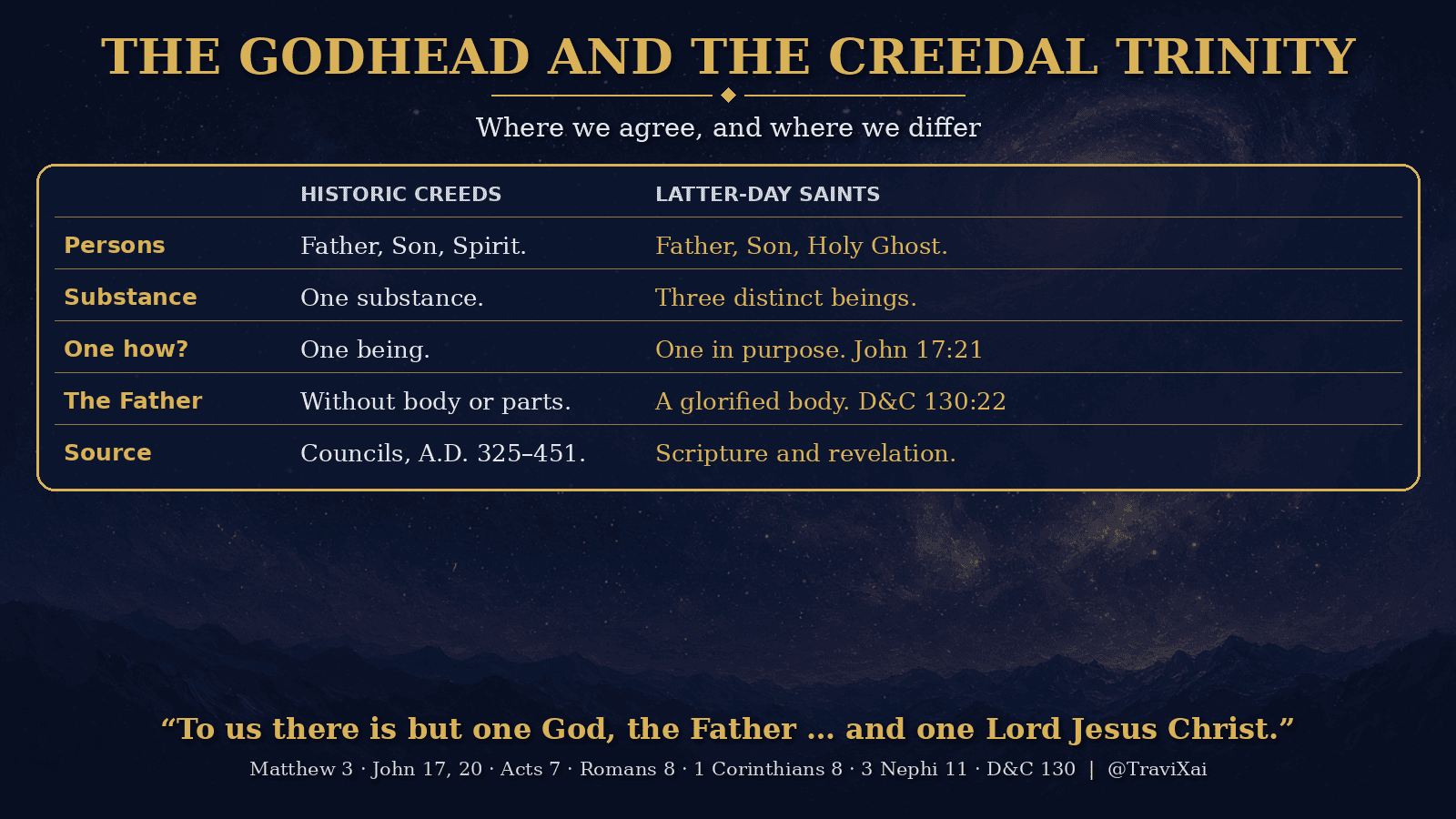
What we don’t accept is the definition adopted at Nicaea in 325 and later councils: that the three are one being of one substance. We believe they are three distinct Persons, perfectly one in will, purpose, love and glory. The Father and the Son have glorified bodies, and the Holy Ghost is a Spirit (D&C 130:22).
The BibleThree Persons, seen and heard separately
At Jesus’s baptism, all three were present at once: the Son came up out of the water, “he saw the Spirit of God descending like a dove,” and “lo a voice from heaven, saying, This is my beloved Son, in whom I am well pleased” (Matthew 3:16–17). Stephen “saw the glory of God, and Jesus standing on the right hand of God” (Acts 7:55–56).
Jesus prayed to His Father, not to Himself, and called Him greater: “my Father is greater than I” (John 14:28). After His Resurrection He said, “I ascend unto my Father, and your Father; and to my God, and your God” (John 20:17). Paul wrote, “to us there is but one God, the Father, of whom are all things … and one Lord Jesus Christ, by whom are all things” (1 Corinthians 8:6).
How they are one“That they may be one, as we are”
Jesus explained what kind of oneness He meant. He prayed that His disciples “may be one, as we are” (John 17:11), and “that they all may be one; as thou, Father, art in me, and I in thee, that they also may be one in us … that they may be one, even as we are one” (John 17:21–22).
The disciples were never going to become one substance. They could become one in heart and purpose. That’s the oneness of the Godhead. When the risen Christ taught the Nephites that “the Father, and I, and the Holy Ghost are one” (3 Nephi 11:36), the Father had just spoken from heaven, introducing “my Beloved Son” (3 Nephi 11:7). See “One” in the Bible: Echad, Hen and John 10:30.
What Joseph Smith taught“Three distinct personages”
In the First Vision, Joseph saw “two Personages” and heard one say of the other, “This is My Beloved Son. Hear Him!” (Joseph Smith—History 1:17). In June 1844 he summarized what he had always taught: “I have always declared God to be a distinct personage, Jesus Christ a separate and distinct personage from God the Father, and that the Holy Ghost was a distinct personage and a Spirit” (History of the Church 6:474).
In that same sermon he taught that the Father Himself has a Father, an endless line of divine Fathers and sons: “If Jesus Christ was the Son of God, and John discovered that God the Father of Jesus Christ had a Father, you may suppose that He had a Father also. Where was there ever a son without a father?” (History of the Church 6:476). And he taught that God’s children can become like Him, “from grace to grace, from exaltation to exaltation” (History of the Church 6:306), while always worshipping Him as their Father. See Was God Once a Man?.
Why it mattersA Father we can know
“Let us make man in our image, after our likeness” (Genesis 1:26). If God is a glorified, embodied Father, then we really are His children, made in His image, and “heirs of God, and joint-heirs with Christ” (Romans 8:17). Jesus said eternal life is to “know thee the only true God, and Jesus Christ, whom thou hast sent” (John 17:3).
That’s why Latter-day Saints are comfortable with the label “not Trinitarian” while being firmly Christian: we worship the Father in the name of His Son by the power of the Holy Ghost, just as the New Testament describes. See Are Latter-day Saints Christian? and Nicaea 325 and Homoousios.
Check the premiseThe presuppositions baked into the question
Before this question can be answered fairly, the person asking has to justify a few assumptions packed inside it:
- That rejecting the Nicene definition means rejecting the Father, Son and Holy Ghost. We believe in all three (Articles of Faith 1:1) and baptize in their name (3 Nephi 11:27).
- That the Trinity doctrine is spelled out in the Bible. The word “Trinity” and the phrase “one substance” don’t appear in the Bible; they come from later councils.
- That “one God” must mean one being. Jesus prayed His disciples would be “one, as we are” (John 17:11), and they were separate people.
- That Latter-day Saints worship three Gods equally without order. We worship the Father in the name of the Son; Jesus said, “my Father is greater than I” (John 14:28).
FAQQuick answers
Do Latter-day Saints believe in the Trinity?
They believe in the Father, the Son and the Holy Ghost, called the Godhead, but not the creedal definition that they are one substance. They teach three distinct Persons, one in purpose.
What is the Godhead?
The Father, Jesus Christ and the Holy Ghost: three separate, divine Persons who are perfectly united. The Father and Son have glorified bodies; the Holy Ghost is a Spirit (D&C 130:22).
Do Latter-day Saints believe Jesus is God?
Yes. Jesus Christ is the Son of God, the Creator and Redeemer, and divine. He is a distinct Person from the Father.
How are the Father, Son and Holy Ghost one?
One in purpose, will and glory, the same kind of oneness Jesus prayed His disciples would have (John 17:21–22).
Does the Book of Mormon teach the Trinity?
It says the Father, Son and Holy Ghost “are one” and “one God” (3 Nephi 11:36; 2 Nephi 31:21), while showing the Father speaking from heaven about His Son (3 Nephi 11:7).
Does God the Father have a body?
Yes. “The Father has a body of flesh and bones as tangible as man’s; the Son also; but the Holy Ghost has not a body of flesh and bones, but is a personage of Spirit” (D&C 130:22).
What does Jesus’ baptism show about the Godhead?
All three appear at once: the Son in the water, “the Spirit of God descending like a dove,” and the Father’s voice from heaven saying, “This is my beloved Son, in whom I am well pleased” (Matthew 3:16–17).
Did Jesus pray to the Father?
Yes, as a distinct person, even on the cross: “Father, into thy hands I commend my spirit” (Luke 23:46). The Father is literally His Father, and He is our Father too, always.
SummaryKey takeaways
- Latter-day Saints believe in the Father, Son and Holy Ghost: the Godhead.
- They are three distinct Persons, one in purpose, not one substance.
- The Bible shows them separately at Jesus’s baptism (Matthew 3:16–17).
- The Father is a glorified, embodied Being, and we can become like Him as His children.
Read John 17 and Matthew 3:16–17 for yourself. For quick, sourced answers, open Galatians18, and follow me on X at @TraviXai.
Sources
- King James Bible (churchofjesuschrist.org): Genesis 1:26 · Matthew 3:16–17 · John 14:28 · John 17:11 · John 17:21–22 · John 20:17 · Acts 7:55–56 · 1 Corinthians 8:6 · Romans 8:17 · John 17:3
- Book of Mormon: 2 Nephi 31:21 · 3 Nephi 11:7 · 3 Nephi 11:27 · 3 Nephi 11:36
- Doctrine and Covenants: D&C 20:28 · D&C 130:22
- Pearl of Great Price: Articles of Faith 1:1 · Joseph Smith—History 1:17
- History of the Church 6:473–479 (Sermon in the Grove), BYU Studies
- History of the Church 6:305–306 (King Follett discourse), BYU Studies
- Featured image and in-article graphic: original graphics by thebookofmormon.ai (painterly backgrounds; no photographs or likenesses of real people).