
Critics love the punchline. The actual teaching is bigger: an endless line of exalted Fathers, children who inherit all He has, worlds without number, and a Father we never outgrow.
The “own planet” line is a cartoon. The doctrine behind it is bigger, and it’s in scripture. God’s faithful children inherit “all that my Father hath” (D&C 84:38) as “joint-heirs with Christ” (Romans 8:17), the Heir “by whom also he made the worlds” (Hebrews 1:2). Exalted beings will create as our Father has, and not one planet but “worlds without number” (Moses 1:33). Joseph Smith taught that God “was once as we are now,” that the Father had a Father, and that we must “learn how to be Gods yourselves.” And He will always be our Father and our God, and we will always worship Him.
Check the premise first“Get your own planet” is a cartoon. Mocking a cartoon refutes nothing.
The line usually comes with a smirk, as if the punchline were the argument. Here’s the presupposition hiding in it: that the doctrine is a sci-fi real estate deal, so if you can make it sound silly, you’ve shown it’s false. Nobody has ever justified that step. Sounding strange to a modern ear is not the same thing as being unbiblical.
The Church’s own Gospel Topics essay “Becoming Like God” calls the media version “a cartoonish image of people receiving their own planets” (Becoming Like God). Read the next sentence too, because critics never quote it: “while few Latter-day Saints would identify with caricatures of having their own planet, most would agree that the awe inspired by creation hints at our creative potential in the eternities.” The cartoon is rejected. The creative potential is not.
So drop the cartoon and look at the actual teaching. God’s children can become like their Father and inherit all that He has. If “all that my Father hath” includes His work of creation, then creation is on the table. And not a planet. Scripture talks about “worlds without number.” Exalted sons and daughters of God will organize worlds as our Father has, because that is what it means to receive all He has. That is what Joseph Smith taught, what his successors preached, and what I believe. The question isn’t whether it sounds odd. The question is whether scripture and the prophets teach it. They do.
D&C 84 · D&C 76 · Romans 8 · Hebrews 1“All that my Father hath”
Start with the promise itself. The Lord says that whoever receives Him receives the Father, “and he that receiveth my Father receiveth my Father’s kingdom; therefore all that my Father hath shall be given unto him” (D&C 84:38). Not some of it. All.
D&C 76 describes the same people: “They are they into whose hands the Father has given all things” and “who have received of his fulness, and of his glory.” Then: “Wherefore, as it is written, they are gods, even the sons of God— Wherefore, all things are theirs” (D&C 76:55–59). Later in the vision: “And he makes them equal in power, and in might, and in dominion” (D&C 76:95). Hold that word “equal.” We’ll come back to exactly what it does and doesn’t mean.
This isn’t a Restoration add-on to the Bible. Paul: “The Spirit itself beareth witness with our spirit, that we are the children of God: And if children, then heirs; heirs of God, and joint-heirs with Christ” (Romans 8:16–17). Jesus: “To him that overcometh will I grant to sit with me in my throne, even as I also overcame, and am set down with my Father in his throne” (Revelation 3:21).
Now put Hebrews next to Romans. God “hath in these last days spoken unto us by his Son, whom he hath appointed heir of all things, by whom also he made the worlds” (Hebrews 1:2). Worlds, plural. The Heir of all things is the one through whom the worlds were made, and Paul says we are joint-heirs with that Heir. A critic who wants to rule out any creative inheritance has to explain why being a joint-heir with the Creator of worlds would exclude the very thing the Heir is known for.
Moses 1 · Moses 7 · D&C 88 · Abraham 3Worlds without number
The Lord told Moses: “And worlds without number have I created; and I also created them for mine own purpose; and by the Son I created them, which is mine Only Begotten” (Moses 1:33). Then: “there are many worlds that have passed away by the word of my power. And there are many that now stand, and innumerable are they unto man” (Moses 1:35). And: “as one earth shall pass away, and the heavens thereof even so shall another come; and there is no end to my works, neither to my words” (Moses 1:38).
No end to His works. Enoch saw the same scale: “were it possible that man could number the particles of the earth, yea, millions of earths like this, it would not be a beginning to the number of thy creations” (Moses 7:30). That is the Father whose children we are, and whose “all” is promised to the faithful. One planet is the critic’s number, not God’s.
And the purpose of all those worlds? “For behold, this is my work and my glory—to bring to pass the immortality and eternal life of man” (Moses 1:39). Creation in scripture is never a hobby. It’s how God brings His children home.
D&C 88 even uses the word critics like to mock. God has given a law to the heavens and the earth, “which comprehend the earth and all the planets,” and “any man who hath seen any or the least of these hath seen God moving in his majesty and power” (D&C 88:43–47). The same revelation says the celestial earth was made so “that bodies who are of the celestial kingdom may possess it forever and ever” (D&C 88:20), and promises that “the saints shall be filled with his glory, and receive their inheritance and be made equal with him” (D&C 88:107).
Abraham 3 shows that God doesn’t create alone. Abraham sees the eternal spirits, “gnolaum, or eternal” (Abraham 3:18), and God standing among “the noble and great ones” (Abraham 3:22). Then “there stood one among them that was like unto God, and he said unto those who were with him: We will go down, for there is space there, and we will take of these materials, and we will make an earth whereon these may dwell” (Abraham 3:24). Those who keep their second estate “shall have glory added upon their heads for ever and ever” (Abraham 3:26). Creation is a family work, done by the Father through the Son with others “with him.” It already includes people who aren’t the Father.
Psalm 82 · John 10 · D&C 132“Then shall they be gods”
“I have said, Ye are gods; and all of you are children of the most High” (Psalm 82:6). When Jesus was accused of blasphemy, He didn’t back away from that verse. He quoted it: “Is it not written in your law, I said, Ye are gods?” (John 10:34). And He commanded, “Be ye therefore perfect, even as your Father which is in heaven is perfect” (Matthew 5:48). Commands aimed at the impossible aren’t commands. They’re taunts. Jesus doesn’t taunt.
D&C 132 ties exaltation to the covenant of eternal marriage. Those sealed by the Holy Spirit of promise “shall inherit thrones, kingdoms, principalities, and powers, dominions, all heights and depths,” and “pass by the angels, and the gods, which are set there, to their exaltation and glory in all things … which glory shall be a fulness and a continuation of the seeds forever and ever.” Then: “Then shall they be gods, because they have no end; therefore shall they be from everlasting to everlasting, because they continue” (D&C 132:19–20).
And it isn’t hypothetical. The same revelation says Abraham, Isaac and Jacob “have entered into their exaltation, according to the promises, and sit upon thrones, and are not angels but are gods” (D&C 132:37). Men who once lived on this earth are gods now. That is the pattern in canonized scripture, not a footnote from a sermon.
“A continuation of the seeds forever and ever.” Eternal increase. Eternal family. A Father who has spirit children and worlds for them, and children promised a fulness and a continuation. You don’t have to be a mathematician to see where that points. The Church’s own manual puts it plainly: God “is the Father of spirit children. He is a creator. We can become like our Heavenly Father. This is exaltation,” and the exalted “will become gods” and “be able to have eternal increase” (Gospel Principles, ch. 47).
King Follett · Sermon in the Grove · Lorenzo SnowWhat Joseph taught: a Father who had a Father
Joseph Smith preached the King Follett discourse on April 7, 1844, and he didn’t whisper it. As the Church prints it in its own manual: “God Himself was once as we are now, and is an exalted man, and sits enthroned in yonder heavens! That is the great secret” (Teachings of Presidents of the Church: Joseph Smith, ch. 2). The Times and Seasons text from that August adds that “God himself; the Father of us all dwelt on an earth the same as Jesus Christ himself did.”
Then the charge to the Saints: “Here then is eternal life, to know the only wise and true God. You have got to learn how to be Gods yourselves; to be kings and priests to God, the same as all Gods have done; by going from a small degree to another, from grace to grace, from exaltation to exaltation” (Times and Seasons, Aug. 15, 1844, p. 614). “The same as all Gods have done.” Not one God who was always God, and not one exaltation that happened once. A pattern that has repeated before us and will repeat through us.
The same text continues: the faithful “shall be heirs of God and joint heirs with Jesus Christ. What is it? to inherit the same glory, the same power and the same exaltation, until you ascend the throne of eternal power the same as those who are gone before. What did Jesus do? why I do the things I saw my Father do when worlds came rolling into existence.” Worlds rolling into existence, the Son doing what He saw His Father do, and the faithful ascending “the same as those who are gone before.” That is eternal progression, stated by the Prophet.
Two months later Joseph made the lineage explicit in one of his last sermons, the “Sermon in the Grove,” on June 16, 1844, eleven days before he was killed. He took his text from Revelation 1:6: Christ “hath made us kings and priests unto God and his Father.” Not God, period. God and his Father. Joseph told the Saints the passage “is altog[ethe]r correct in the translat[io]n,” even though years earlier, in his Bible revision, he had rendered it “God, his Father.”
Then he reasoned from Abraham 3 (as Bullock recorded it, if one man is wiser than another, one “wiser than the wisest may exist”), and “intelligences exist one above ano[the]r that there is no end to it.” And then the line critics love to quote and never answer: “if J[esus] C[hrist] was the Son of God & John disc[overe]d that God the Fa[the]r of J[esus] C[hrist] had a fa[the]r you may suppose that he had a Fa[the]r also— where was there ever a Son with[ou]t a Fa[the]r— when ever did a tree or any thing spring into existence with[ou]t a progenitor” (Discourse, 16 June 1844–A, as Reported by Thomas Bullock, p. [3], Joseph Smith Papers).
That is a literal, endless divine lineage, Father before Father with “no end to it,” and Joseph taught it to answer critics who were already calling it heresy. (Bullock’s text is a report taken down as Joseph spoke, which is why it reads in abbreviations.) The scripture he reasoned from is canonized: “there shall be another more intelligent than they; I am the Lord thy God, I am more intelligent than they all” (Abraham 3:19).
Lorenzo Snow, later the Church’s fifth President, received the same truth in 1840 and put it in a couplet: “As man now is, God once was: As God now is, man may be” (Teachings of Presidents of the Church: Lorenzo Snow, ch. 5). Both halves are doctrine. The first looks back: our Father was once where we are. The second looks forward: His children can become what He is. A Father who progressed, children who progress, and no end in either direction.
The prophets after Joseph didn’t retreat from it. Brigham Young said of the Father, “He is the God and Father of our Lord Jesus Christ, both body and spirit; and he is the Father of our spirits,” and asked, “Could you have a father without having a grandfather; or a grandfather without having a great grandfather?” (sermon, Oct. 8, 1854). Orson Hyde of the Twelve taught that “God, our heavenly Father, was perhaps once a child, and mortal like we ourselves, and rose step by step in the scale of progress, in the school of advancement” (both quoted in BYU Studies, “What Is the Nature of God’s Progress?”). And the Church still prints Joseph’s “God Himself was once as we are now” and Snow’s couplet in its own manuals today. This is what the Church has taught from Nauvoo forward. Anyone who calls it fringe is the one walking away from the record.
John 20:17 · 1 Corinthians 15 · D&C 76Always His children. Never above Him.
Here’s the critic’s next move: “So you think you’ll be equal to God.” That presupposes that becoming like someone means overtaking them. It doesn’t, not in any family on earth and not in the family of God. A son can grow up, become a father, run a household of his own and stand as his dad’s equal as a man. He will never become his father’s father. The order of a lineage doesn’t flip because the children grow up.
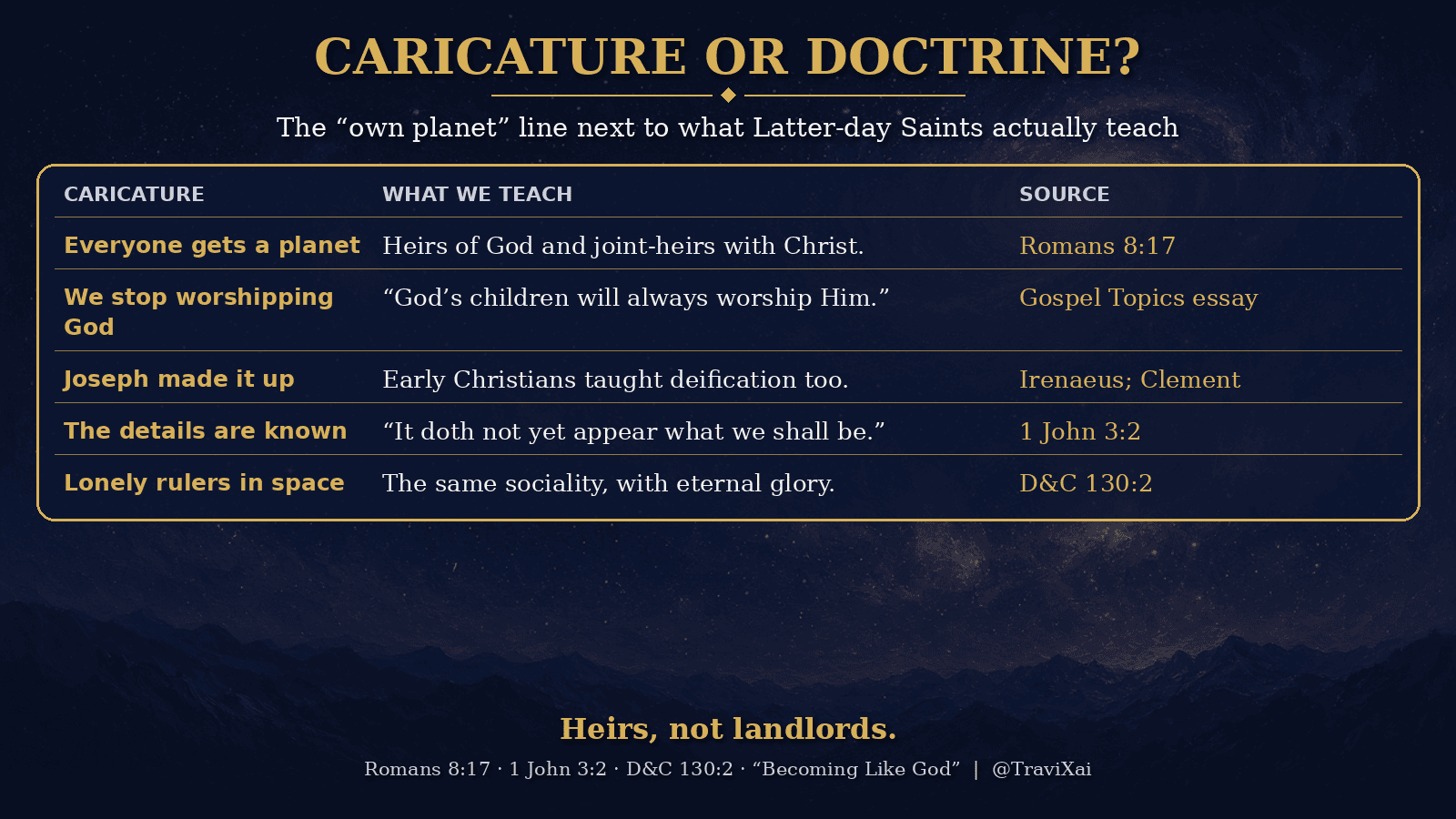
That is the Latter-day Saint view of the Father. We believe in a divine lineage. He is always our Father and always our God, and we will always be below Him and worship Him. The essay says it without hedging: “Latter-day Saints believe that God’s children will always worship Him. Our progression will never change His identity as our Father and our God.”
Look at Jesus Himself. After His resurrection, glorified and about to ascend to sit on the Father’s throne, He said: “I ascend unto my Father, and your Father; and to my God, and your God” (John 20:17). The risen Son still calls the Father “my God.” Paul says that at the end, “when all things shall be subdued unto him, then shall the Son also himself be subject unto him that put all things under him, that God may be all in all” (1 Corinthians 15:27–28). If the Son, who “thought it not robbery to be equal with God” (Philippians 2:6), is still subject to the Father, no exalted man or woman is going to outrank Him.
That’s why Paul says joint-heirs with Christ (Romans 8:17), not past Him. It’s why D&C 76:59 ends the way it does: “all are theirs and they are Christ’s, and Christ is God’s.” And it’s how to read “equal” in D&C 76:95 and 88:107. “He makes them equal.” The Father does the making. It’s an inheritance given, the way a father makes his heir equal in what he owns. It is never a throne seized. Even D&C 132:20, “then shall they be above all, because all things are subject unto them,” describes what is given to them, and verse 19 says they reach it by passing “to their exaltation” under a covenant He made and a sealing He authorized.
And notice what that endless lineage does not do. In every link of the chain, the son is still a son. Nobody climbs past his own Father. Abraham 3:19 puts the Lord above all the spirits He governs, and Revelation 1:6 still reads “unto God and his Father.” The lineage runs back forever, and it never inverts. That’s why eternal progression and a Father we will always worship fit together without contradiction.
Joseph said the same in the King Follett sermon. Christ says, “when I get my kingdom I shall present it to my Father, so that he obtains kingdom upon kingdom, and it will exalt his glory” (Times and Seasons). Every world an exalted child organizes adds to the Father’s glory. It doesn’t compete with it. “This is my work and my glory” never stops being His.
1 Corinthians 2:9 · Early Christians“Eye hath not seen” is a promise, not a hedge
President Gordon B. Hinckley said it plainly when a reporter pressed him in 1997: “Well, as God is, man may become. We believe in eternal progression. Very strongly” (quoted in the essay). Very strongly. That is the posture. Not embarrassment.
Will we know every mechanic of how worlds are organized before we get there? No, and scripture says why: “Eye hath not seen, nor ear heard, neither have entered into the heart of man, the things which God hath prepared for them that love him” (1 Corinthians 2:9). John: “it doth not yet appear what we shall be: but we know that, when he shall appear, we shall be like him” (1 John 3:2). Not having seen the blueprint doesn’t make the inheritance uncertain. It makes it bigger than we can picture.
And no, Joseph didn’t invent the idea that redeemed humans can become like God. The essay quotes Irenaeus (died about A.D. 202): Christ “did, through His transcendent love, become what we are, that He might bring us to be what He is Himself.” Clement of Alexandria: “the Word of God became man, that thou mayest learn from man how man may become God.” Eastern Orthodox Christians still call it theosis. What the Restoration added was the part the creeds lost: we are literally His children, and children grow up to be like their Father.
Check the premiseThe presuppositions baked into the question
Before this question can be answered fairly, the person asking has to justify a few assumptions packed inside it:
- That the cartoon is the doctrine. The Church calls the “own planet” image a “cartoonish image” in media, then affirms “our creative potential in the eternities.” Mock the cartoon all you want. You haven’t touched the teaching.
- That sounding strange makes something false. Worlds without number (Moses 1:33), joint-heirs with the Heir “by whom also he made the worlds” (Hebrews 1:2; Romans 8:17), and “Ye are gods” (John 10:34) sound strange too. They’re still scripture.
- That becoming like God means becoming equal to Him or replacing Him. The risen Christ still says “my God” (John 20:17), and the Son Himself will be “subject unto him” (1 Corinthians 15:28). “They are Christ’s, and Christ is God’s” (D&C 76:59). Heirs inherit. They don’t usurp.
- That quieter modern messaging means the doctrine was dropped. Joseph taught it (King Follett, Sermon in the Grove), Lorenzo Snow and Brigham Young preached it, D&C 132:20 and 132:37 canonize it, and the Church’s manuals still print “God Himself was once as we are now” and “As God now is, man may be.”
- That this is a novel, non-Christian idea. Irenaeus, Clement of Alexandria and Basil the Great taught that redeemed humans could be made like God. Eastern Orthodoxy still teaches theosis.
FAQQuick answers
Do Latter-day Saints believe they get their own planet?
Not the cartoon version, which the Church itself calls a “cartoonish image.” The actual doctrine is bigger: God’s faithful children inherit “all that my Father hath” (D&C 84:38) as joint-heirs with Christ (Romans 8:17), and exalted beings will create as our Father has, not one planet but “worlds without number” (Moses 1:33). Joseph Smith taught it in the King Follett sermon, and D&C 132:20 says of the exalted, “Then shall they be gods.”
Will exalted people create worlds?
Yes. God has created “worlds without number” by the Son (Moses 1:33), the Son is “heir of all things, by whom also he made the worlds” (Hebrews 1:2), and we are joint-heirs with Him (Romans 8:17). Exaltation brings “a continuation of the seeds forever and ever” (D&C 132:19), and Joseph Smith taught that the faithful learn to be Gods “the same as all Gods have done.”
Do Latter-day Saints think they will be equal to God or replace Him?
No. Heavenly Father will always be our Father and our God, and we will always be below Him and worship Him. Even the risen Christ calls Him “my God” (John 20:17) and will be “subject unto him” (1 Corinthians 15:28). The exalted are joint-heirs with Christ (Romans 8:17), and “they are Christ’s, and Christ is God’s” (D&C 76:59). Exaltation means becoming like Him as His heirs, never surpassing Him.
What is exaltation in the Church of Jesus Christ of Latter-day Saints?
Eternal life, the kind of life God lives, in the highest degree of the celestial kingdom with eternal families. Those sealed under the new and everlasting covenant receive “a fulness and a continuation of the seeds forever and ever” and “shall they be gods, because they have no end” (D&C 132:19–20). God calls it “my work and my glory” (Moses 1:39).
What did Joseph Smith teach in the King Follett sermon?
That “God Himself was once as we are now, and is an exalted man, and sits enthroned in yonder heavens,” and that “You have got to learn how to be Gods yourselves … the same as all Gods have done; by going from a small degree to another, from grace to grace, from exaltation to exaltation.” It matches D&C 76, 84 and 132.
Do Latter-day Saints believe Heavenly Father had a Father?
Joseph Smith taught it. In the Sermon in the Grove (June 16, 1844), as reported by Thomas Bullock, he reasoned from Revelation 1:6 (“unto God and his Father”) and from Abraham 3 that God the Father had a Father: “where was there ever a Son with[ou]t a Fa[the]r.” Brigham Young taught the same. It is an endless divine lineage, and in it our Father is always our Father and our God.
What does “As man now is, God once was: As God now is, man may be” mean?
It is Lorenzo Snow’s couplet from 1840, and the Church still teaches it in its manuals. The first half means our Father progressed to where He is. The second means His children can become like Him (Romans 8:17; 1 John 3:2). It restates what Joseph Smith taught in the King Follett sermon.
Did early Christians believe humans could become like God?
Yes. Irenaeus, Clement of Alexandria and Basil the Great all wrote about humans being made like God, or being “made God,” through Christ. Eastern Orthodox Christians call this theosis.
SummaryKey takeaways
- “Get your own planet” is a cartoon. The doctrine is inheriting “all that my Father hath” (D&C 84:38).
- God’s works are “worlds without number” with “no end” (Moses 1:33, 38). The exalted will create as He has (D&C 132:19–20; Hebrews 1:2).
- Joseph Smith taught an endless divine lineage: God was once as we are, and the Father had a Father (King Follett; Sermon in the Grove). Lorenzo Snow and Brigham Young taught the same.
- Exaltation is a lineage, not a coup: joint-heirs with Christ, “and Christ is God’s.” He is always our Father and our God.
- “Eye hath not seen” (1 Corinthians 2:9) is a promise of more, not a reason to back away.
Read the Church’s essay “Becoming Like God,” then read Moses 1, D&C 76 and Romans 8 side by side. For quick, sourced answers, open Galatians18, and follow me on X at @TraviXai.
Sources
- King James Bible (churchofjesuschrist.org): Psalm 82:6 · Matthew 5:48 · John 10:34 · John 20:17 · Romans 8:16–17 · 1 Corinthians 2:9 · 1 Corinthians 15:27–28 · Philippians 2:6 · Hebrews 1:2 · 1 John 3:2 · Revelation 1:6 · Revelation 3:21
- Doctrine and Covenants: D&C 76:55–59 · 76:95 · 84:38 · 88:20 · 88:43–47 · 88:107 · 132:19–20
- Pearl of Great Price: Moses 1:33–39 · Moses 7:30 · Abraham 3:18–26 · D&C 132:37
- Discourse, 7 April 1844 (King Follett), as published in Times and Seasons, Aug. 15, 1844, pp. 612–614, Joseph Smith Papers
- Discourse, 16 June 1844–A (“Sermon in the Grove”), as Reported by Thomas Bullock, pp. [1], [3], Joseph Smith Papers (a contemporary report with abbreviations; editorial brackets as in the Papers)
- Teachings of Presidents of the Church: Joseph Smith, ch. 2 (King Follett: “God Himself was once as we are now”)
- BYU Studies, “What Is the Nature of God’s Progress?” (source of the Brigham Young 1854 and Orson Hyde quotations)
- Teachings of Presidents of the Church: Lorenzo Snow, ch. 5 (the 1840 couplet)
- Gospel Principles, ch. 47, “Exaltation”
- Gospel Topics Essays, “Becoming Like God,” churchofjesuschrist.org (source of the Hinckley, Irenaeus and Clement quotations)
- Featured image and in-article graphic: original graphics by thebookofmormon.ai (painterly backgrounds; no photographs or likenesses of real people).