
Critics wave papyrus fragments like a mic drop. Joseph published three facsimiles, a long text, and explanations. Here is what he said, what Egyptologists generally say, and what the Church’s own essay actually claims.
I LOVE LOVE LOVE the Book of Abraham. And that is exactly why the online pile-on feels so familiar: obsess over the scraps, ignore the contents, declare victory. Cue the Saturday-morning cartoon. Cue nobody opening the Gospel Topics Essay.
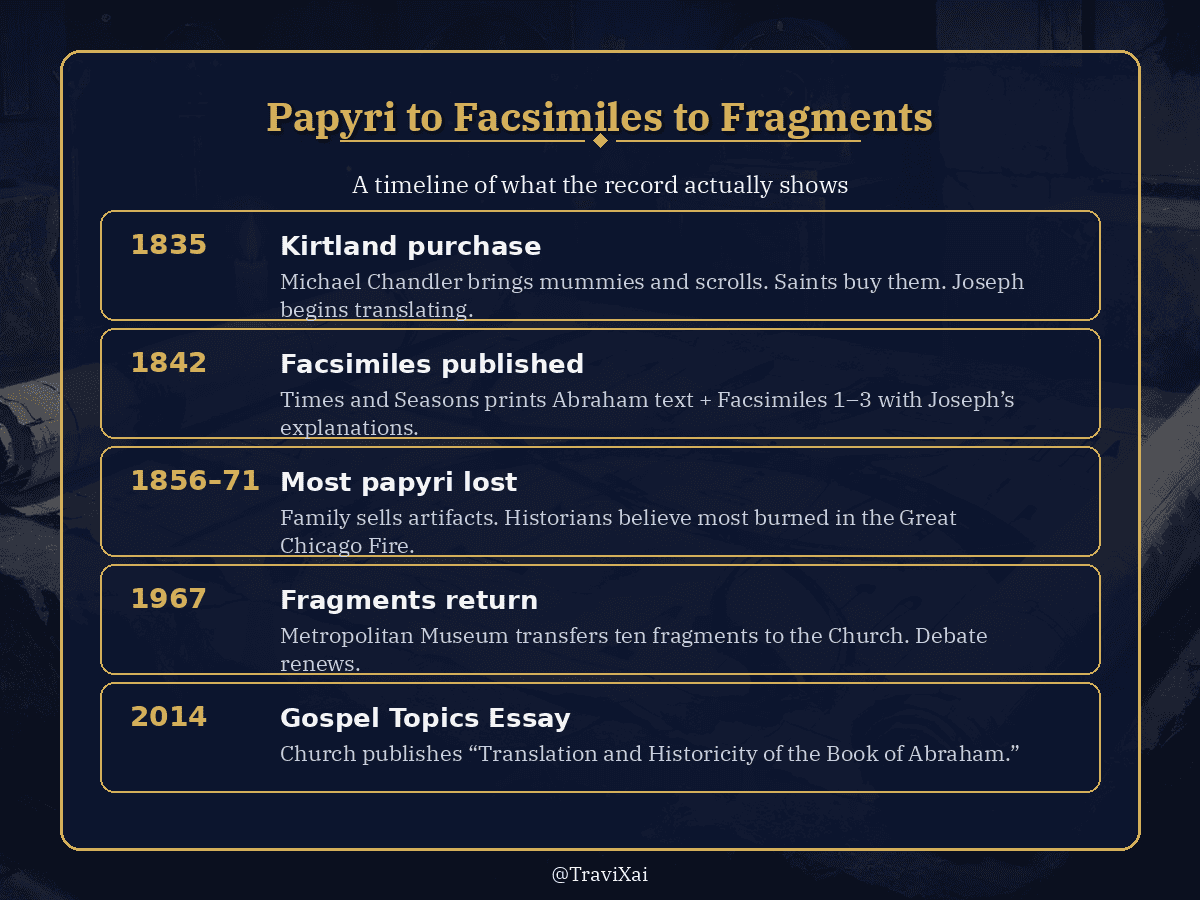
So let’s open the record. In 1835 the Saints in Kirtland bought Egyptian antiquities from Michael Chandler. Joseph Smith began a translation that was later published, with three illustrations, in the Times and Seasons in 1842. Those illustrations are Facsimiles 1, 2, and 3. Most of the original papyri are gone. Ten fragments resurfaced in 1967. Critics treat those fragments as a closed case. The Church’s own essay does not.
Part IWhat the debate is actually about
Two conversations get glued together: how Joseph produced the book, and what the published text and facsimiles claim. Critics prefer the first, because the second requires reading Abraham 1–5.
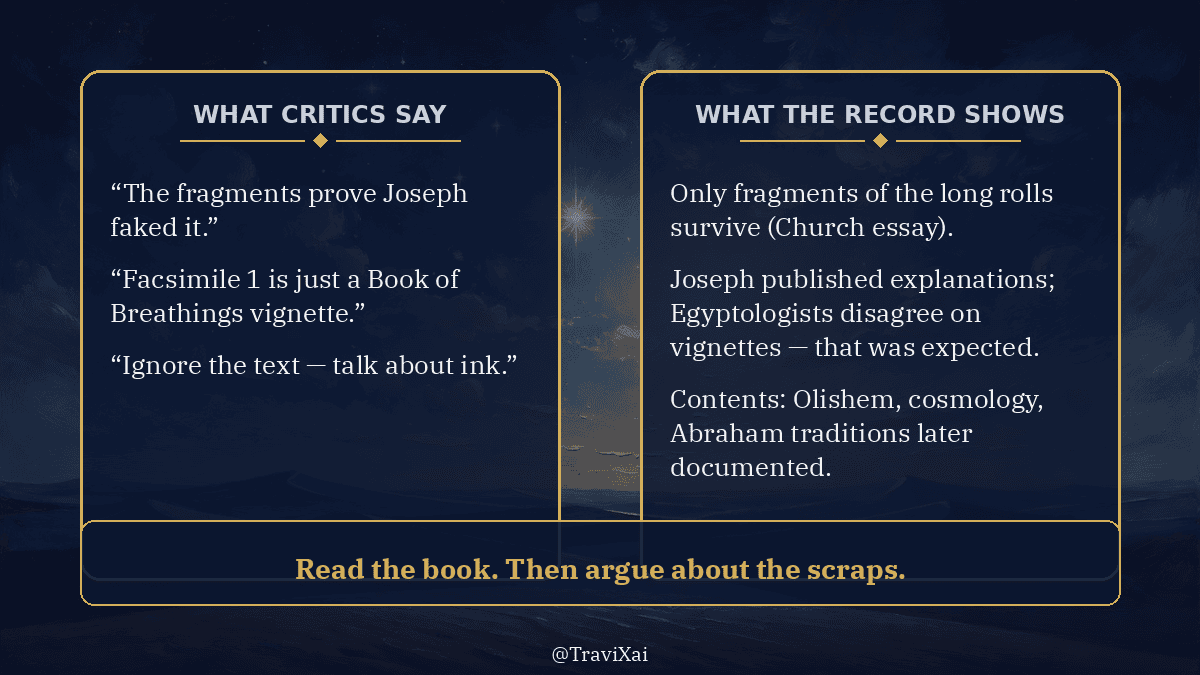
The Church of Jesus Christ of Latter-day Saints is blunt about the limits. The Gospel Topics Essay “Translation and Historicity of the Book of Abraham” states that many people saw the papyri, but “no eyewitness account of the translation survives,” that only small fragments of the long scrolls exist today, and that “the relationship between those fragments and the text we have today is largely a matter of conjecture.”
That is not a Reddit dodge. That is the Church’s published position. If your entire argument is “the 1967 fragments settle everything,” you are arguing with a straw man, not with the essay. For the wider “con man” frame, see Was Joseph Smith a Con Man? and the Book of Abraham topic on Galatians18.
Part IILong rolls, not just fragments
Eyewitnesses in the 1830s described more than the mounted scraps we have now. The Joseph Smith Papers introduction to the Egyptian papyri notes that Oliver Cowdery described four mummies, “two rolls of papyrus,” and other small pieces, and said the papyri were “beautifully written in papyrus with black, and a small part, red ink or paint, in perfect preservation.” The same black-and-red description appears in the manuscript history (History, 1838–1856, volume B-1).
The Gospel Topics Essay leans on that gap: eyewitnesses spoke of “a long roll” or multiple “rolls,” and “since only fragments survive, it is likely that much of the papyri accessible to Joseph… is not among these fragments.” It also allows that the artifacts may have catalyzed revelation about Abraham’s life, “even if that revelation did not directly correlate to the characters on the papyri.” Treating the Metropolitan Museum fragments as the entire source text is an assumption, not a proven fact.
Missing originals are not unique to Latter-day Saints. Moses broke the first tablets. We do not have the Ark. We do not have any original biblical manuscript. For that double standard on missing plates, see Moses Broke the Tablets. The Kinderhook case is the opposite problem — a confessed brass forgery with no published revealed translation — and that record is covered in The Kinderhook Plates: What the Record Actually Shows and on Galatians18.
Part IIIFacsimile 1: the altar scene
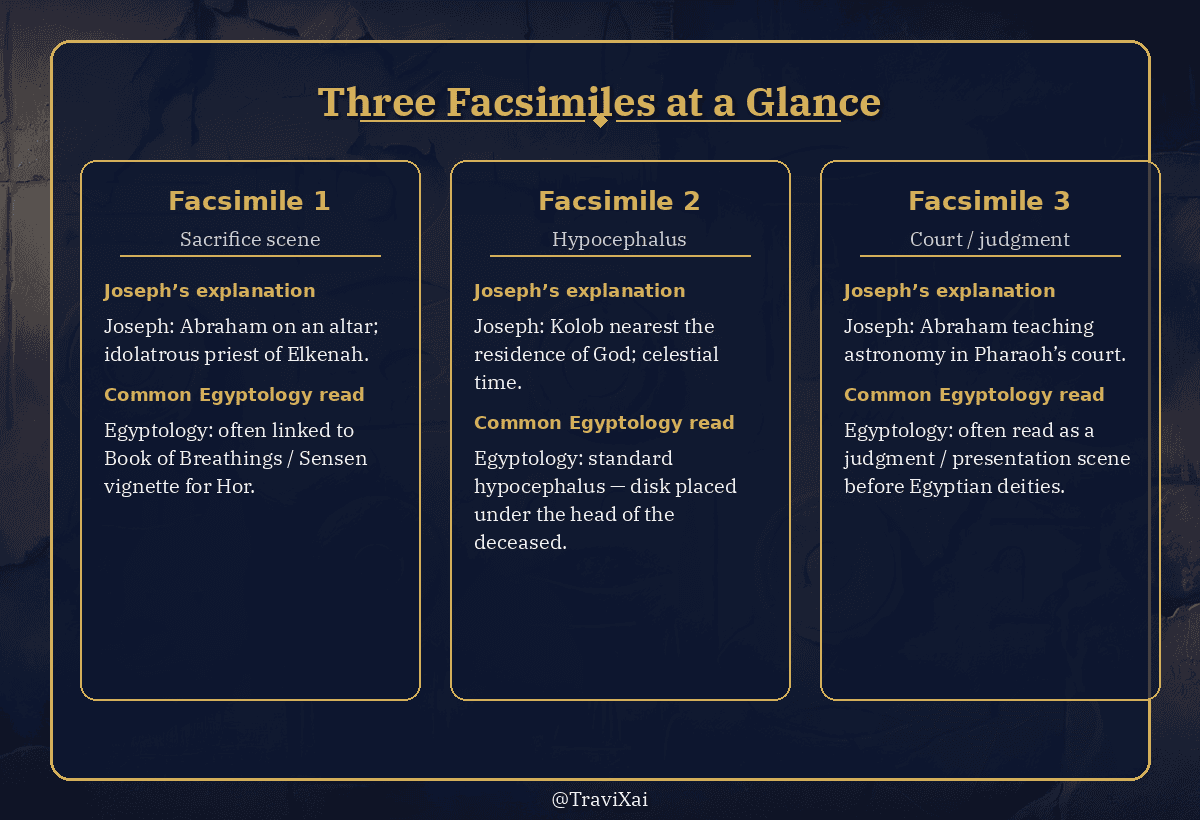
Facsimile 1 is the scene most people recognize: a figure on a lion couch, a standing figure with a knife, canopic jars underneath, a bird-like figure above. Joseph’s published explanation identifies Fig. 1 as “The Angel of the Lord,” Fig. 2 as “Abraham fastened upon an altar,” and Fig. 3 as “The idolatrous priest of Elkenah attempting to offer up Abraham as a sacrifice.” The lower figures are labeled as idolatrous gods (Elkenah, Libnah, Mahmackrah, Korash, and Pharaoh), with the crocodile and “firmament” explained in Egyptian terms in Figs. 11–12. Read the full explanation on the Church’s site: Facsimile 1.
Egyptologists generally identify the surviving vignette linked to Facsimile 1 as part of a Book of Breathings (Sensen) for a priest named Hor — a funerary couch scene, not Abraham on an altar. The Gospel Topics Essay acknowledges the conflict: Latter-day Saint and non–Latter-day Saint Egyptologists agree the characters on the surviving fragments do not match the Book of Abraham translation, and scholars date those funerary texts many centuries after Abraham.
The essay does not dodge that tension. It notes that records travel as copies of copies, that illustrations can drift from earlier contexts, and that by revelation illustrations “with no clear connection to Abraham anciently could… shed light on the life and teachings of this prophetic figure.” It also warns that a vignette’s adjacent hieroglyphs need not be the English text’s source — Egyptian vignettes were often placed apart from their commentary.
Part IVFacsimile 2: Kolob and the hypocephalus
Facsimile 2 is the round figure. Egyptologists call that class of object a hypocephalus — a disk placed under the head of the deceased. Joseph’s Fig. 1 explanation is the line critics love to mock and Saints love to read:
Kolob, signifying the first creation, nearest to the celestial, or the residence of God. First in government, the last pertaining to the measurement of time…. One day in Kolob is equal to a thousand years according to the measurement of this earth….
Book of Abraham, Facsimile 2, Fig. 1
That matches Abraham 3, where the Lord shows Abraham the stars and names the great one:
And I saw the stars, that they were very great, and that one of them was nearest unto the throne of God; and there were many great ones which were near unto it; And the Lord said unto me: These are the governing ones; and the name of the great one is Kolob, because it is near unto me, for I am the Lord thy God….
Abraham 3:2–3
Kolob, in Joseph’s framing and in Abraham 3’s own wording, is a star — nearest where God resides — not a cartoon planet. Facsimile 2 also speaks of priesthood, firmament, and “this earth in its four quarters” (Fig. 6); the essay notes a similar four-quarters reading has been argued for identical figures elsewhere. You can disagree with Joseph’s restoration. You cannot honestly pretend he never published a coherent celestial reading of the disk.
Part VFacsimile 3: Abraham in the court
Facsimile 3 shows a seated figure with a scepter, standing attendants, and a darker-skinned figure at the end. Joseph’s explanation: Fig. 1 is “Abraham sitting upon Pharaoh’s throne, by the politeness of the king,” with a crown “representing the Priesthood”; Fig. 2 is King Pharaoh; Fig. 4 a prince; Fig. 5 “Shulem, one of the king’s principal waiters”; Fig. 6 “Olimlah, a slave belonging to the prince.” The caption closes: “Abraham is reasoning upon the principles of Astronomy, in the king’s court.” Full text: Facsimile 3.
The common Egyptological read treats the vignette as a judgment or presentation scene before Egyptian deities, not Abraham tutoring Pharaoh’s court. That disagreement is real, and Saints should say so. The point is not “Egyptologists secretly agree.” It is that Joseph published a specific Abrahamic reading — Abraham teaching the heavens — that lines up with the book’s narrative and with ancient traditions the essay summarizes in which Abraham instructs Egyptians about the heavens.
Part VIContents critics skip
Here is the part that makes the process-obsession so obvious. The Book of Abraham is not only three woodcuts. It is scripture about priesthood, covenant, idolatry, creation, and the premortal council. Abraham seeks the blessings of the fathers, rejects his father’s idols under threat of death, and learns why we are here: “We will prove them herewith, to see if they will do all things whatsoever the Lord their God shall command them” (Abraham 3:25).
The Gospel Topics Essay lists particulars that fit the ancient world and were not the Saturday-morning cartoon of 1835 America: the plain of Olishem beside a later-found “Ulisum” inscription; Near Eastern-style poetry in Abraham 3:22–23; Elkenah among Mesopotamian gods; and ancient traditions connecting Abraham with astronomy taught to Egyptians and deliverance from a sacrificial threat. The essay is careful — parallels cannot “prove” scripture like a lab test. Faith still decides. Pretending the text is empty while you argue about ink is avoidance.
Part VIIThe double standard on reused materials
Biblical authors reuse and reframe older materials all the time — temple imagery for Christ, Jude quoting Enoch, Paul citing pagan poets. Nobody serious pretends every Christian use of an older form must match a modern museum label or the faith collapses.
So when Joseph attaches Abrahamic meaning to Egyptian vignettes — by restoration, revelatory reinterpretation, or catalyst — the outrage is selective. The Church’s essay allows that documents “initially composed for one context can be repackaged for another context or purpose.” If you grant that to Matthew and Paul, do not demand a National Geographic caption for Facsimile 1. If “missing originals kill the claim,” start with Moses’ tablets. See also Seer Stones in the Bible, translation and the seer stone, the facsimiles topic, and the Pearl of Great Price topic.
SummaryKey takeaways
- Joseph published Facsimiles 1–3 with explanations in 1842; those explanations are public and specific (altar/Abraham; Kolob; Abraham teaching astronomy).
- Egyptologists generally read the vignettes as funerary: Book of Breathings / Sensen for Facsimile 1–related material, a hypocephalus for Facsimile 2, and a judgment/presentation scene for Facsimile 3. The disagreement is real — and the Church’s essay says so.
- Eyewitnesses described long rolls with black and red ink; only fragments survive. The Gospel Topics Essay says the fragment-to-text relationship is largely conjecture and allows a revelatory / catalyst model of translation.
- Contents still matter: Olishem, Abrahamic cosmology, Kolob as the star nearest God’s residence, and ancient Abraham traditions the essay documents. Process arguments that never open the book are not serious.
- Reusing or reinterpreting older iconography is not uniquely “Mormon.” Hold one standard for biblical authors and Joseph, or admit the double standard.
Next time someone drops “Facsimile 1” like a mic, ask whether they have read Abraham 3 — and whether they have read the Church’s own essay. For quick, sourced answers on the Book of Abraham, the facsimiles, the Pearl of Great Price, and translation, open Galatians18. And for more like this every day, follow me on X at @TraviXai.
Sources
- Gospel Topics Essay: “Translation and Historicity of the Book of Abraham” (Church of Jesus Christ of Latter-day Saints)
- Gospel Topics: “Abraham, Book of”
- Pearl of Great Price facsimiles: Facsimile 1 · Facsimile 2 · Facsimile 3 · Abraham 3:2–3 · Abraham 3:25
- Joseph Smith Papers: Introduction to Egyptian Papyri, circa 300–100 BC (Cowdery black-and-red ink / rolls description)
- Joseph Smith Papers: History, 1838–1856, volume B-1, p. 675 (black and red ink description)
- Joseph Smith Papers: Book of Abraham topic · Egyptian papyri topic
- BYU Religious Studies Center: “The Relationship of the Book of Abraham Text to the Papyri” (John Gee; long-roll eyewitness summary)
- Galatians18: Book of Abraham · Facsimiles · Pearl of Great Price · Kinderhook plates · Translation / seer stone
- Featured image and in-article graphics: original graphics by thebookofmormon.ai (painterly backgrounds; no photographs or likenesses of real people).