
Almost everyone who knows a Latter-day Saint eventually wonders about garments. Here’s what they are, why members wear them, and why sacred clothing is as old as the Bible.
LDS temple garments are a simple white undergarment that adult members wear under their regular clothes after receiving the temple endowment. The First Presidency calls the garment “a sacred symbol of Jesus Christ” and “an outward expression of your inner commitment to follow Him.” Sacred clothing is biblical: God commanded “holy garments for Aaron … for glory and for beauty,” including linen worn underneath (Exodus 28:2, 42).
The basicsWhat temple garments are
The Church explains it plainly: adult members who receive the temple endowment “receive a simple undergarment—often referred to as the ‘temple garment’ or ‘garment of the Holy Priesthood.’” Unlike the ceremonial clothing worn inside the temple, “the garment is worn underneath members’ normal clothing for the rest of their lives, serving as a daily physical reminder of their covenant relationship with God” (Church Newsroom, “Garments”).
It’s white, it comes in two pieces, and it looks a lot like ordinary modest underclothing. Children don’t wear it, and neither do members who haven’t been to the temple. Missionaries usually receive their endowment before they serve, which is why most of them wear it.
Garments aren’t secret, but they are sacred. That’s why Latter-day Saints don’t put them on display or joke about them, the same way a Catholic wouldn’t toss a rosary around or a Jewish family wouldn’t treat a Torah scroll casually. The Lord said, “that which cometh from above is sacred, and must be spoken with care” (D&C 63:64).
The meaningWhy Latter-day Saints wear them: a symbol of Christ
Here’s the official guidance from the First Presidency, published in the Church’s General Handbook:
The garment of the holy priesthood reminds us of the veil in the temple, and that veil is symbolic of Jesus Christ. When you put on your garment, you put on a sacred symbol of Jesus Christ. Wearing it is an outward expression of your inner commitment to follow Him. The garment is also a reminder of your temple covenants.
First Presidency, General Handbook 38.5.5
That’s the heart of it. The garment points to Jesus Christ. Paul used the same picture: “as many of you as have been baptized into Christ have put on Christ” (Galatians 3:27), and “put ye on the Lord Jesus Christ” (Romans 13:14). A Latter-day Saint who dresses each morning is reminded, in a physical way, of a promise to follow Him.
The Handbook adds that as members keep their covenants, “including the sacred privilege to wear the garment as instructed in the initiatory ordinances,” they “will have greater access to the Savior’s mercy, protection, strength, and power.” Notice where the power comes from: the Savior, through keeping covenants. Not the fabric.
Exodus 28Aaron’s holy garments: clothing God designed for His house
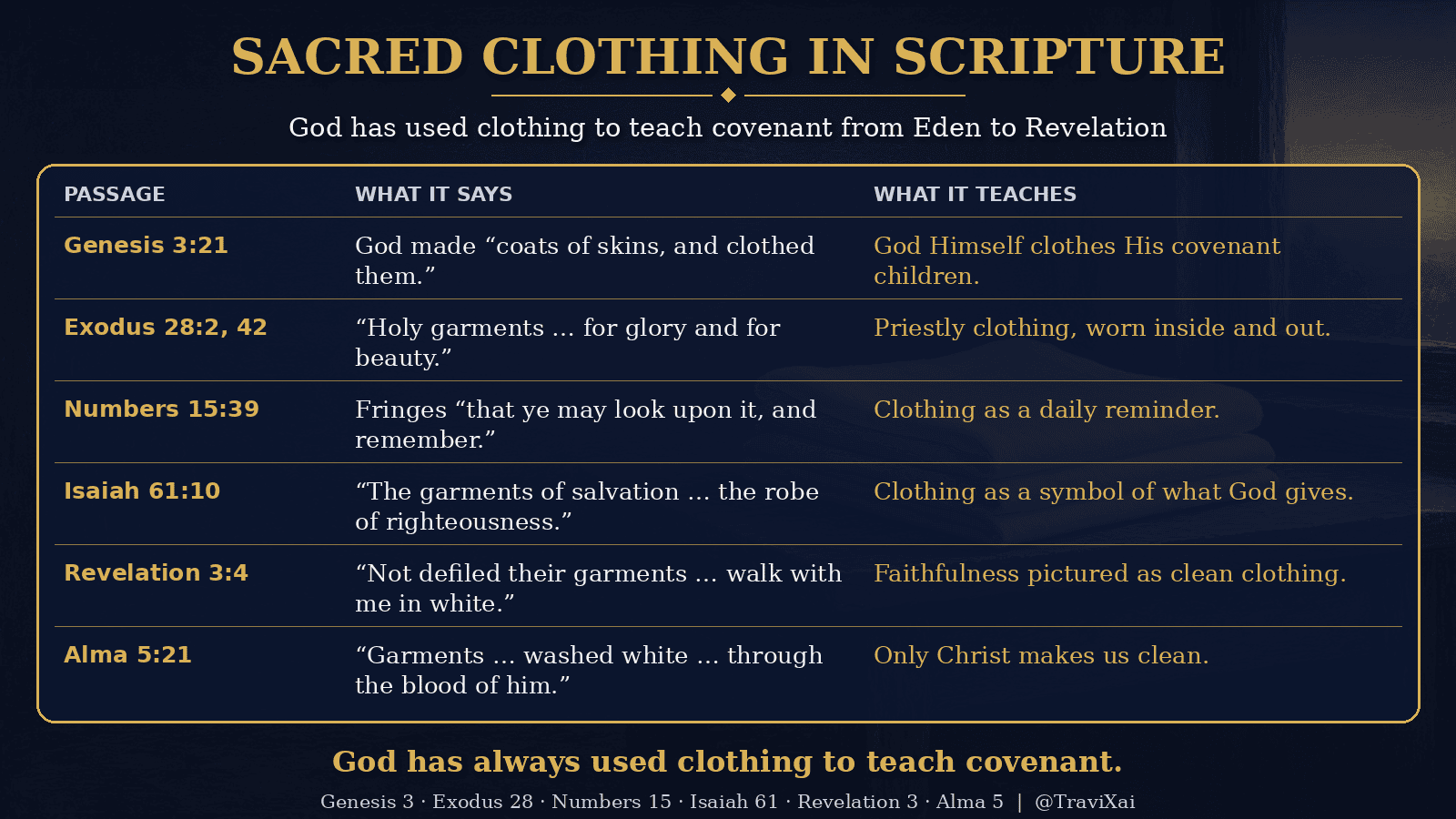
The idea of sacred clothing didn’t start in 1842. It starts in the Bible. Even in Eden, after the Fall, “unto Adam also and to his wife did the Lord God make coats of skins, and clothed them” (Genesis 3:21; Moses 4:27). Later the Lord told Moses:
And thou shalt make holy garments for Aaron thy brother for glory and for beauty.
Exodus 28:2
Those garments were made “to consecrate him, that he may minister unto me in the priest’s office” (Exodus 28:3). And they weren’t only outer robes. The Lord also commanded linen clothing worn underneath: “thou shalt make them linen breeches to cover their nakedness; from the loins even unto the thighs they shall reach” (Exodus 28:42). On the Day of Atonement the high priest put on “the holy linen coat, and he shall have the linen breeches upon his flesh … these are holy garments; therefore shall he wash his flesh in water, and so put them on” (Leviticus 16:4).
Washing, then holy clothing, then service in God’s house. A Latter-day Saint reading Leviticus 16 recognizes the pattern. The Church’s own explanation of garments cites Exodus 28 for exactly this reason, noting that Aaron’s clothing included “clothing that was visible to an observer and clothing worn underneath these outer layers” (Newsroom).
Numbers 15Clothing that helps you remember
God has asked His people to wear reminders before. He told Israel to put fringes on the borders of their garments with “a ribband of blue”:
And it shall be unto you for a fringe, that ye may look upon it, and remember all the commandments of the Lord, and do them; and that ye seek not after your own heart and your own eyes … That ye may remember, and do all my commandments, and be holy unto your God.
Numbers 15:39–40
That’s the same purpose the Church gives for the garment: a daily physical reminder. Many observant Jewish men still wear a fringed garment under their shirts for this commandment. Catholics wear scapulars under their clothing, and Sikhs wear a sacred undergarment as one of the articles of their faith. Sacred clothing under everyday clothing isn’t strange in the history of religion. It’s common.
Revelation · Alma“Walk with me in white”: what the clothing points to
All through scripture, clothing stands for the condition of the soul. Isaiah rejoiced, “he hath clothed me with the garments of salvation, he hath covered me with the robe of righteousness” (Isaiah 61:10). In Zechariah’s vision, the Lord took away Joshua’s filthy garments and said, “I have caused thine iniquity to pass from thee, and I will clothe thee with change of raiment” (Zechariah 3:4).
Thou hast a few names even in Sardis which have not defiled their garments; and they shall walk with me in white: for they are worthy. He that overcometh, the same shall be clothed in white raiment.
Revelation 3:4–5
The Book of Mormon makes the same point and makes sure we know who does the cleaning: “there can no man be saved except his garments are washed white; yea, his garments must be purified until they are cleansed from all stain, through the blood of him of whom it has been spoken by our fathers” (Alma 5:21). The risen Christ said nothing enters His rest “save it be those who have washed their garments in my blood” (3 Nephi 27:19). John saw the same: the saints “have washed their robes, and made them white in the blood of the Lamb” (Revelation 7:14).
At the dedication of the Kirtland Temple, Joseph Smith prayed “that our garments may be pure, that we may be clothed upon with robes of righteousness” (D&C 109:76). The white garment is a daily picture of that hope.
In practiceHow Latter-day Saints wear and care for them
The General Handbook gives practical guidance that most people never see (General Handbook 38.5):
- Day and night. Endowed members wear the garment under their clothing, removing it for activities that can’t reasonably be done in it (swimming, for example) and putting it back on as soon as they can.
- No altering it. “Members should not modify or alter the garment to accommodate different styles of clothing.” Members also aren’t allowed to make their own; garments are bought from the Church’s distribution services, and a bishop can use fast-offering funds to help members who can’t afford them.
- Not for display. “Members should not inappropriately display the garment to those who do not understand its significance.”
- Exceptions for real needs. Members in the military or with medical conditions sometimes can’t wear it. The Handbook says their standing isn’t affected: “The Lord focuses on the heart and a willing mind,” citing D&C 64:34.
- Respectful disposal. Worn-out garments are cut up so they can’t be recognized before they’re thrown away. They aren’t donated to thrift stores.
Styles do change. In October 2024 the Church announced redesigned options, including sleeveless tops, for members in hot, humid climates, with a global rollout through the end of 2025. A Church spokesman said, “The First Presidency has authorized changes in the garment to bless those members and others who might benefit from the changes” (Church News, Oct. 17, 2024). The design is the Church’s to adjust. The symbol stays the same.
Check the premiseThe presuppositions baked into the question
Before this question can be answered fairly, the person asking has to justify a few assumptions packed inside it:
- That garments are “magic underwear.” That’s a mocking phrase, not a Church teaching. The Church says the garment is “a sacred symbol of Jesus Christ” and that access to His “mercy, protection, strength, and power” comes through keeping covenants. Power comes from Christ, not cloth.
- That sacred clothing is unbiblical. God designed holy garments for Aaron, including linen worn underneath (Exodus 28:2, 42; Leviticus 16:4), and commanded Israel to wear fringes as reminders (Numbers 15:38–40). The asker has to explain why God’s own pattern is suspicious.
- That “sacred” means “secret,” and secret means sinister. The Church openly explains what garments are and why they’re worn. Jesus taught, “Give not that which is holy unto the dogs” (Matthew 7:6). Not mocking something holy isn’t hiding it.
- That Latter-day Saints wear garments to earn salvation. Alma 5:21 and 3 Nephi 27:19 say garments are washed white only “through the blood” of Christ. The garment is a reminder of covenants with Him, not a substitute for Him.
FAQQuick answers
What are LDS temple garments?
A simple white two-piece undergarment that endowed members of The Church of Jesus Christ of Latter-day Saints wear under their regular clothing. The Church describes it as a sacred symbol of Jesus Christ and a daily reminder of covenants made in the temple.
Who wears temple garments?
Adult members who have received the temple endowment. Children and members who haven’t been to the temple don’t wear them.
Why do Latter-day Saints wear garments?
The First Presidency teaches that “when you put on your garment, you put on a sacred symbol of Jesus Christ” and that wearing it “is an outward expression of your inner commitment to follow Him” (General Handbook 38.5.5).
Is there a Bible basis for temple garments?
Yes. God commanded “holy garments for Aaron … for glory and for beauty” (Exodus 28:2), including linen worn underneath (Exodus 28:42; Leviticus 16:4), and told Israel to wear fringes “that ye may look upon it, and remember” (Numbers 15:39).
Did the Church change the temple garment?
In October 2024 the Church announced redesigned garment options, including sleeveless tops for members in hot, humid areas, with a global rollout through the end of 2025.
Are temple garments “magic underwear”?
No. Latter-day Saints don’t believe garments are magical. They are a sacred reminder of the covenants made with God in the temple, much as other faiths have sacred clothing.
What clothing did God give Adam and Eve?
After the Fall, “Unto Adam also and to his wife did the Lord God make coats of skins, and clothed them” (Genesis 3:21). Latter-day Saints see God clothing His covenant children as a pattern that runs through scripture.
Do Latter-day Saints wear garments all the time?
Endowed members are asked to wear them day and night. They may take them off for activities that can’t reasonably be done while wearing them, such as swimming, and put them back on as soon as they can.
SummaryKey takeaways
- Temple garments are a simple white undergarment worn by endowed adult Latter-day Saints.
- The First Presidency teaches the garment is “a sacred symbol of Jesus Christ” and a reminder of temple covenants.
- God designed holy garments for Aaron, including linen worn beneath (Exodus 28:42), and fringes as reminders for Israel (Numbers 15:39).
- Only Christ makes garments “white” (Alma 5:21; Revelation 7:14). The power is His, not the fabric’s.
If you have a Latter-day Saint friend, it’s fine to ask about garments respectfully. Most of us are glad to explain what they mean. For quick, sourced answers, open Galatians18, and follow me on X at @TraviXai.
Sources
- King James Bible (churchofjesuschrist.org): Genesis 3:21 · Exodus 28:2–4 · Exodus 28:42–43 · Leviticus 16:4 · Numbers 15:38–40 · Isaiah 61:10 · Zechariah 3:3–5 · Matthew 7:6 · Romans 13:14 · Galatians 3:27 · Revelation 3:4–5 · Revelation 7:14
- Book of Mormon: Alma 5:21–24 · 3 Nephi 27:19
- Doctrine and Covenants and Pearl of Great Price: D&C 63:64 · D&C 64:34 · D&C 109:76 · Moses 4:27
- General Handbook, 38.5 “Temple Clothing and Garments” (The Church of Jesus Christ of Latter-day Saints)
- “Garments,” Church Newsroom
- Scott Taylor, “First Presidency authorizes redesigned temple garments for members in hot, humid areas,” Church News, Oct. 17, 2024
- Featured image and in-article graphic: original graphics by thebookofmormon.ai (painterly backgrounds; no photographs or likenesses of real people).