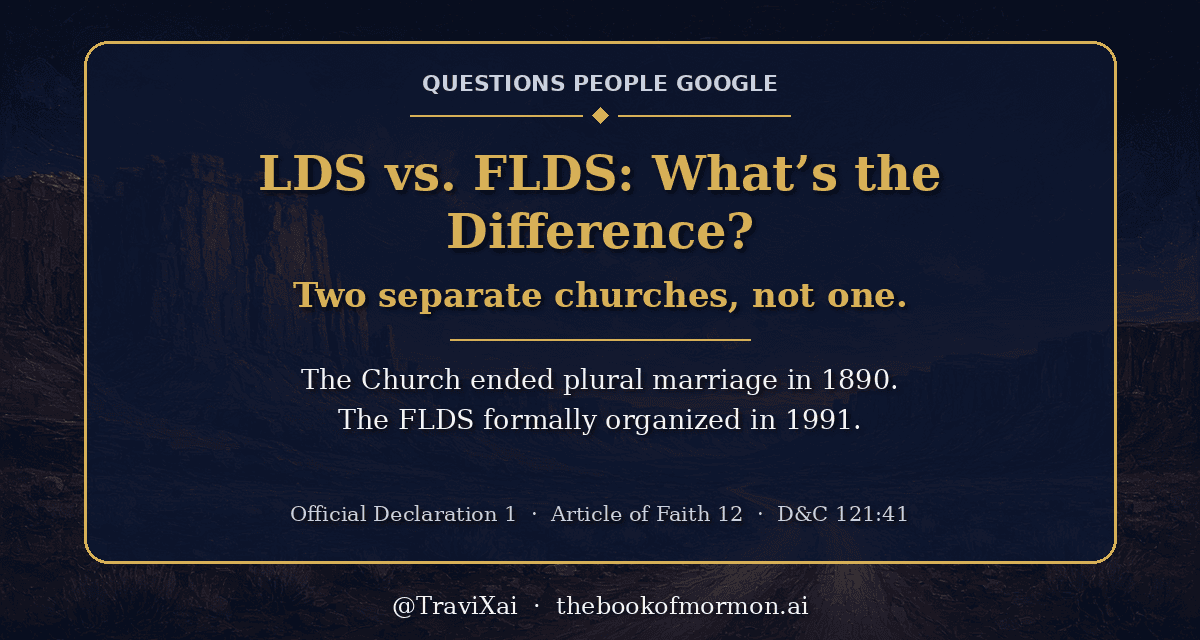

News stories about polygamy and Warren Jeffs often get attached to Latter-day Saints. Here’s who the FLDS are, where they came from, and why they aren’t part of the Church.
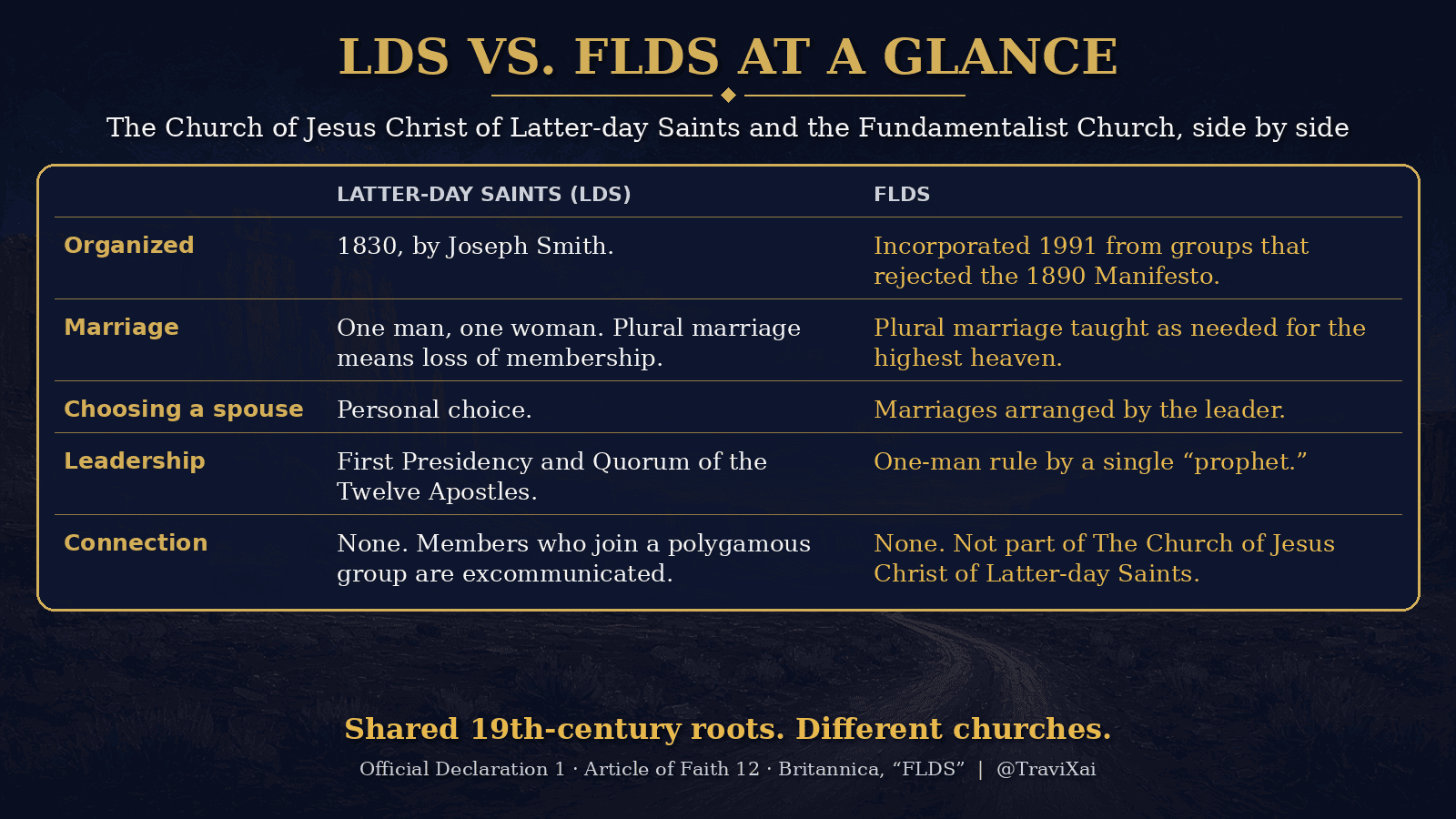
They are two separate churches. The Church of Jesus Christ of Latter-day Saints (LDS) ended plural marriage in 1890 and excommunicates anyone who practices it. The Fundamentalist Church of Jesus Christ of Latter Day Saints (FLDS) is a breakaway polygamous group, formally incorporated in 1991 from people who rejected the 1890 Manifesto. The FLDS has no connection to the Church; as President Gordon B. Hinckley said, “There is no such thing as a ‘Mormon fundamentalist.’”
The namesTwo names, two churches
The names are close on purpose. One is The Church of Jesus Christ of Latter-day Saints, the worldwide church headquartered in Salt Lake City. The other is the Fundamentalist Church of Jesus Christ of Latter Day Saints (FLDS), a small polygamous group historically centered in Short Creek, the twin towns of Hildale, Utah, and Colorado City, Arizona. Britannica describes the FLDS as “a breakaway Mormon fundamentalist group that arose from communities that continued to practice polygamy” after the Church ended it in 1890 (Britannica).
The Church is blunt about the relationship: polygamous groups “have no affiliation whatsoever with The Church of Jesus Christ of Latter-day Saints, despite the fact that the term ‘Mormon’ … is sometimes misleadingly applied to them” (Church Newsroom). President Gordon B. Hinckley put it more sharply: “There is no such thing as a ‘Mormon fundamentalist.’ It is a contradiction to use the two words together” (October 1998 general conference).
The splitWhere the FLDS came from
The Church of Jesus Christ of Latter-day Saints practiced plural marriage from the 1840s until 1890, when President Wilford Woodruff issued the Manifesto, now Official Declaration 1. In 1904 the Second Manifesto made new plural marriages grounds for excommunication (Gospel Topics essay). I tell that whole story in Does the LDS Church Still Practice Polygamy?.
Some people refused to accept the change. According to Britannica, they saw it as “a capitulation to U.S. government pressure,” appealed to a reported 1886 revelation to President John Taylor, and claimed a separate line of authority. In the 1920s a group led by Lorin C. Woolley settled Short Creek on the Utah–Arizona border. The Church excommunicated members of the Short Creek group in 1935. Under Rulon Jeffs the group moved to one-man rule, and in 1991 it formally incorporated as the FLDS (Britannica).
So the FLDS isn’t a branch of the Church that kept an old practice. It’s a separate organization built by people the Church had already cut off, claiming an authority the Church has never recognized.
AuthorityWho speaks for God? The keys question
Every group that breaks away has to claim it holds authority the main body lost. The Lord told the Church in 1831 how revelation for the whole Church works: “there is none other appointed unto you to receive commandments and revelations until he be taken,” and “none else shall be appointed unto this gift except it be through him” (D&C 43:3–4).
The man holding those keys in 1890 was Wilford Woodruff. He testified, “The Lord showed me by vision and revelation exactly what would take place if we did not stop this practice” (excerpts following OD 1). A group that rejects that revelation while claiming to follow Joseph Smith is rejecting the very order Joseph’s revelations set up.
MarriageMarriage: choice versus control
This is where the difference is clearest. In the Church, marriage is between one man and one woman, and members choose whom they marry. Even when plural marriage was practiced in the 1800s, the Church’s essay says “women were free to choose their spouses … or whether to marry at all.”
Britannica describes the FLDS very differently: leaders arrange marriages “rather than allowing individuals to choose their marriage partners,” wives can be reassigned “as a method of control,” and FLDS teaching holds “that a man must have at least three wives” to reach the highest heaven (Britannica). That last claim has no basis in Latter-day Saint scripture. The Book of Mormon’s standard is “there shall not any man among you have save it be one wife” (Jacob 2:27).
Revelation through Joseph Smith actually condemns controlling religious leadership. “It is the nature and disposition of almost all men, as soon as they get a little authority, as they suppose, they will immediately begin to exercise unrighteous dominion” (D&C 121:39). Instead:
No power or influence can or ought to be maintained by virtue of the priesthood, only by persuasion, by long-suffering, by gentleness and meekness, and by love unfeigned; By kindness, and pure knowledge.
D&C 121:41–42
The lawObeying the law versus defying it
The Church binds its members to obey the law: “We believe in being subject to kings, presidents, rulers, and magistrates, in obeying, honoring, and sustaining the law” (Article of Faith 12). An 1831 revelation says, “Let no man break the laws of the land, for he that keepeth the laws of God hath no need to break the laws of the land” (D&C 58:21). President Hinckley used Article of Faith 12 to explain excommunicating polygamists: “One cannot obey the law and disobey the law at the same time.”
The FLDS became known to most Americans through crime. Britannica summarizes: Warren Jeffs, who took over after his father’s death in 2002, landed on the FBI’s Ten Most Wanted list, was arrested in 2006, and in 2011 was convicted in Texas of aggravated sexual assault of a child and sexual assault of a child, involving two girls aged 12 and 15 he called “spiritual wives.” He was sentenced to life plus 20 years (Britannica).
Jesus’s words about that kind of leader are hard to read: “whoso shall offend one of these little ones which believe in me, it were better for him that a millstone were hanged about his neck, and that he were drowned in the depth of the sea” (Matthew 18:6). And His test of a prophet is fruits: “Beware of false prophets, which come to you in sheep’s clothing … Ye shall know them by their fruits” (Matthew 7:15–16).
MediaWhy people mix them up
Part of it is the names, and part of it is the word “Mormon,” which reporters still apply to anyone with roots in Joseph Smith’s movement. Shows and documentaries about polygamous groups add to it. Britannica notes that the family on Sister Wives belongs to yet another group, the Apostolic United Brethren, not the FLDS and not the Church.
A simple rule helps: if a group practices polygamy today, it is not The Church of Jesus Christ of Latter-day Saints. That’s one more good reason to use the Church’s full name.
Check the premiseThe presuppositions baked into the question
Before this question can be answered fairly, the person asking has to justify a few assumptions packed inside it:
- That FLDS members are a stricter kind of Latter-day Saint. They belong to a different church that rejects the Church’s prophets and the revelation ending plural marriage. As President Hinckley said of polygamists in 1998, “Most of them have never been members.”
- That the Church secretly approves of polygamy. Members who practice plural marriage are excommunicated, “the most serious penalty the Church can impose” (President Hinckley, 1998), and the Church won’t baptize people living in plural marriages even where it’s legal.
- That the FLDS is what the Church would be if it hadn’t “given in.” Even in the 1800s, Church members chose their spouses, divorce was available to women, and two-thirds of plural husbands had only two wives. Arranged marriages and a “three wives” rule describe the FLDS, not the 19th-century Church.
- That a shared history makes the churches the same. Protestant churches share history with Catholics; the Church of Jesus Christ and the FLDS share 19th-century roots. Shared roots don’t make separate churches one church.
FAQQuick answers
What is the difference between LDS and FLDS?
LDS refers to The Church of Jesus Christ of Latter-day Saints, a worldwide church that ended plural marriage in 1890 and excommunicates anyone who practices it. FLDS is the Fundamentalist Church of Jesus Christ of Latter Day Saints, a separate polygamous group formally incorporated in 1991 with no connection to the Church.
Is the FLDS part of the LDS Church?
No. The Church says polygamous groups “have no affiliation whatsoever” with it, and President Gordon B. Hinckley said, “There is no such thing as a ‘Mormon fundamentalist.’”
Do LDS people practice polygamy?
No. Members of The Church of Jesus Christ of Latter-day Saints who practice plural marriage lose their membership. The practice ended with the 1890 Manifesto and was made grounds for excommunication in 1904.
Who is Warren Jeffs?
Warren Jeffs became leader of the FLDS in 2002. In 2011 he was convicted in Texas of aggravated sexual assault of a child and sexual assault of a child and sentenced to life in prison plus 20 years. He was never a leader in The Church of Jesus Christ of Latter-day Saints.
Where is the FLDS located?
Its historical center is Short Creek, the towns of Hildale, Utah, and Colorado City, Arizona, with smaller communities in other states, Canada, and Mexico.
When did the FLDS split from the Church?
Fundamentalist groups formed in the early 1900s among people who rejected the Church’s 1890 and 1904 decisions to end plural marriage. The FLDS Church itself was incorporated in 1991. It has never been part of The Church of Jesus Christ of Latter-day Saints.
What happens to Latter-day Saints who practice polygamy today?
They are excommunicated. The Church has not authorized new plural marriages since President Wilford Woodruff’s 1890 Manifesto, which told members “to refrain from contracting any marriage forbidden by the law of the land” (Official Declaration 1).
Does the FLDS use the Book of Mormon?
Yes, the FLDS accepts the Book of Mormon. But the Book of Mormon itself sets one wife as the standard unless God commands otherwise: “there shall not any man among you have save it be one wife” (Jacob 2:27).
SummaryKey takeaways
- The FLDS is a separate church, formally incorporated in 1991, with no connection to The Church of Jesus Christ of Latter-day Saints.
- The Church ended plural marriage in 1890 (Official Declaration 1) and excommunicates members who practice it.
- The FLDS practices arranged plural marriages and one-man rule; the Church teaches one man and one woman, freely chosen, and leadership “only by persuasion … and by love unfeigned” (D&C 121:41).
- If a group practices polygamy today, it isn’t The Church of Jesus Christ of Latter-day Saints.
When a news story blurs the two, share this post and Article of Faith 12. For quick, sourced answers, open Galatians18, and follow me on X at @TraviXai.
Sources
- King James Bible (churchofjesuschrist.org): Matthew 7:15–16 · Matthew 18:6
- Book of Mormon: Jacob 2:27
- Doctrine and Covenants and Pearl of Great Price: D&C 43:3–4 · D&C 58:21 · D&C 121:39–42 · Official Declaration 1 and excerpts · Article of Faith 12
- “The Manifesto and the End of Plural Marriage,” Gospel Topics Essays
- “Polygamy: Latter-day Saints and the Practice of Plural Marriage,” Church Newsroom
- Gordon B. Hinckley, “What Are People Asking about Us?” October 1998 general conference
- Charles Preston, “Fundamentalist Church of Jesus Christ of Latter-day Saints,” Encyclopaedia Britannica
- Featured image and in-article graphic: original graphics by thebookofmormon.ai (painterly backgrounds; no photographs or likenesses of real people).