
Polygamy is one of the first things people associate with Latter-day Saints. Here’s the whole picture: the standard, the Bible, how it began, the hard details, and how it ended.
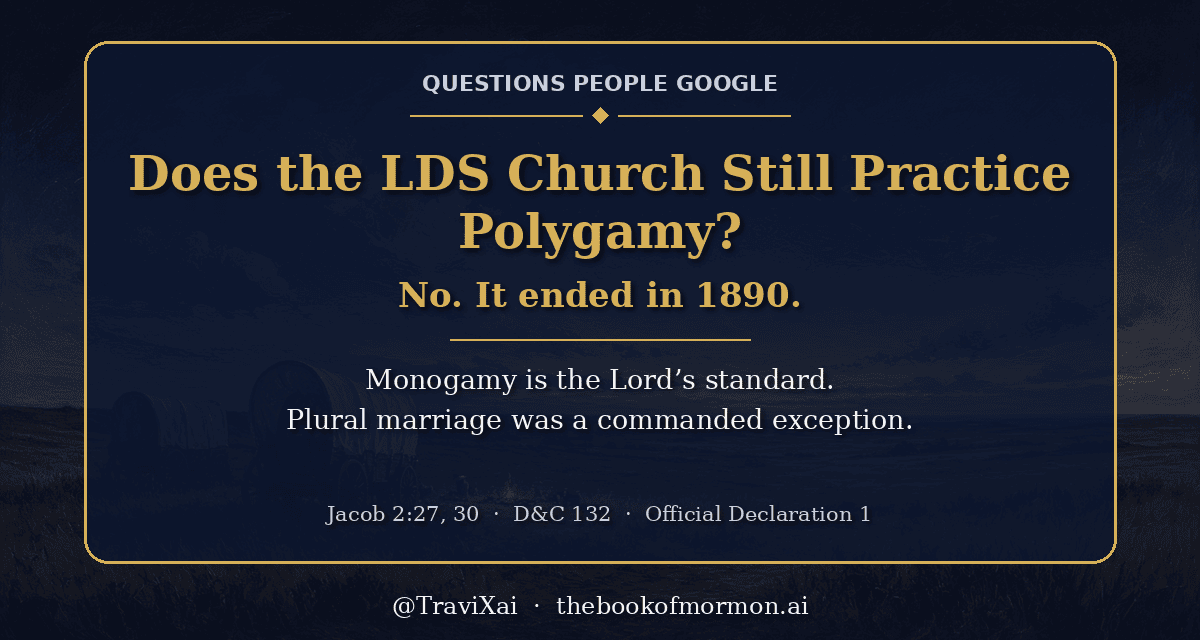
No. The Church of Jesus Christ of Latter-day Saints does not practice polygamy, and anyone who practices it today loses their membership. Monogamy is the Lord’s standard (Jacob 2:27). The Book of Mormon allows one exception, “if I will … raise up seed unto me, I will command my people” (Jacob 2:30), and the Church believes God commanded plural marriage from the 1840s until the 1890 Manifesto, just as He did for Abraham and Jacob in the Bible.
TodayThe Church does not practice polygamy
This is the easy part. The Church’s newsroom says it plainly: “Today, the practice of polygamy is strictly prohibited in the Church, as it has been for over 120 years,” and “no person can practice plural marriage and remain a member” (Church Newsroom).
President Gordon B. Hinckley said it in general conference in 1998: “If any of our members are found to be practicing plural marriage, they are excommunicated, the most serious penalty the Church can impose.” He added, “Even in countries where civil or religious law allows polygamy, the Church teaches that marriage must be monogamous and does not accept into its membership those practicing plural marriage” (“What Are People Asking about Us?”).
Groups that practice polygamy today, like the FLDS, are separate churches with no connection to The Church of Jesus Christ of Latter-day Saints. I explain that difference in LDS vs. FLDS: What’s the Difference?.
Jacob 2Monogamy is the Lord’s standard, in the Book of Mormon itself
Critics often assume Joseph Smith invented a doctrine of polygamy. The Book of Mormon he published in 1830 actually teaches the opposite as the rule:
Wherefore, my brethren, hear me, and hearken to the word of the Lord: For there shall not any man among you have save it be one wife; and concubines he shall have none.
Jacob 2:27
Then it names the one exception:
For if I will, saith the Lord of Hosts, raise up seed unto me, I will command my people; otherwise they shall hearken unto these things.
Jacob 2:30
So the standard is one man and one woman, “otherwise” only if God commands it. The Doctrine and Covenants agrees: “it is lawful that he should have one wife, and they twain shall be one flesh” (D&C 49:16), echoing Genesis 2:24. The Gospel Topics essay begins the same way: “Latter-day Saints believe that the marriage of one man and one woman is the Lord’s standing law of marriage” (Gospel Topics).
The BibleWhat the Bible says about plural marriage
The Bible doesn’t treat plural marriage as automatically sinful. It records it among the people God called righteous. “Sarai Abram’s wife took Hagar her maid … and gave her to her husband Abram to be his wife” (Genesis 16:3). Jacob married Leah and Rachel, and they gave him Bilhah and Zilpah “to wife” (Genesis 30:4, 9). Those four women are the mothers of the twelve tribes.
The law of Moses regulated it rather than forbidding it: “If he take him another wife; her food, her raiment, and her duty of marriage, shall he not diminish” (Exodus 21:10; see Deuteronomy 21:15). When Nathan rebuked David, he quoted the Lord: “I gave thee thy master’s house, and thy master’s wives into thy bosom” (2 Samuel 12:8). And Jesus said many “shall sit down with Abraham, and Isaac, and Jacob, in the kingdom of heaven” (Matthew 8:11).
The Bible also condemns plural marriage when people take it on themselves. A king was not to “multiply wives to himself, that his heart turn not away” (Deuteronomy 17:17), and Solomon’s “seven hundred wives … turned away his heart” (1 Kings 11:3). The Book of Mormon says the same: “David and Solomon truly had many wives and concubines, which thing was abominable before me” (Jacob 2:24). The pattern is consistent across both books: what God commands is right; what men take for themselves is not.
Kirtland & NauvooHow it began, including the hard parts
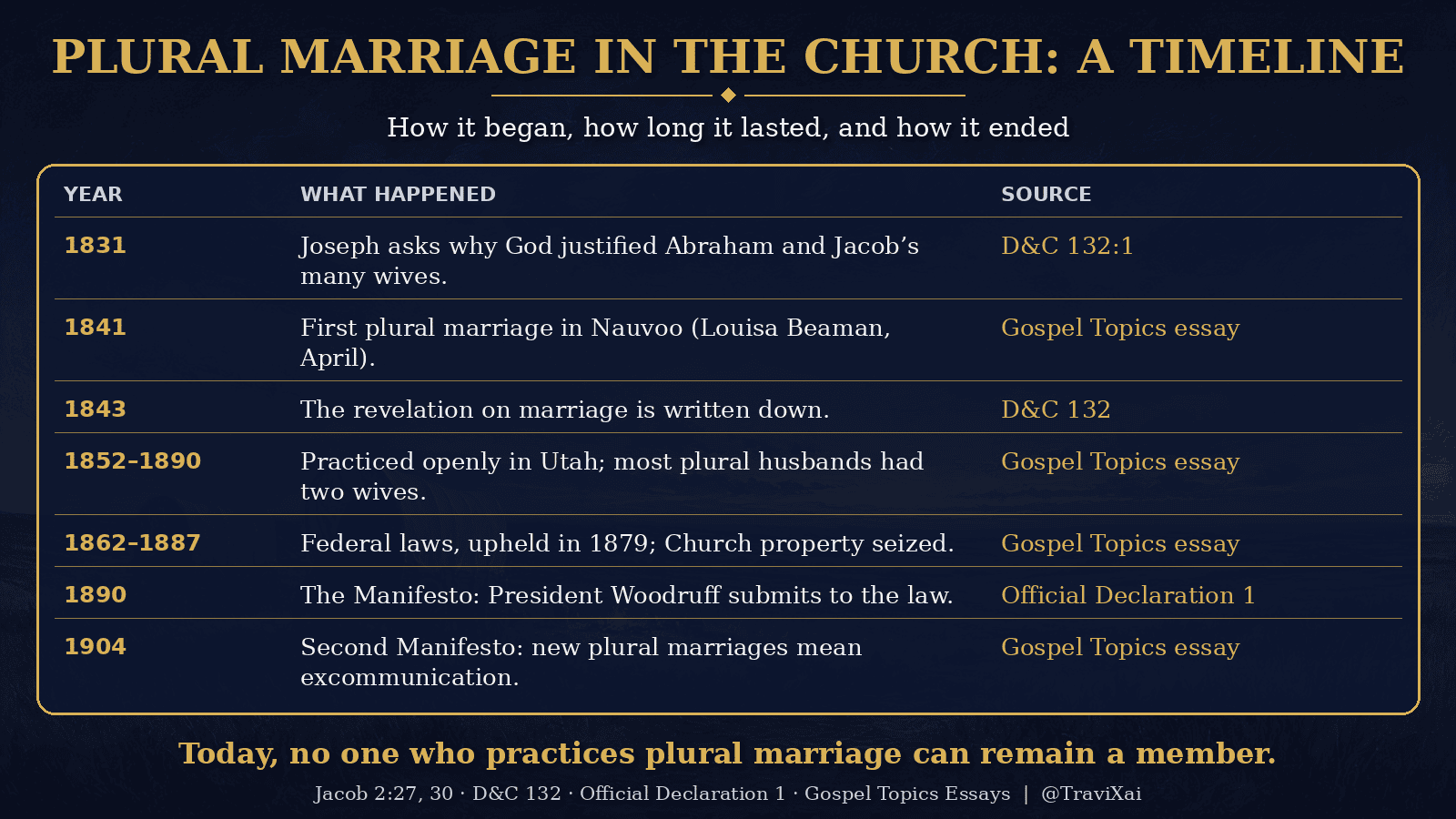
The revelation now in Doctrine and Covenants 132 opens with Joseph asking why the Lord “justified my servants Abraham, Isaac, and Jacob, as also Moses, David and Solomon … as touching the principle and doctrine of their having many wives and concubines” (D&C 132:1). The Church dates that question to his Bible study in 1831; the revelation was written down in 1843. The answer: “God commanded Abraham, and Sarah gave Hagar to Abraham to wife … Was Abraham, therefore, under condemnation? Verily I say unto you, Nay; for I, the Lord, commanded it” (D&C 132:34–35).
Joseph didn’t rush into it. He told associates that an angel appeared three times between 1834 and 1842, the last time “with a drawn sword,” commanding him to go forward (Gospel Topics essay). The first plural marriage in Nauvoo was to Louisa Beaman in April 1841.
The Church’s own essays don’t soften the difficult details, and neither will I:
- The exact number is unknown, but “careful estimates put the number between 30 and 40” women sealed to Joseph Smith.
- Some sealings were “for time and eternity,” which generally included the possibility of sexual relations; others were “for eternity only,” meaning a relationship in the next life alone.
- Most of the women were between 20 and 40. The youngest, Helen Mar Kimball, was sealed to him “several months before her 15th birthday,” which the essay calls “inappropriate by today’s standards” though legal then. She described it as “for eternity alone.”
- Joseph was also sealed to some women who were already married. Several said those sealings were for eternity only, and the first husbands generally kept living with their wives.
- For Emma Smith, plural marriage “was an excruciating ordeal.” She approved some of the marriages, at least for a time, and opposed others.
The women who entered it weren’t naïve. Zina Huntington Jacobs said, “I made a greater sacrifice than to give my life,” but also, “I searched the scripture & by humble prayer to my Heavenly Father I obtained a testimony for myself” (Gospel Topics essay). After Joseph’s death, most of the women sealed to him went west, stayed faithful, and defended him.
UtahPlural marriage in Utah, 1852–1890
From 1852 to 1890 the Church practiced plural marriage openly. The essays give a picture very different from the stereotype (Gospel Topics):
- “Two-thirds of polygamist men had only two wives at a time.”
- “Women were free to choose their spouses, whether to enter into a polygamous or a monogamous union, or whether to marry at all.”
- “Divorce was therefore available to women who were unhappy in their marriages; remarriage was also readily available.”
- At its peak in 1857, “perhaps one half of all Utah Latter-day Saints experienced plural marriage as a husband, wife, or child,” and the share declined after that.
- Not everyone was expected to live it, and every plural marriage needed the approval of Church leaders.
Utah women also voted in 1870, decades before most American women could. Plural marriage was hard, and many who lived it said so. But they believed God had commanded it, and they paid a real price for obeying.
1890–1904How it ended: the Manifesto
Congress outlawed polygamy in 1862. The Supreme Court upheld the law in 1879, and by the late 1880s federal officers were jailing husbands and wives and seizing Church property, including threatening the temples. In September 1890 President Wilford Woodruff issued the Manifesto, now canonized as Official Declaration 1:
Inasmuch as laws have been enacted by Congress forbidding plural marriages, which laws have been pronounced constitutional by the court of last resort, I hereby declare my intention to submit to those laws, and to use my influence with the members of the Church over which I preside to have them do likewise.
Official Declaration 1
He later explained it was revelation, not just politics: “The Lord showed me by vision and revelation exactly what would take place if we did not stop this practice … all ordinances would be stopped throughout the land of Zion” (Excerpts following OD 1). The Lord had taught the principle before: when enemies hinder a work He has commanded, “it behooveth me to require that work no more at the hands of those sons of men, but to accept of their offerings” (D&C 124:49).
The end came gradually. A small number of plural marriages were still performed, mostly in Mexico and Canada, until President Joseph F. Smith’s Second Manifesto in April 1904 made new plural marriages “punishable by excommunication” (Gospel Topics essay). That has been the rule ever since. The Twelfth Article of Faith settles it for today: “We believe in being subject to kings, presidents, rulers, and magistrates, in obeying, honoring, and sustaining the law” (Article of Faith 12).
Check the premiseThe presuppositions baked into the question
Before this question can be answered fairly, the person asking has to justify a few assumptions packed inside it:
- That the Bible forbids all plural marriage. Abraham, Jacob, and others God called righteous had plural wives (Genesis 16:3; 30:4, 9), the law of Moses regulated it (Exodus 21:10), and Jesus placed Abraham, Isaac and Jacob in the kingdom (Matthew 8:11). “Husband of one wife” in 1 Timothy 3:2 is a qualification for bishops, which only makes sense if some men had more.
- That the Church hides this history. The Church’s own Gospel Topics essays give the 30-to-40 estimate, Helen Mar Kimball’s age, the sealings to married women, and Emma’s pain. Hiding history doesn’t look like publishing it on your own website.
- That Joseph Smith invented polygamy to indulge himself. The Book of Mormon he published in 1830 calls monogamy the standard (Jacob 2:27). He resisted the command for years, by his own account, and many of his sealings were for eternity only. It brought him far more danger than comfort, and it fueled the hostility that ended at Carthage.
- That today’s polygamists are Latter-day Saints. They belong to separate groups the Church has no connection with. Members who practice plural marriage lose their membership.
FAQQuick answers
Does the LDS Church still practice polygamy?
No. The Church of Jesus Christ of Latter-day Saints stopped authorizing new plural marriages with the 1890 Manifesto, made them grounds for excommunication in 1904, and today no one who practices plural marriage can remain a member.
Why did early Latter-day Saints practice plural marriage?
They believed God commanded it, as He did for Abraham and Jacob in the Bible (D&C 132:34–35). The Book of Mormon gives one reason God may command it: to “raise up seed unto me” (Jacob 2:30).
How many wives did Joseph Smith have?
The exact number is unknown. The Church’s Gospel Topics essay says careful estimates put the number of women sealed to him between 30 and 40, and some of those sealings were for eternity only.
When did polygamy end in the LDS Church?
President Wilford Woodruff issued the Manifesto (Official Declaration 1) in 1890. In 1904 President Joseph F. Smith’s Second Manifesto made new plural marriages punishable by excommunication.
Is polygamy in the Bible?
Yes. Abraham, Jacob, and others had more than one wife (Genesis 16:3; 30:4, 9), and the law of Moses regulated plural marriage (Exodus 21:10; Deuteronomy 21:15). The Bible also condemns multiplying wives without God’s approval (Deuteronomy 17:17; 1 Kings 11:3).
What does the Book of Mormon say about polygamy?
It makes monogamy the rule: “there shall not any man among you have save it be one wife; and concubines he shall have none” (Jacob 2:27). It also names the exception: “if I will, saith the Lord of Hosts, raise up seed unto me, I will command my people” (Jacob 2:30).
What is Doctrine and Covenants 132?
A revelation recorded on July 12, 1843, about eternal marriage and the sealing power. It also includes the commandment on plural marriage given to Joseph Smith.
What happens to Church members who practice polygamy today?
They are excommunicated. Since the 1890 Manifesto, which advised members “to refrain from contracting any marriage forbidden by the law of the land” (Official Declaration 1), the Church has not authorized new plural marriages.
SummaryKey takeaways
- The Church ended plural marriage in 1890 (Official Declaration 1) and made it grounds for excommunication in 1904.
- Monogamy is the standard; plural marriage happens only if God commands it (Jacob 2:27, 30).
- The Bible records plural marriage among the patriarchs and condemns it when men take it on themselves (Genesis 16; Deuteronomy 17:17).
- The Church’s Gospel Topics essays openly cover the hard details, including the number of Joseph’s sealings and Helen Mar Kimball’s age.
If someone brings up polygamy, start with Jacob 2:27–30 and the Gospel Topics essays; honesty is our best defense. For quick, sourced answers, open Galatians18, and follow me on X at @TraviXai.
Sources
- King James Bible (churchofjesuschrist.org): Genesis 2:24 · Genesis 16:3 · Genesis 30:4–9 · Exodus 21:10 · Deuteronomy 17:17 · Deuteronomy 21:15 · 2 Samuel 12:8 · 1 Kings 11:3 · Matthew 8:11 · 1 Timothy 3:2
- Book of Mormon: Jacob 2:24–30
- Doctrine and Covenants and Pearl of Great Price: D&C 49:16 · D&C 124:49 · D&C 132:1 · D&C 132:34–37 · Official Declaration 1 and excerpts · Article of Faith 12
- Gospel Topics Essays: Plural Marriage in The Church of Jesus Christ of Latter-day Saints · Plural Marriage in Kirtland and Nauvoo · The Manifesto and the End of Plural Marriage
- “Polygamy: Latter-day Saints and the Practice of Plural Marriage,” Church Newsroom
- Gordon B. Hinckley, “What Are People Asking about Us?” October 1998 general conference
- Featured image and in-article graphic: original graphics by thebookofmormon.ai (painterly backgrounds; no photographs or likenesses of real people).