
It’s one of the hardest chapters in Latter-day Saint history. Here’s what happened, what the Church disavows today, and how the 1978 revelation ended the restriction.
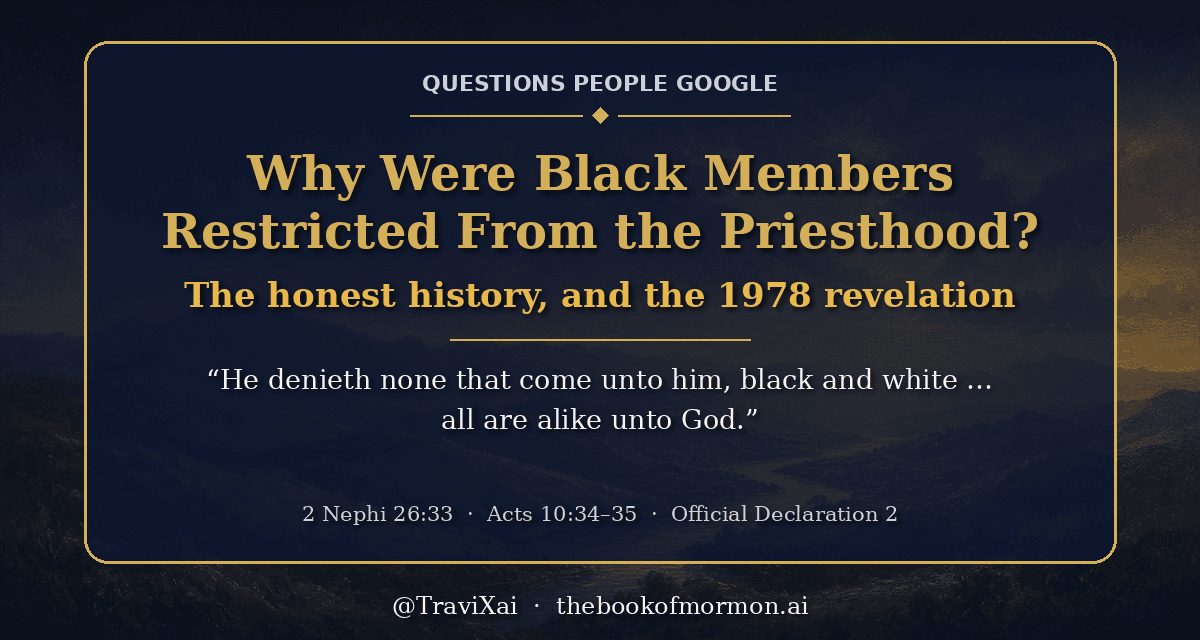
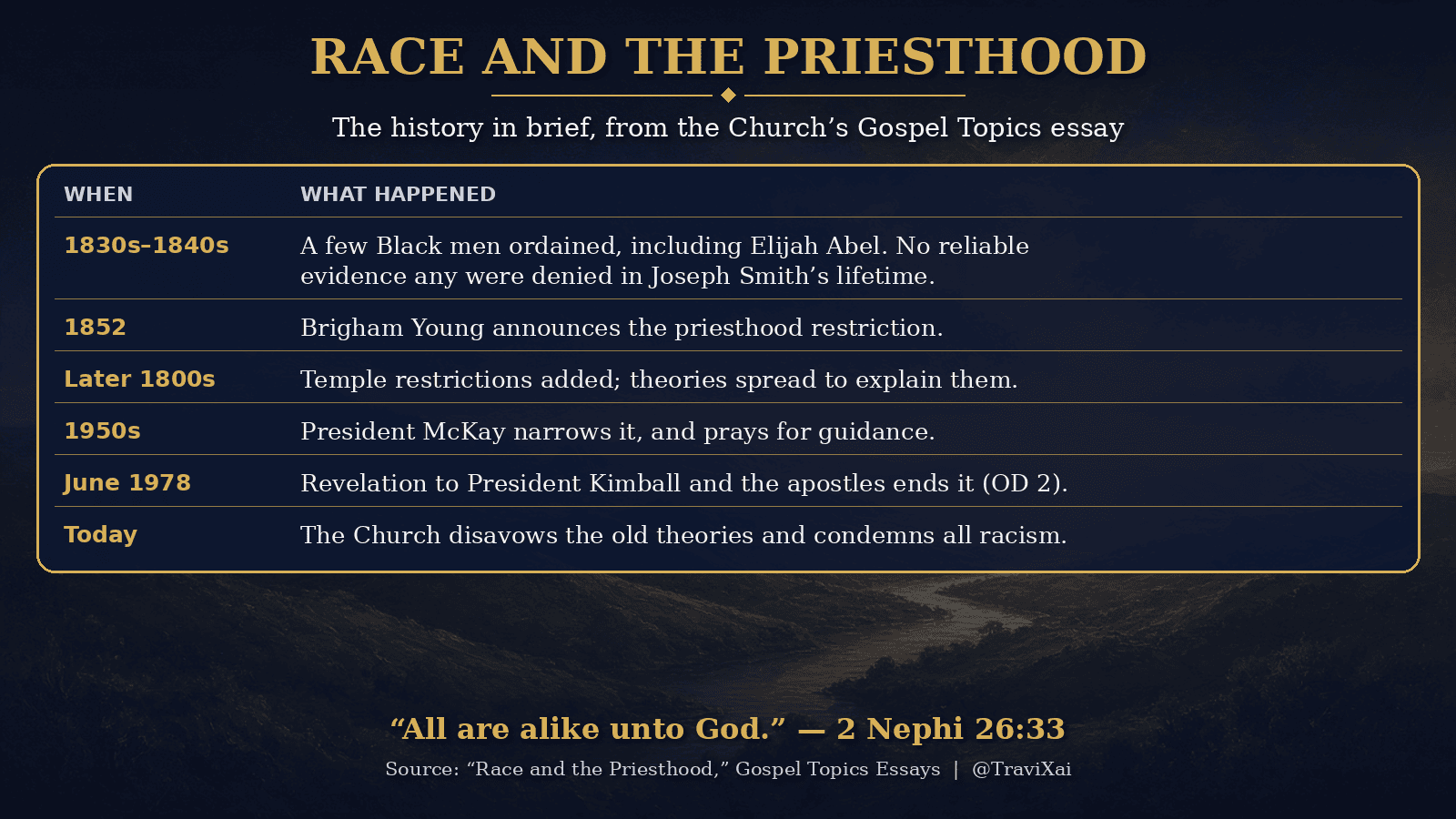
From 1852 until 1978, men of Black African descent could not be ordained to the priesthood, and Black members could not receive temple endowments or sealings. The Church’s essay “Race and the Priesthood” says Black men were ordained in Joseph Smith’s lifetime, that the restriction began under Brigham Young in 1852, and that the Church today “disavows” the theories once used to explain it and condemns “all racism, past and present.” A revelation in June 1978 ended it (Official Declaration 2). The Book of Mormon teaches “all are alike unto God” (2 Nephi 26:33).
The factsWhat happened
The Church’s Gospel Topics essay “Race and the Priesthood” states it plainly: “for much of its history—from the mid-1800s until 1978—the Church did not ordain men of black African descent to its priesthood or allow black men or women to participate in temple endowment or sealing ordinances” (Race and the Priesthood).
It began after Joseph Smith. The essay notes that “during the first two decades of the Church’s existence, a few black men were ordained to the priesthood,” including Elijah Abel, and that “there is no reliable evidence that any black men were denied the priesthood during Joseph Smith’s lifetime.” In 1847 Brigham Young praised Q. Walker Lewis, a Black elder: “We have one of the best Elders, an African.” Then “in 1852, President Brigham Young publicly announced that men of black African descent could no longer be ordained to the priesthood,” though Black people continued to be baptized and confirmed.
Why?Why did it happen?
The honest answer is that the Church doesn’t give one. The essay explains that the restriction was announced in a period of deep American racism, when the Supreme Court had said Black people had “no rights which the white man was bound to respect,” and that “the justifications for this restriction echoed the widespread ideas about racial inferiority” of that era.
“Over time, Church leaders and members advanced many theories to explain the priesthood and temple restrictions. None of these explanations is accepted today as the official doctrine of the Church.”
What the Church disavows
The essay is direct: “Today, the Church disavows the theories advanced in the past that black skin is a sign of divine disfavor or curse, or that it reflects unrighteous actions in a premortal life; that mixed-race marriages are a sin; or that blacks or people of any other race or ethnicity are inferior in any way to anyone else. Church leaders today unequivocally condemn all racism, past and present, in any form.”
So if someone tells you Latter-day Saints believe dark skin is a curse, or that Black people were less valiant before birth, that is exactly what the Church has rejected in writing.
2 Nephi 26:33What the scriptures say
The Book of Mormon, published in 1830, contains one of the clearest statements on race in any scripture: the Lord “denieth none that come unto him, black and white, bond and free, male and female; and he remembereth the heathen; and all are alike unto God, both Jew and Gentile” (2 Nephi 26:33). Ammon rejoiced that “God is mindful of every people, whatsoever land they may be in” (Alma 26:37).
The Bible says the same. God “hath made of one blood all nations of men” (Acts 17:26). “There is no respect of persons with God” (Romans 2:11). “There is neither Jew nor Greek … for ye are all one in Christ Jesus” (Galatians 3:28). The Doctrine and Covenants: “all flesh is mine, and I am no respecter of persons” (D&C 38:16).
God promised Abraham that through his priesthood “shall all the families of the earth be blessed, even with the blessings of the Gospel” (Abraham 2:11), and that those who receive the gospel “shall be accounted thy seed” (Abraham 2:10). The scriptures point to every family, not some.
Acts 10A biblical pattern: God’s people needed a revelation too
The Bible shows that God’s own people sometimes held boundaries that took a revelation to remove. Jesus first sent the Twelve with the instruction, “Go not into the way of the Gentiles … But go rather to the lost sheep of the house of Israel” (Matthew 10:5–6), and later commanded, “Go ye therefore, and teach all nations” (Matthew 28:19).
Even then, it took a vision for Peter to bring the gospel to Gentiles. He told Cornelius, “Ye know how that it is an unlawful thing for a man that is a Jew to keep company, or come unto one of another nation; but God hath shewed me that I should not call any man common or unclean” (Acts 10:28). Then he said, “Of a truth I perceive that God is no respecter of persons: But in every nation he that feareth him, and worketh righteousness, is accepted with him” (Acts 10:34–35).
This isn’t an excuse for the restriction or for the racist theories once used to explain it. It’s a reminder that apostles are human, that culture affects them, and that God corrects His Church by revelation. That’s what happened in 1978.
Official Declaration 2The 1978 revelation
The essay describes how faithful Black Saints in Brazil, who had sacrificed to help build the São Paulo temple, and thousands of converts in Nigeria and Ghana “moved Church leaders.” In June 1978, after “spending many hours in the Upper Room of the [Salt Lake] Temple supplicating the Lord for divine guidance,” President Spencer W. Kimball, his counselors and the Twelve received a revelation. The First Presidency announced on June 8: “He has heard our prayers, and by revelation has confirmed that the long-promised day has come.” The statement is canonized as Official Declaration 2.
Gordon B. Hinckley, who was in the room, recalled: “There was a hallowed and sanctified atmosphere in the room. … Every man in that circle, by the power of the Holy Ghost, knew the same thing. … Not one of us who was present on that occasion was ever quite the same after that. Nor has the Church been quite the same.”
The essay says “many Latter-day Saints wept for joy,” ordinations began immediately, and today “the number of Church members of African descent is now in the hundreds of thousands.”
Check the premiseThe presuppositions baked into the question
Before this question can be answered fairly, the person asking has to justify a few assumptions packed inside it:
- That the restriction began with Joseph Smith. The Church’s essay says Black men were ordained in Joseph’s lifetime, including Elijah Abel, and that the restriction was announced in 1852.
- That the Church still teaches the old explanations. The Church “disavows” the curse and premortal theories and condemns “all racism, past and present, in any form.”
- That Latter-day Saint scripture teaches racial inferiority. 2 Nephi 26:33 says “all are alike unto God,” “black and white.” D&C 38:16 says God is “no respecter of persons.”
- That a church led by prophets can’t have needed correction. In Acts 10, the chief apostle needed a vision to stop calling Gentiles “common or unclean.” God corrects by revelation, as He did in 1978.
FAQQuick answers
Why were Black members restricted from the priesthood?
The Church doesn’t give a reason. Its essay “Race and the Priesthood” says the restriction was announced by Brigham Young in 1852 in an era of widespread racism, that many theories were later offered, and that “none of these explanations is accepted today as the official doctrine of the Church.”
When did the priesthood restriction end?
In June 1978. After praying in the Salt Lake Temple, President Spencer W. Kimball and the apostles received a revelation, announced June 8, 1978, and canonized as Official Declaration 2.
Did Joseph Smith ordain Black men to the priesthood?
Yes. The Church’s essay says a few Black men were ordained in the Church’s first two decades, including Elijah Abel, and “there is no reliable evidence that any black men were denied the priesthood during Joseph Smith’s lifetime.”
Does the Church still teach the curse of Cain?
No. The Church “disavows the theories advanced in the past that black skin is a sign of divine disfavor or curse,” and condemns “all racism, past and present, in any form.”
What does the Book of Mormon say about race?
“He denieth none that come unto him, black and white, bond and free, male and female … and all are alike unto God, both Jew and Gentile” (2 Nephi 26:33).
What is Official Declaration 2?
The 1978 announcement of the revelation that ended the restriction. It says “all worthy male members of the Church may be ordained to the priesthood without regard for race or color.”
Who was Elijah Able?
An early Black Latter-day Saint who was ordained an elder in 1836 and later served as a Seventy. He remained faithful until his death in 1884.
Does the Church accept the old explanations for the restriction?
No. The Church’s Gospel Topics essay disavows the theories that black skin is a sign of divine disfavor or that the restriction reflected unrighteous actions in a premortal life. Peter’s words stand: “God is no respecter of persons” (Acts 10:34).
SummaryKey takeaways
- Black men were ordained in Joseph Smith’s day; the restriction was announced in 1852.
- The Church gives no doctrinal reason and disavows the curse and premortal theories.
- The scriptures teach “all are alike unto God” (2 Nephi 26:33; Acts 10:34–35).
- The 1978 revelation, Official Declaration 2, opened the priesthood and temple to all worthy members.
Read the Church’s full essay, “Race and the Priesthood,” and Official Declaration 2. For quick, sourced answers, open Galatians18, and follow me on X at @TraviXai.
Sources
- King James Bible (churchofjesuschrist.org): Matthew 10:5–6 · Matthew 28:19 · Acts 10:28 · Acts 10:34–35 · Acts 17:26 · Romans 2:11 · Galatians 3:28
- Book of Mormon: 2 Nephi 26:33 · Alma 26:37
- Doctrine and Covenants and Pearl of Great Price: D&C 38:16 · Official Declaration 2 · Abraham 2:9–11
- “Race and the Priesthood,” Gospel Topics Essays, churchofjesuschrist.org (source of all historical facts and quotations, including Brigham Young 1847, the 1978 First Presidency statement, and Gordon B. Hinckley)
- Featured image and in-article graphic: original graphics by thebookofmormon.ai (painterly backgrounds; no photographs or likenesses of real people).