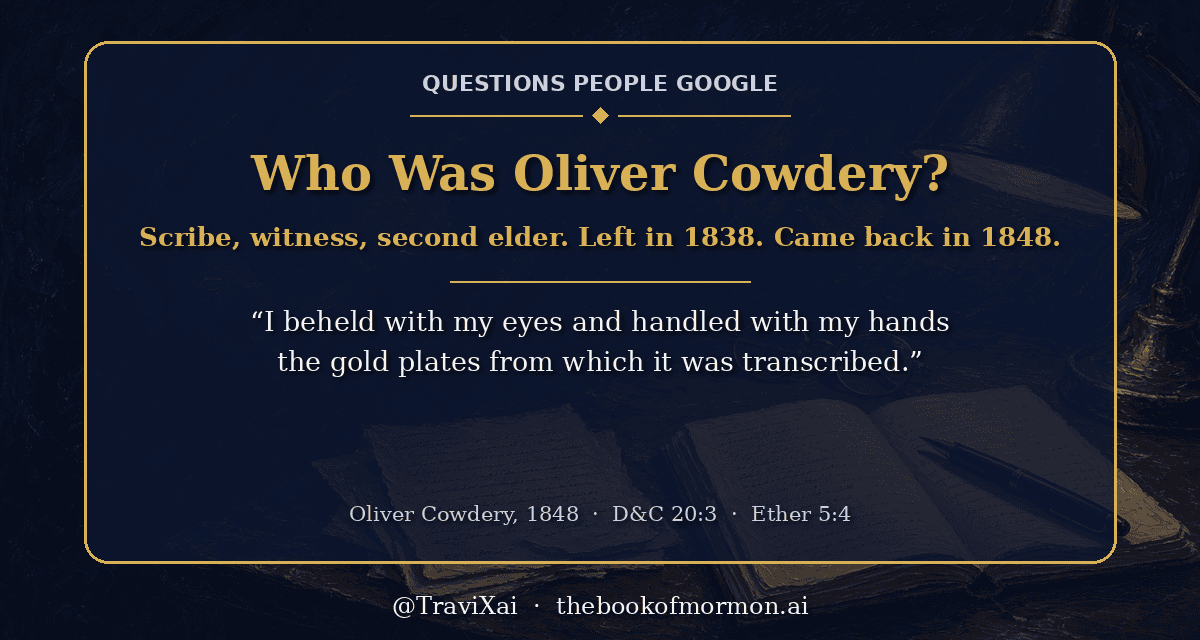

He wrote the Book of Mormon down, saw the angel, was baptized first, left the Church, and came back. Here is Oliver Cowdery’s story and his testimony.
The question often assumes that a witness who left the Church must have recanted. Oliver Cowdery is the clearest proof that this one didn’t. He was the Book of Mormon’s main scribe, one of the Three Witnesses, the first person baptized with authority in this dispensation and the Church’s “second elder” (D&C 20:3). He was excommunicated in 1838 over disputes with Joseph Smith and spent ten years outside the Church without denying his witness. On October 21, 1848, at Kanesville, Iowa, he testified, “I beheld with my eyes and handled with my hands the gold plates.” He was rebaptized that November.
Who he wasThe scribe
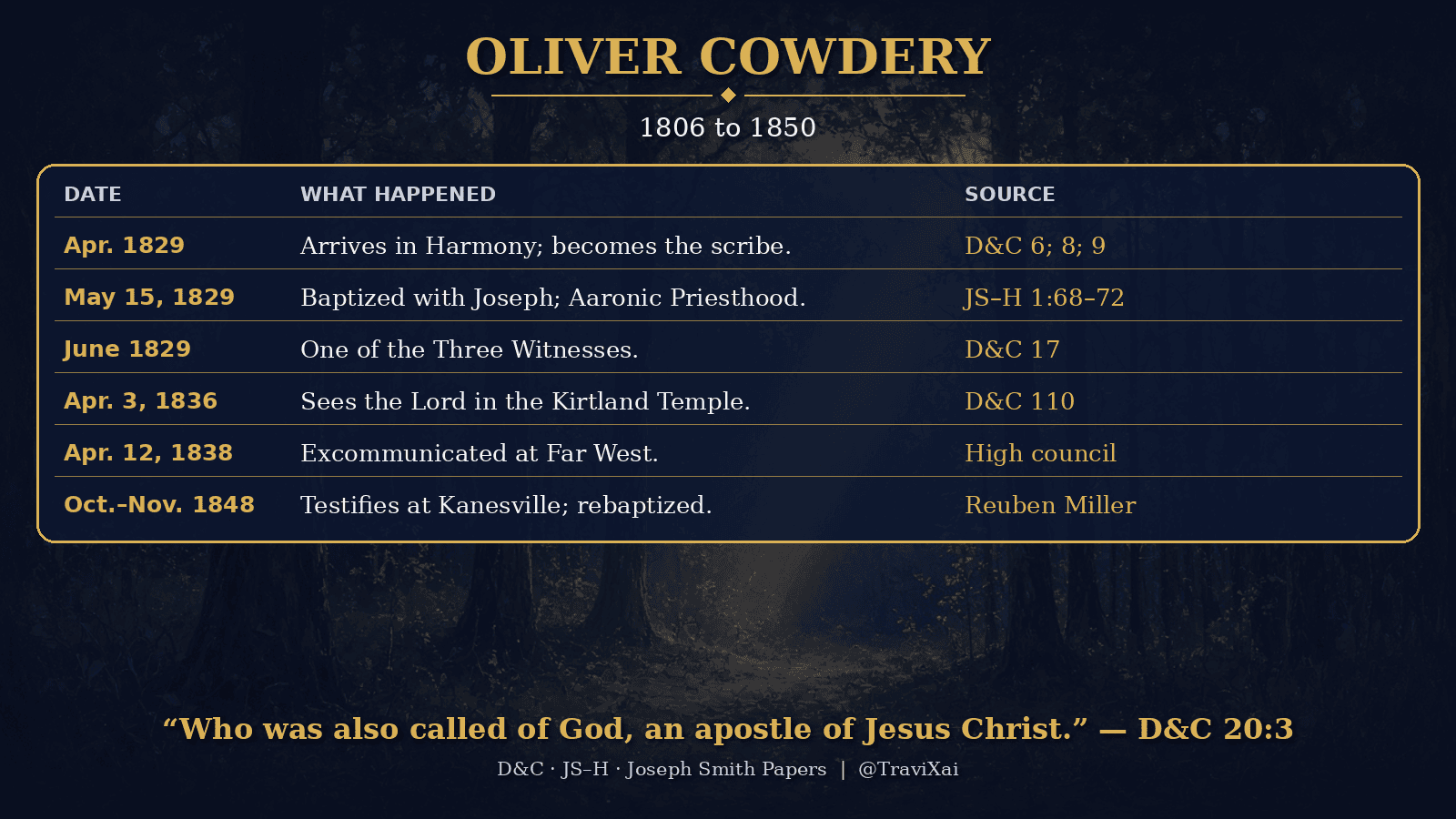
Oliver Cowdery was born October 3, 1806, in Wells, Vermont. In 1828 he was teaching school near Palmyra and boarding with Joseph Smith’s parents, who told him about the plates. He prayed about it, then traveled to Harmony, Pennsylvania, arriving April 5, 1829. Two days later he began writing as Joseph dictated, and he wrote nearly all of the Book of Mormon as we have it, in about three months. He later described it in an account now printed with Joseph Smith—History: “These were days never to be forgotten—to sit under the sound of a voice dictated by the inspiration of heaven.”
The Lord’s first revelations to him reminded him of his own witness: “if you desire a further witness, cast your mind upon the night that you cried unto me in your heart … Did I not speak peace to your mind concerning the matter? What greater witness can you have than from God?” (D&C 6:22–23). He even tried to translate himself, and was told, “you must study it out in your mind; then you must ask me if it be right” (D&C 9:7–8).
The witnessPresent at the founding
Oliver was present at nearly every founding event of the Restoration. On May 15, 1829, he and Joseph went into the woods to pray about baptism, and John the Baptist appeared: “Upon you my fellow servants, in the name of Messiah I confer the Priesthood of Aaron” (D&C 13:1). Peter, James and John later conferred the Melchizedek Priesthood. In June 1829 he was one of the Three Witnesses shown the plates by an angel, as the Lord had promised: “after that you have obtained faith, and have seen them with your eyes, you shall testify of them, by the power of God” (D&C 17:3). See The Witnesses Never Recanted.
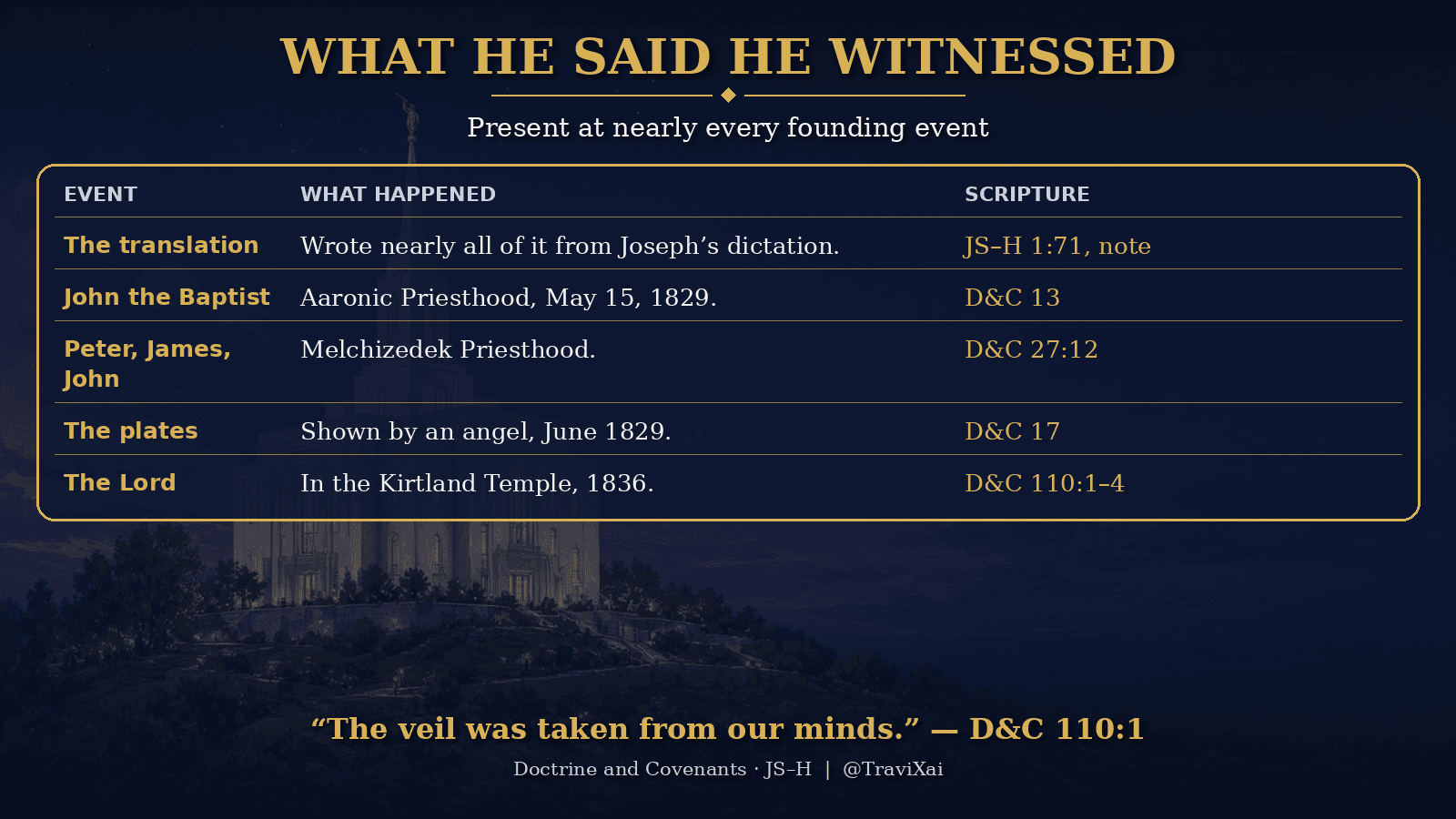
When the Church was organized on April 6, 1830, the Lord named him “an apostle of Jesus Christ, to be the second elder of this church” (D&C 20:3). He led the first mission to the Lamanites in 1830, helped edit Church newspapers, and in 1834 was made Assistant President of the Church. On April 3, 1836, in the Kirtland Temple, he and Joseph saw the Savior: “The veil was taken from our minds … We saw the Lord standing upon the breastwork of the pulpit … I am the first and the last; I am he who liveth, I am he who was slain; I am your advocate with the Father” (D&C 110:1–4). See Aaronic vs. Melchizedek Priesthood.
The Pearl of Great PriceThe first baptisms
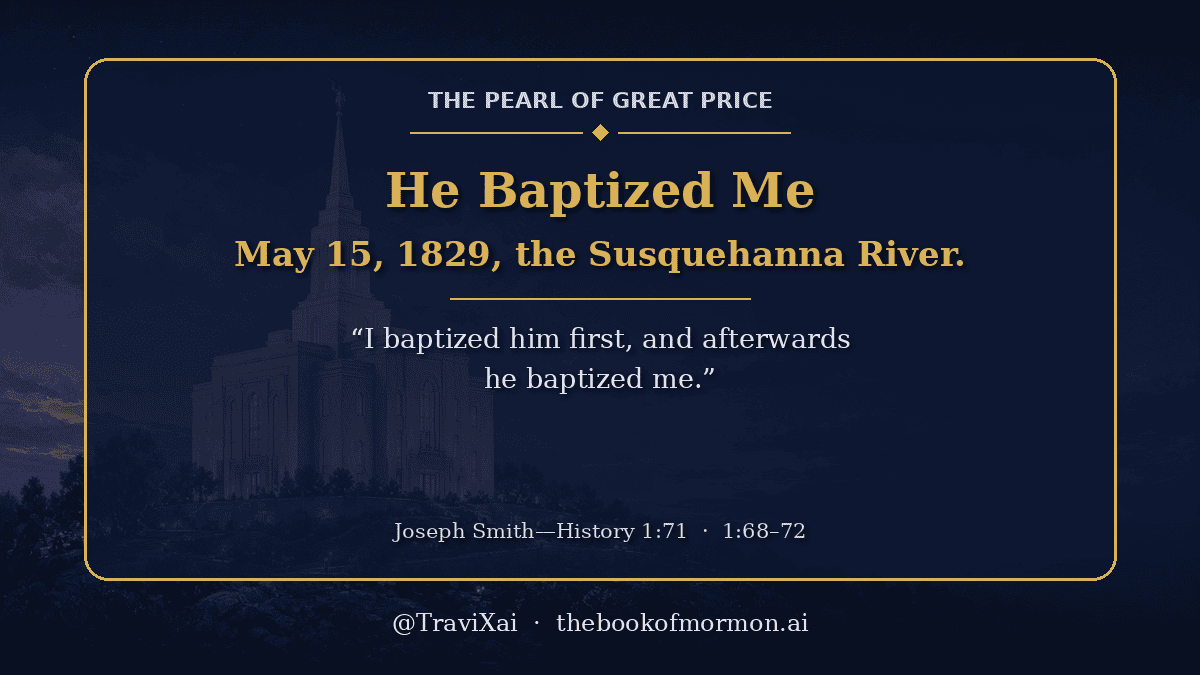
Joseph’s history records the day: the messenger “commanded us to go and be baptized, and gave us directions that I should baptize Oliver Cowdery, and that afterwards he should baptize me. Accordingly we went and were baptized. I baptized him first, and afterwards he baptized me” (JS–H 1:68–72). The first two people baptized with authority in this dispensation baptized each other.
Why he left1838
By 1837–38 Oliver had fallen out with Joseph. He disagreed with Church leaders’ role in economic and political matters, sold land in Jackson County against counsel, and accused Joseph of improper conduct in his relationship with Fanny Alger, a relationship later Church historians identify as an early plural marriage. On April 12, 1838, the high council at Far West excommunicated him on charges that included filing lawsuits against members, selling Jackson County lands and making accusations against Joseph. He moved to Ohio and practiced law in Tiffin, then moved to Elkhorn, Wisconsin.
Critics often point out that in Tiffin he attended a Methodist Protestant congregation. Yet in ten years outside the Church, no statement from Oliver himself denying his witness has ever surfaced. He kept the Book of Mormon testimony he had signed in 1829.
His return in 1848“I know the door”
In the fall of 1848, with help from his brother-in-law Phineas Young, Oliver traveled with his wife Elizabeth and daughter Maria to Kanesville (Council Bluffs), Iowa, where thousands of Latter-day Saints were camped on their way west. On October 21 he walked into a conference conducted by Orson Hyde, the apostle Oliver himself had ordained in 1835. Hyde invited him to speak. As Reuben Miller recorded it: “I wrote, with my own pen, the entire Book of Mormon (save a few pages,) as it fell from the lips of the Prophet Joseph Smith, as he translated it by the gift and power of God … I beheld with my eyes and handled with my hands the gold plates from which it was transcribed. I also saw with my eyes and handled with my hands the ‘holy interpreters.’ That book is true. Sidney Rigdon did not write it. Mr. Spaulding did not write it.”
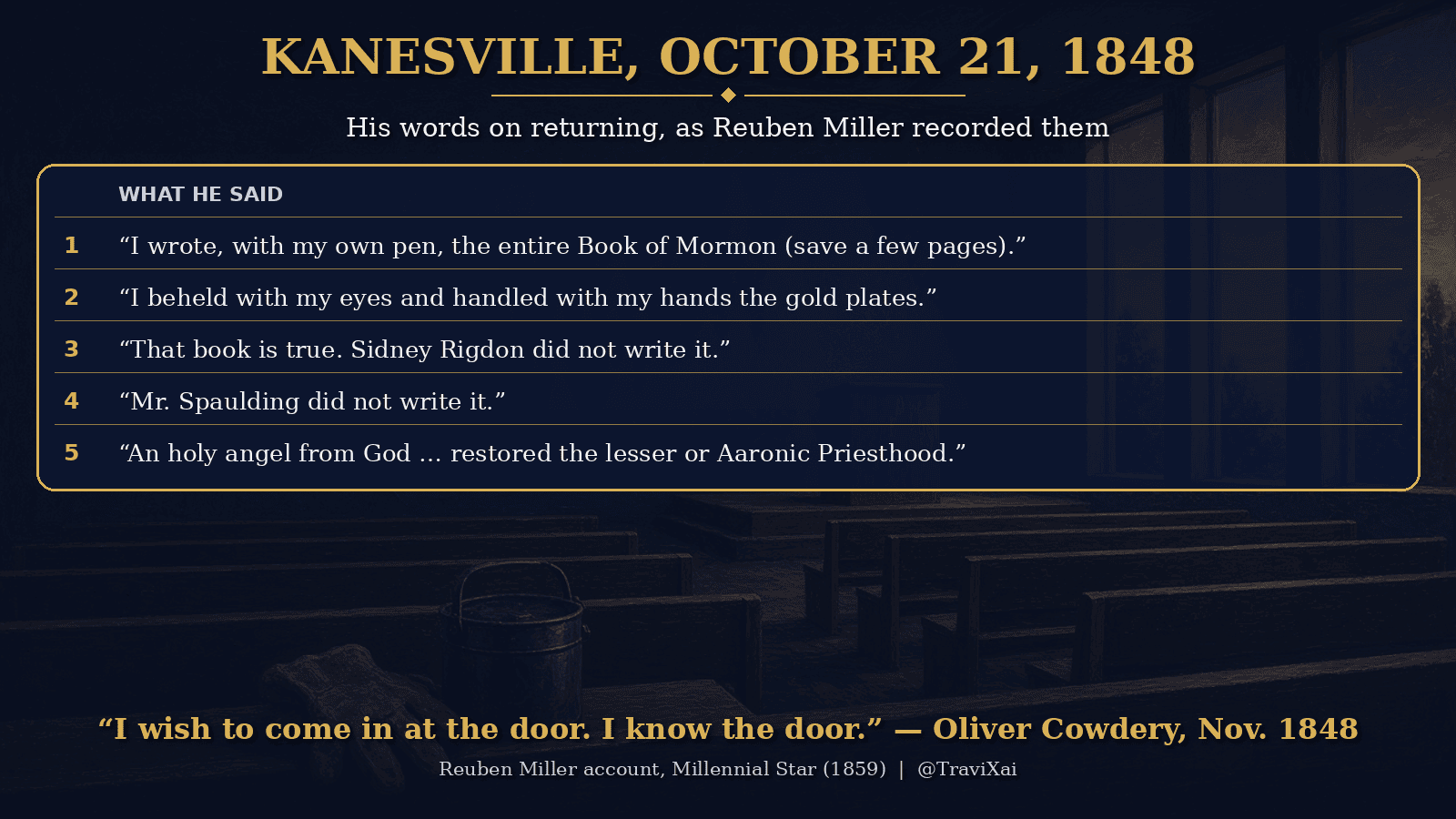
He also testified that he had been present when angels restored both priesthoods. Then he asked for nothing but membership. Before the high council in early November he said, “I wish to come humbly and be one in your midst … I wish to become a member of the church again. I wish to come in at the door. I know the door.” Orson Hyde rebaptized him on November 12, 1848. He planned to go west, but his health failed. He died at David Whitmer’s home in Richmond, Missouri, on March 3, 1850, at 43, a member of the Church.
The BibleTwo or three witnesses, and the prodigal
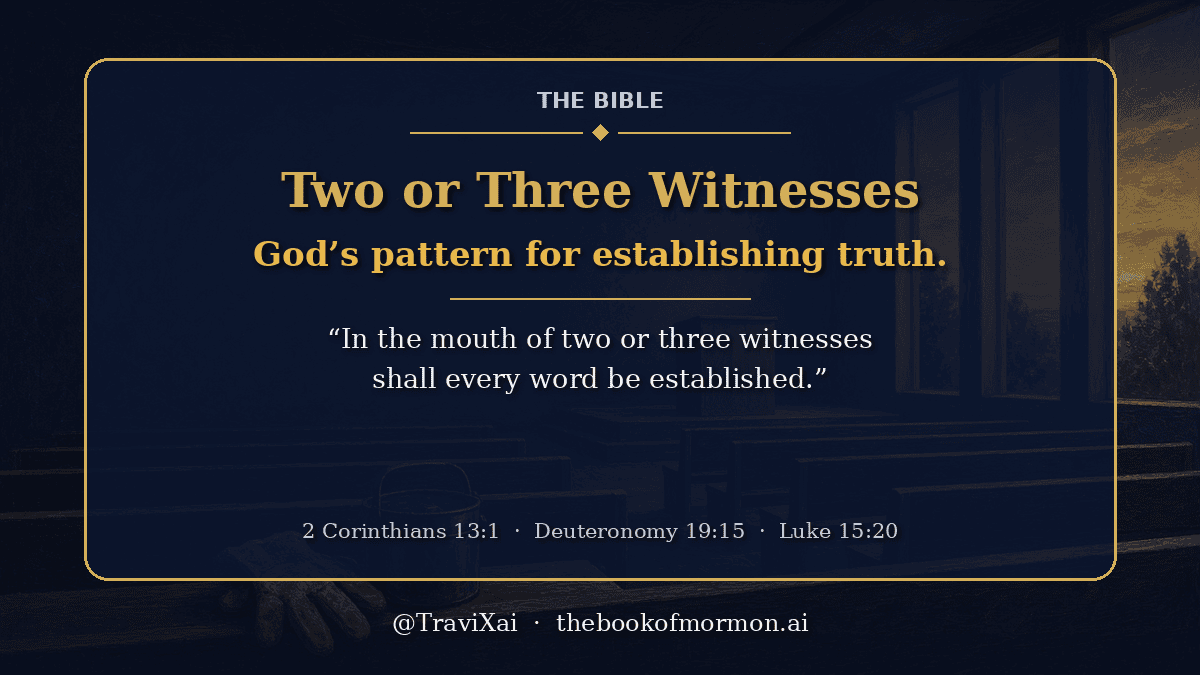
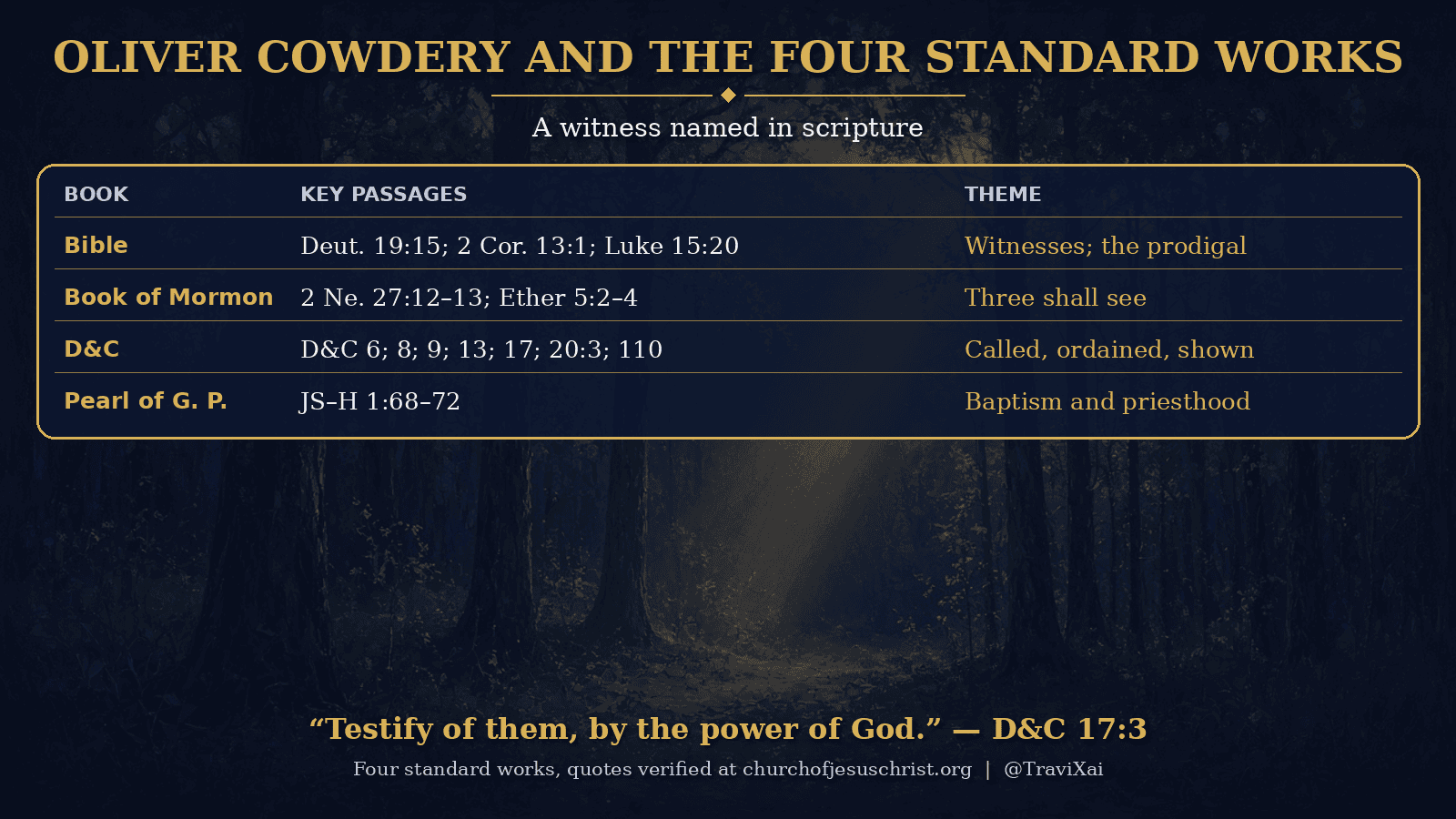
God’s law for truth is witnesses: “at the mouth of two witnesses, or at the mouth of three witnesses, shall the matter be established” (Deuteronomy 19:15; 2 Corinthians 13:1). A witness who stays loyal proves little about his honesty. A witness who leaves, fights the leader, lives as an outsider for ten years and still won’t deny what he saw proves a great deal. And Oliver’s return reads like the parable: “when he was yet a great way off, his father saw him, and had compassion, and ran, and fell on his neck, and kissed him” (Luke 15:20). Orson Hyde stepped down from the stand to embrace him.
The Book of MormonThree shall see
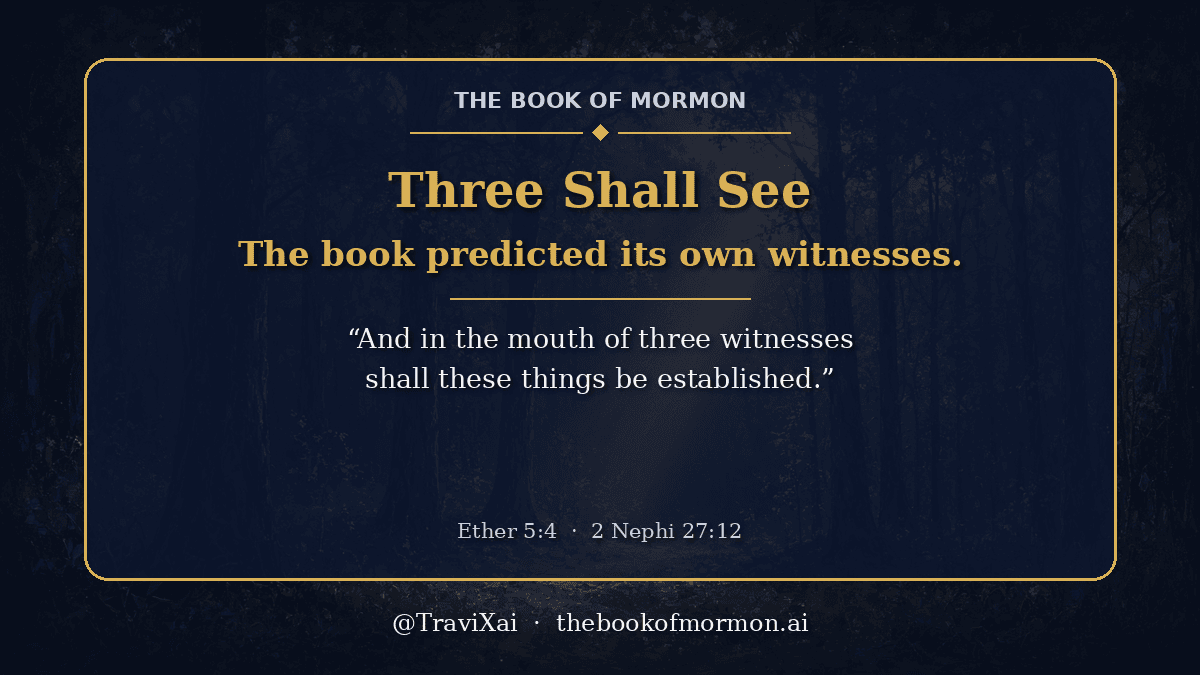
The book Oliver wrote down predicted him. Nephi: “the book shall be hid from the eyes of the world, that the eyes of none shall behold it save it be that three witnesses shall behold it, by the power of God … and they shall testify to the truth of the book” (2 Nephi 27:12–13). Moroni: “unto three shall they be shown by the power of God … And in the mouth of three witnesses shall these things be established” (Ether 5:2–4). See Is the Book of Mormon True?.
The Doctrine and CovenantsThe Lord’s words to him
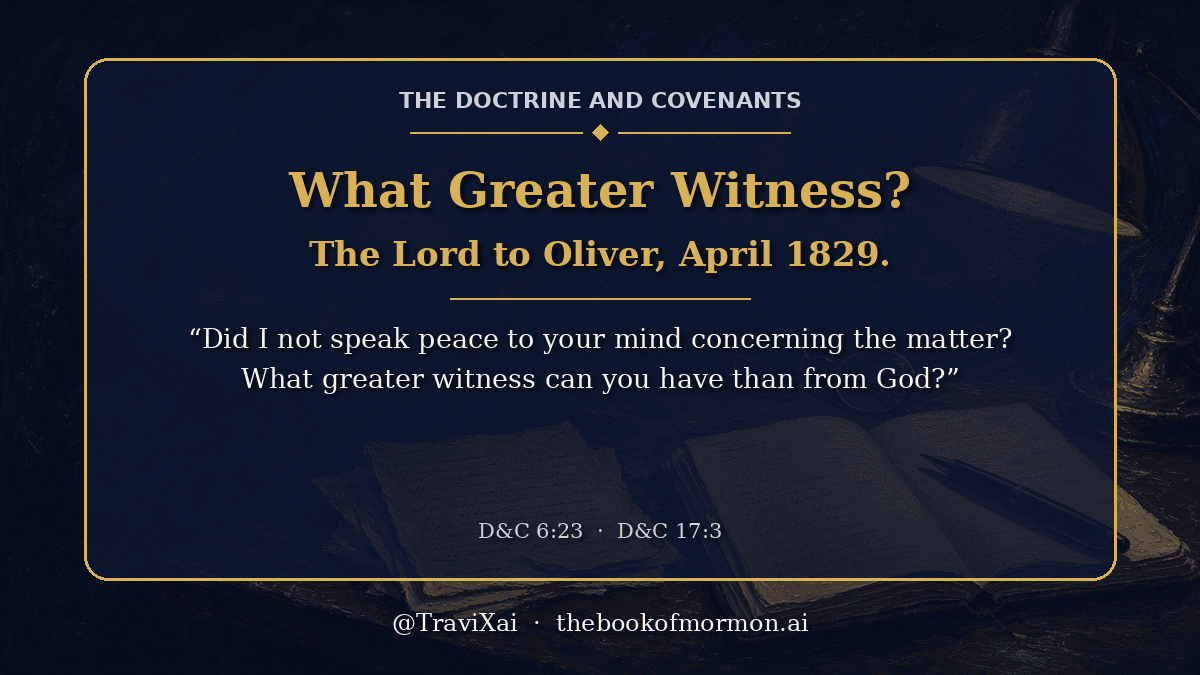
Five early sections speak to Oliver directly. The Lord told him “as often as thou hast inquired thou hast received instruction of my Spirit” (D&C 6:14–15), and taught him how revelation works: “I will tell you in your mind and in your heart, by the Holy Ghost” (D&C 8:2). Those lessons became the Church’s standard teaching on personal revelation. Oliver learned them first, and in 1848 he proved he had kept them.
Check the premiseThe presuppositions baked into the question
Before this question can be answered fairly, the person asking has to justify a few assumptions packed inside it:
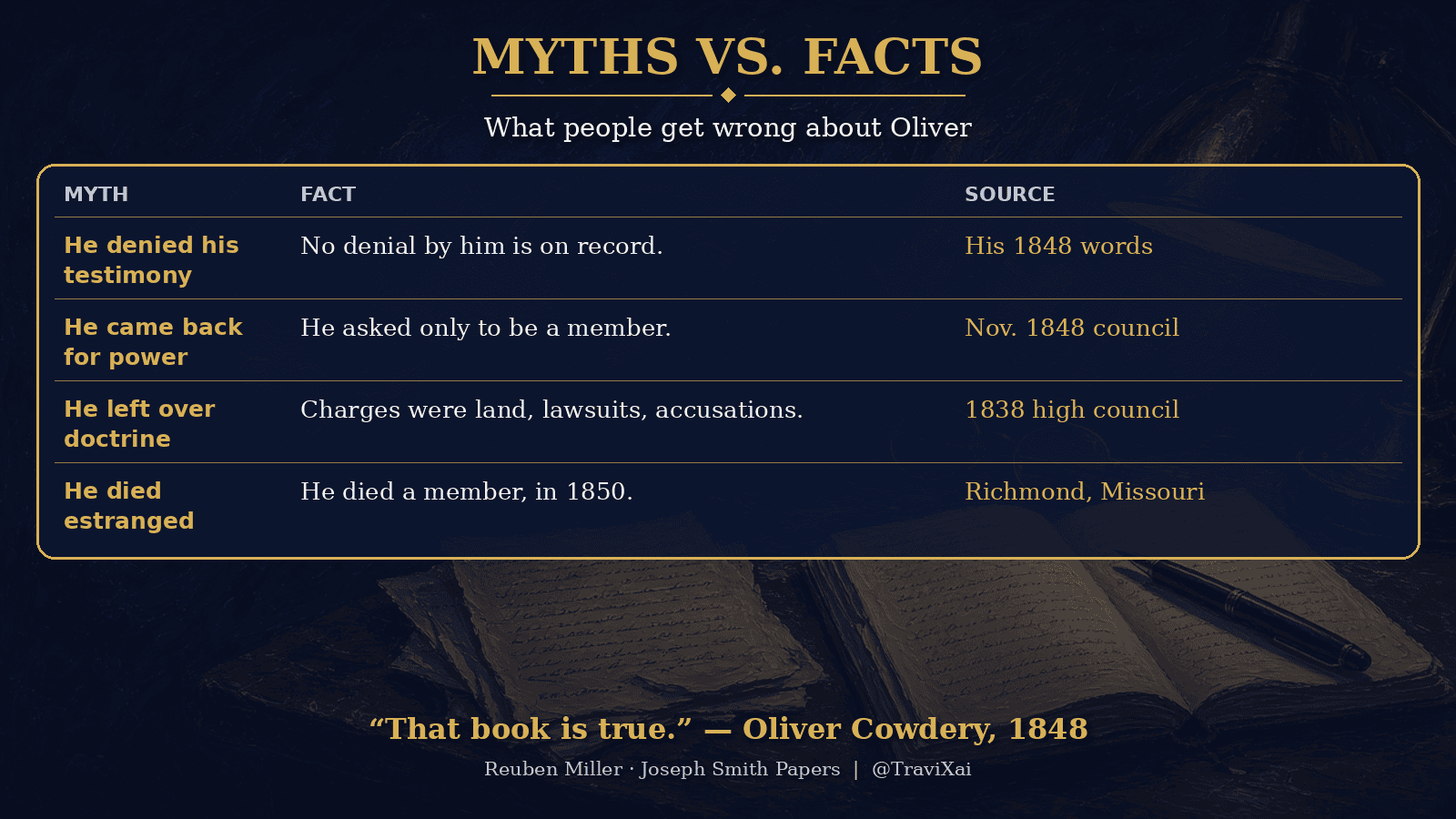
- That leaving the Church means he denied his testimony. He was out for ten years and no denial from him is on record; in 1848 he testified he “beheld” and “handled” the plates.
- That a witness loyal to Joseph is the only kind who counts. Oliver fought Joseph and was excommunicated, which makes his unchanged testimony stronger, not weaker (Deuteronomy 19:15).
- That he came back for position. He asked only for rebaptism: “I wish to come in at the door. I know the door.”
- That he was a minor figure. He was the main scribe, the second elder (D&C 20:3) and present at both priesthood restorations and the Kirtland Temple vision (D&C 110).
FAQQuick answers
Who was Oliver Cowdery?
Oliver Cowdery (1806–1850) was the main scribe for the Book of Mormon, one of the Three Witnesses, the Church’s “second elder” (D&C 20:3), and present at the restoration of both priesthoods.
Was Oliver Cowdery one of the Three Witnesses?
Yes. With David Whitmer and Martin Harris, he testified in June 1829 that an angel showed them the plates.
Why was Oliver Cowdery excommunicated?
On April 12, 1838, the Far West high council excommunicated him on charges including lawsuits against members, selling Jackson County lands and accusations against Joseph Smith.
Did Oliver Cowdery deny his testimony?
No denial by him is on record. In 1848 he publicly testified, “I beheld with my eyes and handled with my hands the gold plates.”
When did Oliver Cowdery return to the Church?
He spoke at Kanesville, Iowa, on October 21, 1848, and was rebaptized by Orson Hyde on November 12, 1848.
Did Oliver Cowdery see Jesus Christ?
Yes. D&C 110 records that he and Joseph saw the Lord in the Kirtland Temple on April 3, 1836.
Who baptized Oliver Cowdery?
Joseph Smith, on May 15, 1829, after John the Baptist conferred the Aaronic Priesthood; Oliver then baptized Joseph (JS–H 1:71).
When and where did Oliver Cowdery die?
March 3, 1850, in Richmond, Missouri, at the home of David Whitmer.
SummaryKey takeaways
- Main scribe for the Book of Mormon, April–June 1829.
- Present for both priesthood restorations and the Kirtland Temple vision.
- One of the Three Witnesses, prophesied in 2 Nephi 27 and Ether 5.
- Excommunicated in 1838; no denial of his witness is on record.
- Testified at Kanesville in October 1848; rebaptized November 12; died a member in 1850.
Read D&C 6 and JS–H 1:68–72 tonight. For quick, sourced answers, open Galatians18, and follow me on X at @TraviXai.
Sources
- King James Bible (churchofjesuschrist.org): Deuteronomy 19:15 · 2 Corinthians 13:1 · Luke 15:20
- Book of Mormon: 2 Nephi 27:12–13 · Ether 5:2–4
- Doctrine and Covenants: D&C 6:14–15 · D&C 6:22–23 · D&C 8:2 · D&C 9:7–8 · D&C 13:1 · D&C 17:3 · D&C 20:3 · D&C 110:1–4
- Pearl of Great Price: Joseph Smith—History 1:68–72 and Oliver Cowdery’s account printed with it
- Richard Lloyd Anderson, “Reuben Miller, Recorder of Oliver Cowdery’s Reaffirmations” (BYU Studies) · Reuben Miller account, Millennial Star (1859) · The Joseph Smith Papers
- Featured image and in-article graphic: original graphics by thebookofmormon.ai (painterly backgrounds; no photographs or likenesses of real people).