
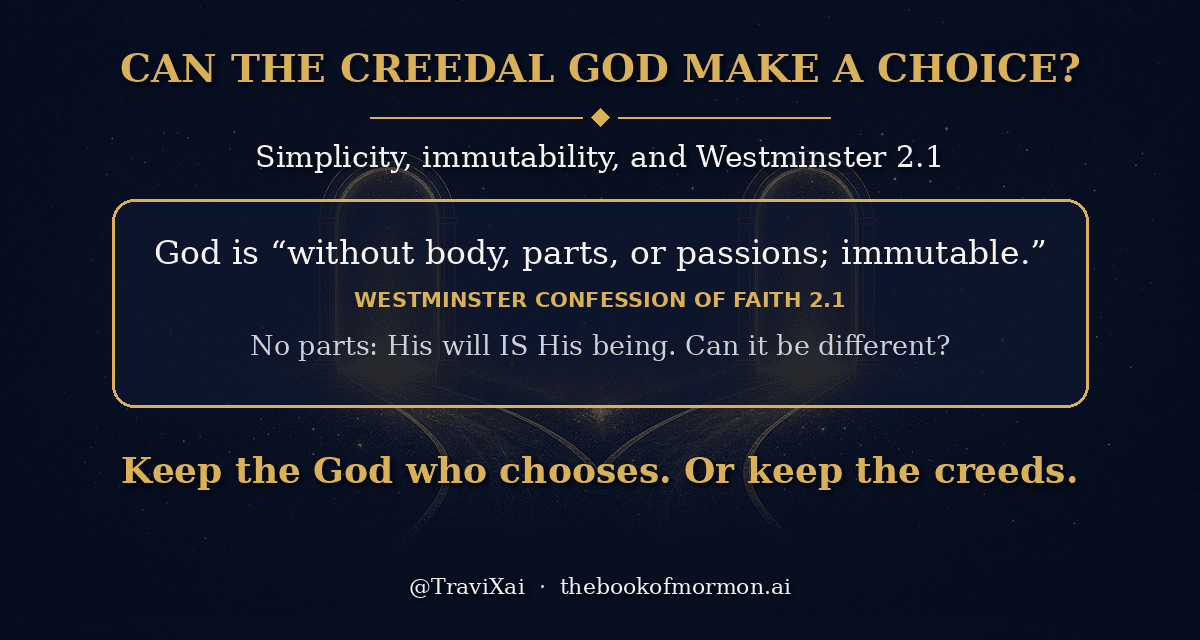

Christians say God chose Israel, chose who to save, sent His Son, and spared Nineveh. Their own creeds say He is simple and immutable, “without body, parts, or passions.” Follow that one step at a time, and one of the two has to go.
Home › Creeds & Councils › Series: What the Creeds Won’t Let God Do
No, not if you follow the creeds all the way. Westminster says God is “without body, parts, or passions; immutable.” With no parts, His will IS His being. A real choice means He could have willed otherwise, and a different will would mean a different God.
Can the creedal God make a choice? Ask a creedal Christian and he’ll say “of course.” Then ask him to square that with his own confession of faith. That’s where it gets quiet. This is the long version of Part 1 of my X series, What the Creeds Won’t Let God Do. Not what God won’t do. What their own creeds say He can’t do.
The questionChristians say God chooses all the time
Start with what nearly every Bible-believing Christian already says about God. He makes choices. Lots of them.
- He chose who to save. “According as he hath chosen us in him before the foundation of the world” (Ephesians 1:4).
- He chose Israel. “The Lord thy God hath chosen thee to be a special people unto himself” (Deuteronomy 7:6), and He says why: “because the Lord loved you” (Deuteronomy 7:8).
- He sent His Son. “He loved us, and sent his Son to be the propitiation for our sins” (1 John 4:10).
- He answers prayer. To Hezekiah: “I have heard thy prayer, I have seen thy tears: behold, I will add unto thy days fifteen years” (Isaiah 38:5).
- He forgives when we repent. “If we confess our sins, he is faithful and just to forgive us our sins” (1 John 1:9).
- He spared Nineveh. “God repented of the evil, that he had said that he would do unto them; and he did it not” (Jonah 3:10).
Every one of those is God deciding something. I agree with every verse on that list. The question is whether the God of the creeds is allowed to do any of it.
Groundwork 1What the creeds actually say
Groundwork first. These aren’t my definitions. They’re theirs. Here is the Westminster Confession of Faith, chapter 2, paragraph 1, the standard for Presbyterian and Reformed churches:
There is but one only, living, and true God, who is infinite in being and perfection, a most pure spirit, invisible, without body, parts, or passions; immutable, immense, eternal, incomprehensible, almighty, most wise, most holy, most free, most absolute; working all things according to the counsel of his own immutable and most righteous will, for his own glory.
Westminster Confession of Faith 2.1 (OPC text)
It’s not just Westminster. The Belgic Confession, Article 1, confesses “a single and simple spiritual being, whom we call God” (Belgic Confession, CRC translation). The Fourth Lateran Council in 1215 called God “unchangeable” and His nature “absolutely simple” (Lateran IV, canon 1). Catholic and Protestant, same God.
Two words carry the whole argument:
- Simple. No parts. Not a body, not a mind plus a will plus feelings. Nothing in God is a piece of God.
- Immutable. No change. Not even the possibility of change.
(The “passions” part of that sentence, the God who grieves and loves and relents, gets its own post next. This one stays on choice.)
Groundwork 2Simple means His will IS His being
Now follow what “no parts” does to God’s will. In you and me, the will is one faculty among others. I can decide to have pancakes, change my mind, and still be me. My will changed. I didn’t.
The creeds won’t let God work that way. Thomas Aquinas, the doctrine’s great architect, says God “is nowise composite, but is altogether simple” (Summa Theologiae I, q.3, a.7). Then he applies it to the will:
And as His intellect is His own existence, so is His will.
Aquinas, Summa Theologiae I, q.19, a.1
So God doesn’t have a will the way you have one. His will is His being. Same thing, just named differently. And because His being can’t change, Aquinas concludes: “The will of God is entirely unchangeable” (q.19, a.7).
Westminster says the same thing in its own words. God does “all things according to the counsel of his own immutable and most righteous will” (2.1), and He “did, by the most wise and holy counsel of his own will, freely, and unchangeably ordain whatsoever comes to pass” (WCF 3.1). Freely. And unchangeably. Hold onto both of those words. They’re about to run into each other.
The stepsFollow the chain
Ok…. now follow it.
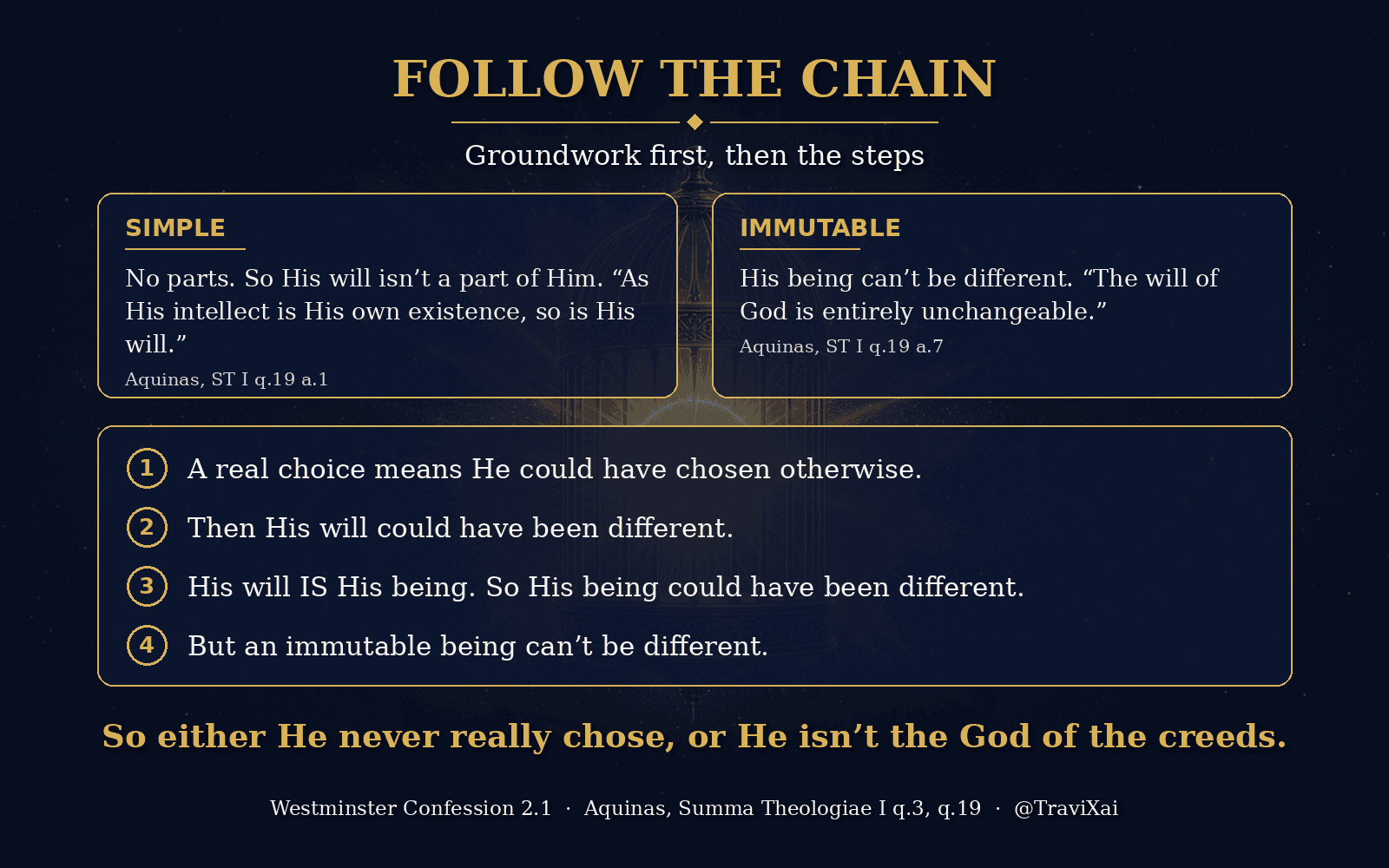
- A real choice means He could have chosen otherwise. If there was only ever one possible outcome, nothing was chosen. That’s just what happens.
- If He could have chosen otherwise, His will could have been different. A choice between two options is a will that could have landed on either one.
- His will IS His being. That’s simplicity. So if His will could have been different, His being could have been different.
- But His being can’t be different. That’s immutability. Aquinas even says “the divine essence is necessary of itself” (q.19, a.3).
So which one goes? Either God never really had an alternative, and the choices the Bible describes all flow out of His nature like water out of a spring, or He did have alternatives, and a God whose will could be different is a God whose being could be different. A different will would be a different God.
Think about what that does to the list from the first section. Before the foundation of the world, God “hath chosen us in him.” Could He have chosen differently? If not, it wasn’t a choice. If so, then the God who chose you and the God who would have chosen someone else are two different beings, because His choosing is His being. The same goes for sending His Son, for when to answer a prayer, for when to step in, for when to judge.
A choice needs a real alternative. A perfect, unchanging God “without body, parts, or passions” can’t have one.
Dodge #1“He wills creation freely”
The first answer you’ll get is Aquinas’s own. He saw this coming and said God wills His own goodness necessarily, but not everything else:
Although God necessarily wills His own goodness, He does not necessarily will things willed on account of His goodness; for it can exist without other things.
Aquinas, Summa Theologiae I, q.19, a.3, reply 2
Fine. Then take the world where God didn’t create. In that world His will is different, because He willed not to create. But His will is His essence. So in that world His essence is different. A simple, immutable God can’t be different from Himself in any way at all. You can call the will free all day. If the will is identical to an essence that can’t be otherwise, the word “free” isn’t doing anything.
The glory problem
Then ask why He created at all. You’ll hear that God created to be glorified. Westminster says creation was “for the manifestation of the glory of his eternal power, wisdom, and goodness” (WCF 4.1). But look at what Westminster says one paragraph after 2.1. God is “not standing in need of any creatures which he hath made, nor deriving any glory from them, but only manifesting his own glory in, by, unto, and upon them” (WCF 2.2). Aquinas: “no perfection can accrue to Him from them” (q.19, a.3).
So He created to be glorified, but He gains no glory. He gets nothing from it, needs nothing from it, and is not one bit different for having done it. A perfectly self-sufficient God can’t gain glory. Then “He created for His glory” isn’t a reason at all. For that God, creating and not creating come out exactly the same.
Dodge #2“The change is only in us”
The second answer is the big one: “The difference is only in the creature, not in God.” When God “relents” or “forgives” or “answers,” nothing changes in Him. Only we change. Aquinas puts it this way:
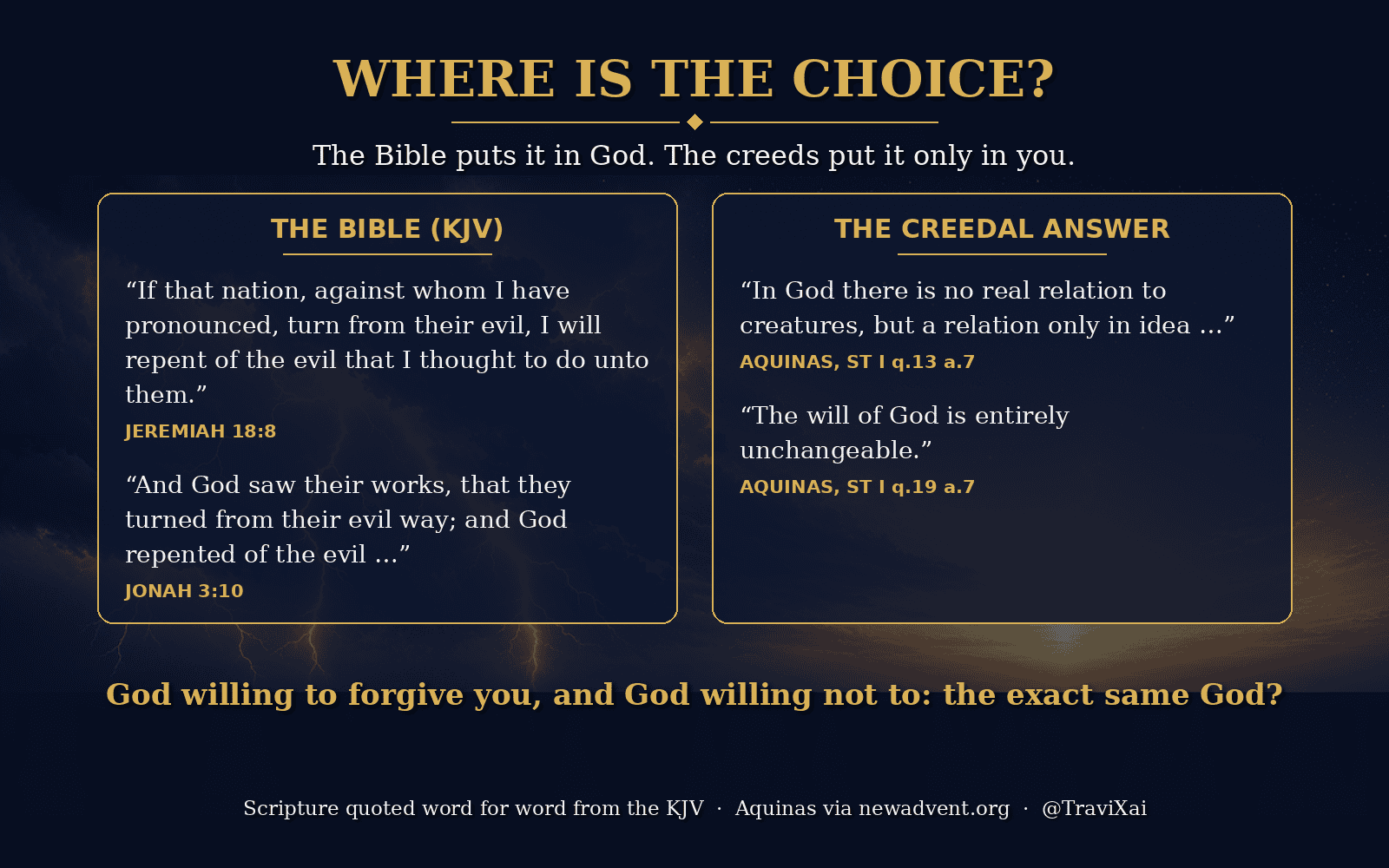
In God there is no real relation to creatures, but a relation only in idea, inasmuch as creatures are referred to Him.
Aquinas, Summa Theologiae I, q.13, a.7
And about the will: “to change the will is one thing; to will that certain things should be changed is another” (q.19, a.7). When Scripture says God “repented,” Aquinas calls it a comparison “with our mode of acting” (same article). A figure of speech.
Ok. So God willing to forgive you, and God willing NOT to forgive you, are the exact same God, with nothing different in Him at all? No real relation to you at all?
Then the choice isn’t in God. It’s only in you. That’s not a God who chooses. That’s a machine. Put the coin in, get the output.
Now read how God describes Himself:
If that nation, against whom I have pronounced, turn from their evil, I will repent of the evil that I thought to do unto them.
Jeremiah 18:8 (KJV)
“If… I will.” God is telling you He has two possible courses, and which one He takes depends on what the nation does. Two verses later He says it the other way: “If it do evil in my sight… then I will repent of the good, wherewith I said I would benefit them” (Jeremiah 18:10). And then Nineveh actually does it. “God saw their works, that they turned from their evil way; and God repented of the evil” (Jonah 3:10). God saw. God responded. God did not do what He said He would do. I went through how Jonah’s prophecy works in Deuteronomy 18:22 Cuts Both Ways.
Here’s the hypocrisy. The same people who tell us to take the Bible literally turn every one of these verses into a figure of speech the second it collides with a creed written centuries later. And the verse they reach for, “I am the Lord, I change not” (Malachi 3:6), is followed right away by God saying, “Return unto me, and I will return unto you” (Malachi 3:7). Even their proof text has God responding to people. His character doesn’t change. That’s the point of the verse. It never says He can’t decide anything.
The God who choosesWhat the Bible shows instead
Latter-day Saints believe God is perfect, faithful, and unchanging in His character. James calls Him the “Father of lights, with whom is no variableness, neither shadow of turning” (James 1:17). We believe that. We just don’t believe it means He can’t do anything. Faithfulness means He keeps His word. It doesn’t mean He has no options.
The God of the Bible is a real Person. He so loved the world “that he gave his only begotten Son” (John 3:16). A Father who gives His Son could have held Him back. That’s exactly why the gift means something.
“Simple” and “without body, parts, or passions” aren’t Bible words. They came from later philosophical theology, like the Nicene vocabulary (see Nicaea 325). The Bible’s God has a body (God Has a Body) and a will He uses.
So here’s the question for every creedal Christian who tells me God chose him before the foundation of the world. Did He? Could He have done otherwise? If yes, your confession is wrong about simplicity and immutability. If no, then He didn’t choose you. It just happened.
Keep the God who chooses. Or keep the creeds. You can’t keep both.
SummaryKey takeaways
- The Bible says God chooses: who to save (Ephesians 1:4), Israel (Deuteronomy 7:6–8), sending His Son (1 John 4:10), answering prayer (Isaiah 38:5), sparing Nineveh (Jonah 3:10).
- Westminster 2.1 says God is “without body, parts, or passions; immutable.” The Belgic Confession and Lateran IV say He is simple.
- Simple means no parts, so His will IS His being (Aquinas, ST I q.19 a.1). Immutable means that being can’t be different.
- A real choice needs a real alternative. A different will would mean a different God, so the creedal God either never truly chose or isn’t simple and immutable.
- “He wills creation freely” doesn’t escape it, and a God who gains no glory from creation (WCF 2.2) can’t have created to gain glory.
- “The change is only in us” makes God a machine. Jeremiah 18:8 and Jonah 3:10 put the response in God.
Can the creedal God choose? Quick answers
Does the Westminster Confession say God has no passions?
Yes. Chapter 2, paragraph 1 says God is “without body, parts, or passions; immutable.” That clause is the root of the problem this post walks through.
What is divine simplicity?
The teaching that God has no parts of any kind. Aquinas says God “is nowise composite, but is altogether simple” (Summa Theologiae I, q.3, a.7), and that “as His intellect is His own existence, so is His will” (I, q.19, a.1).
Why can’t a simple, immutable God make a real choice?
A real choice means He could have willed otherwise. If His will is His being, a different will means a different being. An immutable being can’t be different, so the alternative was never real.
Doesn’t Malachi 3:6 prove God can’t change His mind?
Malachi 3:6 says “I change not,” and the next verse says “Return unto me, and I will return unto you.” It’s about God’s faithful character, not a God who can’t respond. Jeremiah 18:8 and Jonah 3:10 show Him responding.
Where can I read more?
Next time someone tells you God chose them before the foundation of the world, agree with them. Then hand them Westminster 2.1 and ask whether He could have chosen otherwise. For quick, sourced answers on the Godhead, an embodied God, Numbers 23:19, and whether the creeds define a Christian, open Galatians18. And for more like this every day, follow me on X at @TraviXai.
Sources
- Bible (KJV, churchofjesuschrist.org): Deuteronomy 7:6–8 · Isaiah 38:5 · Jeremiah 18:7–10 · Jonah 3:10 · Malachi 3:6–7 · John 3:16 · Ephesians 1:4 · James 1:17 · 1 John 1:9 · 1 John 4:10
- Westminster Confession of Faith, chapters 2.1–2.2, 3.1, 4.1 (Orthodox Presbyterian Church text)
- Belgic Confession, Article 1 (Christian Reformed Church translation)
- Fourth Lateran Council (1215), canon 1 (Internet History Sourcebooks, Fordham University)
- Thomas Aquinas, Summa Theologiae, First Part (New Advent, English Dominican Province translation): q.3, The simplicity of God (a.7) · q.13, The names of God (a.7) · q.19, The will of God (a.1, a.3, a.7)
- X series: What the Creeds Won’t Let God Do, Part 1 (@TraviXai, Nov 16, 2026)
- Galatians18: The Godhead, Not the Classical Trinity · An Embodied God · Numbers 23:19 — God Is Not a Man · Must You Affirm the Creeds to Be Christian?
- Featured image and charts: original graphics by thebookofmormon.ai on painted backgrounds from the What the Creeds Won’t Let God Do series (no photographs or likenesses of real people; Jesus is not depicted).