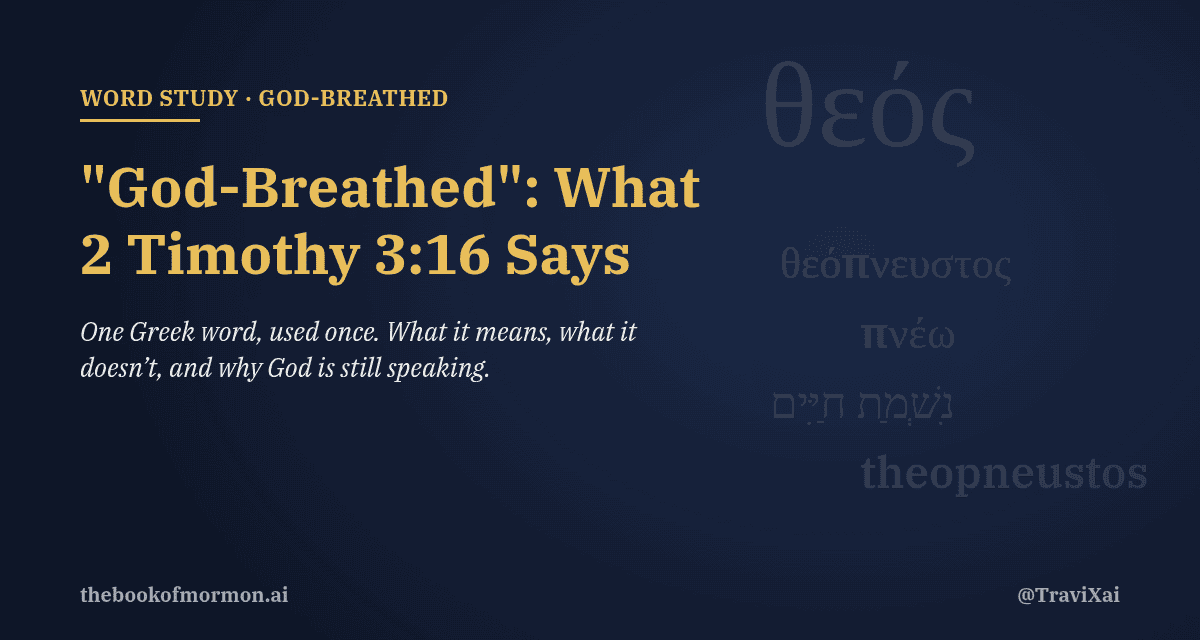

2 Timothy 3:16 rests on one Greek word, theopneustos, used only once in the New Testament. Here’s what it says, what it doesn’t, a recent study suggesting it meant “life-giving,” and how the Bible itself describes inspiration.
If you’ve ever talked with someone about whether the Bible can contain human errors, you’ve probably heard this verse:
“All scripture is given by inspiration of God, and is profitable for doctrine, for reproof, for correction, for instruction in righteousness:” (2 Timothy 3:16)
For many Christians, that verse settles it: the Bible is inspired, so it must be perfect, maybe even dictated word for word. Latter-day Saints believe the Bible is the word of God. We also believe it came to us through human prophets, scribes, and translators, and that God still speaks today. People sometimes think that view clashes with 2 Timothy 3:16.
It doesn’t. Let’s look at what the verse actually says, the one Greek word behind it, a fascinating recent study on that word’s history, and how the Bible itself describes inspiration.
Part 1: One word, used once
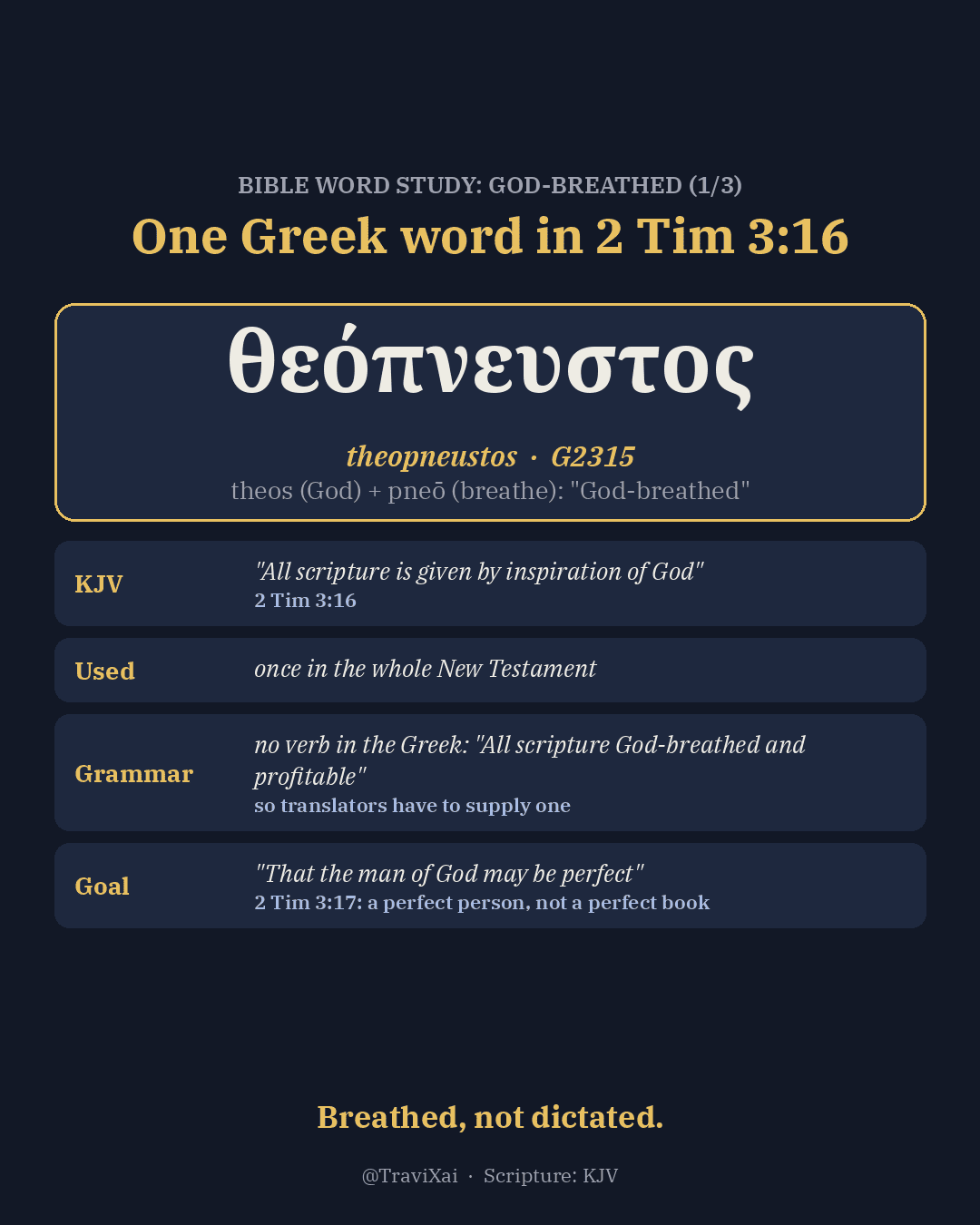
The KJV phrase “given by inspiration of God” translates a single Greek word: theopneustos (θεόπνευστος, Strong’s G2315). It’s built from theos, “God,” and pneo, “to breathe.” Literally: God-breathed.
That word appears only once in the entire New Testament. Our whole doctrine of biblical inspiration often rests on a word Paul used one time.
Three things to notice about the verse
1. The Greek has no verb. Word for word, the verse reads something like “All scripture God-breathed and profitable for teaching…” Translators have to add “is,” and where they put it matters. Most say “All scripture is God-breathed and profitable.” Some older translations read “Every scripture inspired of God is also profitable.” Both are possible Greek. Either way, the verse makes a positive claim about scripture’s source and usefulness.
2. The point is what scripture does. The verse lists four uses: doctrine, reproof, correction, and instruction in righteousness. It’s a practical statement. Scripture is useful because it comes from God.
3. The goal is a perfect person, not a perfect book. Look at the next verse:
“That the man of God may be perfect, throughly furnished unto all good works.” (2 Timothy 3:17)
The word “perfect” is in the passage. It describes the believer, not the text. Scripture is given to make people complete and ready for good works.
Which scripture was Paul talking about?
The verse before gives context:
“And that from a child thou hast known the holy scriptures, which are able to make thee wise unto salvation through faith which is in Christ Jesus.” (2 Timothy 3:15)
Timothy learned scripture as a child. That means Paul was talking mainly about the Jewish scriptures, what Christians now call the Old Testament. The New Testament as a collected book didn’t exist yet. Paul couldn’t have been describing a 66-book Bible, because that collection came together over the following centuries.
And notice the purpose in verse 15: scripture makes you “wise unto salvation through faith which is in Christ Jesus.” Its job is to lead people to Christ.
What the verse doesn’t say
The verse says scripture comes from God and is profitable. It does not say:
- that God dictated every word,
- that the copies and translations we have are free of every human error,
- or that God would never give more scripture.
Those ideas might be argued from somewhere else, but they aren’t in this verse.
Part 2: What if “God-breathed” meant “life-giving”?
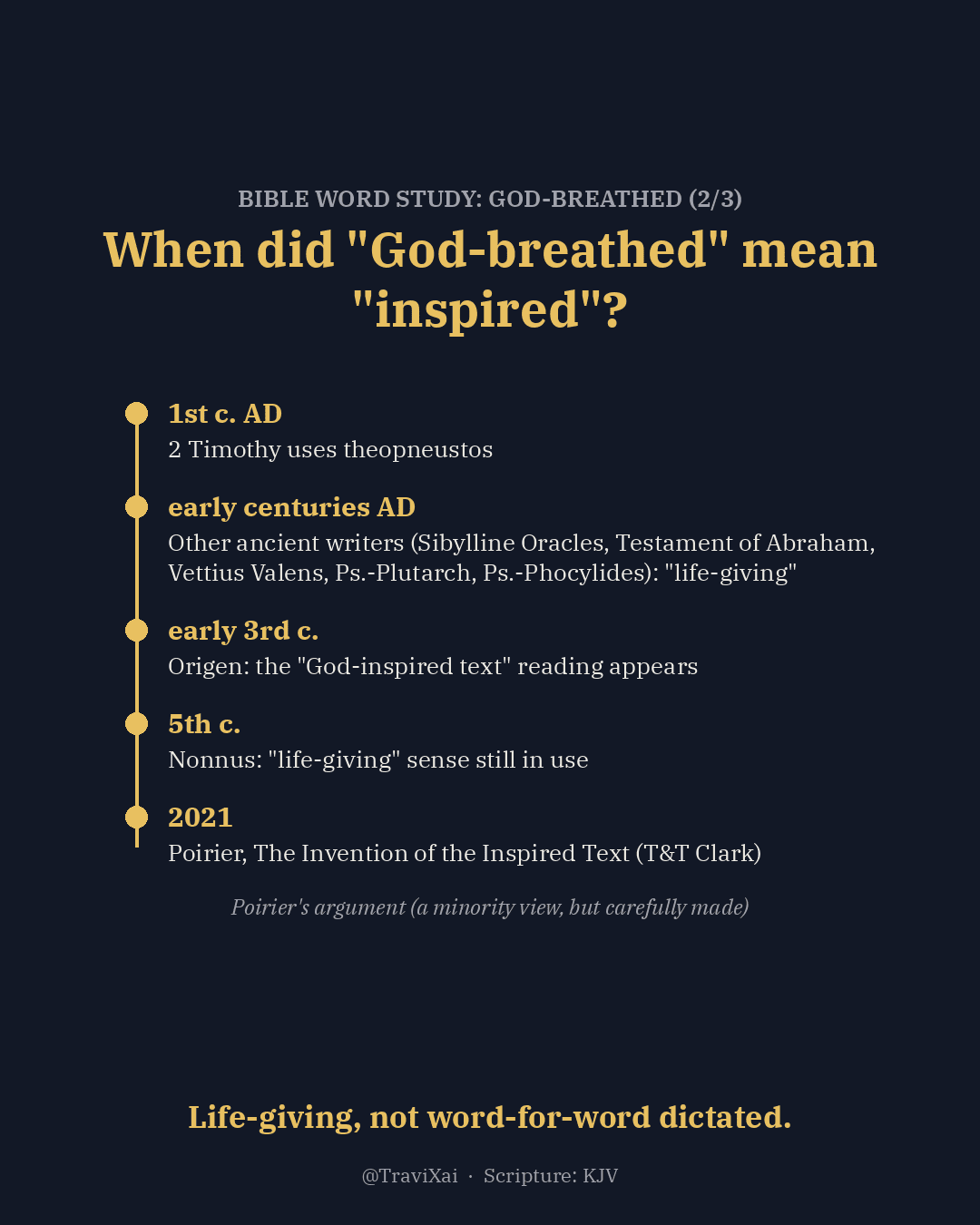
Here’s where it gets interesting. In 2021, John C. Poirier published The Invention of the Inspired Text: Philological Windows on the Theopneustia of Scripture (Library of New Testament Studies 640, T&T Clark/Bloomsbury; hardback February 2021, paperback 2022, 272 pages).
Poirier asked a simple question: how did ancient writers outside the Bible use the word theopneustos? Since the word appears only once in the New Testament, its meaning has to be judged partly from how other people used it.
He went through the early examples, including:
- the Sibylline Oracles (book 5),
- the Testament of Abraham,
- the astrologer Vettius Valens,
- Pseudo-Plutarch,
- and Pseudo-Phocylides.
He also looked at the related word theopnous.
His conclusion: in the uses before Origen, the word doesn’t mean “breathed out by God” in the sense of God producing words. It means something closer to “God-breathed into,” that is, filled with divine life, or life-giving. Think of Genesis 2:7:
“And the Lord God formed man of the dust of the ground, and breathed into his nostrils the breath of life; and man became a living soul.”
God’s breath gives life. Poirier argues that early readers would have heard theopneustos the same way.
According to Poirier, the sense “inspired text,” meaning words produced by God’s breath, shows up with Origen in the early third century, and from there it shaped later Christian thinking. He also notes that the older “life-giving” sense hadn’t disappeared: the fifth-century poet Nonnus still uses it.
How strong is the argument?
We should be honest. Poirier’s reading is a minority position. Most translations and many scholars still read theopneustos as “inspired by God,” and reviewers have debated his conclusions. But his work is careful, published by a respected academic press, and it raises a real question about how much weight one word can bear.
And notice how well “life-giving” fits the context. Verse 15 says scripture can “make thee wise unto salvation.” Verse 17 says it makes the believer “perfect, throughly furnished unto all good works.” A life-giving scripture that brings people to salvation and equips them for good works: that reading flows naturally.
Even if you keep the traditional “inspired,” the verse still says nothing about dictation or perfect copies.
The canon came later
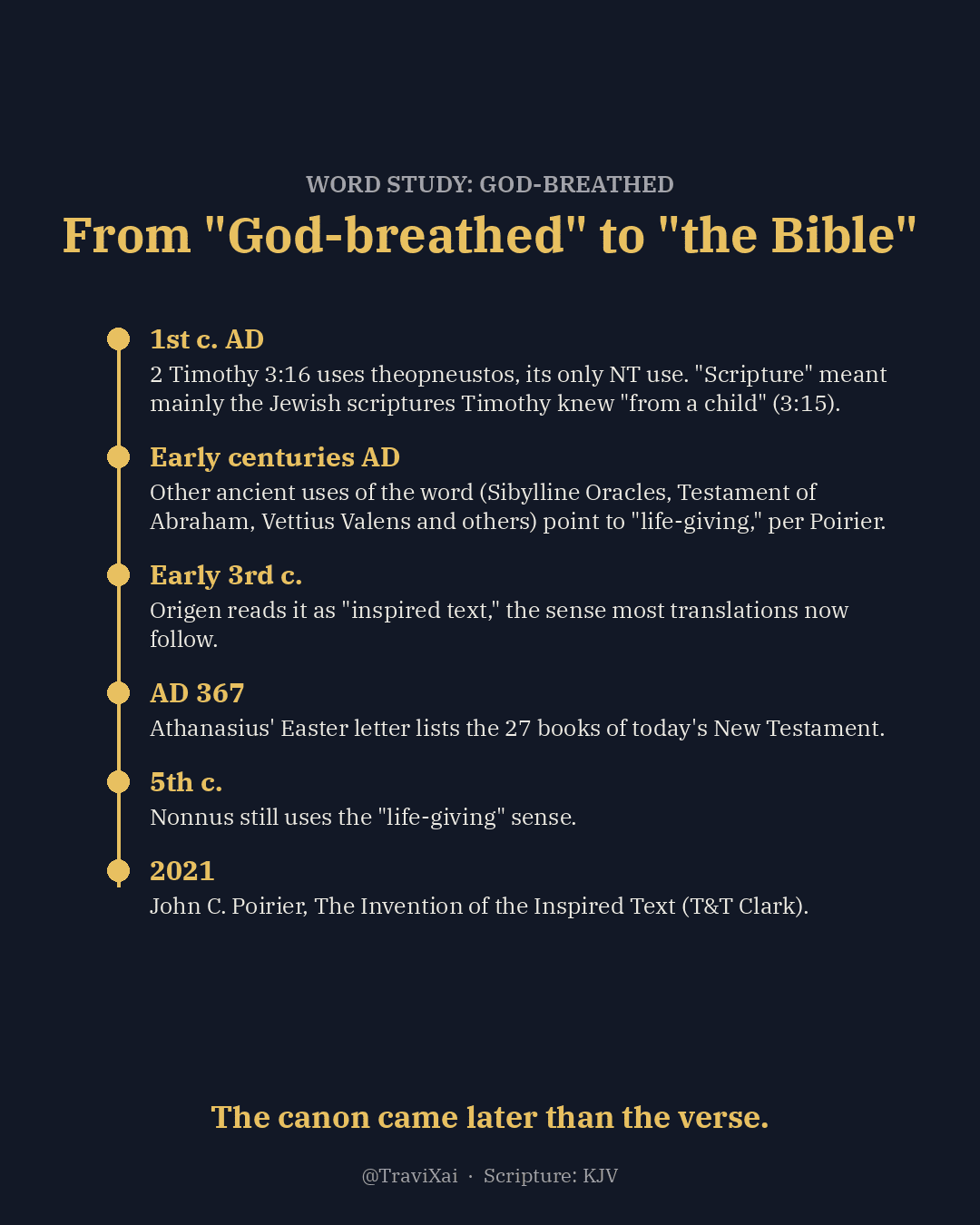
Put the dates in order and something else becomes clear. Paul wrote 2 Timothy in the first century. Origen’s “inspired text” reading came in the early third century. Athanasius’ Easter letter of AD 367 is the earliest surviving list of exactly the 27 books of today’s New Testament. The collection we call “the Bible” was gathered by the Church over centuries.
Latter-day Saints honor that collection. We read it, study it, and love it. But it’s fair to note that when Paul wrote “all scripture,” he wasn’t pointing at a closed list. The idea that scripture ended with the last page of Revelation isn’t something 2 Timothy says.
Part 3: How inspiration actually works
The Bible itself describes how inspiration happened. The clearest statement is in 2 Peter:
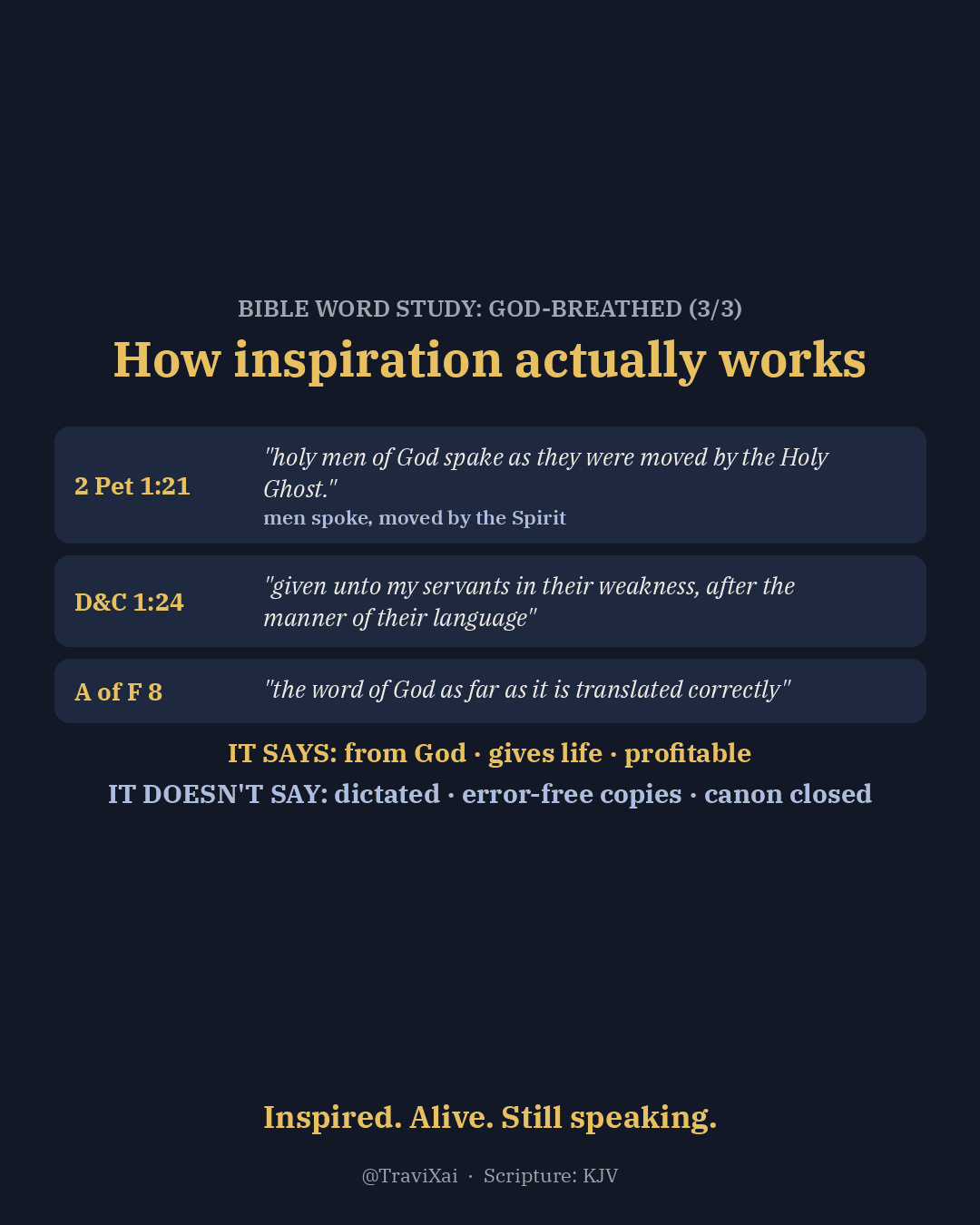
“Knowing this first, that no prophecy of the scripture is of any private interpretation. For the prophecy came not in old time by the will of man: but holy men of God spake as they were moved by the Holy Ghost.” (2 Peter 1:20–21)
Notice the order. Holy men spoke. The Holy Ghost moved them. The message came from God, and the words came through people, each with their own language, style, and setting. That’s why Paul sounds like Paul, John sounds like John, and Amos sounds like a farmer.
The Lord describes modern revelation the same way:
“Behold, I am God and have spoken it; these commandments are of me, and were given unto my servants in their weakness, after the manner of their language, that they might come to understanding.” (D&C 1:24)
“In their weakness, after the manner of their language.” God speaks to people in words they understand, through servants who are still human. The revelation is His. The language is theirs.
And the Lord defines scripture by its source, not by a closed list:
“And whatsoever they shall speak when moved upon by the Holy Ghost shall be scripture, shall be the will of the Lord, shall be the mind of the Lord, shall be the word of the Lord, shall be the voice of the Lord, and the power of God unto salvation.” (D&C 68:4)
That’s very close to 2 Timothy. Scripture is what comes from God through the Spirit, and it is “the power of God unto salvation.”
What scholars say
Peter Enns, a non-LDS scholar, argues in Inspiration and Incarnation (Baker Academic, 2005) that scripture should be understood by analogy to Christ: fully divine in origin, and fully human in its setting and language. God accommodated Himself to the cultures of the biblical writers. Enns’ view isn’t Latter-day Saint doctrine, but it strikingly echoes D&C 1:24.
Philip L. Barlow, a Latter-day Saint historian, traces how Latter-day Saints have actually used the Bible in Mormons and the Bible: The Place of the Latter-day Saints in American Religion (Oxford University Press, 1991; updated edition 2013). He shows a tradition that deeply reveres the Bible while refusing to treat it as the only or final word from God.
John C. Poirier, as discussed above, challenges the standard reading of theopneustos itself.
The Latter-day Saint view of scripture
Joseph Smith summarized it in the eighth article of faith:
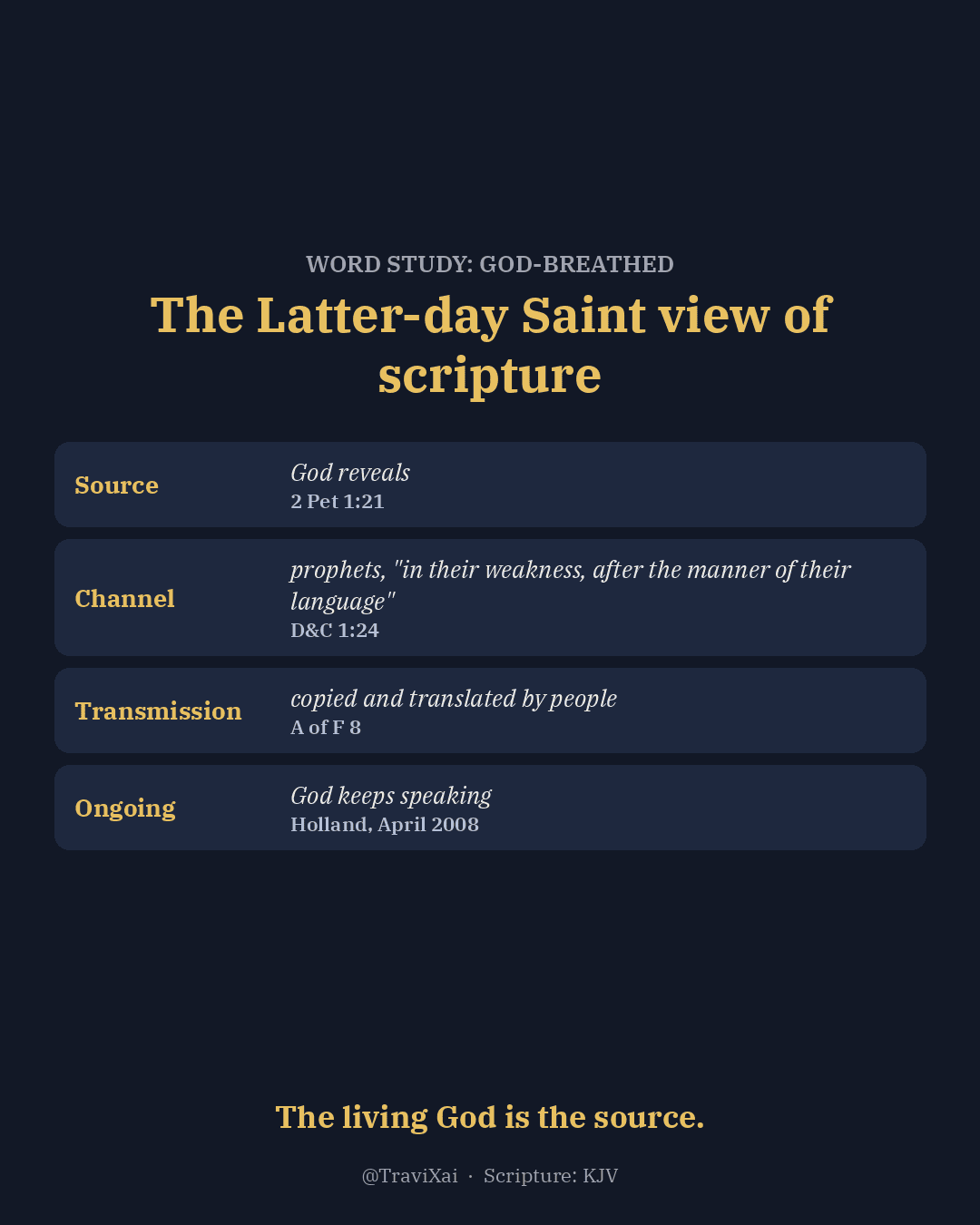
“We believe the Bible to be the word of God as far as it is translated correctly; we also believe the Book of Mormon to be the word of God.”
And the ninth:
“We believe all that God has revealed, all that He does now reveal, and we believe that He will yet reveal many great and important things pertaining to the Kingdom of God.”
Elder Jeffrey R. Holland explained the principle behind this in his April 2008 general conference address, “My Words … Never Cease”:
“The scriptures are not the ultimate source of knowledge for Latter-day Saints. They are manifestations of the ultimate source. The ultimate source of knowledge and authority for a Latter-day Saint is the living God.”
The strongest case for the Latter-day Saint view
- “Inspired” doesn’t mean “inerrant” or “dictated.” 2 Timothy 3:16 says scripture comes from God and is profitable. It says nothing about dictation or perfect transmission. The verse’s own goal is a “perfect” person, not a perfect book.
- The Bible shows inspiration through human beings. 2 Peter 1:21 says holy men spoke as they were moved by the Holy Ghost. D&C 1:24 says revelation comes to God’s servants “in their weakness, after the manner of their language.” That explains why scripture is both divine and human.
- “As far as it is translated correctly” is honesty, not doubt. The Bible came to us through copyists and translators over thousands of years. Scholars of every faith study manuscript differences. Article of Faith 8 simply admits what everyone who studies the manuscripts knows, while affirming the Bible as the word of God.
- The word itself may mean “life-giving.” If Poirier is right, the verse is about scripture’s power to give spiritual life, which fits verse 15’s “wise unto salvation” perfectly. Even if he’s not, nothing in the word requires inerrancy.
- The verse never closes the canon. Paul was speaking mainly of the Jewish scriptures. The 27-book New Testament was listed centuries later. A God whose word is “life-giving” is a God who can keep speaking, and the ninth article of faith says He does.
- The living God is the source. Elder Holland’s point is the heart of it. Scripture matters because it comes from God. The same God who breathed it still speaks.
The bottom line
2 Timothy 3:16 is a glorious verse. Scripture comes from God. It teaches, corrects, and trains us. It makes us wise unto salvation through faith in Christ. It’s meant to make us whole.
What it doesn’t do is turn the Bible into a book dictated by God and closed forever. The Bible itself shows God speaking through human beings, in human language, moved by the Holy Ghost. That’s still how He works.
God breathed life into Adam. He breathes life into scripture. And He’s still breathing.
Next time someone uses 2 Timothy 3:16 to say the Bible is dictated, error-free, and closed, ask them where the verse says any of that, and what “perfect” describes in verse 17. For quick, sourced answers on scripture and continuing revelation, open Galatians18. And for more word studies like this, follow me on X at @TraviXai.
Sources
- Strong’s G2315 (theopneustos). BibleHub.
- John C. Poirier, The Invention of the Inspired Text: Philological Windows on the Theopneustia of Scripture, Library of New Testament Studies 640 (London: T&T Clark/Bloomsbury, 2021; paperback 2022). Non-LDS.
- Peter Enns, Inspiration and Incarnation: Evangelicals and the Problem of the Old Testament (Grand Rapids: Baker Academic, 2005). Non-LDS.
- Philip L. Barlow, Mormons and the Bible: The Place of the Latter-day Saints in American Religion (New York: Oxford University Press, 1991; updated 2013). LDS.
- Jeffrey R. Holland, “My Words … Never Cease,” general conference, April 2008. LDS.
- Doctrine and Covenants 1:24; 68:4. Articles of Faith 1:8–9.
- Scripture quotations: King James Version, churchofjesuschrist.org.
- Featured image, word cards, timeline, and chart: original graphics by thebookofmormon.ai (no photographs or likenesses of real people).