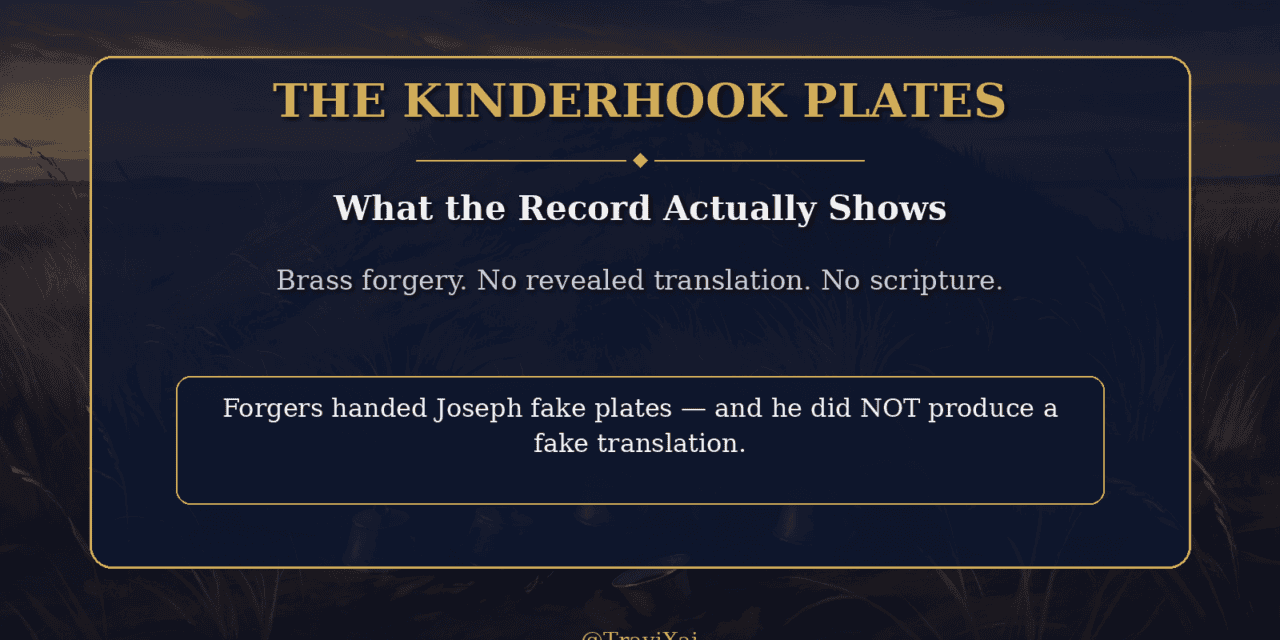

Critics still wave the Kinderhook plates like a gotcha. Brass forgery. No revealed translation. No scripture. Here is what the record actually shows — and what it doesn’t.
If you’ve spent five minutes in online Book of Mormon debates, you’ve heard it: “Joseph Smith translated the Kinderhook plates — and they were a fake.” Cue the mic drop. Cue the victory lap. Cue the part where nobody opens a primary source.
So let’s open them. The plates were brass, not gold. They were a confessed nineteenth-century hoax. Joseph Smith never published a revealed translation of them, never put them in scripture, and never sprung the trap the forgers set. That is not spin. That is the record.
Part IBrass plates, not gold
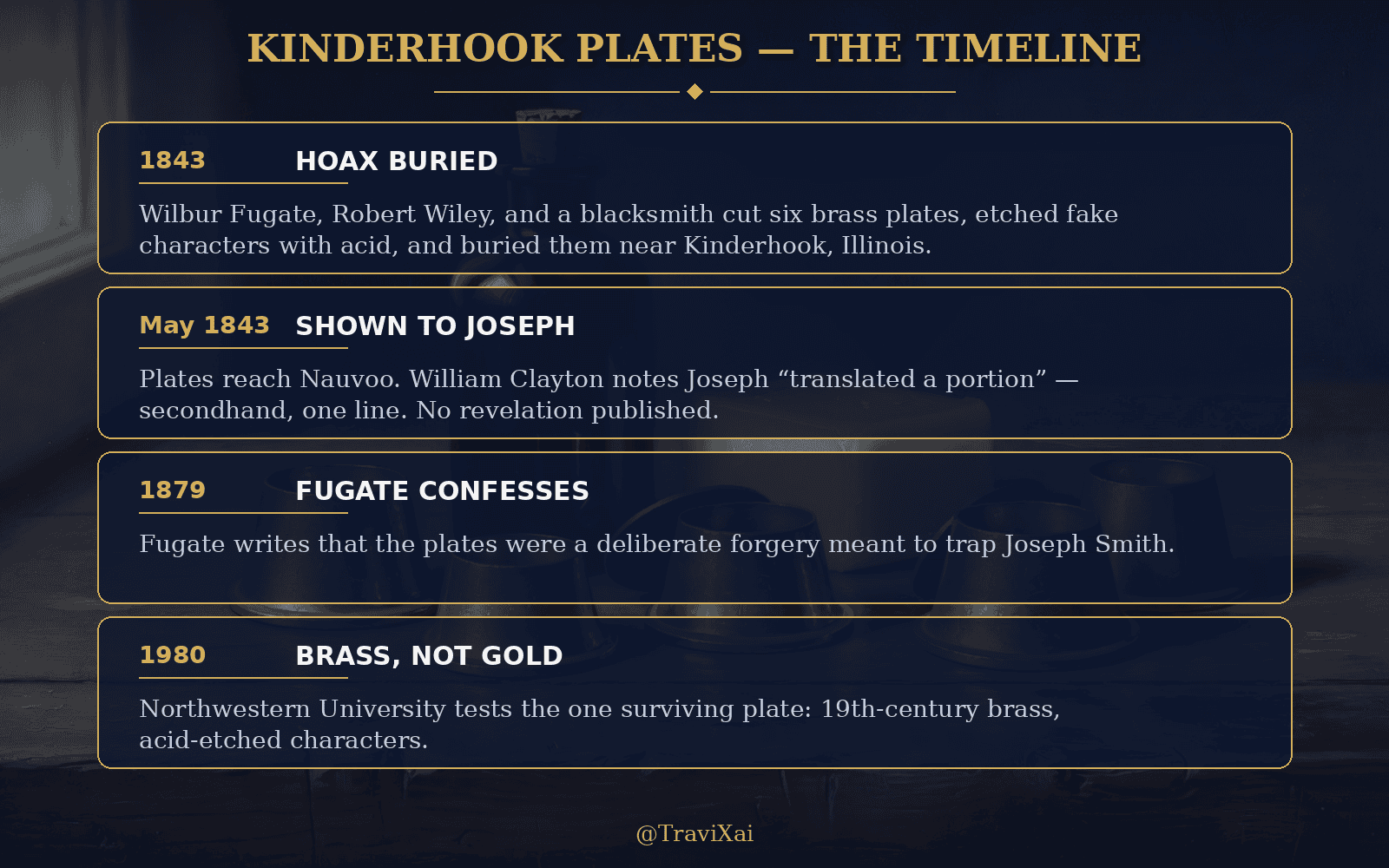
First, drop the gold-plate myth. The Kinderhook artifacts were six small, bell-shaped brass plates, about three inches tall, dug from an American Indian burial mound near Kinderhook, Illinois, in April 1843. They were brought to Nauvoo because someone thought they looked like a job for Joseph Smith.
One plate survived. In 1980, materials scientist D. Lynn Johnson at Northwestern University ran destructive and microscopic tests for historian Stanley B. Kimball. Scanning electron microscopy showed acid-etched grooves — pockmarked, not tool-cut. A scanning Auger microprobe found nitrogen consistent with nitric-acid etching. X-ray fluorescence showed modern brass alloy. Kimball published the results in the August 1981 Ensign: nineteenth-century manufacture, not an ancient record.
That matters, because critics often blur Kinderhook into the Book of Mormon gold plates as if they were the same kind of claim. They weren’t. Different metal. Different origin. Different outcome. If you want the actual gold-plate case — witnesses who never recanted, physical handling, and a published book — start with the witnesses who never recanted and the gold plates topic on Galatians18. Kinderhook is a different file.
Part IIA confessed hoax
Wilbur Fugate later admitted what the lab confirmed. In an 1879 letter, Fugate said he, Robert Wiley, and a local blacksmith forged the plates, etched invented characters with acid, and planted them in the mound the night before the “discovery.” The Church’s own Church History Topics essay on the Kinderhook plates states that plainly: it was a prank, the characters match no known language, and metallurgy rules out antiquity.
Why do it? The forgers wanted Joseph Smith to publish a revealed translation of their fake. That was the trap. Get the Prophet to canonize nonsense, then unveil the joke. It’s the nineteenth-century version of a sting — and it failed.
Part IIIWhat Joseph actually did — and didn’t
Contemporaneous sources cover only a few days in 1843. Joseph examined the plates. People in Nauvoo talked about them. Facsimiles circulated. And then… nothing. No Doctrine and Covenants section. No Times and Seasons “revealed translation.” No Kinderhook book on the shelf next to the Book of Mormon. The Church History Topics essay puts it this way: whatever he thought of the plates, “he quickly lost interest in them,” and “no translated text resulted from this short-lived excitement.”
That is the opposite of how Joseph treated the Book of Mormon plates. Those produced a published book, named witnesses, and a movement that still reads the text. Kinderhook produced a few journal lines and a dead end. If Joseph were the reckless “translate anything shiny” con man of internet lore, this was the perfect setup. The forgers handed him the bait. He did not take the reveal. For the broader con-man charge, see Was Joseph Smith a Con Man? and Joseph as a fallen prophet.
Part IV“Translated a portion”: one secondhand line
So where does “Joseph translated them” come from? Mostly from William Clayton’s journal, 1 May 1843. Clayton, Joseph’s clerk, wrote that he had seen the six brass plates and that “Prest J. has translated a portion and says they contain the history of the person with whom they were found & he was a descendant of Ham through the loins of Pharaoh king of Egypt, and that he received his kingdom from the ruler of heaven & earth.”
Read that carefully. It is Clayton’s journal, not Joseph’s. It is one sentence. It reports what Clayton understood Joseph to have said. It does not include a published translation text. Later, when Church historians compiled the multi-volume History of the Church, that kind of third-person clerk material was often rewritten into a first-person narrative that reads as if Joseph wrote it. Stanley Kimball and later researchers flagged that for Kinderhook specifically: the familiar “I have translated a portion of them…” line in History of the Church tracks Clayton, not an autograph Joseph journal entry claiming a revelatory translation.
Critics quote the rewritten History and act like Joseph published scripture. He didn’t. One clerk’s note is not a canonized translation. The Joseph Smith Papers materials on the 1843 journal period make the documentary chain visible; the Church History Topics essay cites the same Clayton-derived remark and still concludes there was no revelatory translation like the Book of Mormon.
Part VDon Bradley and the Egyptian alphabet match
What about that “descendant of Ham… Pharaoh” content? Historian Don Bradley (with Mark Ashurst-McGee) showed a clean, non-miraculous explanation. One prominent boat-shaped character on the Kinderhook plates closely matches a character in the Kirtland Grammar and Alphabet of the Egyptian Language (GAEL) — the working notebook tied to the Book of Abraham project. The GAEL definition for that character already talked about kingly power “by the line of Pharaoh” and possession of “heaven and earth.”
Bradley’s point: Joseph appears to have compared symbols by hand, matched one character to his own notebook, and read off the notebook’s definition. That is conventional character matching, not a “thus saith the Lord” translation of the plates. The Church History Topics essay agrees with the substance: Joseph “appears to have compared the symbols on the Kinderhook plates with other ancient artifacts in his possession,” and one symbol “closely matches a glyph” whose prior explanation mentions a descendant of Ham through the pharaohs.
So even if Clayton heard Joseph correctly, the “portion” looks like one character matched to a shelf notebook — not a new revealed book. Critics who flatten that into “Joseph failed the translation test” are skipping the method the Church’s own essay now describes. For related context on how critics handle Joseph’s other translation claims, see the Book of Abraham and seer stones topics, and seer stones in the Bible.
Part VIThe punchline critics skip
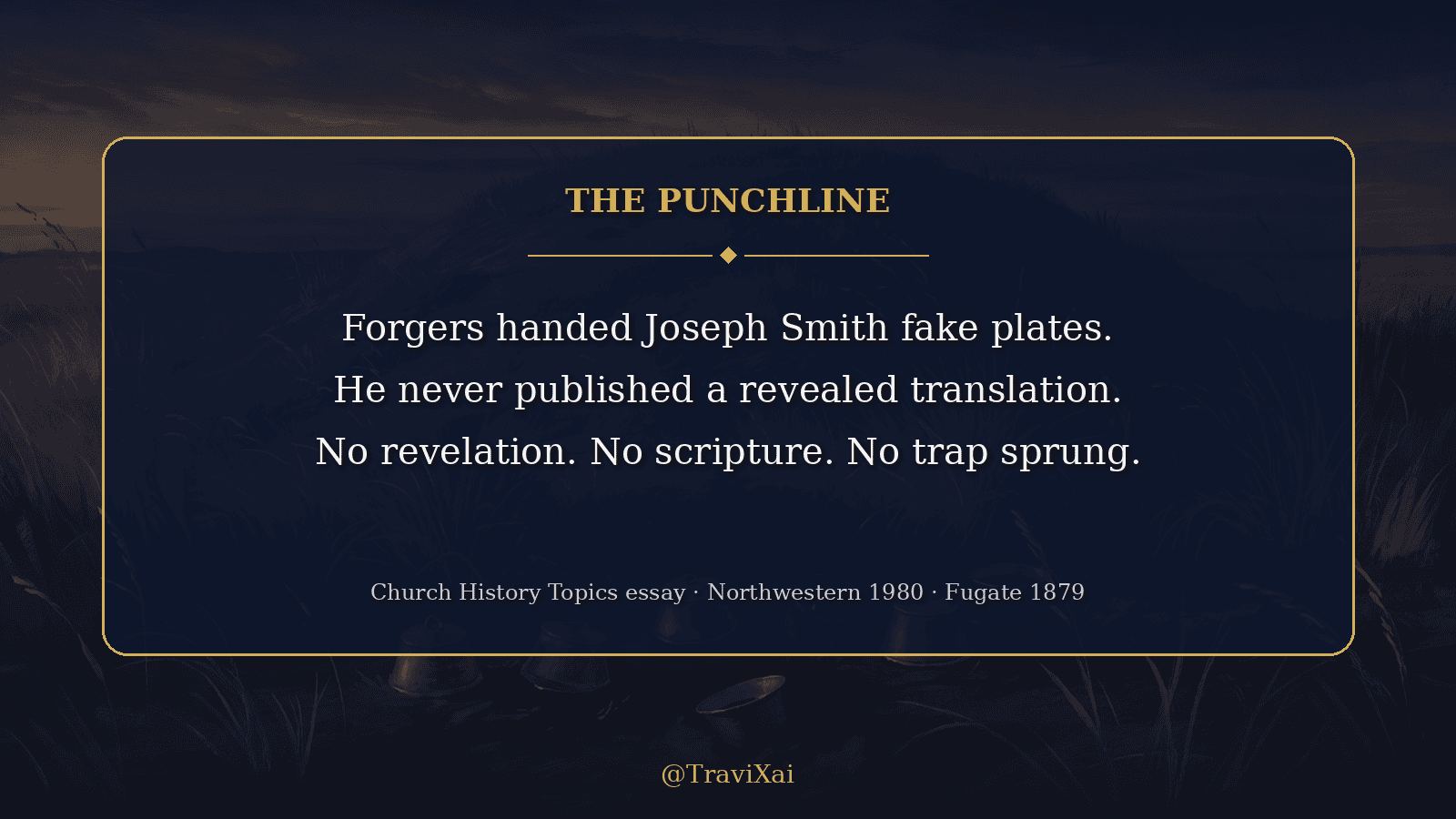
Here is the line critics hate, because it ruins the gotcha: forgers handed Joseph Smith fake plates, and he did not produce a fake translation.
No published revelation. Nothing added to the standard works. Interest that flared for a few days and died. The men who made the plates later confessed the sting. A university lab confirmed the brass and the acid. The Church’s own historical essay says there was no revelatory translation like the Book of Mormon.
If the charge is “Joseph would invent scripture for any shiny metal,” Kinderhook is evidence against that charge. The shiny metal arrived. The invention did not. Compare that to how casually some people dismiss the Book of Mormon plates while demanding physical relics for every biblical claim. Where are Moses’ stone tablets? Who besides Moses left a signed statement that they saw them? Moses came down the mountain alone. Eleven named Book of Mormon witnesses signed their own testimonies and never recanted. That double standard is its own article — see Moses Broke the Tablets — and it belongs next to Kinderhook, not instead of it. For “the Church hid this,” open Church hid history and the Kinderhook plates topic on Galatians18; the Church published the essay.
SummaryKey takeaways
- The Kinderhook plates were brass, not gold. Northwestern University’s 1980 analysis of the surviving plate found nineteenth-century brass with acid-etched characters (Kimball, Ensign, Aug. 1981).
- Wilbur Fugate confessed in 1879 that he, Robert Wiley, and a blacksmith forged and planted the plates to trap Joseph Smith.
- Joseph never published a revealed translation, never added Kinderhook text to scripture, and quickly lost interest (Church History Topics essay).
- The “translated a portion” claim is one secondhand line from William Clayton’s journal, later rewritten in first person in History of the Church.
- Don Bradley’s research — echoed by the Church History Topics essay — ties the “descendant of Ham” content to a character match in Joseph’s Egyptian alphabet notebook, not a revelatory translation of the plates.
- Punchline: forgers handed Joseph fake plates, and he did not produce a fake translation.
Next time someone drops “Kinderhook” like a mic, ask whether Joseph published a translation — and what the forgers admitted. For quick, sourced answers on the Kinderhook plates, the gold plates, Joseph as a fallen prophet, and whether the Church hid its history, open Galatians18. And for more like this every day, follow me on X at @TraviXai.
Sources
- Church History Topics: “Kinderhook Plates” (Church of Jesus Christ of Latter-day Saints)
- Stanley B. Kimball, “Kinderhook Plates Brought to Joseph Smith Appear to Be a Nineteenth-Century Hoax,” Ensign, Aug. 1981 (Northwestern / D. Lynn Johnson analysis)
- Joseph Smith Papers: Journal, December 1842–June 1844; Book 2 (context for the May 1843 Kinderhook period; see also the Church History Topics citation to Clayton via this journal)
- Don Bradley and Mark Ashurst-McGee, “Joseph Smith and the Kinderhook Plates,” in Laura Harris Hales, ed., A Reason for Faith (BYU Religious Studies Center / Deseret Book, 2016); Bradley’s earlier FAIR presentation: “President Joseph Has Translated a Portion” (PDF)
- BYU Religious Studies Center overview: “Did Joseph Smith Translate the Kinderhook Plates?”
- FAIR: Kinderhook Plates (summary of Fugate confession, Clayton entry, Bradley thesis)
- Galatians18: Kinderhook plates · Gold plates · Joseph as a fallen prophet · Did the Church hide its history? · Book of Abraham · Seer stones
- Featured image and in-article graphics: original graphics by thebookofmormon.ai (painterly backgrounds; no photographs or likenesses of real people).