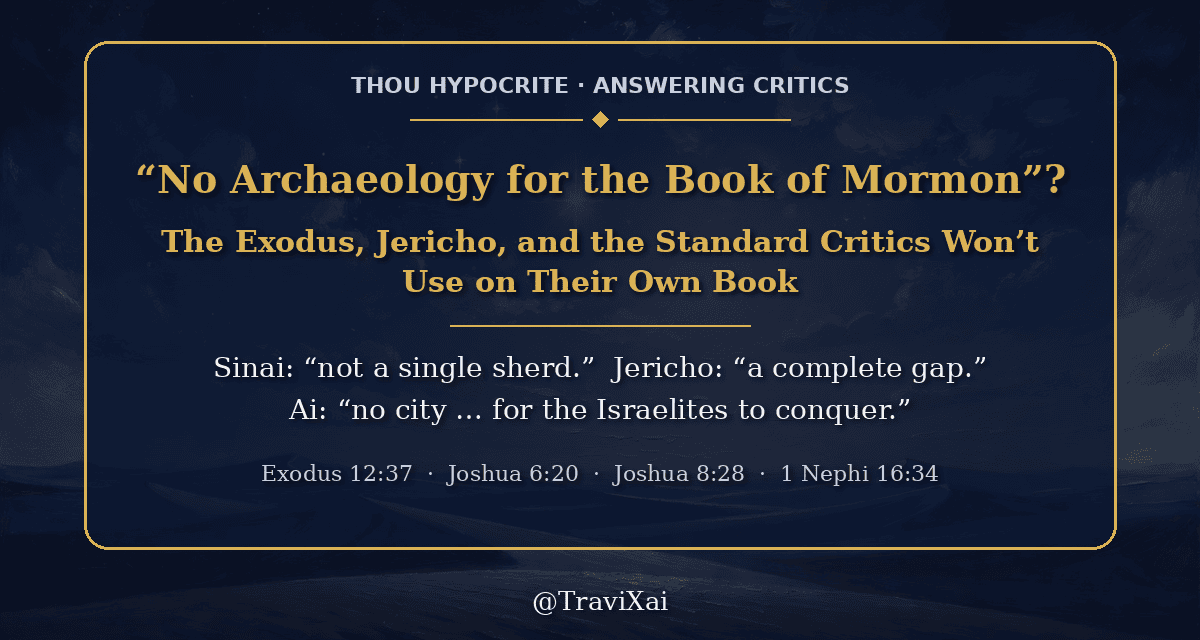

Critics say no ruins means no Book of Mormon. Mainstream archaeologists say the same thing about the Exodus, Jericho, and Ai. Here’s what happens when one standard is applied to both books.
“Show me Zarahemla. Show me one Nephite city, one Nephite coin, one Nephite street sign. No archaeology, no Book of Mormon.” I hear it every week, almost always from someone holding a Bible. So let’s ask the same about the Bible’s biggest story. Show me the camp of six hundred thousand men in the Sinai. Show me the walls of Jericho. Show me the city of Ai that Joshua burned.
This is my Thou Hypocrite series: take a critic’s argument against the Book of Mormon and run it, word for word, on the Bible. Archaeology got one section in The Hypocritical Book of Mormon Denier. Here it gets the full treatment, and the only witnesses I’m calling are mainstream archaeologists, not Latter-day Saint apologists.
Part IThe rule critics bring
The rule: if a book describes nations, cities, and wars, the ground should back it up, and if the ground is silent, the book is fiction. Fine, I’ll accept it. But a rule you only point at the other guy’s book isn’t a rule, it’s a weapon. Jesus had a word for people who use it that way:
Thou hypocrite, first cast out the beam out of thine own eye; and then shalt thou see clearly to cast out the mote out of thy brother’s eye.
Matthew 7:5
Part IISix hundred thousand men and no campsite
The Exodus is the founding event of Israel, and the text gives numbers:
And the children of Israel journeyed from Rameses to Succoth, about six hundred thousand on foot that were men, beside children.
Exodus 12:37
The Lord says “your children shall wander in the wilderness forty years” (Numbers 14:33). A nation on the move for a generation should leave something behind.
What the surveys found in the Sinai
Israel Finkelstein of Tel Aviv University and Neil Asher Silberman went looking, and reported the results in The Bible Unearthed (2001). Surveys “in all regions of the peninsula, including the mountainous area around the traditional site of Mount Sinai … has yielded only negative evidence: not a single sherd, no structure, not a single house, no trace of an ancient encampment” (excerpt).
Then the place Israel stayed longest: “ye abode in Kadesh many days” (Deuteronomy 1:46). At Kadesh-barnea, “repeated excavations and surveys throughout the entire area have not provided the slightest evidence for activity in the Late Bronze Age, not even a single sherd left by a tiny fleeing band of frightened refugees.” Their conclusion, “that the Exodus did not happen at the time and in the manner described in the Bible,” they called “irrefutable.”
Ze’ev Herzog, also of Tel Aviv University, in Haaretz (1999): “the Israelites were never in Egypt, did not wander in the desert, did not conquer the land in a military campaign.” On Mount Sinai and the desert camps: “not even one site has been found that can match the biblical account” (Herzog, “Deconstructing the Walls of Jericho”).
Israeli archaeologists, digging in the land the Bible describes, not anti-Christian activists. Ever heard a Book of Mormon critic quote them?
Part IIIJericho and Ai, the two showcase cities
If any conquest should show up in the ground, it’s these two:
… the people shouted with a great shout, that the wall fell down flat, so that the people went up into the city, every man straight before him, and they took the city.
Joshua 6:20
Jericho: “a complete gap”
Kathleen Kenyon dug Jericho from 1952 to 1958. Her finding: “there is a complete gap both on the tell and in the tombs … between c. 1560 B.C. and c. 1400 B.C.” Bryant Wood, the scholar who later tried to rescue a Joshua-era date, summed up where her work left things: “In short, there was no strongly fortified Late Bronze Age city at Jericho for Joshua to conquer. The archaeological evidence conflicted with the Biblical account – indeed, disproved it” (Wood, BAR 1990).
In 1995, radiocarbon dating of charred grain from that destruction layer concluded that “the final destruction of MBA Jericho occurred during the late 17th or the 16th century bc” (Bruins and van der Plicht, Radiocarbon). That’s well before the roughly 1400 BC date that, in Wood’s words, “would match the chronology derived from the Bible.”
Ai: “no city … to conquer”
Ai is worse. “Joshua burnt Ai, and made it an heap for ever, even a desolation unto this day” (Joshua 8:28). The mound usually identified as Ai, et-Tell, was dug in the 1930s and again by Joseph Callaway in the 1960s and ’70s. Ziony Zevit summed up the result in Biblical Archaeology Review: “the evidence shows that there was no city at Ai for the Israelites to conquer” (Zevit, “The Problem of Ai”).
Herzog covers both cities in one sentence: at the end of the Late Bronze Age, “the agreed period for the conquest, there were no cities in either tell, and of course no walls that could have been toppled.” Two showcase battles, two empty mounds. If the Book of Mormon’s Ammonihah turned up as an empty field from the right century, critics would print T-shirts.
Part IVWatch what Bible believers do next
Bible-believing scholars didn’t throw out Joshua. Herzog lists their explanations: “Some claimed that the walls around Jericho were washed away by rain, while others suggested that earlier walls had been used; and, as for Ai, it was claimed that the original story actually referred to the conquest of nearby Beit El.” The full kit:
- The evidence eroded. Kenyon herself wrote that most of the Late Bronze town, “including the whole circuit of the town walls, has been removed by erosion” (Kenyon, Britannica, “Jericho”).
- We have the wrong dates. Wood re-dated Jericho’s pottery to about 1400 BC, the date that fits biblical chronology.
- We have the wrong site. Wood’s team excavated another mound, Khirbet el-Maqatir, as a “proposed new site for Joshua’s Ai”.
- Absence of evidence. Evangelical scholar Richard Averbeck at The Gospel Coalition: “We do not have historical or archaeological data to prove each point, but, as the saying goes, absence of evidence is not evidence of absence” (TGC). Egyptologist Kenneth Kitchen said the same (BAR 1995).
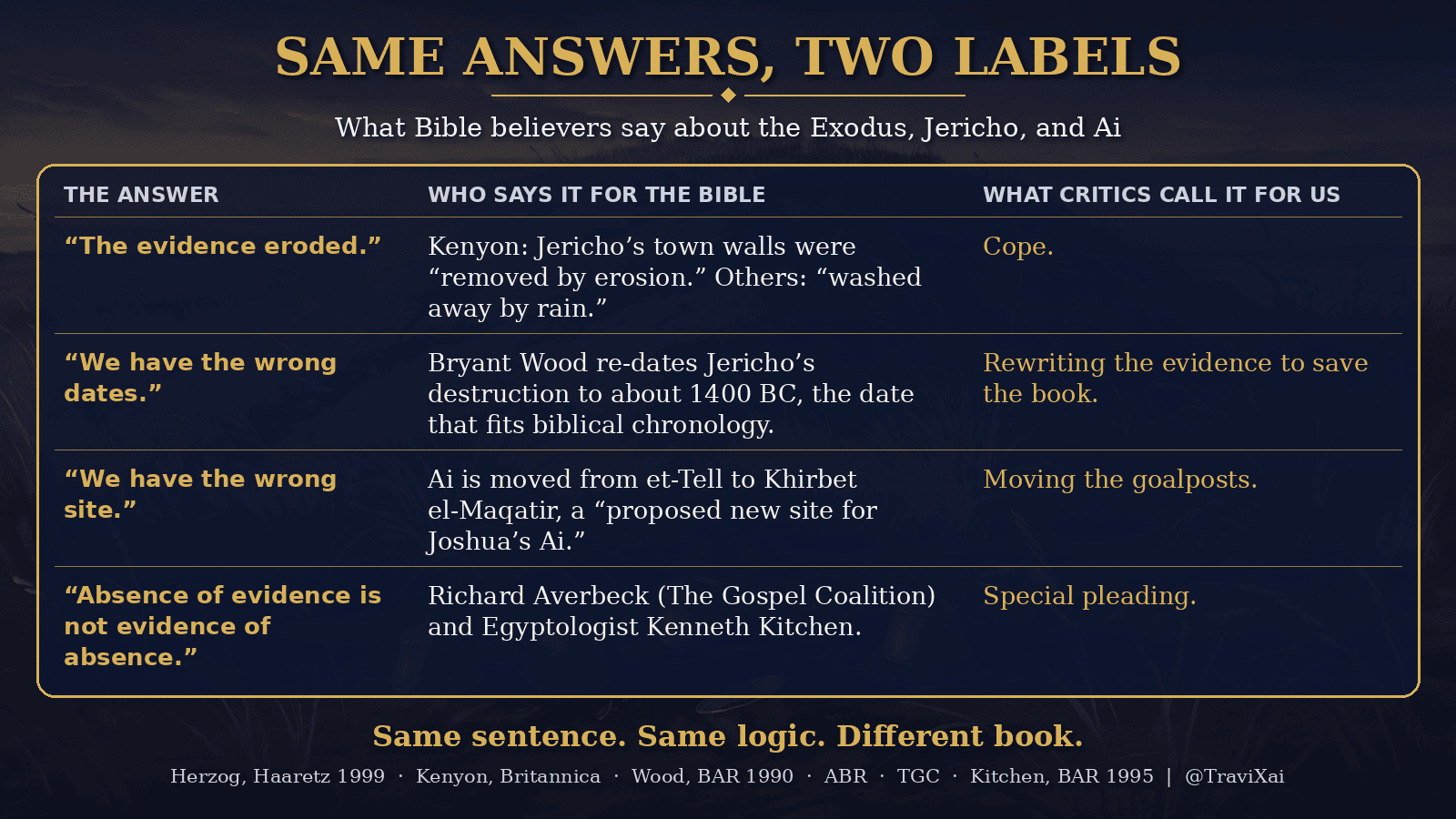
Every one is reasonable. Now say one about the Book of Mormon. “The evidence is under jungle and centuries of rebuilding”: cope. “We may not have the right site yet”: moving the goalposts. “Absence of evidence isn’t evidence of absence”: special pleading. Same sentence, same logic, different book.
Part VThe presupposition under the shovel
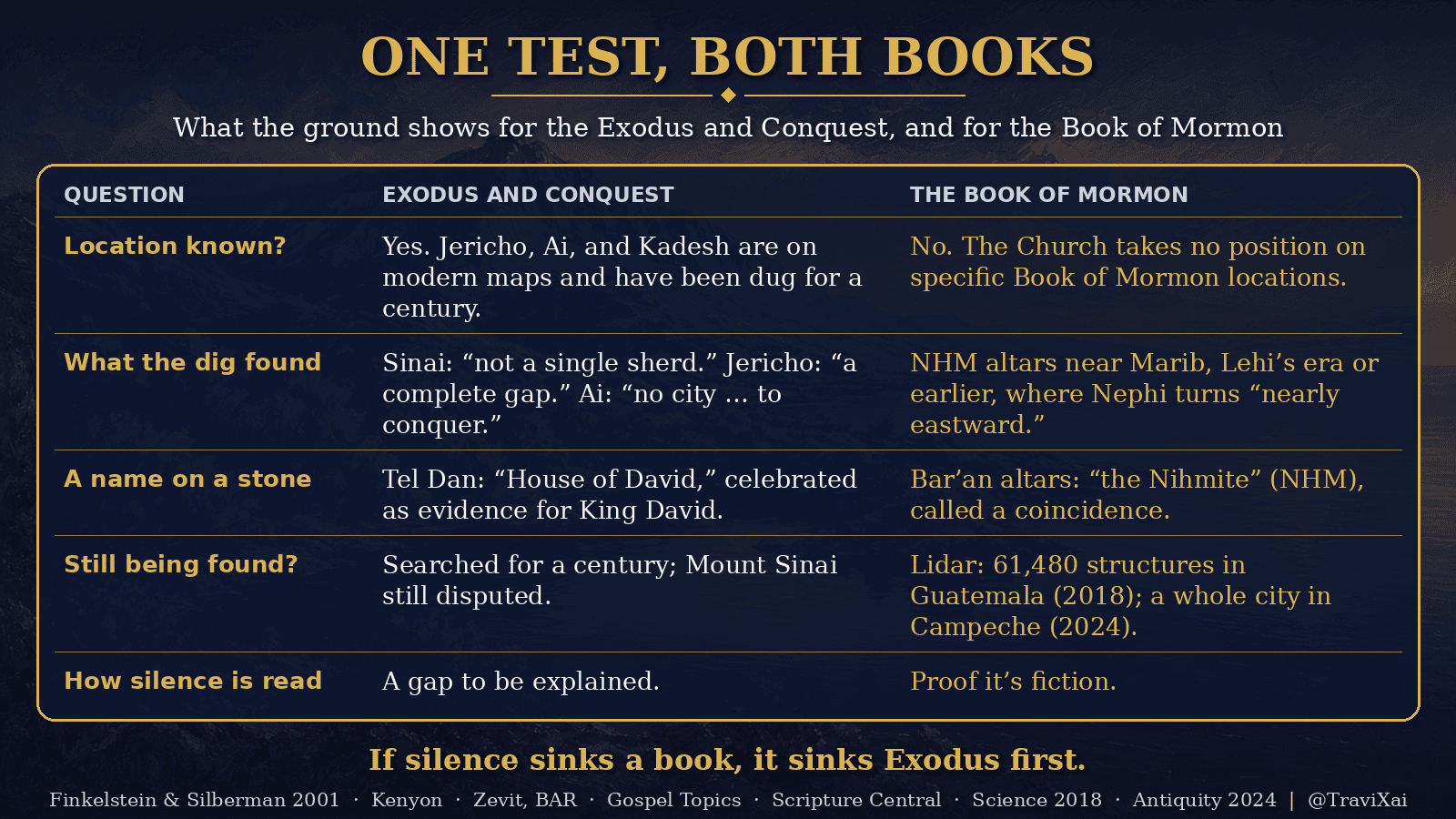
Here’s what’s buried under the argument. The critic starts with the Bible as true by default. When the ground is silent about the Exodus, silence is a gap to be explained. When the ground is silent about Zarahemla, silence is a verdict. The archaeology didn’t decide that. The starting assumption did: the Bible is presumed innocent, the Book of Mormon presumed guilty.
And the Bible has the easier test. Jericho, Ai, and Kadesh are on modern maps and have been dug for a century. Scholars still can’t agree on Mount Sinai. Herzog notes that some have tried to “discover” it “in the northern Hijaz or … at Mount Karkoum in the Negev.” You can’t demand a Zarahemla street sign while you’re still arguing which country holds Mount Sinai.
The Book of Mormon, by contrast, never ties its cities to a modern map. The Church’s “only position is that the events the Book of Mormon describes took place in the ancient Americas,” and it “does not take a position on the specific geographic locations” (Gospel Topics, “Book of Mormon Geography”). So the critic demands a dig report for cities with no agreed location, and excuses a missing nation at locations everyone agrees on.
Part VIWhat the ground has given the Book of Mormon
The book with “no archaeology” has a name carved in stone in the right place:
And it came to pass that Ishmael died, and was buried in the place which was called Nahom.
1 Nephi 16:34
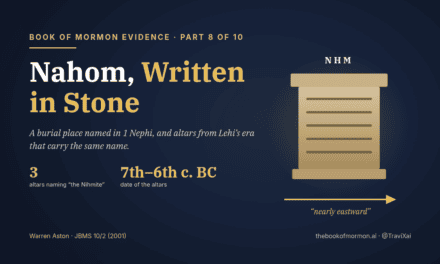
Then “we did travel nearly eastward from that time forth” (1 Nephi 17:1). In Yemen, the German Archaeological Institute excavated the Bar’an temple near Marib and found altars donated by a man called “the Nihmite,” carrying the tribal name NHM, dated to Lehi’s era or earlier, in the region where Nephi’s route turns east (Scripture Central). East of there, on the coast of Oman, sits a fertile inlet that fits Nephi’s Bountiful, “because of its much fruit and also wild honey” (1 Nephi 17:5). The full case is in Book of Mormon Evidence, Part 8: Nahom.
One name on one stone
Compare a find just like it. The Tel Dan Stele, found in 1993, is a broken basalt fragment written by an enemy king that mentions the “House of David.” The Jewish Museum says it “lends archaeological evidence to the existence of the Biblical King David as a historical figure” (The Jewish Museum). One name on one stone is a headline. NHM, in the right place at the right time, is a “coincidence.”
The Americas aren’t dug out
A lidar survey of northern Guatemala, published in Science in 2018, identified 61,480 ancient structures across 2,144 square kilometers (Canuto et al.), including fortifications and highways (National Geographic). In 2024 researchers found a whole Maya city in Campeche, Mexico, in lidar data collected to measure forest carbon. Lead author Luke Auld-Thomas: “The government never knew about it; the scientific community never knew about it. That really puts an exclamation point behind the statement that, no, we have not found everything” (Antiquity).
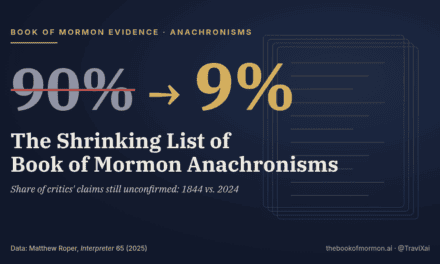
I’m not claiming those are Nephite cities. The point is the search isn’t finished, and the trend runs one way. Archaeologist John E. Clark checked sixty nineteenth-century criticisms of the book and “found that about 60 percent of those criticisms have been resolved in favor of the book” (BYU Studies 44, no. 4, 2005). The longer list is in The Shrinking List of Book of Mormon Anachronisms.
Part VIIHow I actually know
I believe Moses and Joshua. Latter-day Saints believe “the Bible to be the word of God as far as it is translated correctly” (Article of Faith 8). I don’t believe the Exodus because someone found a campsite. Nobody has. I believe it because God told me it’s true, the same way He told me the Book of Mormon is true.
That’s the Bible’s own standard: “faith is the substance of things hoped for, the evidence of things not seen” (Hebrews 11:1). And Moroni promises that if you ask “with real intent,” God “will manifest the truth of it unto you, by the power of the Holy Ghost” (Moroni 10:4).
My offer to any critic: if the empty Sinai and the empty mounds at Jericho and Ai don’t shake your faith in the Bible, stop using “no archaeology” against the Book of Mormon. If they do matter, apply them to Exodus first. One standard, not two.
SummaryKey takeaways
- Exodus has “six hundred thousand” men in the wilderness forty years. Sinai surveys found “not a single sherd … no trace of an ancient encampment.”
- Kenyon found “a complete gap” at Jericho, and at Ai “there was no city … for the Israelites to conquer.”
- Bible believers answer with erosion, re-dating, new sites, and “absence of evidence.” Critics mock those exact answers from Latter-day Saints.
- The Book of Mormon has NHM carved in stone where Nephi turns east, a Bountiful candidate in Oman, and a shrinking list of criticisms.
Next time someone tells you there’s no archaeology for the Book of Mormon, ask them where the Sinai campsites are. Then hand them 1 Nephi 16:34. For quick, sourced answers on “no archaeology”, Nahom and NHM, Book of Mormon geography, and Bible inerrancy, open Galatians18. And for more like this every day, follow me on X at @TraviXai.
Sources
- King James Bible (Church of Jesus Christ of Latter-day Saints edition): Matthew 7:5 · Exodus 12:37 · Numbers 14:33 · Deuteronomy 1:46 · Joshua 6:20 · Joshua 8:28 · Hebrews 11:1
- Book of Mormon and Pearl of Great Price: 1 Nephi 16:34 · 1 Nephi 17:1–5 · Moroni 10:4 · Article of Faith 8
- Israel Finkelstein and Neil Asher Silberman, The Bible Unearthed (Free Press, 2001), excerpted as “Phantom Wanderers” (Beliefnet)
- Ze’ev Herzog, “Deconstructing the Walls of Jericho”, Haaretz, October 29, 1999
- Bryant G. Wood, “Did the Israelites Conquer Jericho? A New Look at the Archaeological Evidence”, Biblical Archaeology Review 16, no. 2 (March/April 1990), quoting Kenyon
- Kathleen M. Kenyon, “Jericho”, Encyclopaedia Britannica
- Hendrik J. Bruins and Johannes van der Plicht, “Tell es-Sultan (Jericho): Radiocarbon Results of Short-Lived Cereal and Multiyear Charcoal Samples from the End of the Middle Bronze Age”, Radiocarbon 37, no. 2 (1995): 213–220
- Ziony Zevit, “The Problem of Ai”, Biblical Archaeology Review (BAS Library)
- Associates for Biblical Research, “Khirbet el-Maqatir: A Fortress in the Highlands of Canaan and Proposed New Site for Joshua’s Ai”
- Richard E. Averbeck, “The Reliability of the Old Testament” (The Gospel Coalition)
- Kenneth A. Kitchen, “The Patriarchal Age: Myth or History?”, Biblical Archaeology Review 21, no. 2 (March/April 1995)
- Gospel Topics, “Book of Mormon Geography”
- Scripture Central, “Nahom” (Book of Mormon Evidence)
- The Jewish Museum, “Tel Dan Stele” (exhibition, Dec. 2024–Jan. 2025)
- Marcello A. Canuto et al., “Ancient lowland Maya complexity as revealed by airborne laser scanning of northern Guatemala”, Science (2018); Tom Clynes, “Laser Scans Reveal Maya ‘Megalopolis’ Below Guatemalan Jungle”, National Geographic, February 1, 2018
- Antiquity, “Have we found all the major Maya cities? Not even close, new research suggests” (October 29, 2024)
- John E. Clark, “Archaeological Trends and Book of Mormon Origins”, BYU Studies 44, no. 4 (2005)
- Galatians18: No Archaeology? · Nahom (NHM) · Heartland vs. Mesoamerica · Is the Bible Infallible?
- Featured image and in-article graphics: original graphics by thebookofmormon.ai (painterly backgrounds; no photographs or likenesses of real people).