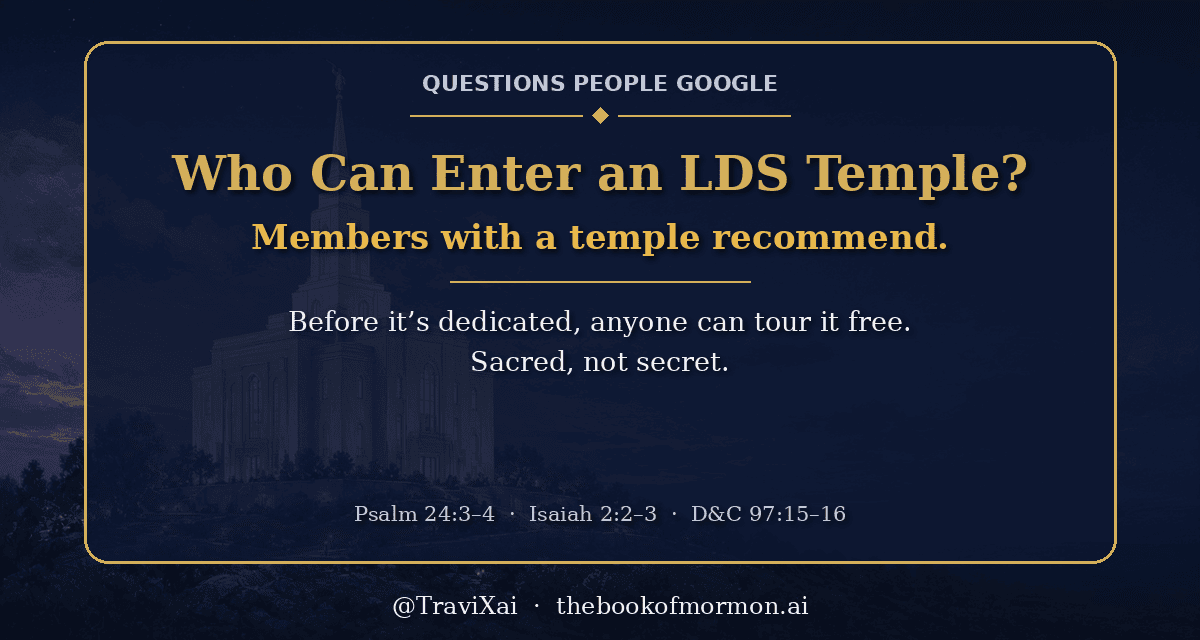

People see the beautiful buildings and wonder why they can’t walk in. Here’s who can, why the standard exists, and how anyone can see inside before a temple is dedicated.
Members of the Church with a current temple recommend can enter a dedicated temple. A recommend comes from interviews about faith in Jesus Christ and keeping His commandments. But anyone can tour a new temple for free during the public open house before it’s dedicated, and anyone can visit the grounds. The standard is biblical: “Who shall stand in his holy place? He that hath clean hands, and a pure heart” (Psalm 24:3–4).
The ruleWho can go inside
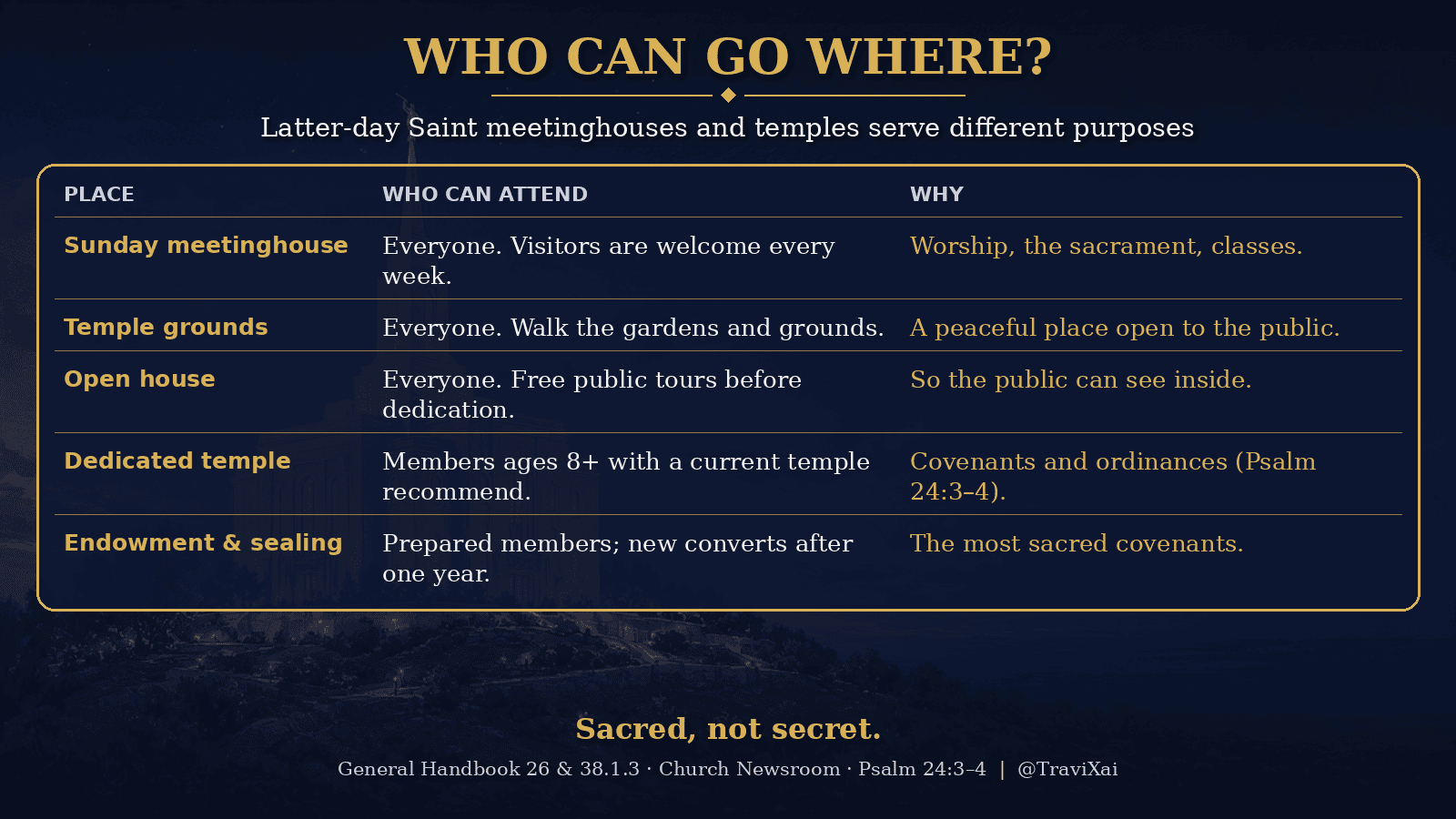
The Church’s General Handbook states the rule simply: “Because of this sacredness and the covenants made, only members of the Church with a current temple recommend may worship in the temple” (General Handbook 38.1.3). It adds, “Members ages 8 and older must have a current temple recommend to enter a temple” (General Handbook 26.0).
A temple recommend is a card (printed or on a phone) a member receives after interviews with local leaders. Members preparing for their own endowment or temple marriage are interviewed by their bishop and stake president. New converts can serve in the baptistry soon after baptism, but they wait a year after baptism before receiving the endowment or being sealed (Newsroom, “Temples”).
That isn’t the same as a meetinghouse. “All are welcome to attend sacrament meeting, other Sunday meetings, and social events,” says the same Handbook section. Anyone can walk the temple grounds. And before every new or renovated temple is dedicated, the public is invited inside.
Open houseAnyone can tour a temple before it’s dedicated
This surprises a lot of people. “When The Church of Jesus Christ of Latter-day Saints builds a new temple, the sacred building is opened for public tours. Anyone can attend this open house, which usually lasts a few weeks” (Newsroom, “Temple Open House”). Tours are free. A guide walks visitors through the main rooms, including the baptistry, instruction rooms, and sealing rooms, and explains what happens in each.
Open houses happen all the time. As I write this in November 2026, the Church lists open houses running for the Fort Worth Texas Temple and the Pago Pago American Samoa Temple, with more scheduled in 2027, including the renovated Salt Lake Temple (Newsroom, open house and dedication dates). If you want to see the inside of a temple, check that list and go. You’ll be welcome.
A Church that’s hiding something doesn’t give the public guided tours of every room. The point of the recommend isn’t secrecy. It’s sacredness.
The BibleThe Bible always limited who could enter God’s house
Restricted entry to God’s house isn’t a Latter-day Saint invention. It runs all through the Bible. David asked:
Who shall ascend into the hill of the Lord? or who shall stand in his holy place? He that hath clean hands, and a pure heart; who hath not lifted up his soul unto vanity, nor sworn deceitfully.
Psalm 24:3–4
The Church’s Handbook cites that very psalm for the temple recommend. In the tabernacle, even Aaron could not “come … at all times into the holy place within the veil” (Leviticus 16:2). Hebrews recalls that “into the second went the high priest alone once every year” (Hebrews 9:7). When King Uzziah forced his way into the temple to burn incense, “the leprosy even rose up in his forehead” (2 Chronicles 26:16, 19); I covered that story in Priesthood Authority: Korah, Uzziah, and Hebrews 5:4. Ezekiel’s vision of the future temple says, “No stranger, uncircumcised in heart … shall enter into my sanctuary” (Ezekiel 44:9).
Jesus Himself honored the temple as holy. He called it “my Father’s house” and drove out those who treated it as “an house of merchandise” (John 2:16). After His resurrection, Peter and John still “went up together into the temple at the hour of prayer” (Acts 3:1), and Paul purified himself before he “entered into the temple” (Acts 21:26).
The reasonWhy the standard: covenants and God’s presence
The Lord’s first reason for a sanctuary was His presence: “let them make me a sanctuary; that I may dwell among them” (Exodus 25:8). Modern revelation repeats the promise, with a condition:
And inasmuch as my people build a house unto me in the name of the Lord, and do not suffer any unclean thing to come into it, that it be not defiled, my glory shall rest upon it; Yea, and my presence shall be there, for I will come into it, and all the pure in heart that shall come into it shall see God.
D&C 97:15–16
That’s why the recommend interview asks about faith and conduct. The first questions are about Christ: “Do you have faith in and a testimony of God, the Eternal Father; His Son, Jesus Christ; and the Holy Ghost?” and “Do you have a testimony of the Atonement of Jesus Christ and of His role as your Savior and Redeemer?” Others ask about the law of chastity, honesty, tithing, the Word of Wisdom, and sustaining Church leaders (General Handbook 26.4.1). They’re the same commitments members already make. The temple asks members to be keeping them.
Inside, members make covenants with God and receive ordinances: the endowment, temple marriage (sealing), and ordinances for ancestors who died without them, including baptism for the dead. The Church describes the endowment as focused on “the Savior, His role in Heavenly Father’s plan, and the personal commitment of each member to follow Him” (Newsroom). Members wear white inside and, after the endowment, wear the temple garment.
Isaiah 2 · NephiTemples in the last days, and in the Book of Mormon
Isaiah saw temples in the last days: “the mountain of the Lord’s house shall be established in the top of the mountains … and all nations shall flow unto it,” and people would say, “let us go up to the mountain of the Lord, to the house of the God of Jacob; and he will teach us of his ways” (Isaiah 2:2–3). John saw the redeemed who “serve him day and night in his temple” (Revelation 7:15).
The Book of Mormon people built temples too. Nephi “did build a temple; and I did construct it after the manner of the temple of Solomon” (2 Nephi 5:16). When the risen Christ came to the Americas, the people were gathered “round about the temple which was in the land Bountiful” (3 Nephi 11:1). And in the Kirtland Temple in 1836, Joseph Smith and Oliver Cowdery recorded the Lord saying, “I have accepted this house, and my name shall be here” (D&C 110:7).
Today the Church lists 385 temples dedicated, under construction, or announced, with 229 dedicated (Newsroom, November 2026). Isaiah’s “all nations shall flow unto it” is happening in plain sight.
WeddingsWhat about family members at temple weddings?
This is the hardest part for many families, and the Church has addressed it. In 2019 the First Presidency ended the old one-year wait after a civil wedding: “Where a licensed marriage is not permitted in the temple, or when a temple marriage would cause parents or immediate family members to feel excluded, a civil ceremony followed by a temple sealing is authorized” (Newsroom, May 6, 2019).
So a couple can hold a civil ceremony that everyone attends, then be sealed in the temple. Many families also gather on the temple grounds for photos after the sealing.
Check the premiseThe presuppositions baked into the question
Before this question can be answered fairly, the person asking has to justify a few assumptions packed inside it:
- That restricted means secret. The Church gives free public tours of every new temple and publishes the recommend questions in its Handbook. Jesus said, “Give not that which is holy unto the dogs” (Matthew 7:6). Guarding what’s holy isn’t hiding it.
- That a true church would let anyone into every room. God’s house in the Bible never worked that way. Only priests served in the holy place, only the high priest entered within the veil, and only once a year (Leviticus 16:2; Hebrews 9:7). Psalm 24:3–4 asks who may stand in His holy place.
- That Isaiah 56:7 (“an house of prayer for all people”) means no standards. The same verse says God will bring people “to my holy mountain” and accept their offerings, under the covenant terms of the chapter (Isaiah 56:4–6). All people are invited to prepare and enter. That’s exactly what the recommend is for.
- That temple worship replaces Jesus. The first recommend questions are about faith in Jesus Christ and His Atonement, and the endowment “focuses on the Savior.” The temple is His house (John 2:16).
FAQQuick answers
Who can enter an LDS temple?
After a temple is dedicated, members of The Church of Jesus Christ of Latter-day Saints with a current temple recommend may enter. The General Handbook says members ages 8 and older need a recommend. Before dedication, anyone can tour the temple free during a public open house.
Can non-members go inside an LDS temple?
Yes, during the public open house held before a new or renovated temple is dedicated. Tours are free and visit the main rooms. After dedication, only members with a temple recommend may enter, though anyone can visit the grounds.
What is a temple recommend?
A temple recommend is a card a member receives after interviews with local Church leaders confirming faith in Jesus Christ and obedience to commandments such as the law of chastity, honesty, tithing, and the Word of Wisdom.
Why can’t everyone go into LDS temples?
Latter-day Saints believe temples are houses of the Lord where sacred covenants are made. As in the Bible, where only those prepared could enter the holy place (Psalm 24:3–4; Leviticus 16:2), entry is reserved for members who are keeping those commitments.
Can non-member family attend an LDS temple wedding?
Not inside the temple, but since 2019 couples may hold a civil ceremony that family attends and then be sealed in the temple, with no waiting period.
Why do Latter-day Saints build temples?
Temples are houses of the Lord, where ordinances such as the endowment, eternal marriage and baptism for the dead are performed. Isaiah foresaw people saying, “let us go up to the mountain of the LORD, to the house of the God of Jacob” (Isaiah 2:3).
Can anyone tour a new LDS temple?
Yes. Before a temple is dedicated, the Church holds a public open house, and anyone can walk through. Temple grounds and visitors’ centers stay open to the public after dedication.
At what age can Latter-day Saints enter the temple?
Youth may enter for baptisms for the dead beginning in January of the year they turn 12. Adults, usually 18 or older, may receive their own endowment once they are prepared.
SummaryKey takeaways
- After dedication, temples are for members with a current temple recommend; meetinghouses are open to everyone.
- Anyone can tour a new or renovated temple free during its public open house.
- Restricted entry to God’s house is biblical (Psalm 24:3–4; Leviticus 16:2; Hebrews 9:7).
- The recommend interview starts with faith in Jesus Christ and His Atonement. Temples are sacred, not secret.
Find an open house near you and take a friend. Then read Psalm 24 together on the way home. For quick, sourced answers, open Galatians18, and follow me on X at @TraviXai.
Sources
- King James Bible (churchofjesuschrist.org): Exodus 25:8 · Leviticus 16:2 · 2 Chronicles 26:16–19 · Psalm 24:3–4 · Isaiah 2:2–3 · Isaiah 56:4–7 · Ezekiel 44:9 · Matthew 7:6 · John 2:16 · Acts 3:1 · Acts 21:26 · Hebrews 9:7 · Revelation 7:15
- Book of Mormon: 2 Nephi 5:16 · 3 Nephi 11:1
- Doctrine and Covenants: D&C 97:15–16 · D&C 110:7
- General Handbook, 26 “Temple Recommends” (26.0, 26.4.1) · General Handbook 38.1.3 “Temple Worship”
- “Temples,” Church Newsroom · “Temple Open House,” Church Newsroom · “Temple Open House, Dedications and Rededication Dates,” Church Newsroom (accessed Nov. 11, 2026)
- “Couples Married Civilly Now Authorized for Immediate Temple Marriage,” Church Newsroom, May 6, 2019
- Featured image and in-article graphic: original graphics by thebookofmormon.ai (painterly backgrounds; no photographs or likenesses of real people).