
Ten percent can sound like a lot. Here’s why Latter-day Saints give it gladly, from all four standard works.
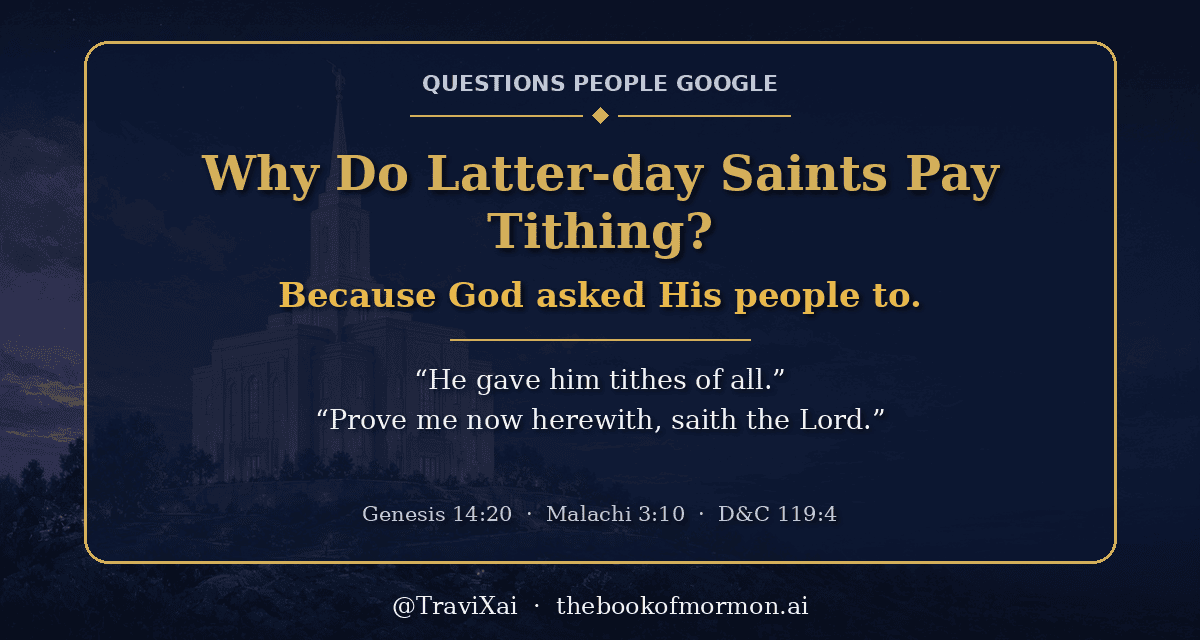
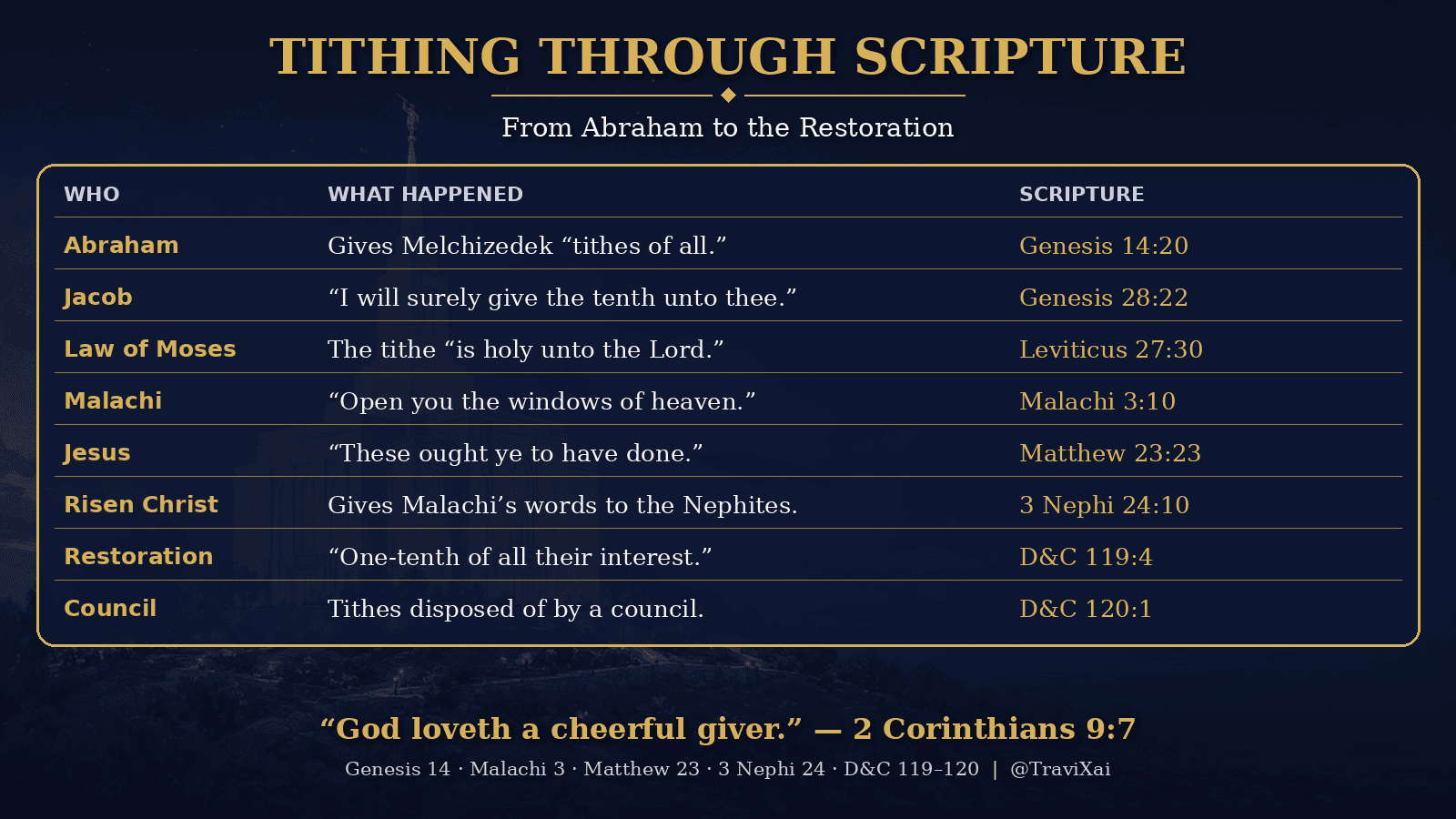
Latter-day Saints pay tithing, one-tenth of their income, because God commanded it. Abraham gave Melchizedek “tithes of all” (Genesis 14:20). Malachi promised the “windows of heaven” (Malachi 3:10). Jesus said tithing “ought ye to have done” (Matthew 23:23). The risen Christ gave Malachi’s words to the Nephites (3 Nephi 24). God restored the law in 1838: “one-tenth of all their interest annually” (D&C 119:4). The money builds temples and meetinghouses and supports missionary work and education. It doesn’t pay local leaders.
The short versionWhat tithing is
The Church’s Topics and Questions entry on tithing puts it simply: “To fulfill this commandment, Church members give one-tenth of their income to the Lord through His Church” (Tithing). It adds that “by paying tithing, Church members show their gratitude to God for their blessings and their resolve to trust in the Lord rather than in material things.”
So the plain answer is that Latter-day Saints pay tithing because God asked His people to. The Bible shows them doing it, the Book of Mormon repeats it, and God restored it through Joseph Smith. It’s an act of faith and gratitude. It isn’t a membership fee.
Old TestamentTithing came before the law of Moses
The first tithe in the Bible came centuries before Sinai. When Abram met Melchizedek, “the priest of the most high God,” Melchizedek blessed him, “and he gave him tithes of all” (Genesis 14:18–20). Hebrews repeats it: “To whom also Abraham gave a tenth part of all” (Hebrews 7:1–2). The Book of Mormon adds that “even our father Abraham paid tithes of one-tenth part of all he possessed” (Alma 13:15).
His grandson Jacob made the same promise at Bethel: “of all that thou shalt give me I will surely give the tenth unto thee” (Genesis 28:22). Later the law of Moses declared, “all the tithe of the land … is the Lord’s: it is holy unto the Lord” (Leviticus 27:30).
Because tithing came before Moses, saying it ended with the law of Moses doesn’t work. Abraham, the father of the faithful, paid it before that law existed. In the Pearl of Great Price, Abraham describes himself as one “desiring … to be a greater follower of righteousness … and to keep the commandments of God” (Abraham 1:2). Paying tithes to the Lord’s high priest is what that kind of man does.
Malachi 3“Will a man rob God?”
Malachi gave the best-known passage on tithing: “Will a man rob God? Yet ye have robbed me. But ye say, Wherein have we robbed thee? In tithes and offerings” (Malachi 3:8). Then comes the promise: “Bring ye all the tithes into the storehouse, that there may be meat in mine house, and prove me now herewith, saith the Lord of hosts, if I will not open you the windows of heaven, and pour you out a blessing, that there shall not be room enough to receive it” (Malachi 3:10).
The Book of Mormon shows that the risen Jesus Christ gave these same words to the Nephites, so they would have them too (3 Nephi 24:8–10). After His Resurrection, the Lord Himself repeated Malachi’s call to bring the tithes into the storehouse.
New TestamentWhat Jesus said about tithing
Some Christians say the New Testament never asks for tithing. But when Jesus rebuked the Pharisees, He didn’t tell them to stop tithing. He said: “ye pay tithe of mint and anise and cummin, and have omitted the weightier matters of the law, judgment, mercy, and faith: these ought ye to have done, and not to leave the other undone” (Matthew 23:23). Tithing and mercy, not one instead of the other.
Jesus praised the poor widow who gave two mites, because “she of her penury hath cast in all the living that she had” (Luke 21:1–4). Paul taught the spirit of giving: “Every man according as he purposeth in his heart, so let him give; not grudgingly, or of necessity: for God loveth a cheerful giver” (2 Corinthians 9:6–7). Latter-day Saints try to pay tithing that way, gladly and as an offering of the heart.
D&C 119–120How God restored the law of tithing
On July 8, 1838, the Lord revealed to Joseph Smith: “this shall be the beginning of the tithing of my people. And after that, those who have thus been tithed shall pay one-tenth of all their interest annually; and this shall be a standing law unto them forever, for my holy priesthood, saith the Lord” (D&C 119:3–4). The Church understands “interest” as income.
The next revelation set how the funds would be handled: “it shall be disposed of by a council, composed of the First Presidency of my Church, and of the bishop and his council, and by my high council; and by mine own voice unto them” (D&C 120:1). Today the Church explains that this council is “comprised of the First Presidency, the Quorum of the Twelve Apostles, and the Presiding Bishopric” (Tithing).
Earlier, the Lord had called this “a day of sacrifice, and a day for the tithing of my people” (D&C 64:23).
Where it goesWhat tithing pays for
The Church says “tithing funds are always used for the Lord’s purposes—to build and maintain temples and meetinghouses, to sustain missionary work, to educate Church members, and to carry on the work of the Lord throughout the world” (Tithing). Members give their tithing to local leaders, who send it “directly to the headquarters of the Church.”
It doesn’t pay local leaders. Bishops and stake presidents serve without pay (see Do LDS bishops get paid?). Paying tithing is between each member and God. The temple recommend interview asks, “Are you a full-tithe payer?” (General Handbook 26), and the member answers that question honestly. Nobody inspects their bank account.
Check the premiseThe presuppositions baked into the question
Before this question can be answered fairly, the person asking has to justify a few assumptions packed inside it:
- That tithing is a fee to join the Church. Baptism isn’t sold. Tithing is a commandment members choose to keep, out of gratitude and faith (Topics and Questions, “Tithing”).
- That tithing was only part of the law of Moses. Abraham paid tithes to Melchizedek before Moses was born (Genesis 14:20; Hebrews 7:2; Alma 13:15).
- That Jesus did away with tithing. Jesus said of tithing, “these ought ye to have done, and not to leave the other undone” (Matthew 23:23).
- That tithing pays local pastors. Local leaders aren’t paid. A council directed by revelation decides how tithes are used (D&C 120:1).
FAQQuick answers
Why do Latter-day Saints pay tithing?
Because God commanded it, from Abraham’s tithe to Melchizedek (Genesis 14:20) to Malachi 3:10 and the restored law in D&C 119:4. Members give one-tenth of their income as an act of faith and gratitude.
How much is tithing in the Church of Jesus Christ?
One-tenth. D&C 119:4 says “one-tenth of all their interest annually,” which the Church explains as one-tenth of income.
Is tithing in the Bible?
Yes. Genesis 14:20, Genesis 28:22, Leviticus 27:30 and Malachi 3:8–10 all teach it, and Jesus affirmed it in Matthew 23:23.
Who decides how tithing is spent?
A council of the First Presidency, the Quorum of the Twelve Apostles and the Presiding Bishopric, as D&C 120:1 directs. Funds build temples and meetinghouses, support missionary work and education, and carry on the Lord’s work.
Do you have to pay tithing to go to the temple?
Yes. One of the temple recommend interview questions is “Are you a full-tithe payer?” (General Handbook 26). Members answer it themselves.
What does Malachi 3:10 say about tithing?
“Bring ye all the tithes into the storehouse, that there may be meat in mine house, and prove me now herewith, saith the LORD of hosts, if I will not open you the windows of heaven” (Malachi 3:10).
What does the Doctrine and Covenants say about tithing?
In 1838 the Lord asked the Saints to pay “one-tenth of all their interest annually,” calling it “a standing law unto them forever” (D&C 119:4).
What is tithing used for?
Building and maintaining temples and meetinghouses, missionary work, education, and running Church programs worldwide. Help for the poor is funded mainly by separate fast offerings.
SummaryKey takeaways
- Tithing came before the law of Moses: Abraham paid it to Melchizedek (Genesis 14:20; Alma 13:15).
- Jesus affirmed tithing alongside mercy and faith (Matthew 23:23).
- God restored tithing as one-tenth of income (D&C 119:4), and a council decides how it’s used (D&C 120:1).
- It builds temples, supports missionaries and education, and is given in faith, not as a fee.
Read Malachi 3 and D&C 119 side by side. For quick, sourced answers, open Galatians18, and follow me on X at @TraviXai.
Sources
- King James Bible (churchofjesuschrist.org): Genesis 14:18–20 · Genesis 28:22 · Leviticus 27:30 · Malachi 3:8–10 · Matthew 23:23 · Luke 21:1–4 · 2 Corinthians 9:6–7 · Hebrews 7:1–2
- Book of Mormon: Alma 13:15 · 3 Nephi 24:8–10
- Pearl of Great Price: Abraham 1:2
- Doctrine and Covenants: D&C 64:23 · D&C 119:1–4 · D&C 120:1
- “Tithing,” Topics and Questions, churchofjesuschrist.org
- General Handbook 26, Temple Recommends
- Featured image and in-article graphic: original graphics by thebookofmormon.ai (painterly backgrounds; no photographs or likenesses of real people).