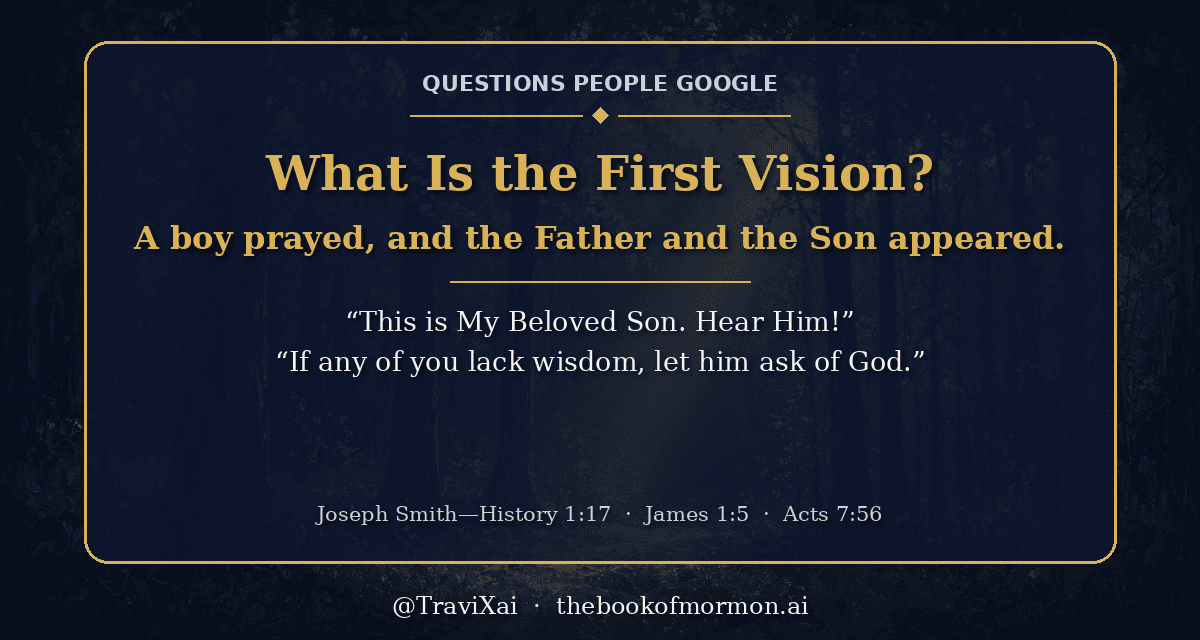

It’s the event the whole Restoration rests on. Here’s what happened in the grove, in Joseph Smith’s own words, and what it reveals about God.
The First Vision is the 1820 appearance of God the Father and Jesus Christ to 14-year-old Joseph Smith. Confused by competing churches, he read James 1:5 and went into a grove near his home in western New York to pray. After a moment of thick darkness, a pillar of light descended and he saw “two Personages.” One said, pointing to the other, “This is My Beloved Son. Hear Him!” (Joseph Smith—History 1:17). He was told to join none of the churches. It revealed that the Father and Son are real, separate, glorified Beings who answer prayer.
The short answerGod the Father and Jesus Christ appeared to a boy
The First Vision is the event that began the Restoration. In the spring of 1820, Joseph Smith, 14, went into a grove of trees near his family’s farm in Manchester, New York, to ask God which church to join. He wrote: “I saw two Personages, whose brightness and glory defy all description, standing above me in the air. One of them spake unto me, calling me by name and said, pointing to the other—This is My Beloved Son. Hear Him!” (Joseph Smith—History 1:17).
The Church’s Gospel Topics essay summarizes: “Joseph Smith recorded that God the Father and Jesus Christ appeared to him in a grove of trees near his parents’ home in western New York State when he was about 14 years old” (First Vision Accounts). The place is now called the Sacred Grove.
Why he prayed“A war of words and tumult of opinions”
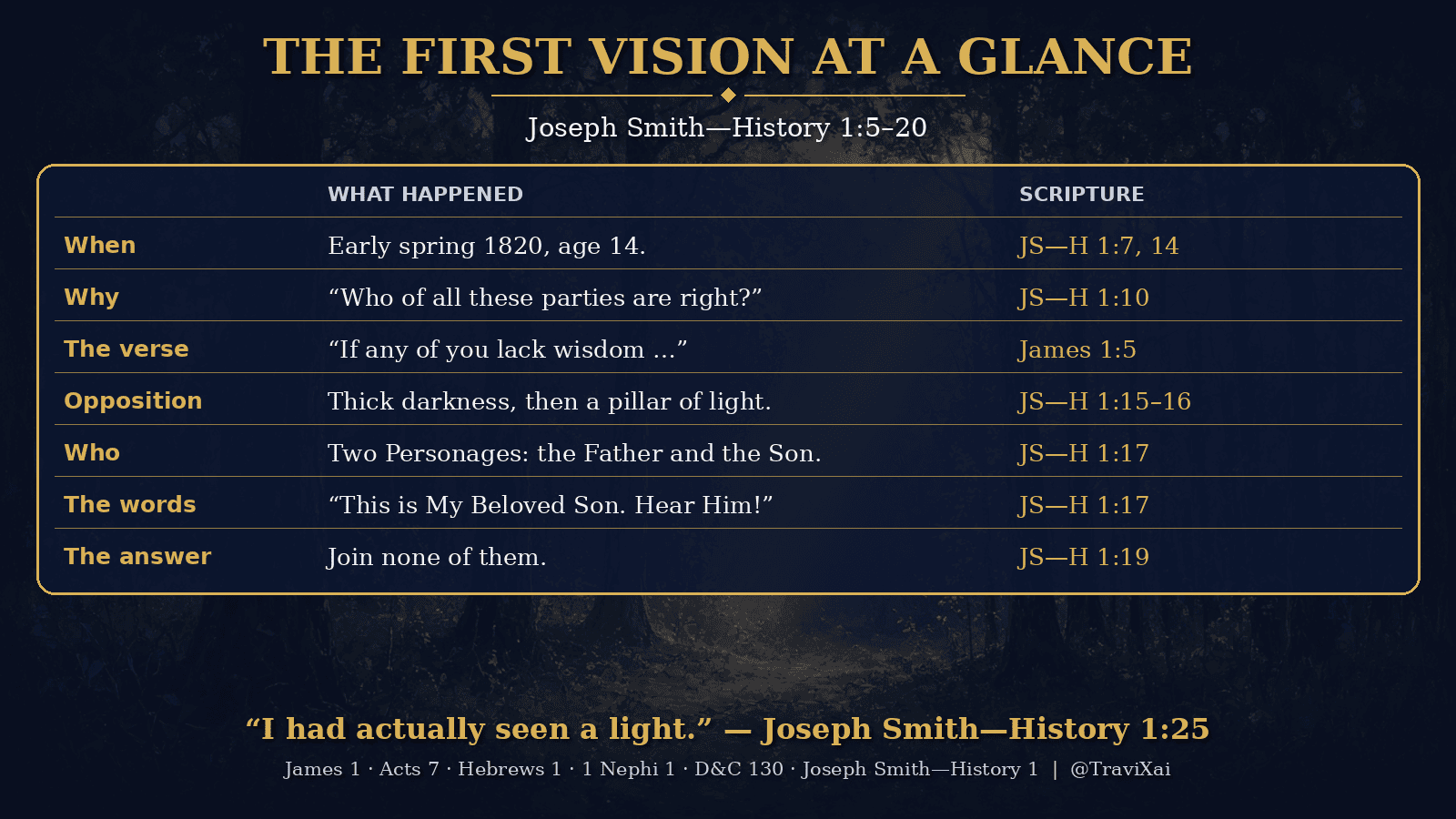
Western New York was swept by religious revivals. Joseph described “an unusual excitement on the subject of religion,” with “some crying, ‘Lo, here!’ and others, ‘Lo, there!’” (Joseph Smith—History 1:5). Part of his family had joined the Presbyterians (1:7). He wrote, “In the midst of this war of words and tumult of opinions, I often said to myself: What is to be done? Who of all these parties are right; or, are they all wrong together?” (1:10).
Then he read James: “If any of you lack wisdom, let him ask of God, that giveth to all men liberally, and upbraideth not; and it shall be given him” (James 1:5). “Never did any passage of scripture come with more power to the heart of man than this did at this time to mine,” he wrote, because the preachers “understood the same passages of scripture so differently as to destroy all confidence in settling the question by an appeal to the Bible” (Joseph Smith—History 1:12).
In the groveDarkness, then light
“It was on the morning of a beautiful, clear day, early in the spring of eighteen hundred and twenty” (1:14). As he began to pray, “thick darkness gathered around me,” and he felt seized by “the power of some actual being from the unseen world.” Then, “just at this moment of great alarm, I saw a pillar of light exactly over my head, above the brightness of the sun, which descended gradually until it fell upon me” (1:15–16).
He saw the Father and the Son. When he asked which church to join, “I was answered that I must join none of them, for they were all wrong,” and the Lord quoted Isaiah: “they draw near to me with their lips, but their hearts are far from me, they teach for doctrines the commandments of men” (1:19; compare Isaiah 29:13). That was a judgment on creeds, not on the sincere people in those churches. When he got home, he told his mother, “I have learned for myself that Presbyterianism is not true” (1:20).
What it teaches about GodThe Father and the Son are real, separate and glorified
The First Vision overturned centuries of speculation. Joseph saw two distinct Persons, just as Stephen did when he “saw the glory of God, and Jesus standing on the right hand of God” (Acts 7:55–56). The Son is “the express image of his person” (Hebrews 1:3). Later revelation states it plainly: “The Father has a body of flesh and bones as tangible as man’s; the Son also” (D&C 130:22).
Everything Joseph later taught about God grew from that morning. In 1844 he said: “God himself was once as we are now, and is an exalted man, and sits enthroned in yonder heavens!” and that His children must “learn how to be gods yourselves … from grace to grace, from exaltation to exaltation” (History of the Church 6:305–306). Our Father in Heaven is a glorified, perfected Man, and His children can grow to become like Him while always remaining His children. As Jesus said, “this is life eternal, that they might know thee the only true God, and Jesus Christ, whom thou hast sent” (John 17:3). See Was God Once a Man?.
A biblical patternProphets begin with a vision of God
Joseph’s experience follows the pattern of ancient prophets. The Book of Mormon opens with Lehi praying, after which “there came a pillar of fire,” and “he saw the heavens open, and he thought he saw God sitting upon his throne” (1 Nephi 1:6–8). Lehi’s ancestor Joseph of Egypt foretold “a choice seer” who would “be called after me; and it shall be after the name of his father” (2 Nephi 3:7; 3:15). Joseph Smith was named after his father, Joseph Smith Sr.
Like Paul, who said, “I was not disobedient unto the heavenly vision” (Acts 26:19), Joseph never backed down: “I had actually seen a light, and in the midst of that light I saw two Personages, and they did in reality speak to me … I knew it, and I knew that God knew it, and I could not deny it” (Joseph Smith—History 1:25).
The accountsWhy there’s more than one version
Joseph “wrote or assigned scribes to write four different accounts of the vision,” in 1832, 1835, 1838 and 1842, and five more descriptions come from people who heard him tell it (First Vision Accounts). The 1832 account, in his own handwriting, emphasizes forgiveness: “the Lord” appeared and forgave his sins. The revelation on Church organization also mentions it: “it was truly manifested unto this first elder that he had received a remission of his sins” (D&C 20:5).
Critics say the differences prove it was made up. But the Bible gives three accounts of Paul’s vision that differ in detail too (Acts 9, 22, 26). The essay puts it well: “the rich historical record enables us to learn more about this remarkable event than we could if it were less well documented.” We compare them in First Vision Accounts and Paul’s Damascus Road.
Check the premiseThe presuppositions baked into the question
Before this question can be answered fairly, the person asking has to justify a few assumptions packed inside it:
- That the First Vision was a later invention. D&C 20:5 (1830) refers to it, and Joseph’s handwritten 1832 account describes it (Gospel Topics essay).
- That different accounts mean it didn’t happen. Paul’s vision has three accounts in Acts that differ in detail (Acts 9; 22; 26).
- That God told Joseph all Christians were bad people. The rebuke was of creeds and of “commandments of men,” quoting Isaiah 29:13 (Joseph Smith—History 1:19).
- That God is an unknowable essence. Joseph saw the Father and the Son as glorified Persons (Joseph Smith—History 1:17; D&C 130:22; Acts 7:56).
FAQQuick answers
What is the First Vision?
The 1820 appearance of God the Father and Jesus Christ to 14-year-old Joseph Smith in a grove near Manchester, New York, in answer to his prayer about which church to join (Joseph Smith—History 1:14–20).
What did God say in the First Vision?
The Father said, “This is My Beloved Son. Hear Him!” The Son told Joseph to join none of the churches of the day (Joseph Smith—History 1:17–19).
How old was Joseph Smith at the First Vision?
He was 14, “in my fifteenth year” (Joseph Smith—History 1:7).
How many accounts of the First Vision are there?
Joseph Smith wrote or dictated four accounts (1832, 1835, 1838 and 1842), and five more were recorded by people who heard him.
Where is the Sacred Grove?
Near the Smith family farm in Manchester (Palmyra area), western New York.
Why did Joseph Smith go to the grove to pray?
Because of James 1:5. He wrote, “Never did any passage of scripture come with more power to the heart of man than this did at this time to mine” (Joseph Smith—History 1:12).
What did the First Vision show about God?
That the Father and the Son are two distinct beings. Joseph wrote, “I saw two Personages, whose brightness and glory defy all description” (Joseph Smith—History 1:17).
Why do the First Vision accounts differ?
Each was told to a different audience for a different purpose, as Paul’s three accounts of his vision on the road to Damascus differ in detail (Acts 9, 22 and 26). The core is the same in every account: Joseph prayed and the Lord appeared to him.
SummaryKey takeaways
- In spring 1820, Joseph Smith, 14, prayed in a grove after reading James 1:5.
- He saw God the Father and Jesus Christ: “This is My Beloved Son. Hear Him!”
- It revealed that the Father and Son are separate, glorified Beings (D&C 130:22).
- Joseph recorded four accounts; like Paul’s, they differ in detail but tell one story.
Read Joseph Smith—History 1:5–20 for yourself, then try James 1:5. For quick, sourced answers, open Galatians18, and follow me on X at @TraviXai.
Sources
- King James Bible (churchofjesuschrist.org): Isaiah 29:13 · John 17:3 · Acts 7:55–56 · Acts 26:19 · Hebrews 1:3 · James 1:5
- Book of Mormon: 1 Nephi 1:6–8 · 2 Nephi 3:7 · 2 Nephi 3:15
- Doctrine and Covenants: D&C 20:5 · D&C 130:22
- Pearl of Great Price: Joseph Smith—History 1:5–25
- “First Vision Accounts,” Gospel Topics Essays
- History of the Church 6:305–306 (King Follett discourse), BYU Studies
- Featured image and in-article graphic: original graphics by thebookofmormon.ai (painterly backgrounds; no photographs or likenesses of real people).