
Critics line up Joseph Smith’s First Vision accounts, circle every difference, and call it fraud. The Bible tells Paul’s Damascus road vision three times, and those accounts don’t match either. Here they are side by side.
“Joseph Smith’s story keeps changing.” That’s one of the most common lines I see about the First Vision. Critics line up the 1832, 1835, 1838, and 1842 accounts, circle every difference, and announce that he made it up. Fine. Let’s use that standard. Now open your Bible to Acts 9, 22, and 26.
When I was 21, I got in a bad car wreck. Right after it happened, I told my boss, “I got in a wreck, I won’t be able to make it in.” That night my family got the truck that turned left in front of me and the Hummer that hit me after I spun. The insurance company got the street names, the wet roads, and exactly where I hit his truck. Weeks later I remembered I’d been on my way home from McDonald’s and never got to eat my McGriddle. Every one of those stories was true. As I put it on X, if it was a lie, it would have been a single memorized statement, and nothing would have changed.
Exhibit APaul told it three times
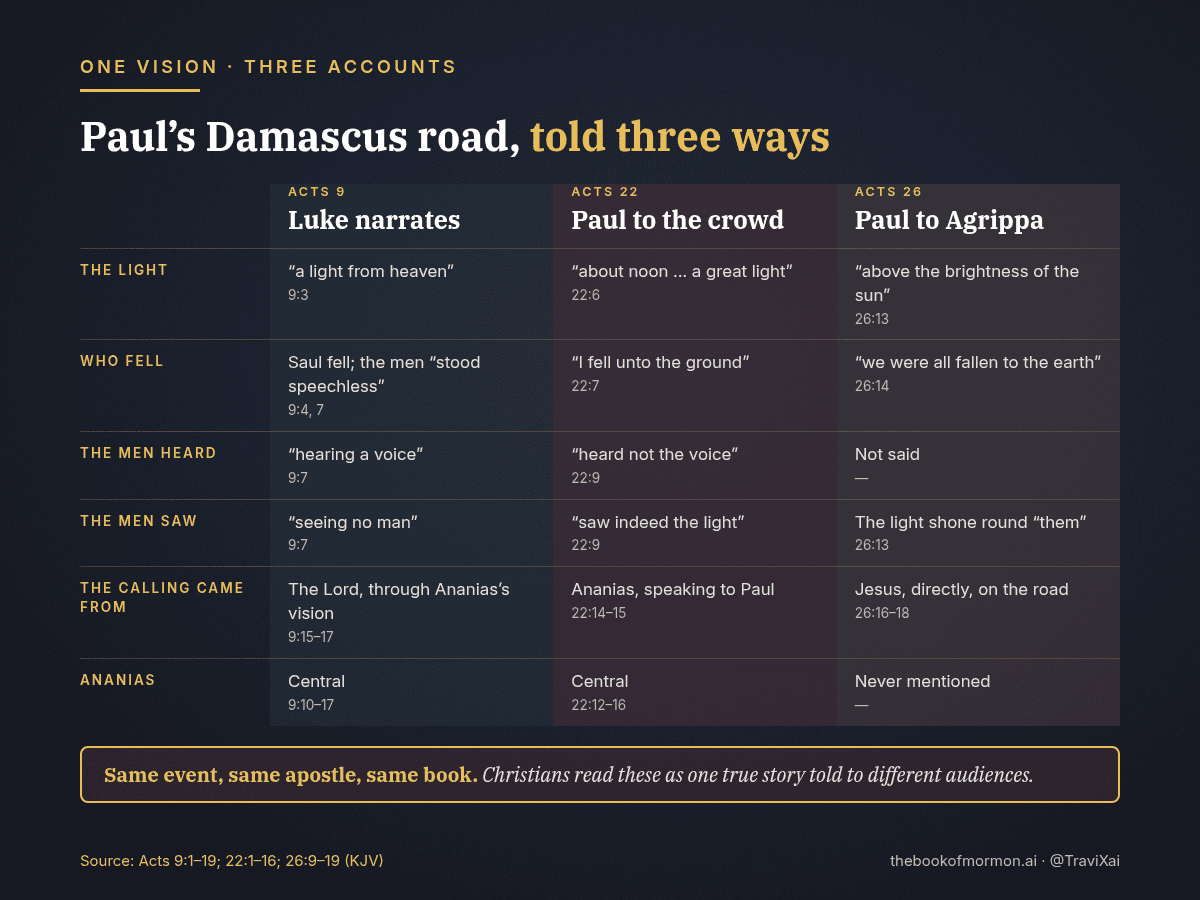
The Bible gives us three accounts of the same vision, all in the same book, written by the same author. Luke narrates it first in Acts 9. Then he records Paul telling it himself twice: once to an angry crowd in Jerusalem in Acts 22, and again, at least two years later (Acts 24:27), to King Agrippa in Acts 26.
The core never moves. A light from heaven, a voice saying “Saul, Saul, why persecutest thou me?”, and the answer, “I am Jesus.” But look at how the details shift. In Acts 9 it’s “a light from heaven.” In Acts 22 it’s “about noon” and “a great light.” By Acts 26 it’s this:
At midday, O king, I saw in the way a light from heaven, above the brightness of the sun, shining round about me and them which journeyed with me.
Acts 26:13 (KJV)
Who gave Paul his calling?
This one is bigger than a sensory detail. In Acts 9, Jesus tells Saul to “go into the city, and it shall be told thee what thou must do” (Acts 9:6). The calling comes to Ananias in his own vision: “he is a chosen vessel unto me, to bear my name before the Gentiles” (Acts 9:15). In Acts 22, Ananias delivers it in person: “The God of our fathers hath chosen thee” (Acts 22:14–15).
Then in Acts 26, Ananias isn’t mentioned at all. Jesus gives the whole commission Himself, right there on the road: “I have appeared unto thee for this purpose, to make thee a minister and a witness” (Acts 26:16), sending him to the Gentiles “to open their eyes, and to turn them from darkness to light” (Acts 26:17–18). Same event, but the messenger changes depending on which telling you read.
The hard oneDid they hear the voice or not?
Here’s the difference Bible skeptics love to point at. Luke says the men with Paul heard the voice:
And the men which journeyed with him stood speechless, hearing a voice, but seeing no man.
Acts 9:7 (KJV)
Paul says they didn’t:
And they that were with me saw indeed the light, and were afraid; but they heard not the voice of him that spake to me.
Acts 22:9 (KJV)
And the men who “stood speechless” in Acts 9 are on the ground in Acts 26: “when we were all fallen to the earth” (Acts 26:14).
The usual fix
Christians answer this one with Greek grammar and common sense. The men heard a sound but didn’t understand the words. They fell, then got back up. Some modern translations bake the explanation right into the text. The ESV renders Acts 22:9 as “did not understand the voice of the one who was speaking to me.”
I’m fine with that. I believe Paul. But notice what that explanation is. It assumes Paul is honest, then reads every account in light of the others and the audience he was talking to. Nobody says Paul’s story “evolved” or that Luke caught him in a lie. That’s called a charitable reading, and it’s exactly what critics refuse to give Joseph.
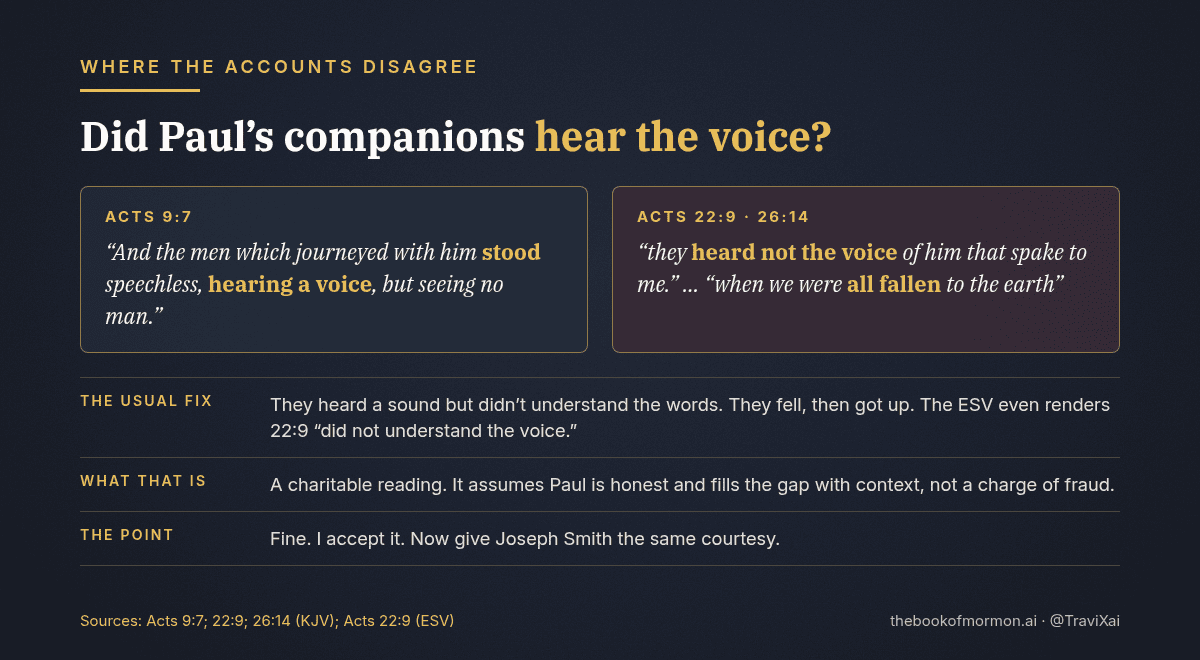
Exhibit BJoseph told it four times
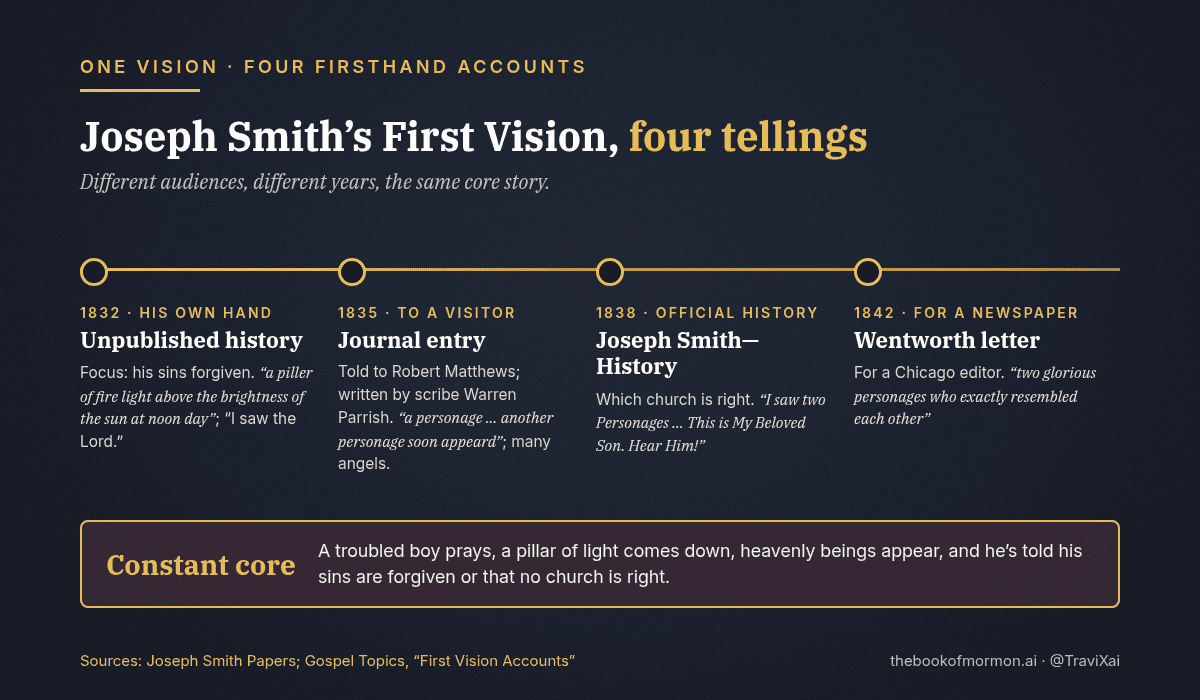
Joseph left four firsthand accounts of his first vision, and five more were written down by people who heard him tell it (Joseph Smith Papers). The Church’s Gospel Topics essay puts it plainly: “The various accounts of the First Vision tell a consistent story, though naturally they differ in emphasis and detail.”
- 1832. The earliest, and the only one in Joseph’s own handwriting. It centers on his sins: “a piller of fire light above the brightness of the sun at noon day come down from above and rested upon me … and I saw the Lord and he spake unto me saying Joseph my son thy sins are forgiven thee” (JSP).
- 1835. Told to a visitor in Kirtland, Ohio, and written in his journal by scribe Warren Parrish: “a personage appeard in the midst, of this pillar of flame … another personage soon appeard like unto the first” (JSP). This one also mentions angels.
- 1838. The official history, now Joseph Smith—History 1:17. Two Personages, and “This is My Beloved Son. Hear Him!”
- 1842. The Wentworth letter, written for a Chicago newspaper editor: “two glorious personages who exactly resembled each other in features, and likeness” (JSP).
Look at that 1832 line again: “above the brightness of the sun at noon day.” Now compare Paul in Acts 22:6, “about noon,” and Acts 26:13, “above the brightness of the sun.” Joseph reached for the same words Paul used.
“But 1832 only mentions one personage”
That’s the critics’ favorite. The essay answers it directly: “the 1832 account does not say that only one being appeared,” and “three of the four accounts clearly state that two personages appeared.” 1832 is focused on Jesus forgiving a boy’s sins, so that’s who he talks about. Acts 26 doesn’t mention Ananias, and nobody says Ananias was invented later.
The same goes for his age. The 1832 history has “in the 16th year of my age” added above the line in Frederick G. Williams’s handwriting (JSP). The others say “about fourteen” or “in my fifteenth year” (JS—H 1:7). Paul’s accounts can’t agree on whether his companions stood or fell. Real people telling real stories get small details like that wrong.
The standardHarmonize Paul, weaponize Joseph?
The essay makes the same comparison I’m making: “differences similar to those in the First Vision accounts exist in the multiple scriptural accounts of Paul’s vision on the road to Damascus.” Then it says, “Some have mistakenly argued that any variation in the retelling of the story is evidence of fabrication.”
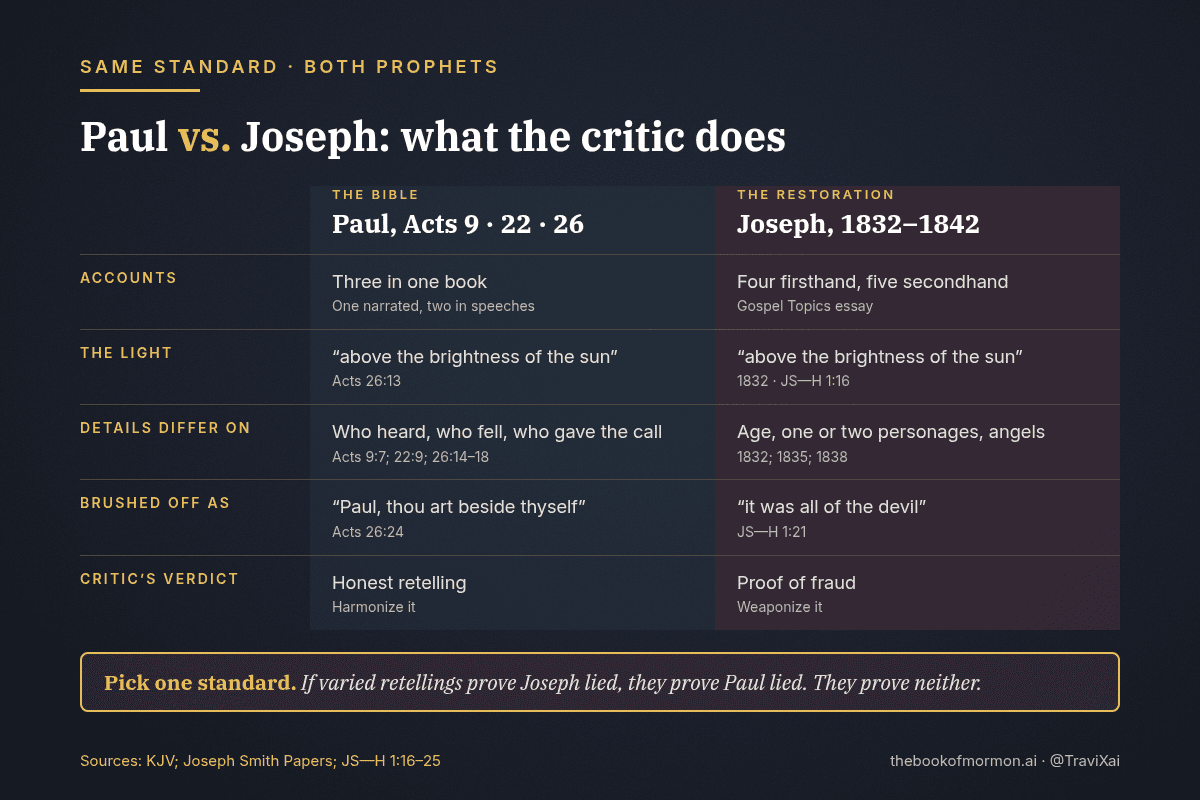
That’s the whole double standard. When Paul’s accounts differ, it’s inspired variety for different audiences. When Joseph’s accounts differ, it’s proof he lied. Same kind of differences, opposite verdict. If varied retellings prove Joseph made it up, they prove Paul made it up too. They prove neither.
Joseph saw this coming
Paul was called crazy for his vision. Festus shouted, “Paul, thou art beside thyself” (Acts 26:24). Joseph was told by a preacher that “it was all of the devil” (JS—H 1:21). And Joseph compared himself to Paul directly:
He had seen a vision, he knew he had, and all the persecution under heaven could not make it otherwise.
Joseph Smith—History 1:24
Then, about himself: “I had seen a vision; I knew it, and I knew that God knew it, and I could not deny it” (JS—H 1:25). Picture being 14 and having an experience almost nobody in history has had. Of course the details shift with the audience, with what you understand later, and with what you feel is too sacred to share.
How I know
I don’t believe Paul because his three accounts line up perfectly. They don’t. I believe him because God told me the Bible is true, and I choose to believe Him. I know Joseph saw what he said he saw the same way, by asking, just like Joseph did (James 1:5; Moroni 10:4–5).
If varied retellings prove Joseph lied, they prove Paul lied. They prove neither.
Believe Paul. I do. Just don’t throw out Joseph for the same “problem” you forgive in Acts. If everyone held their own beliefs to the same standard they hold others to, the world would be a better place.
SummaryKey takeaways
- Acts tells Paul’s vision three times (Acts 9, 22, 26), and the accounts differ on whether the men heard the voice, whether they stood or fell, and who delivered Paul’s calling.
- Christians resolve those differences charitably, by assuming Paul is honest and reading each account in context.
- Joseph left four firsthand accounts (1832, 1835, 1838, 1842), plus five secondhand ones, with a consistent core and differences in emphasis and detail.
- The 1832 account doesn’t say only one being appeared, and three of the four firsthand accounts clearly describe two personages.
- The Church’s own essay points to Paul’s accounts as a parallel. Same kind of differences, same standard.
Next time someone says Joseph’s story kept changing, ask them which of Paul’s three accounts they believe. For quick, sourced answers on the First Vision accounts, James 1:5, and Bible inerrancy, open Galatians18. And for more like this every day, follow me on X at @TraviXai.
Sources
- Bible (KJV, churchofjesuschrist.org): Acts 9:1–19 · Acts 22:1–16 · Acts 24:27 · Acts 26:9–24 · James 1:5; Acts 22:9 (ESV): Bible Gateway
- Joseph Smith Papers: History, circa Summer 1832, p. 3 · Journal, 1835–1836, p. 24 · “Church History,” Times and Seasons, 1 Mar. 1842, p. 707 · Accounts of Joseph Smith’s First Vision
- Gospel Topics essay: “First Vision Accounts”
- Pearl of Great Price: Joseph Smith—History 1:7 · Joseph Smith—History 1:14–25
- Travi𝕏 on X, the car-wreck analogy (June 2026)
- Galatians18: First Vision Accounts · James 1:5 — Just Wisdom, Not a Church? · Is the Bible Infallible?
- Related on this site: Read It and Ask · His Name Had for Good and Evil · 2 Samuel 24 vs. 1 Chronicles 21 · Was Joseph Smith a Con Man? · The Hypocritical Book of Mormon Denier
- Featured image, comparison tables, and timeline: original graphics by thebookofmormon.ai (no photographs or likenesses of real people).