
Critics love this one. Here’s exactly what was said in 1852, what the Church said in 1976, and what scripture teaches about Adam.
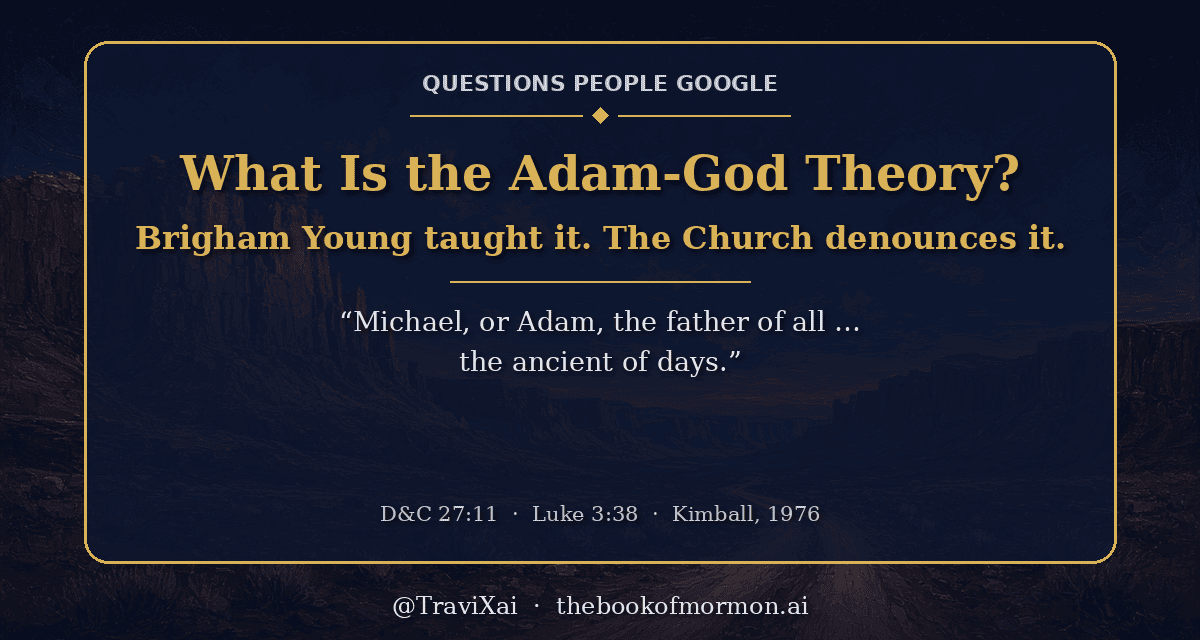
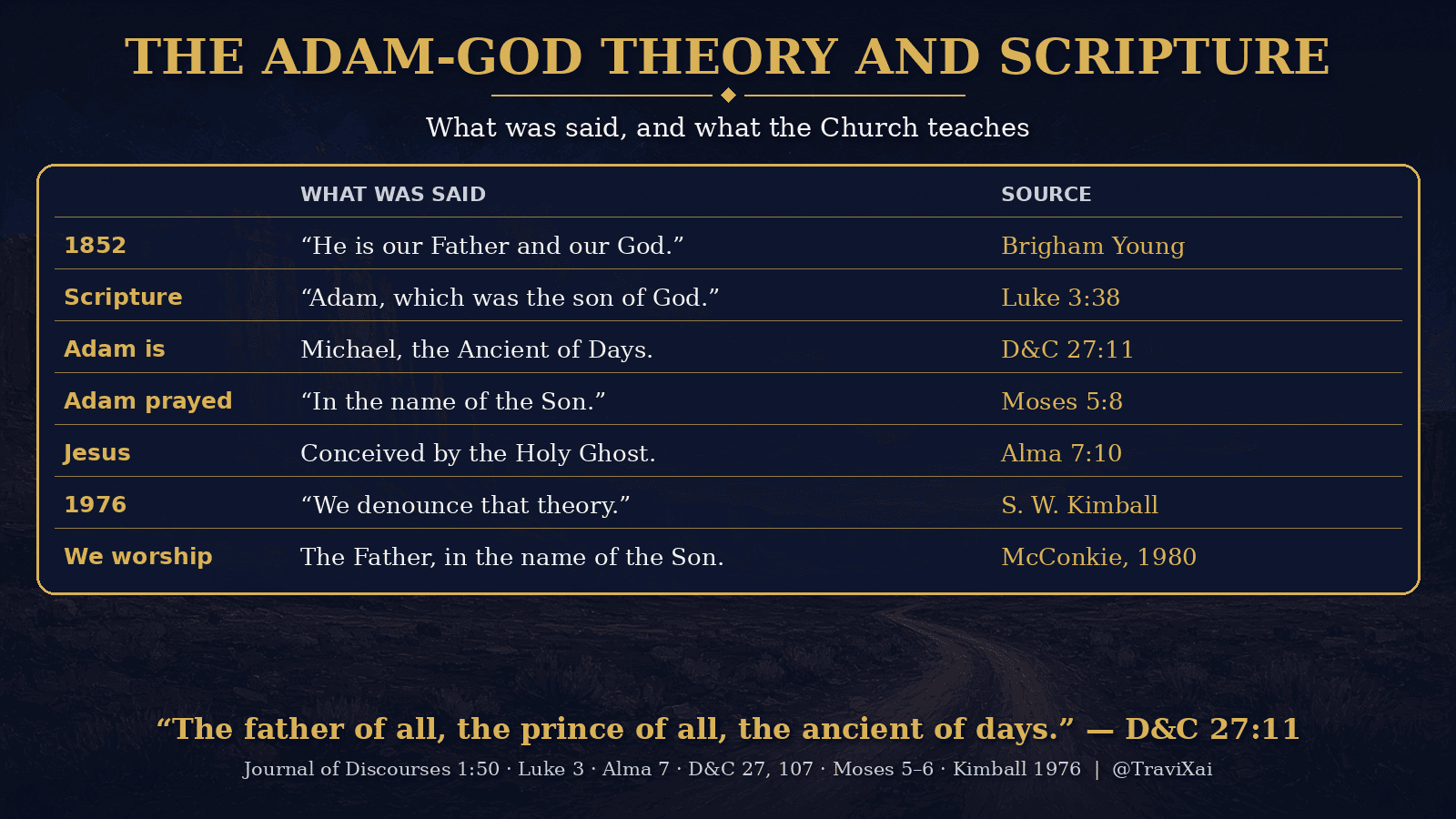
The Adam-God theory is Brigham Young’s 1852 teaching that Adam, the first man, is “our Father and our God, and the only God with whom we have to do” (Journal of Discourses 1:50). The Church rejects it. In 1976 President Spencer W. Kimball said in general conference, “We denounce that theory.” Scripture calls Adam “the son of God” (Luke 3:38) and “Michael … the ancient of days” (D&C 27:11), and Adam himself worshipped the Father in the name of the Son (Moses 5:8). Our Heavenly Father, not Adam, is the Father of our spirits.
The short answerA 19th-century teaching the Church has rejected
The Adam-God theory is the idea that Adam, the first man, is God the Father, the Father of our spirits and the One we worship. Brigham Young taught it in a sermon on April 9, 1852: “When our father Adam came into the garden of Eden, he came into it with a celestial body, and brought Eve, one of his wives, with him … He is Michael, the Archangel, the Ancient of Days! about whom holy men have written and spoken—He is our Father and our God, and the only God with whom we have to do” (Journal of Discourses 1:50).
The Church does not teach it and has publicly rejected it. In general conference in October 1976, President Spencer W. Kimball said: “We warn you against the dissemination of doctrines which are not according to the scriptures and which are alleged to have been taught by some of the General Authorities of past generations. Such, for instance, is the Adam-God theory. We denounce that theory and hope that everyone will be cautioned against this and other kinds of false doctrine” (Our Own Liahona).
What scripture says about AdamThe son of God, not God the Father
The Bible calls Adam a son of God, not the Father: “Which was the son of Seth, which was the son of Adam, which was the son of God” (Luke 3:38). The Book of Moses agrees: “Adam, who was the son of God, with whom God, himself, conversed” (Moses 6:22). Adam himself worshipped the Father. After he offered sacrifices, an angel told him, “thou shalt do all that thou doest in the name of the Son, and thou shalt repent and call upon God in the name of the Son forevermore” (Moses 5:6–8).
The Book of Mormon teaches that Jesus was conceived by the power of the Holy Ghost: Mary would “be overshadowed and conceive by the power of the Holy Ghost, and bring forth a son, yea, even the Son of God” (Alma 7:10). That contradicts the 1852 sermon’s claim that Jesus “was not begotten by the Holy Ghost.”
Who Adam really isMichael, the Ancient of Days
Latter-day Saints do honor Adam highly. Modern revelation calls him “Michael, or Adam, the father of all, the prince of all, the ancient of days” (D&C 27:11). Near the end of his life, “the Lord appeared unto them, and they rose up and blessed Adam, and called him Michael, the prince, the archangel,” and the Lord told him, “I have set thee to be at the head; a multitude of nations shall come of thee, and thou art a prince over them forever” (D&C 107:54–55).
Daniel saw “the Ancient of days” sit in judgment, and “one like the Son of man came with the clouds of heaven, and came to the Ancient of days” (Daniel 7:9; 7:13–14). Modern revelation identifies the Ancient of Days as Adam, who will come to visit his people at Adam-ondi-Ahman (D&C 116:1), where the Son of Man receives the everlasting kingdom. Adam is the archangel Michael (Jude 1:9), the father of the human race, and a son of God.
What the Church does teach about the FatherAn exalted Father who had a Father
Rejecting Adam-God doesn’t mean backing away from what Joseph Smith taught about God. Our Heavenly Father is the Father of our spirits, a glorified Man with a body of flesh and bones (D&C 130:22). Joseph taught in 1844 that “God himself was once as we are now, and is an exalted man,” and that the Father Himself has a Father: “If Jesus Christ was the Son of God, and John discovered that God the Father of Jesus Christ had a Father, you may suppose that He had a Father also. Where was there ever a son without a father?” (History of the Church 6:476).
That endless line of exalted Fathers is the pattern of eternal progression, and faithful children like Adam follow it. Of Abraham, Isaac and Jacob, the Lord says “they have entered into their exaltation … and sit upon thrones, and are not angels but are gods” (D&C 132:37). Adam is not our God; he is our first father, and like all God’s faithful children he is heir to all the Father has, while the Father remains our God forever. See Was God Once a Man?.
Why it still comes upCritics, and splinter groups
Critics bring up Adam-God to suggest Latter-day Saint doctrine is unstable. But prophets are not infallible in every sermon, and the Church’s doctrine is set by the scriptures and the united voice of its leaders. Adam-God was never canonized, and it contradicts scripture.
In 1980, Elder Bruce R. McConkie called it a heresy: “There are those who believe or say they believe that Adam is our father and our god … It is contrary to the whole plan of salvation set forth in the scriptures … We worship the Father, in the name of the Son, by the power of the Holy Ghost; and Adam is their foremost servant, by whom the peopling of our planet was commenced” (The Seven Deadly Heresies). Today it survives mainly among fundamentalist splinter groups that are not part of the Church. See LDS vs. FLDS.
Check the premiseThe presuppositions baked into the question
Before this question can be answered fairly, the person asking has to justify a few assumptions packed inside it:
- That Latter-day Saints worship Adam. We worship the Father in the name of Jesus Christ. Adam himself did the same (Moses 5:8).
- That every sermon by a Church leader is doctrine. Doctrine is found in the scriptures and the united teaching of Church leaders. President Kimball denounced Adam-God in 1976.
- That rejecting Adam-God means rejecting eternal progression. Joseph Smith’s teaching that the Father was once as we are and had a Father stands (History of the Church 6:305, 6:476).
- That the Church hides this history. The 1852 sermon and the 1976 denunciation are both public, and the denunciation was given in general conference.
FAQQuick answers
What is the Adam-God theory?
The idea, taught by Brigham Young in 1852, that Adam is God the Father, the Father of our spirits and the God we worship.
Does the Church teach the Adam-God theory?
No. President Spencer W. Kimball denounced it in general conference in October 1976 as false doctrine.
Who is Adam in Latter-day Saint belief?
The first man, the father of the human race, and the archangel Michael, the “Ancient of Days” (D&C 27:11; 107:54). He is a son of God (Luke 3:38).
Who is God the Father in Latter-day Saint belief?
The Father of our spirits, an exalted, glorified Man (D&C 130:22). Joseph Smith taught that He was once as we are and that He Himself had a Father.
Who believes in Adam-God today?
Mainly some fundamentalist splinter groups outside the Church.
Is Adam-God found in Latter-day Saint scripture?
No. Scripture calls Adam “Michael, the prince, the archangel” (D&C 107:54), a son of God, never God the Father.
Whom did Adam worship?
God the Father, in the name of the Son. Adam was told, “thou shalt repent and call upon God in the name of the Son forevermore” (Moses 5:8).
Is “God was once a man” the same as the Adam-God theory?
No. That God himself was once as we are now is taught in the King Follett Sermon, and that the Father had a Father in the Sermon in the Grove (History of the Church 6:476): an endless line of Fathers and Sons, with our Father always our Father. The Church rejects only the claim that Adam is God the Father.
SummaryKey takeaways
- Brigham Young taught in 1852 that Adam is God the Father.
- President Kimball denounced the theory in 1976; the Church does not teach it.
- Scripture calls Adam a son of God and the archangel Michael (Luke 3:38; D&C 27:11).
- Joseph Smith’s teaching stands: the Father was once as we are and had a Father, and we can become like Him.
Read D&C 107:53–56 and Moses 5 for yourself. For quick, sourced answers, open Galatians18, and follow me on X at @TraviXai.
Sources
- King James Bible (churchofjesuschrist.org): Daniel 7:9 · Daniel 7:13–14 · Luke 3:38 · Jude 1:9
- Book of Mormon: Alma 7:10
- Doctrine and Covenants: D&C 27:11 · D&C 107:54–55 · D&C 116:1 · D&C 130:22 · D&C 132:37
- Pearl of Great Price: Moses 5:6–8 · Moses 6:22
- Brigham Young, April 9, 1852, Journal of Discourses 1:50 (BYU scan)
- Spencer W. Kimball, “Our Own Liahona,” October 1976 general conference
- Bruce R. McConkie, “The Seven Deadly Heresies,” BYU, June 1, 1980
- History of the Church 6:476 (Sermon in the Grove), BYU Studies
- Featured image and in-article graphic: original graphics by thebookofmormon.ai (painterly backgrounds; no photographs or likenesses of real people).