
It’s one of the most shared “gotcha” headlines about the Church. Here’s what Latter-day Saints actually believe, with every verse on the table.
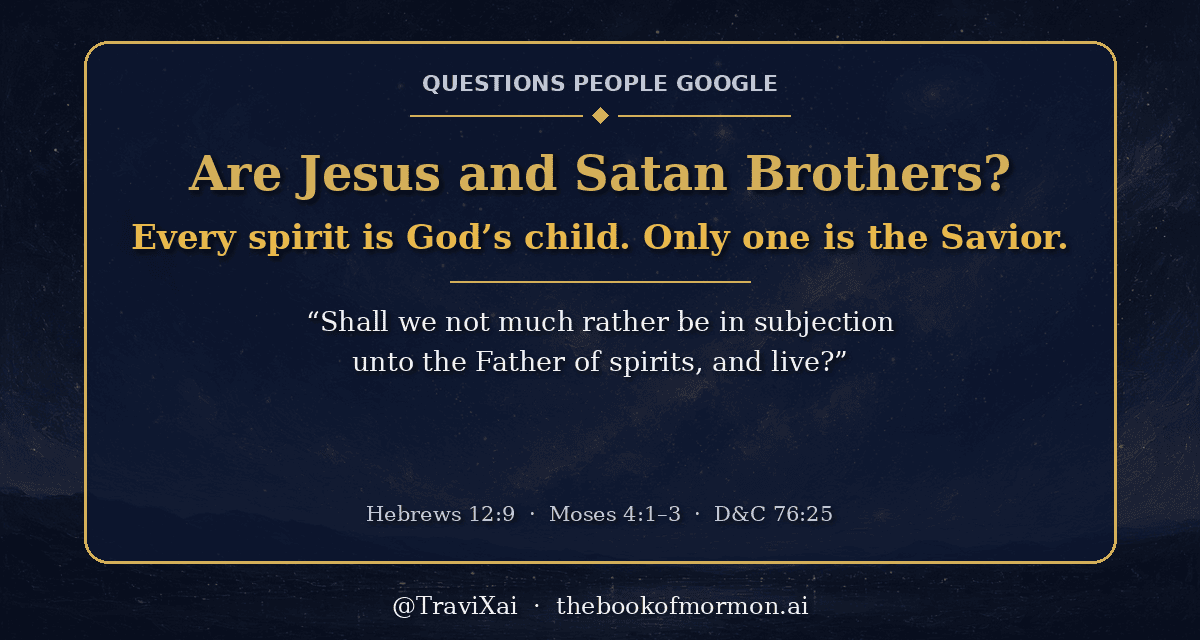
Only in the sense that every spirit, including yours and mine, is a child of God. Latter-day Saints believe God is “the Father of spirits” (Hebrews 12:9). Jesus Christ is His Firstborn, the Beloved and Chosen, the Creator and the only Savior. Lucifer was an angel “in authority” who “rebelled against the Only Begotten Son” and was cast down by Christ’s power (D&C 76:25; Moses 4:3). The Bible itself places Satan among “the sons of God” (Job 1:6). Brothers in origin, never equals.
The short answerChildren of one Father, but never equals
Latter-day Saints believe every person who has ever lived was first a spirit child of God. The Bible calls Him “the Father of spirits” (Hebrews 12:9), and Paul told the Athenians “we are the offspring of God” (Acts 17:29). The Family proclamation puts it simply: “Each is a beloved spirit son or daughter of heavenly parents.” In that sense Jesus, Lucifer, you and I all share one Father.
That is where the “brothers” comparison ends. Jesus Christ is “the Firstborn” (D&C 93:21), “the firstborn among many brethren” (Romans 8:29), the Beloved and Chosen, the Creator, Jehovah of the Old Testament and the only Savior. Lucifer was “an angel of God who was in authority” who “rebelled against the Only Begotten Son” and was thrust down (D&C 76:25–26). The headline “Mormons believe Jesus and Satan are brothers” is meant to suggest they are equals. Nothing in Latter-day Saint teaching says that.
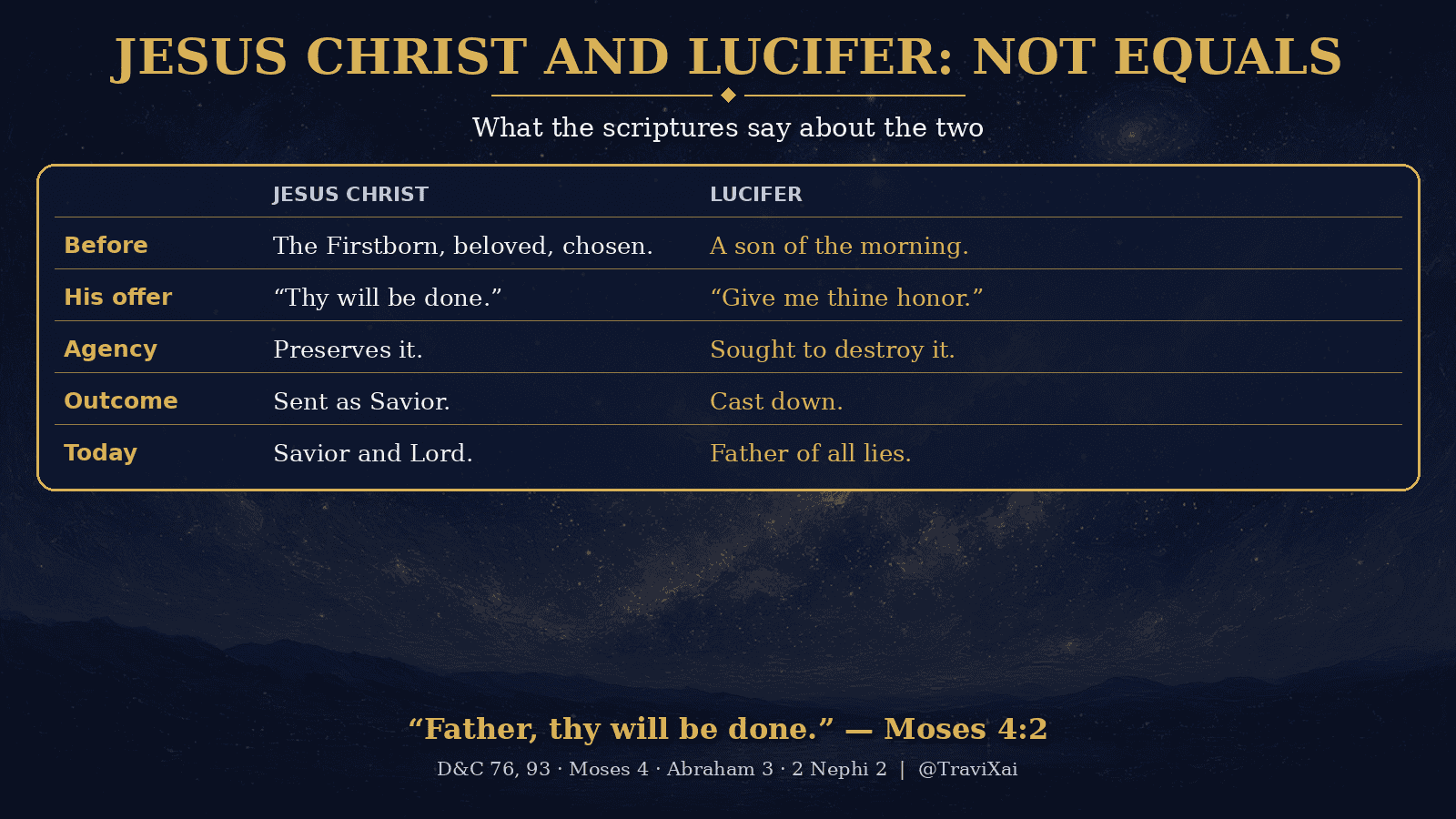
The Bible already puts Satan among the sons of GodJob 1 and Isaiah 14
The idea that Satan began as one of God’s heavenly sons isn’t a Latter-day Saint invention. Job opens in the heavenly council: “Now there was a day when the sons of God came to present themselves before the Lord, and Satan came also among them” (Job 1:6). Isaiah laments, “How art thou fallen from heaven, O Lucifer, son of the morning!” (Isaiah 14:12). John saw “war in heaven,” and “the great dragon was cast out, that old serpent, called the Devil, and Satan … and his angels were cast out with him” (Revelation 12:7–9).
Most Christians already believe the devil was a created angel who fell. The only question is whether angels and humans share one Father. Hebrews says He is “the Father of spirits” (Hebrews 12:9). Latter-day Saints take that literally.
What happened in the premortal councilTwo offers, one Savior
The Pearl of Great Price records the council where the plan of salvation was presented. Satan came and said, “Behold, here am I, send me, I will be thy son, and I will redeem all mankind, that one soul shall not be lost … wherefore give me thine honor.” The Beloved Son said, “Father, thy will be done, and the glory be thine forever” (Moses 4:1–2).
Satan “rebelled against me, and sought to destroy the agency of man … and also, that I should give unto him mine own power,” so “by the power of mine Only Begotten, I caused that he should be cast down” (Moses 4:3). Abraham saw the same choice: “I will send the first. And the second was angry, and kept not his first estate” (Abraham 3:27–28). Notice that Satan was cast down by the power of Christ. One is the Lord; the other is His defeated enemy.
The Book of Mormon on the fallen angel“He became a devil”
Lehi taught that “an angel of God … had fallen from heaven; wherefore, he became a devil, having sought that which was evil before God,” and that he “sought also the misery of all mankind” as “the father of all lies” (2 Nephi 2:17–18). Lucifer’s spirit origin is no honor to him. It makes his rebellion all the more tragic: “the heavens wept over him” (D&C 76:26).
Why the Father of spirits mattersThe doctrine behind the question
The deeper reason critics raise this question is that Latter-day Saints believe God is literally our Father: not a metaphor, but the Father of our spirits, an exalted, glorified Man whose children can grow to become like Him. Joseph Smith taught in the King Follett sermon that “God himself was once as we are now, and is an exalted man,” and that the faithful must learn “how to be gods yourselves … from grace to grace, from exaltation to exaltation.” See Was God Once a Man? The King Follett Sermon.
That is the family Lucifer rejected. Christ, the Firstborn, kept His Father’s will perfectly and made it possible for the rest of us to come home and inherit what the Father has, always as His children, always below Him and worshipping Him. Lucifer wanted the Father’s honor and power for himself and lost everything. The contrast is the whole point.
Is Jesus God, then?Yes, and the Creator
Yes. John wrote, “the Word was God,” and “All things were made by him” (John 1:1–3). Latter-day Saints worship Jesus Christ as Jehovah, the Creator of this world under the Father, and the only name by which we are saved. Calling Him a “brother” of Satan without that context is like calling Abel and Cain “just brothers.” See Do Latter-day Saints Believe Jesus Is God?.
Check the premiseThe presuppositions baked into the question
Before this question can be answered fairly, the person asking has to justify a few assumptions packed inside it:
- That “brothers” means “equals.” Christ is the Firstborn, the Creator and the Savior; Lucifer is a fallen angel cast down by Christ’s power (Moses 4:3).
- That a spirit origin for Satan is unbiblical. Job 1:6 places Satan among “the sons of God,” and Isaiah 14:12 calls him a “son of the morning.”
- That most Christians think Satan was not created by God. Most Christians believe the devil was an angel who fell; the dispute is only about how angels and humans relate.
- That this is a secret teaching. It is in published scripture: Moses 4, Abraham 3 and D&C 76.
FAQQuick answers
Do Latter-day Saints believe Jesus and Satan are brothers?
Only in the sense that all spirits, including yours and mine, are children of God, “the Father of spirits” (Hebrews 12:9). Jesus is the Firstborn and Savior; Lucifer rebelled and was cast down.
Is this belief in the Bible?
Job 1:6 places Satan among “the sons of God,” Isaiah 14:12 calls Lucifer “son of the morning,” and Revelation 12:7–9 describes war in heaven.
Why did Lucifer rebel?
He wanted the Father’s honor and power and sought to destroy human agency (Moses 4:1–3).
Do Latter-day Saints think Satan could be redeemed?
No. D&C 76:25–26 calls him Perdition; he “kept not his first estate” (Abraham 3:28).
Do Latter-day Saints believe Jesus is God?
Yes. They worship Him as Jehovah, the Creator under the Father, and the only Savior (John 1:1–3).
Who is Jesus among God’s spirit children?
The Firstborn. Paul calls Him “the firstborn among many brethren” (Romans 8:29) and “the firstborn of every creature” (Colossians 1:15). He is also the Only Begotten of the Father in the flesh, our Creator and Savior.
What was the war in heaven?
“And there was war in heaven: Michael and his angels fought against the dragon” (Revelation 12:7). Lucifer and those who followed him were cast out for rebelling against the Father’s plan.
How are Jesus and Satan different?
Completely. Lucifer said, “give me thine honor” (Moses 4:1). The Son said, “Father, thy will be done, and the glory be thine forever” (Moses 4:2).
SummaryKey takeaways
- All spirits are children of “the Father of spirits” (Hebrews 12:9).
- Jesus is the Firstborn, the Creator and the Savior (D&C 93:21; John 1:3).
- Lucifer rebelled, sought to destroy agency and was cast down (Moses 4:1–3).
- Job 1:6 and Isaiah 14:12 already place Satan among heavenly beings who fell.
Read Moses 4 and Abraham 3 for yourself. For quick, sourced answers, open Galatians18, and follow me on X at @TraviXai.
Sources
- King James Bible (churchofjesuschrist.org): Job 1:6 · Isaiah 14:12 · John 1:1–3 · Acts 17:29 · Romans 8:29 · Hebrews 12:9 · Revelation 12:7–9
- Book of Mormon: 2 Nephi 2:17–18
- Doctrine and Covenants: D&C 76:25–26 · D&C 93:21
- Pearl of Great Price: Moses 4:1–3 · Abraham 3:27–28
- Joseph Smith, King Follett sermon, April 7, 1844, History of the Church 6:305–306 (BYU Studies online edition)
- The Family: A Proclamation to the World (1995)
- Featured image and in-article graphic: original graphics by thebookofmormon.ai (painterly backgrounds; no photographs or likenesses of real people).