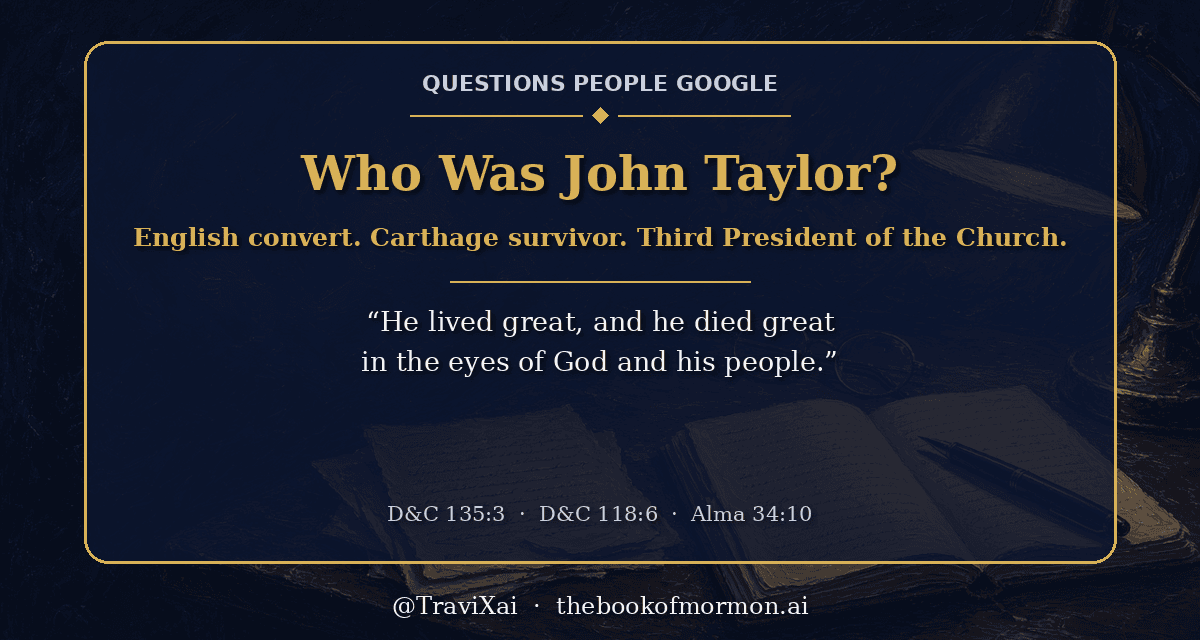

He sang to Joseph in Carthage Jail, took four balls, lived 43 more years, made the Pearl of Great Price scripture, and died in hiding. Here is the whole record.
The question often assumes John Taylor was a caretaker between Brigham Young and Wilford Woodruff, or that his story rests on a watch. Neither holds up. John Taylor (1808–1887) was an English-born convert baptized in Toronto in 1836, named an apostle by revelation (D&C 118:6), and shot four times at Carthage Jail when Joseph and Hyrum Smith were killed. He opened missions in France and Germany, served about 40 years as an apostle, and as the third President of the Church (1880–1887) canonized the Pearl of Great Price. He died in hiding during the anti-polygamy raids.
Who he wasThe apostle who survived Carthage
John Taylor (1808–1887) was an English-born convert who became an apostle in 1838, survived being shot four times in the attack on Carthage Jail that killed Joseph and Hyrum Smith, served as an apostle for about 40 years, and was the third President of the Church from 1880 to his death in 1887. He edited Church newspapers, opened missions in France and Germany, wrote The Mediation and Atonement, and canonized the Pearl of Great Price. He died in hiding from federal marshals.
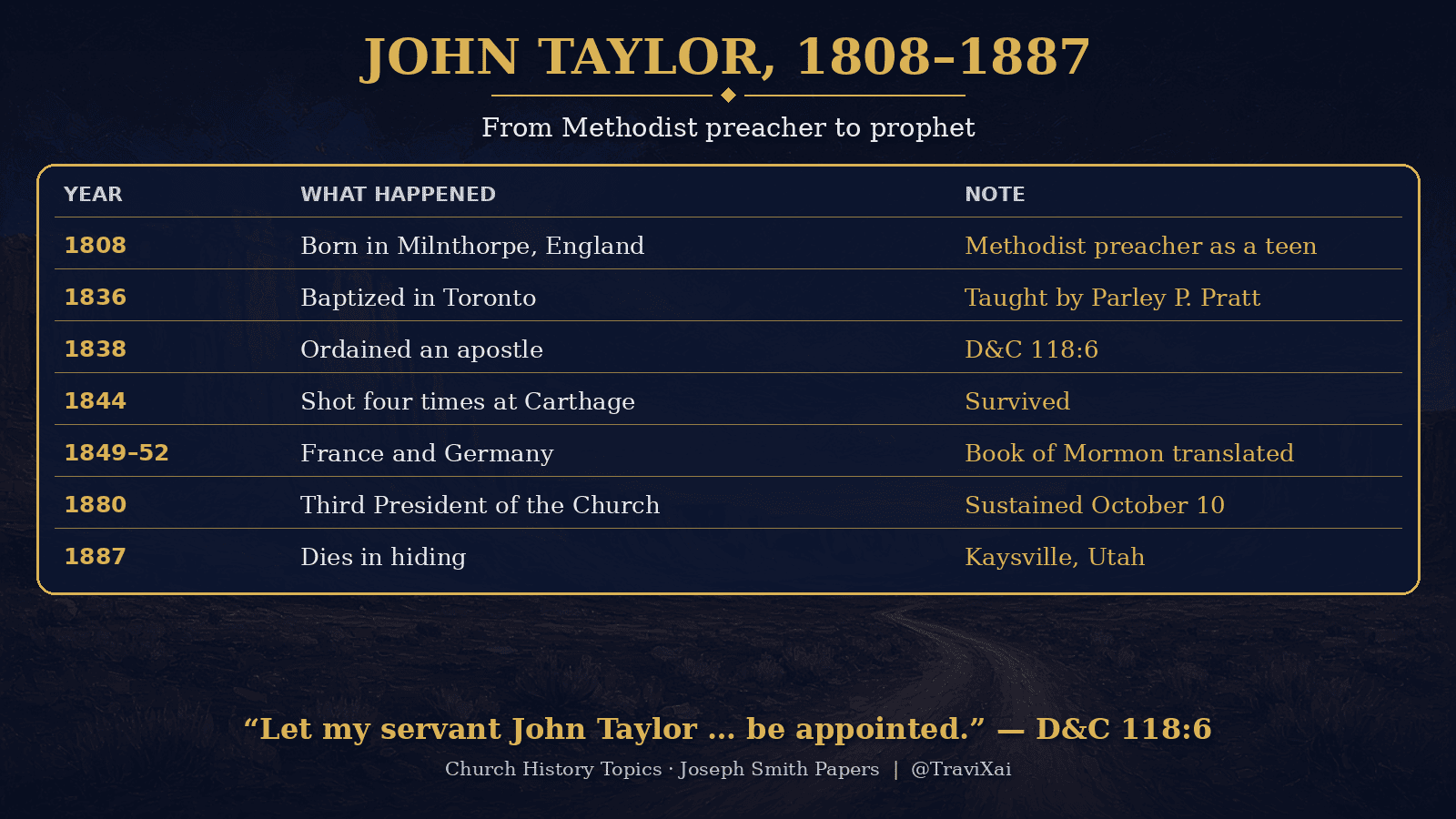
He was born November 1, 1808, in Milnthorpe, England, to parents in the Church of England. Around 16 he joined the Methodists and became a lay preacher. He followed his parents to Upper Canada and in Toronto married Leonora Cannon. Parley P. Pratt preached there in 1836, and John and Leonora were baptized that year. See Who Was Parley P. Pratt?.
ApostleCalled by name
In July 1838 the Lord named him to fill a vacancy in the Twelve: “Let my servant John Taylor, and also my servant John E. Page, and also my servant Wilford Woodruff, and also my servant Willard Richards, be appointed to fill the places of those who have fallen” (D&C 118:6). He was ordained in December 1838, as the Saints were being driven from Missouri. From 1839 to 1841 he served with the Twelve in Britain. In Nauvoo he was on the city council and edited the Times and Seasons and the Nauvoo Neighbor.
CarthageFour balls and a watch
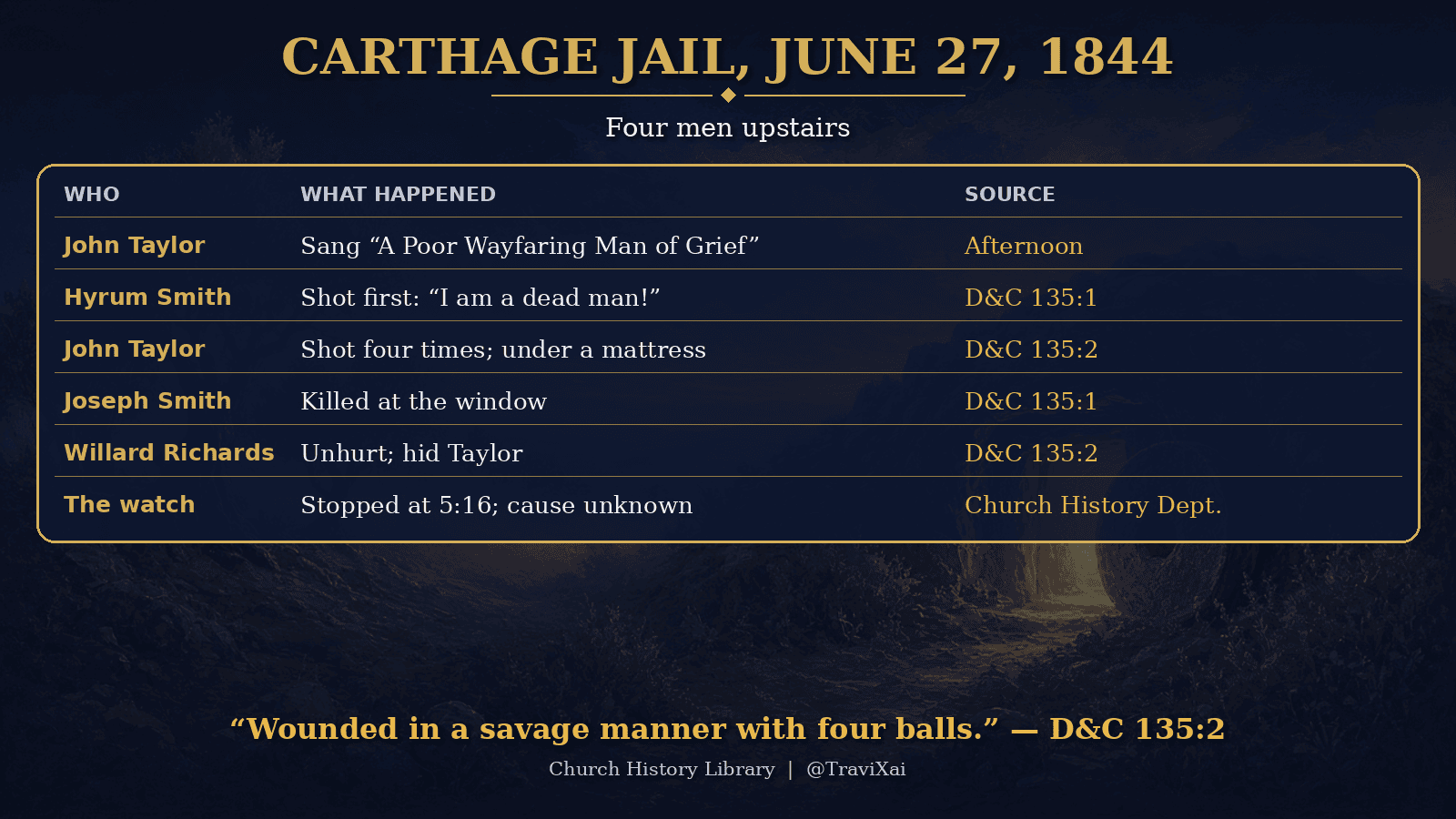
Taylor went to Carthage with Joseph and Hyrum and stayed. On the afternoon of June 27, 1844, he sang “A Poor Wayfaring Man of Grief.” When the mob stormed the stairs, he parried musket barrels at the door with a cane, then headed for the window and was hit. He crawled under a bed and was hit again. Scripture records it: “John Taylor and Willard Richards, two of the Twelve, were the only persons in the room at the time; the former was wounded in a savage manner with four balls, but has since recovered” (D&C 135:2). Willard Richards hid him under a straw mattress. Section 135, the announcement of the martyrdom, is traditionally attributed to Taylor. See Carthage: Like a Lamb to the Slaughter and Who Was Hyrum Smith?.
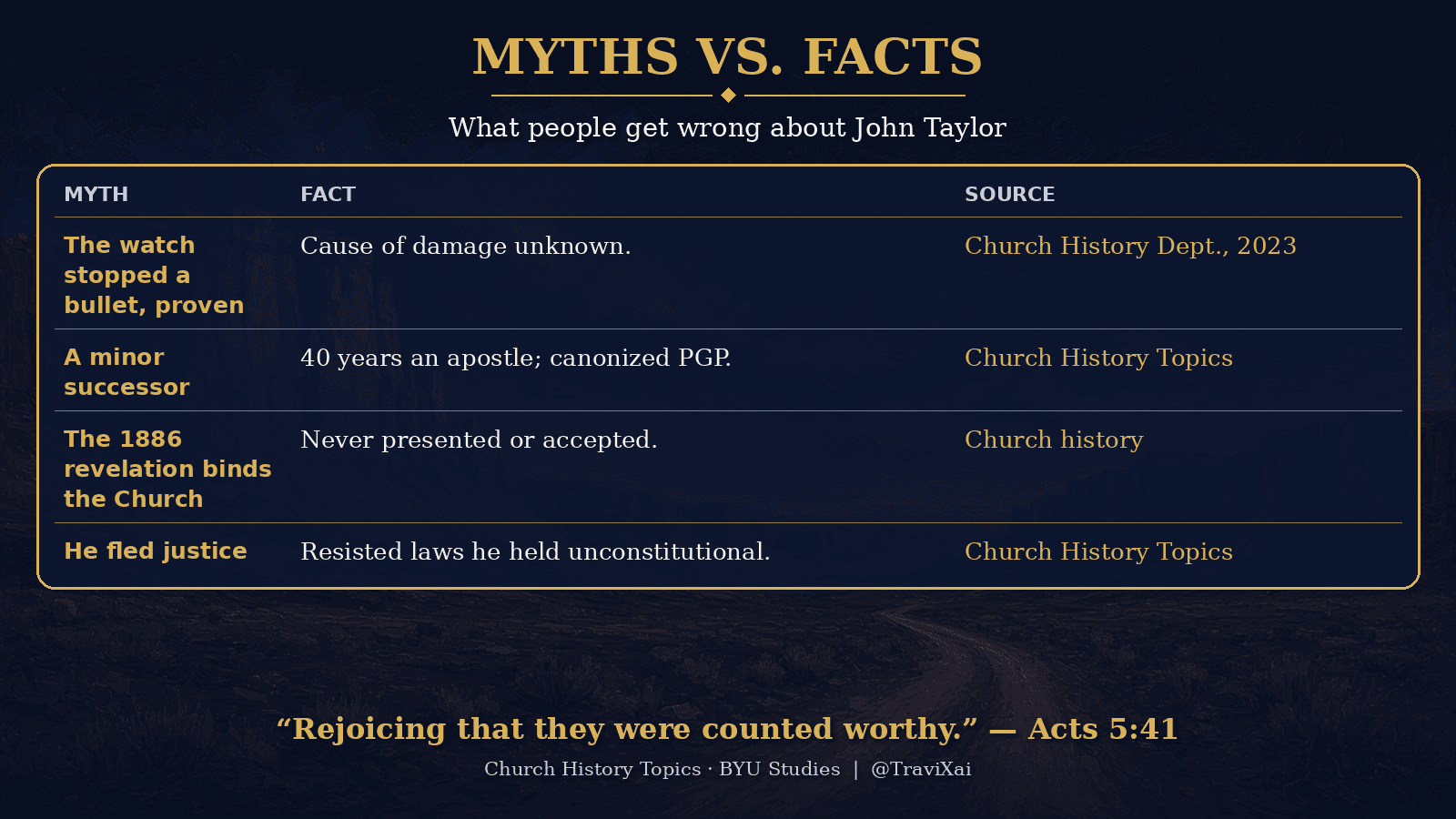
About the watch. His pocket watch stopped at 5:16 p.m. Taylor believed a ball struck it and threw him back inside, which saved his life. Some researchers later argued he smashed it on the windowsill. In 2023 the Church History Department said, after forensic testing, that the cause of the damage cannot be determined; its historian said the likeliest cause was a slowed, possibly ricocheting projectile. So the honest answer is: it might have been a bullet, nobody can prove it, and he survived four wounds anyway. Nobody needs the watch to make that remarkable.
Missionary and editorFrance, Germany, New York
After the exodus, he served again in England, reached the Salt Lake Valley in 1847, and in 1849 went to France. There he arranged the French translation of the Book of Mormon and published a French periodical; in Germany he supervised the German translation. Later, in New York, he edited a paper called The Mormon. He served in the Utah territorial legislature for nearly twenty years. He was the Restoration’s most combative editor, and he picked his fights with critics in print. See Why Do Latter-day Saints Serve Missions?.
President of the Church1877 to 1887
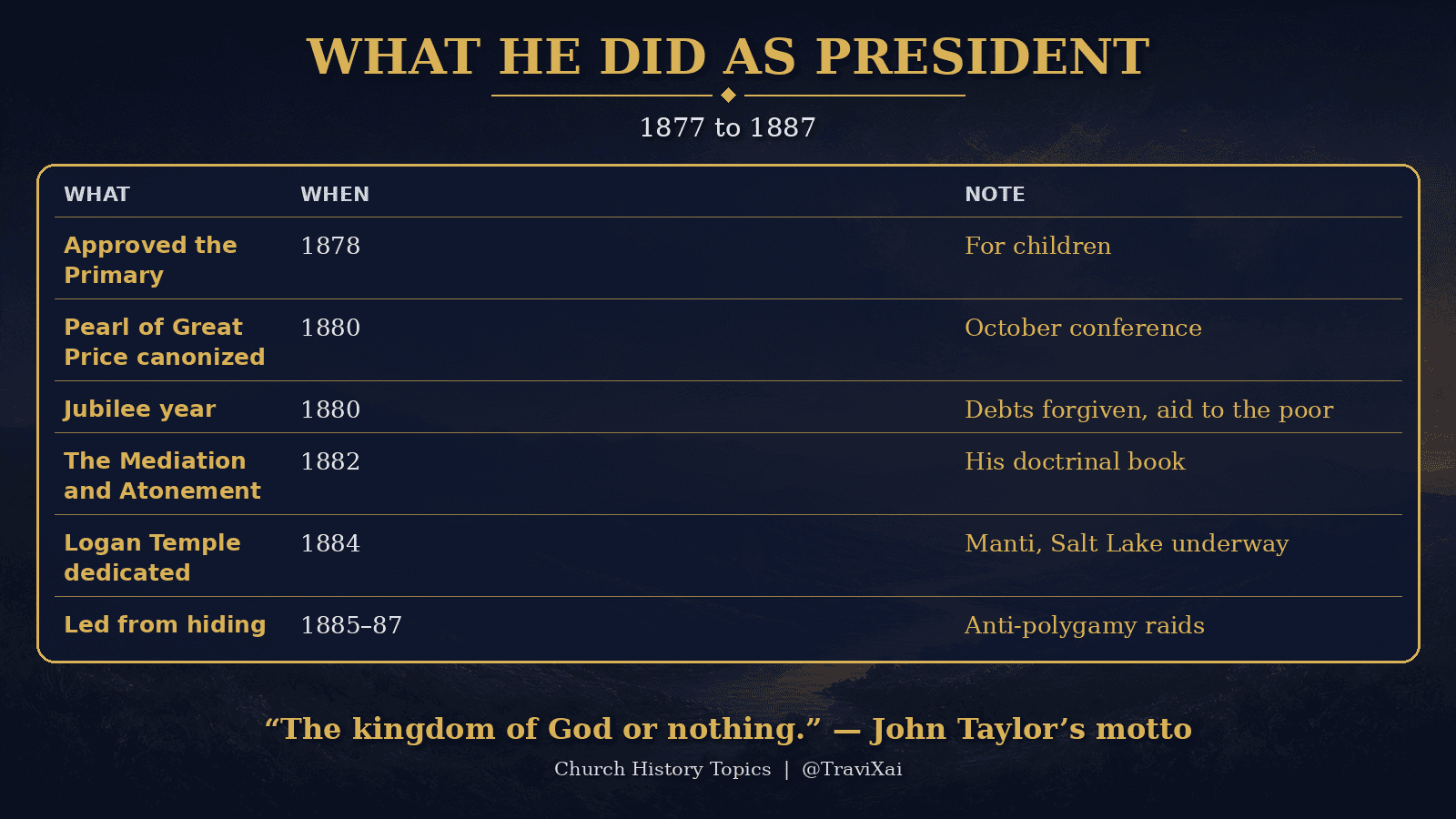
When Brigham Young died in 1877, Taylor led the Church as President of the Quorum of the Twelve. In that role he approved the Primary in 1878 and set apart the first general presidents of the women’s organizations. In October 1880 he was sustained as President and reorganized the First Presidency. At the same conference the Pearl of Great Price was accepted as scripture. For the Church’s 50th year he declared a jubilee: half of what the poor owed the Perpetual Emigrating Fund was forgiven, and cattle and sheep were given to the needy. See Who Was Brigham Young? and How Is a Prophet Chosen?.
The 1880s brought federal prosecution of plural marriage. Taylor, who had entered plural marriage in Nauvoo and married eight women in his life, held that the laws attacked religious freedom and refused to give up the practice. In 1885 he went into hiding, led the Church from safe houses and died on July 25, 1887, in Kaysville, Utah. Fundamentalist groups cite a purported 1886 revelation to him to justify continuing polygamy. It was never presented to or accepted by the Church, and the Church ended new plural marriages under his successor, Wilford Woodruff, in 1890. See Does the LDS Church Still Practice Polygamy? and LDS vs. FLDS: What Is the Difference?.
The BibleCounted worthy
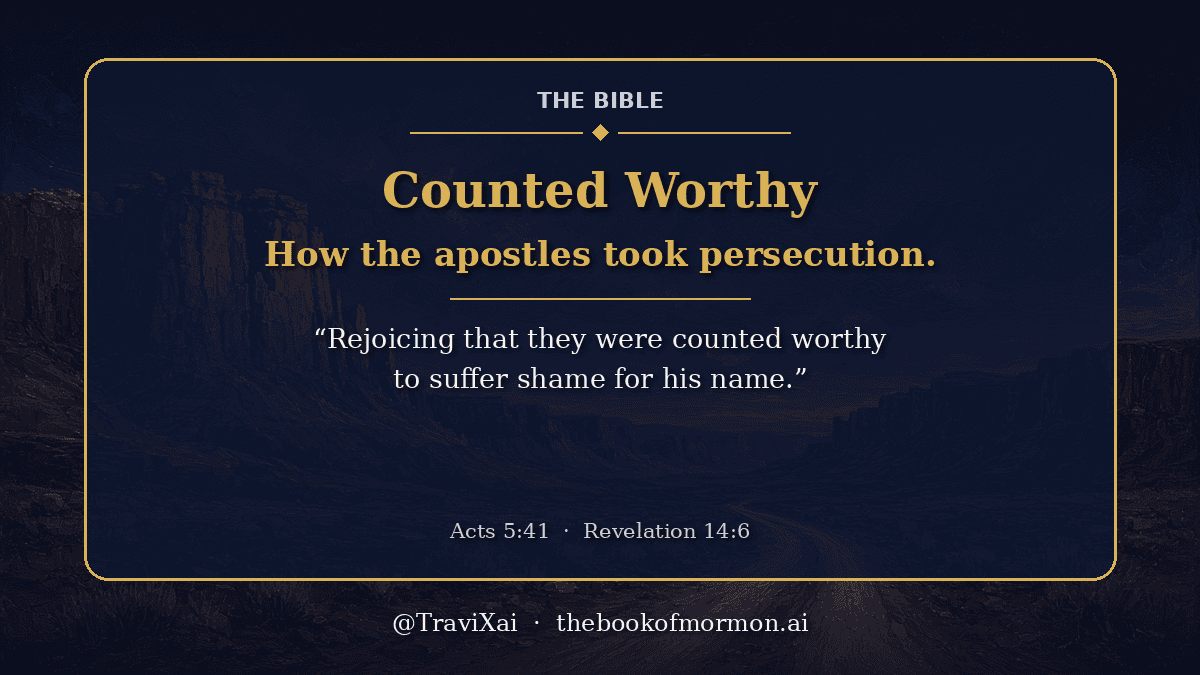
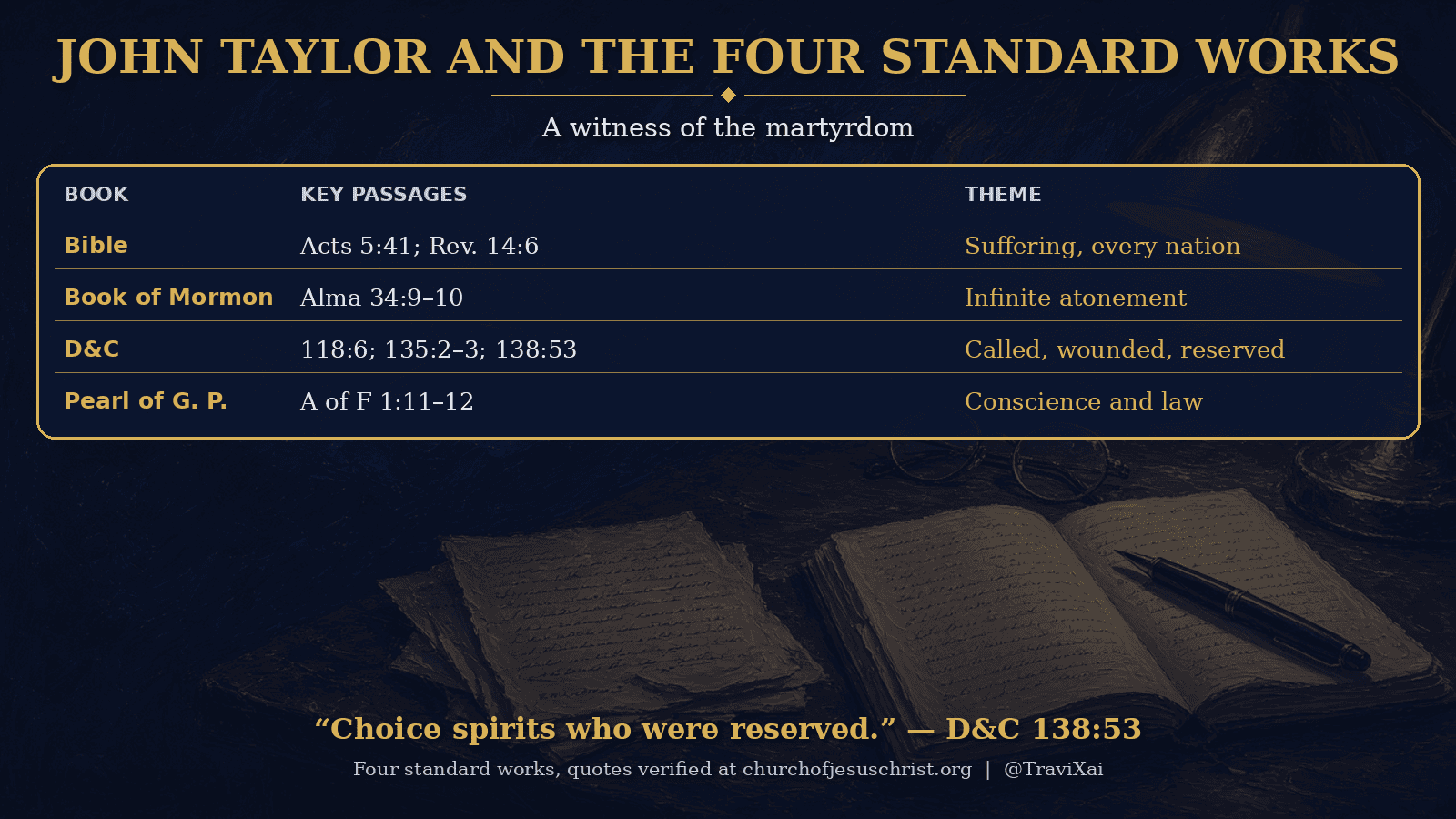
After the Sanhedrin beat the apostles, “they departed from the presence of the council, rejoicing that they were counted worthy to suffer shame for his name” (Acts 5:41). That is Taylor at Carthage and in hiding at the end. His missions to Britain, France and Germany were John’s vision in practice: “another angel fly in the midst of heaven, having the everlasting gospel to preach unto them that dwell on the earth, and to every nation, and kindred, and tongue, and people” (Revelation 14:6). See What Is the Restoration of the Gospel?.
The Book of MormonAn infinite and eternal sacrifice
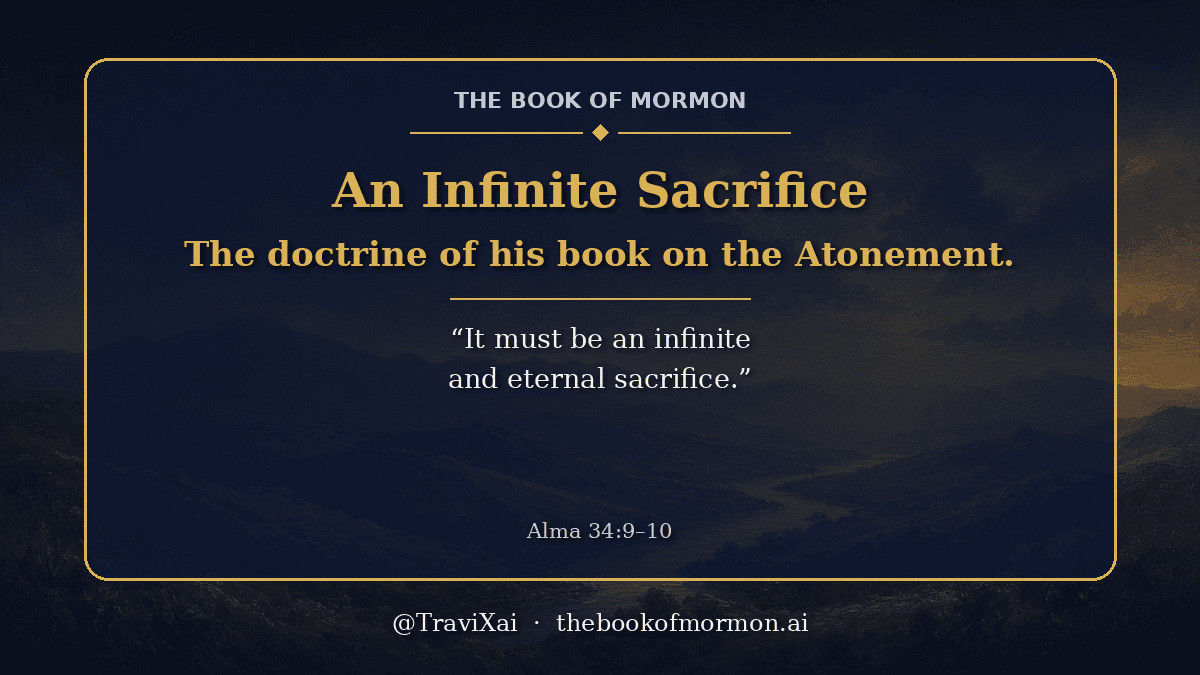
Taylor’s major doctrinal book, The Mediation and Atonement (1882), works out Amulek’s teaching: “according to the great plan of the Eternal God there must be an atonement made, or else all mankind must unavoidably perish … For it is expedient that there should be a great and last sacrifice; yea, not a sacrifice of man, neither of beast, neither of any manner of fowl; for it shall not be a human sacrifice; but it must be an infinite and eternal sacrifice” (Alma 34:9–10). Critics who say Latter-day Saints downplay the Atonement have not read the third President’s main book. See What Is the Atonement of Jesus Christ?.
The Doctrine and CovenantsThe witness he lived to write
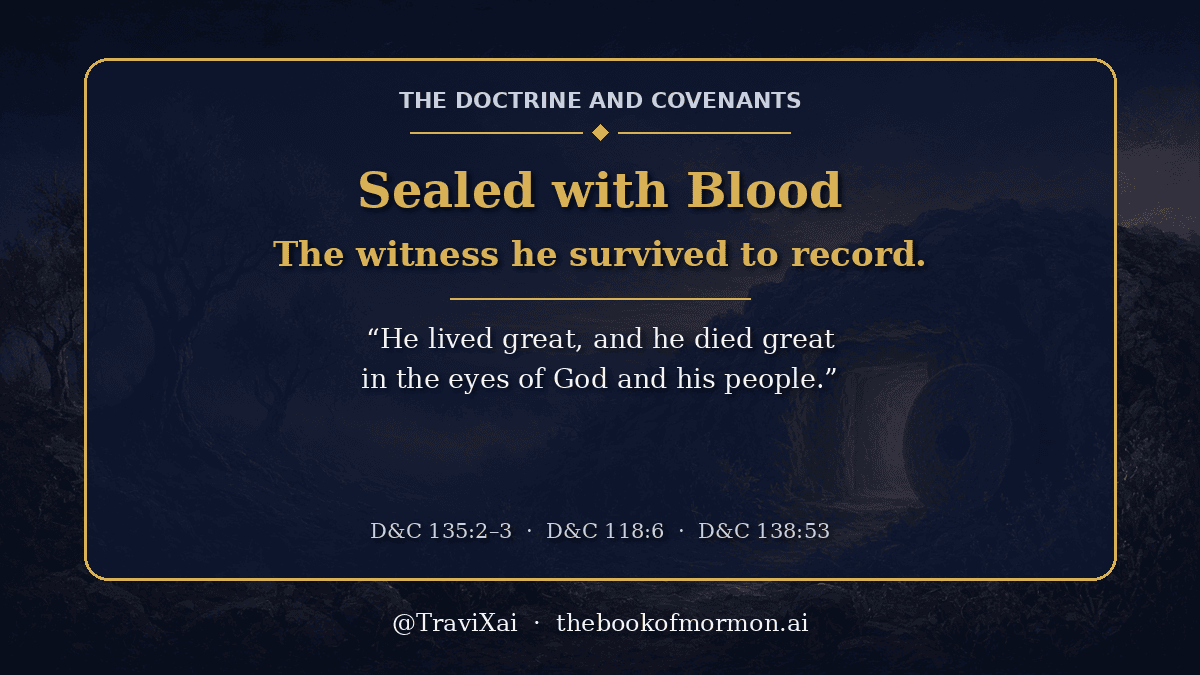
The section attributed to Taylor gives the verdict on Joseph Smith: “Joseph Smith, the Prophet and Seer of the Lord, has done more, save Jesus only, for the salvation of men in this world, than any other man that ever lived in it. … He lived great, and he died great in the eyes of God and his people” (D&C 135:3). Note “save Jesus only.” Joseph is ranked below Christ, by the man who bled beside him. And in his vision of the spirit world, Joseph F. Smith saw “The Prophet Joseph Smith, and my father, Hyrum Smith, Brigham Young, John Taylor, Wilford Woodruff, and other choice spirits who were reserved to come forth in the fulness of times” (D&C 138:53).
The Pearl of Great PriceHe made it scripture
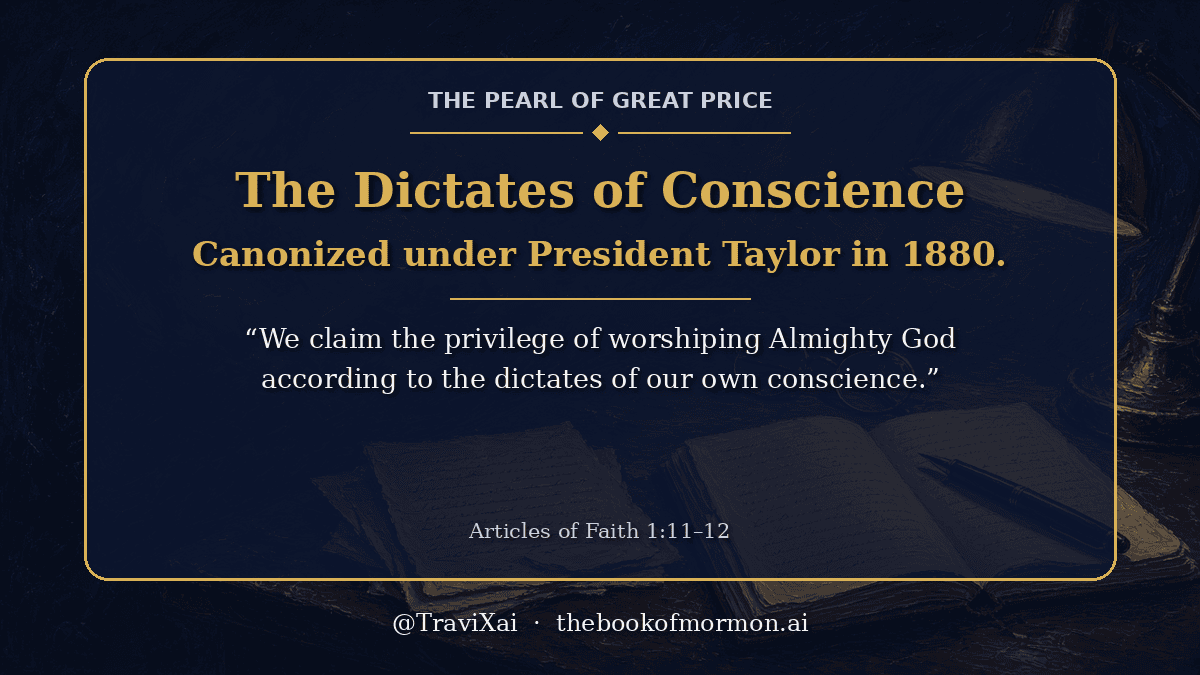
The Pearl of Great Price became a standard work in October 1880, the conference that sustained Taylor as President. It includes the Articles of Faith, and two of them define his last decade: “We claim the privilege of worshiping Almighty God according to the dictates of our own conscience, and allow all men the same privilege, let them worship how, where, or what they may” and “We believe in being subject to kings, presidents, rulers, and magistrates, in obeying, honoring, and sustaining the law” (Articles of Faith 1:11–12). Taylor felt the full tension between those two. He argued in the courts and in print that the anti-polygamy laws violated the First Amendment; the Supreme Court ruled against the Saints in 1879. The tension resolved under Wilford Woodruff by revelation, not by Taylor abandoning his conscience. See What Is the Pearl of Great Price? and What Are the Articles of Faith?.
Check the premiseThe presuppositions baked into the question
Before this question can be answered fairly, the person asking has to justify a few assumptions packed inside it:
- That John Taylor’s watch is proof a bullet was miraculously stopped, or proof the story is fake. Neither. The Church History Department said in 2023 that the cause of the damage cannot be determined. He survived four wounds either way.
- That he was a caretaker between Brigham Young and Wilford Woodruff. He was an apostle for about 40 years, a Carthage witness, and the President who canonized the Pearl of Great Price.
- That his 1886 revelation obligates the Church to practice polygamy. It was never presented to or accepted by the Church. Fundamentalist groups use it; the Church does not.
- That hiding from marshals means he was a lawbreaker at heart. He held the anti-polygamy laws were unconstitutional attacks on religion, and Articles of Faith 1:11–12 show both sides of the tension he lived.
FAQQuick answers
Who was John Taylor?
The third President of The Church of Jesus Christ of Latter-day Saints (1880–1887), an English-born convert and apostle who survived Carthage Jail.
Where was John Taylor born?
In Milnthorpe, England, on November 1, 1808. He joined the Church in Toronto, Canada, in 1836.
Who converted John Taylor?
Parley P. Pratt, who preached in Toronto in 1836. John and Leonora Taylor were baptized that year.
Was John Taylor at Carthage Jail?
Yes. He was shot four times in the attack that killed Joseph and Hyrum Smith on June 27, 1844, and survived.
Did John Taylor’s watch stop a bullet?
He believed so. In 2023 the Church History Department said the cause of the watch’s damage cannot be determined.
When was John Taylor President of the Church?
He led as President of the Twelve from 1877 and was sustained President of the Church on October 10, 1880, serving until his death in 1887.
What did John Taylor do as President?
He canonized the Pearl of Great Price, declared the 1880 jubilee, approved the Primary and wrote The Mediation and Atonement.
How did John Taylor die?
He died on July 25, 1887, in Kaysville, Utah, while in hiding from federal marshals enforcing anti-polygamy laws.
SummaryKey takeaways
- Born in England in 1808; baptized in Toronto in 1836.
- Named an apostle by revelation (D&C 118:6), ordained in 1838.
- Shot four times at Carthage; the watch’s damage cause is unknown.
- Third President of the Church, 1880–1887; canonized the Pearl of Great Price.
- Died in hiding in Kaysville, Utah, on July 25, 1887.
Read D&C 135 and remember who wrote it from experience. For quick, sourced answers, open Galatians18, and follow me on X at @TraviXai.
Sources
- King James Bible (churchofjesuschrist.org): Acts 5:41 · Revelation 14:6
- Book of Mormon: Alma 34:9–10
- Doctrine and Covenants: D&C 118:6 · D&C 135:2–3 · D&C 138:53
- Pearl of Great Price: Articles of Faith 1:11–12
- Church History Topics, “John Taylor” · Joseph Smith Papers, “Taylor, John”
- Church History Library, “John Taylor’s Pocket Watch” · BYU Studies, “A Forensic and Historical Look at John Taylor’s Watch”
- Featured image and in-article graphic: original graphics by thebookofmormon.ai (painterly backgrounds; no photographs or likenesses of real people).