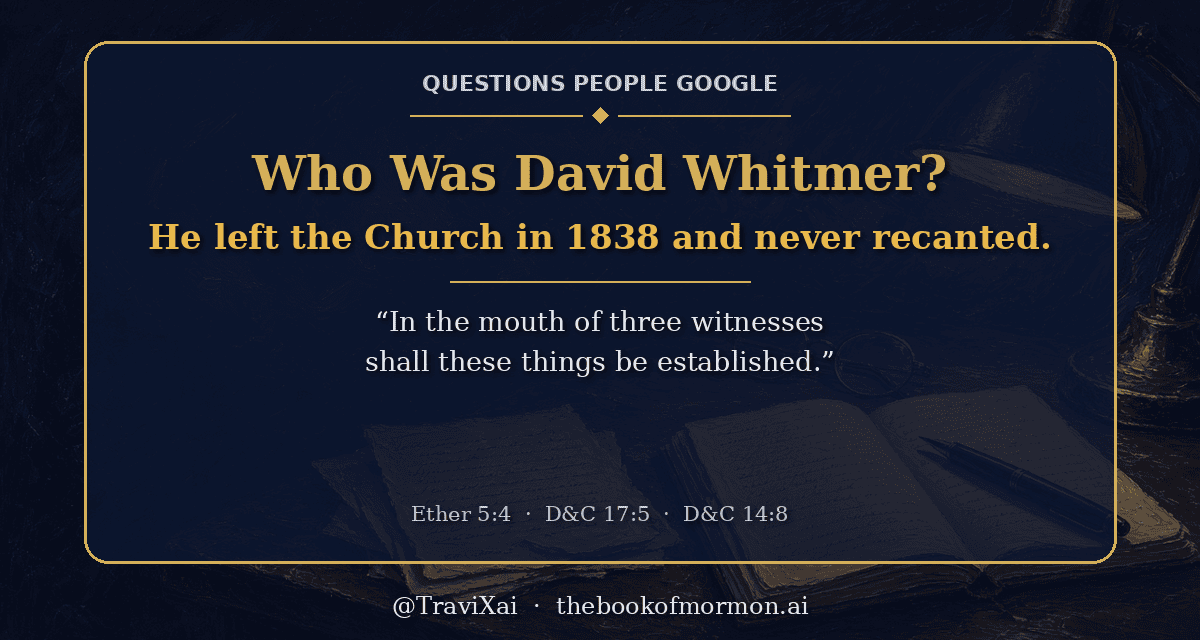

He saw the plates in 1829, left the Church in 1838, and spent the next fifty years in Richmond, Missouri, still saying the same thing. That is not how a hoax usually ends.
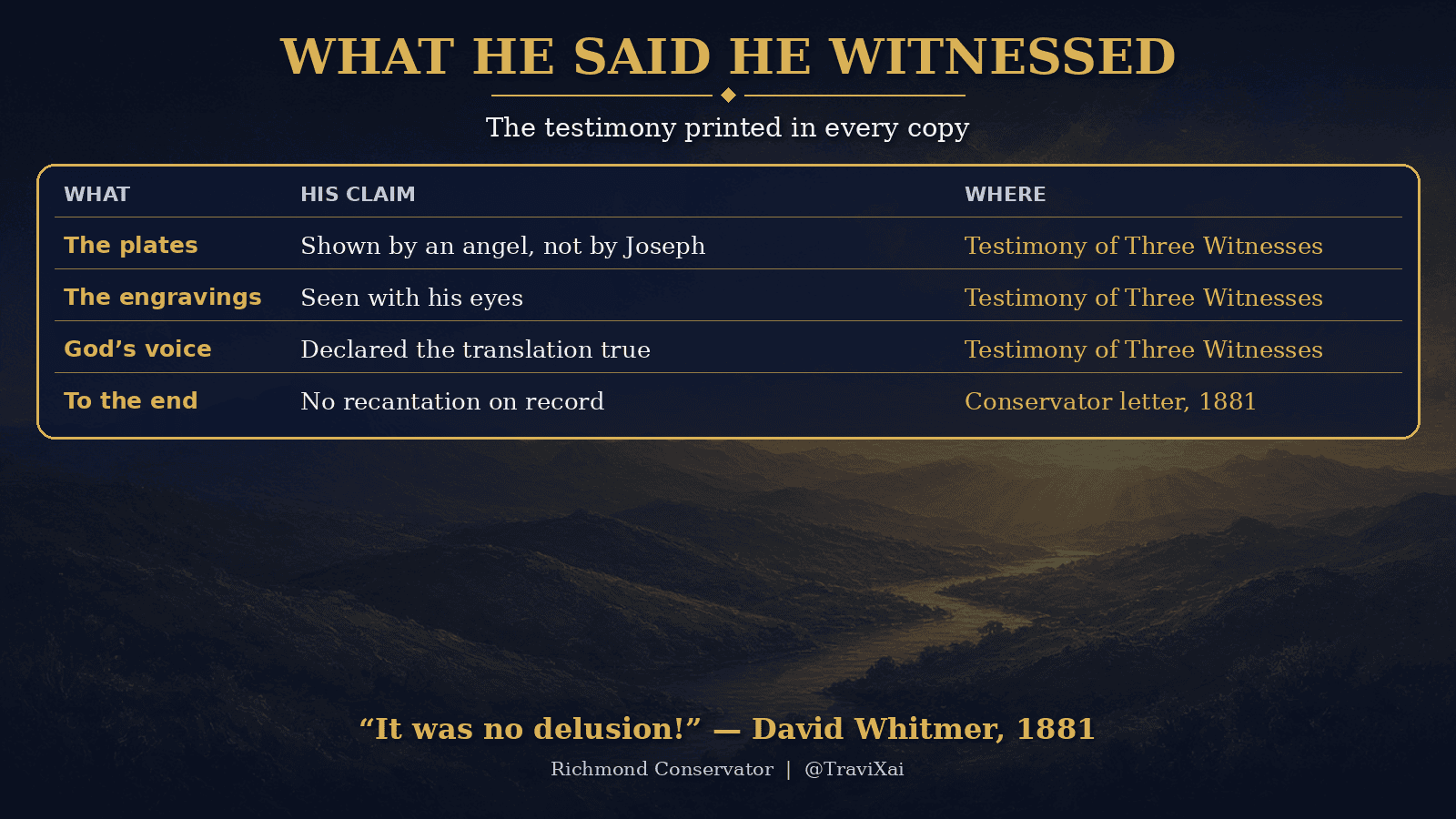
David Whitmer was one of the Three Witnesses of the Book of Mormon, and the one of the three who never came back. In June 1829 he testified that an angel showed him the plates and that the voice of God declared the translation true. The book was finished in his father’s home in Fayette, New York. He was among the six original members of the Church on April 6, 1830, and later president of the Church in Missouri. He was excommunicated at Far West on April 13, 1838, was elected mayor of Richmond, Missouri, in 1867, and died there on January 25, 1888, still bearing that testimony. He never recanted.
Who he wasThe last of the Three Witnesses
David Whitmer was born January 7, 1805, near Harrisburg, Dauphin County, Pennsylvania, the son of Peter Whitmer Sr. and Mary Musselman Whitmer. His family moved to western New York, and by 1829 they were in Fayette, Seneca County. He is one of the Three Witnesses of the Book of Mormon. In June 1829 he helped arrange for Joseph Smith and Oliver Cowdery to finish the translation in his father’s home. He was baptized by Joseph Smith in Seneca Lake that same month. On April 6, 1830, he was among the six original members of the Church and was ordained an elder. Those dates are from the Joseph Smith Papers biographical directory, not from later legend.
He was also the one of the three who never came back. Oliver Cowdery and Martin Harris both returned to the Church. David did not. He was excommunicated at Far West on April 13, 1838, lived the next fifty years in Richmond, Missouri, and died there on January 25, 1888, still bearing the same testimony he had signed in 1829. That is the fact a fraud theory has to explain, and usually tries to skip. See Who Was Oliver Cowdery? and Who Was Martin Harris?.
Fayette, the plates, and D&C 14A promised view, then a name on the flyleaf
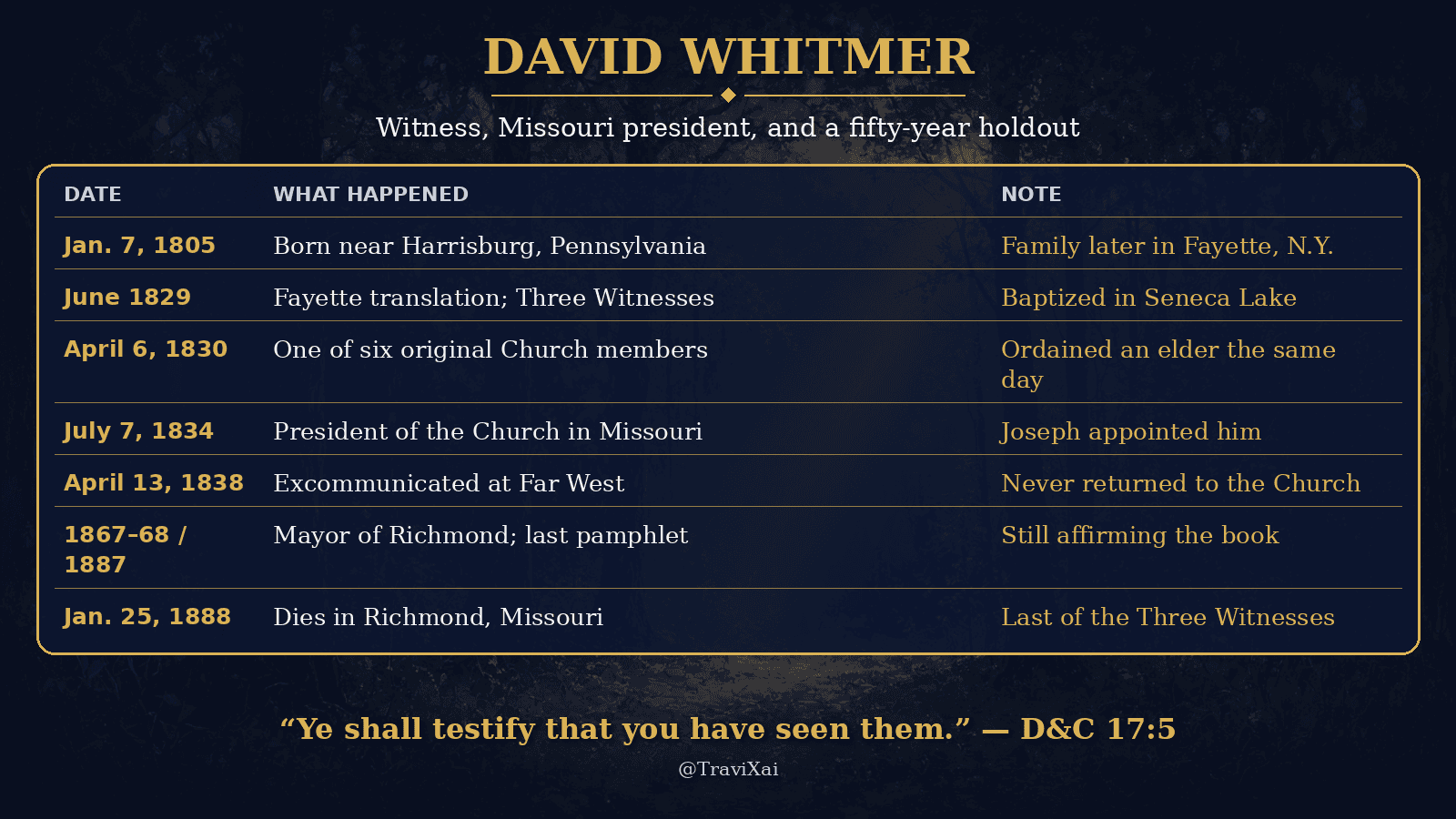
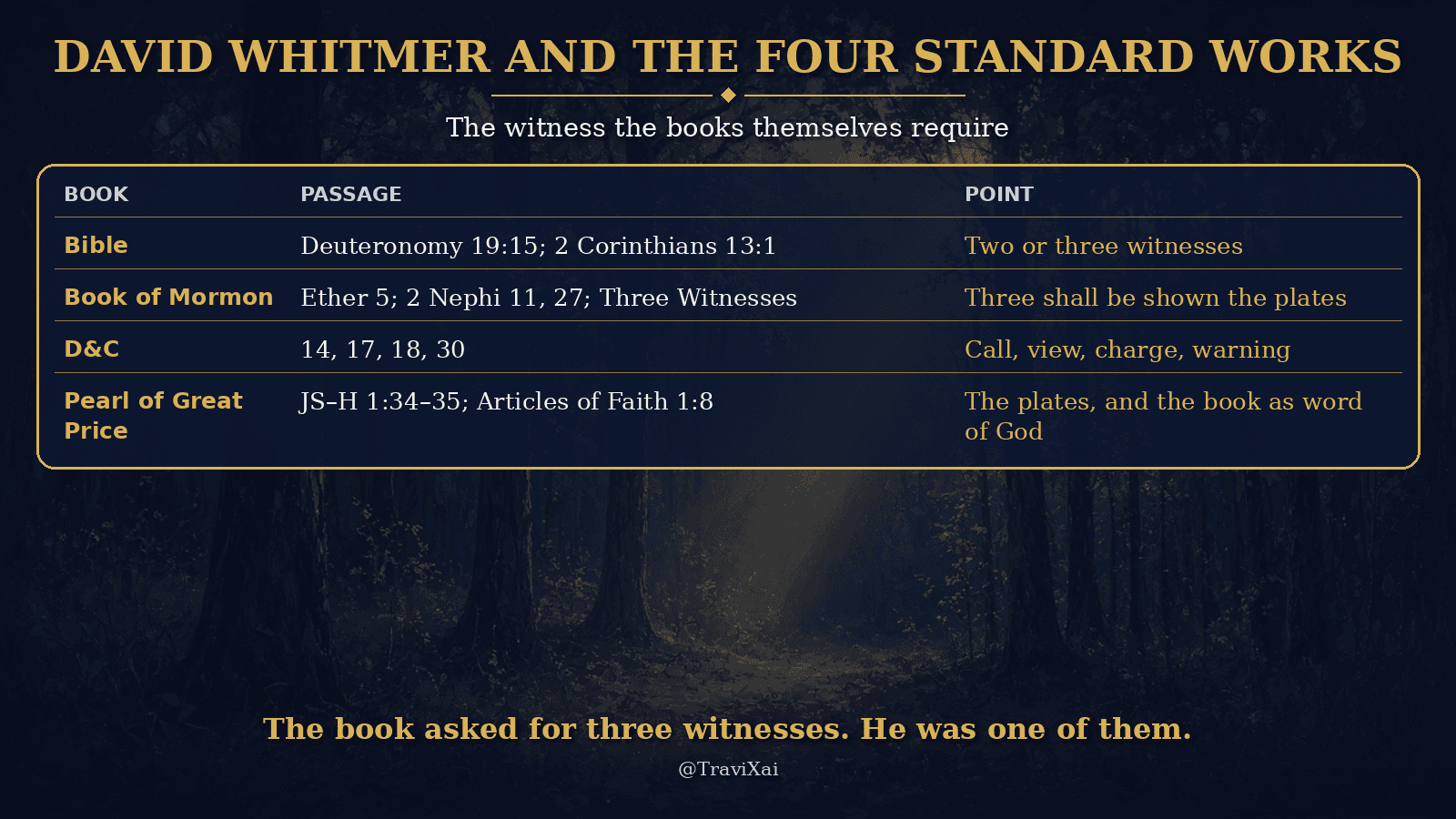
The Book of Mormon had already written the job description. “Unto three shall they be shown by the power of God; wherefore they shall know of a surety that these things are true. And in the mouth of three witnesses shall these things be established” (Ether 5:3–4). Nephi said the same thing: the book would be “hid from the eyes of the world,” except that “three witnesses shall behold it, by the power of God,” and that they would “testify to the truth of the book and the things therein” (2 Nephi 27:12). Before that, Nephi had already invoked the biblical rule: “by the words of three, God hath said, I will establish my word” (2 Nephi 11:3).
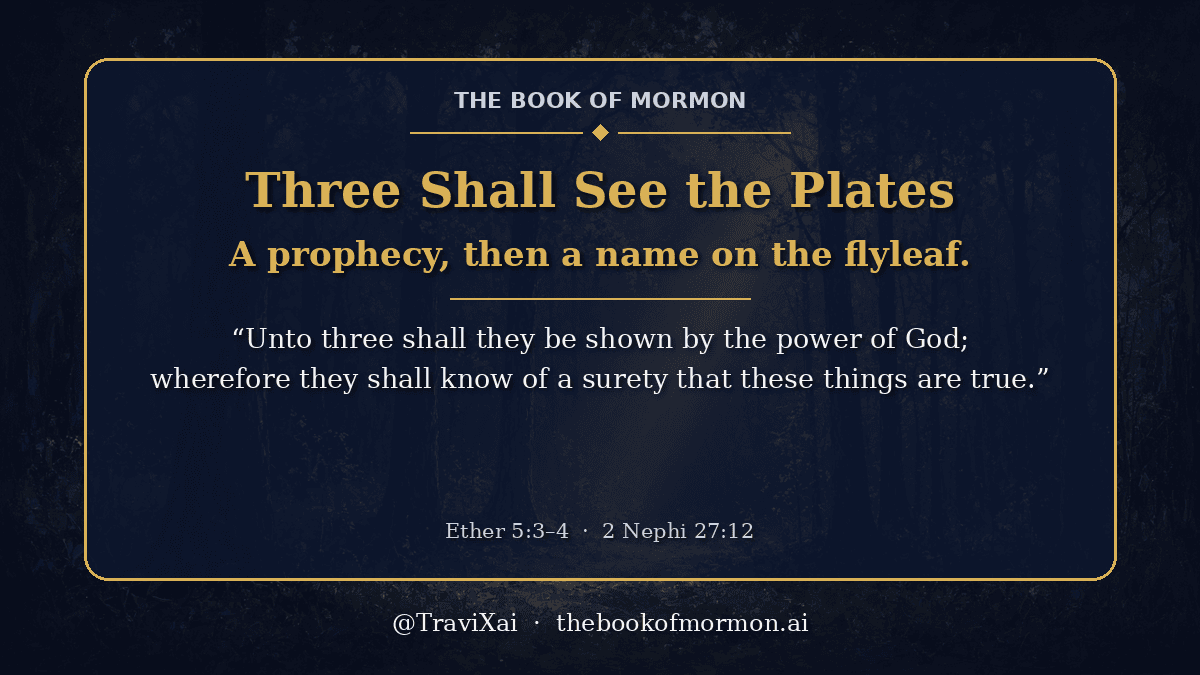
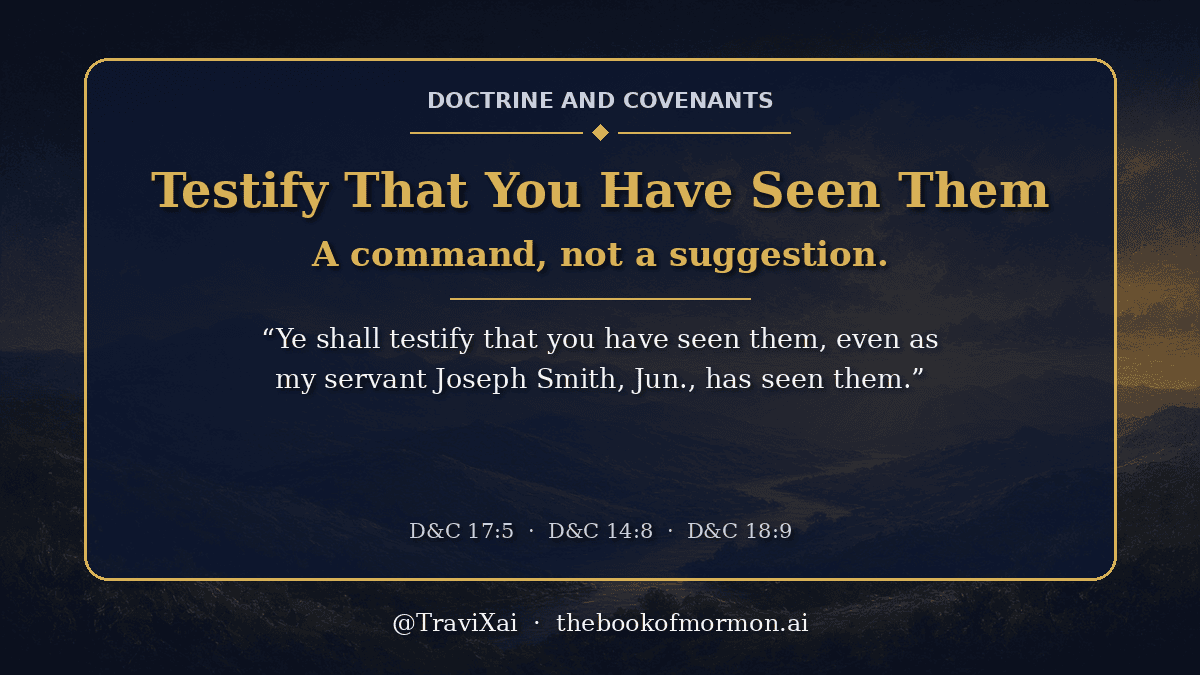
In June 1829 the Lord addressed David directly. “If you shall ask the Father in my name, in faith believing, you shall receive the Holy Ghost, which giveth utterance, that you may stand as a witness of the things of which you shall both hear and see” (D&C 14:8). D&C 17 then promised him, with Oliver and Martin, “a view of the plates, and also of the breastplate, the sword of Laban, the Urim and Thummim,” and the directors given to Lehi, and commanded, “ye shall testify that you have seen them, even as my servant Joseph Smith, Jun., has seen them” (D&C 17:1, 5). The written Testimony of Three Witnesses, printed in every copy of the Book of Mormon, is that testimony: they saw the plates and the engravings, “shown unto us by the power of God, and not of man,” and “an angel of God came down from heaven, and he brought and laid before our eyes, that we beheld and saw the plates.” They also testified that “his voice hath declared it unto us; wherefore we know of a surety that the work is true.”
Later that month the Lord spoke to Oliver and David “even as unto Paul mine apostle, for you are called even with that same calling with which he was called” (D&C 18:9). That is a heavy line. It also makes the later break more, not less, significant. A man flattered into a hoax does not usually spend fifty years refusing to walk the claim back. See Is the Book of Mormon True? and Who Wrote the Book of Mormon?.
Missouri, 1838, and the years that followedHe left the Church. He did not leave the witness.
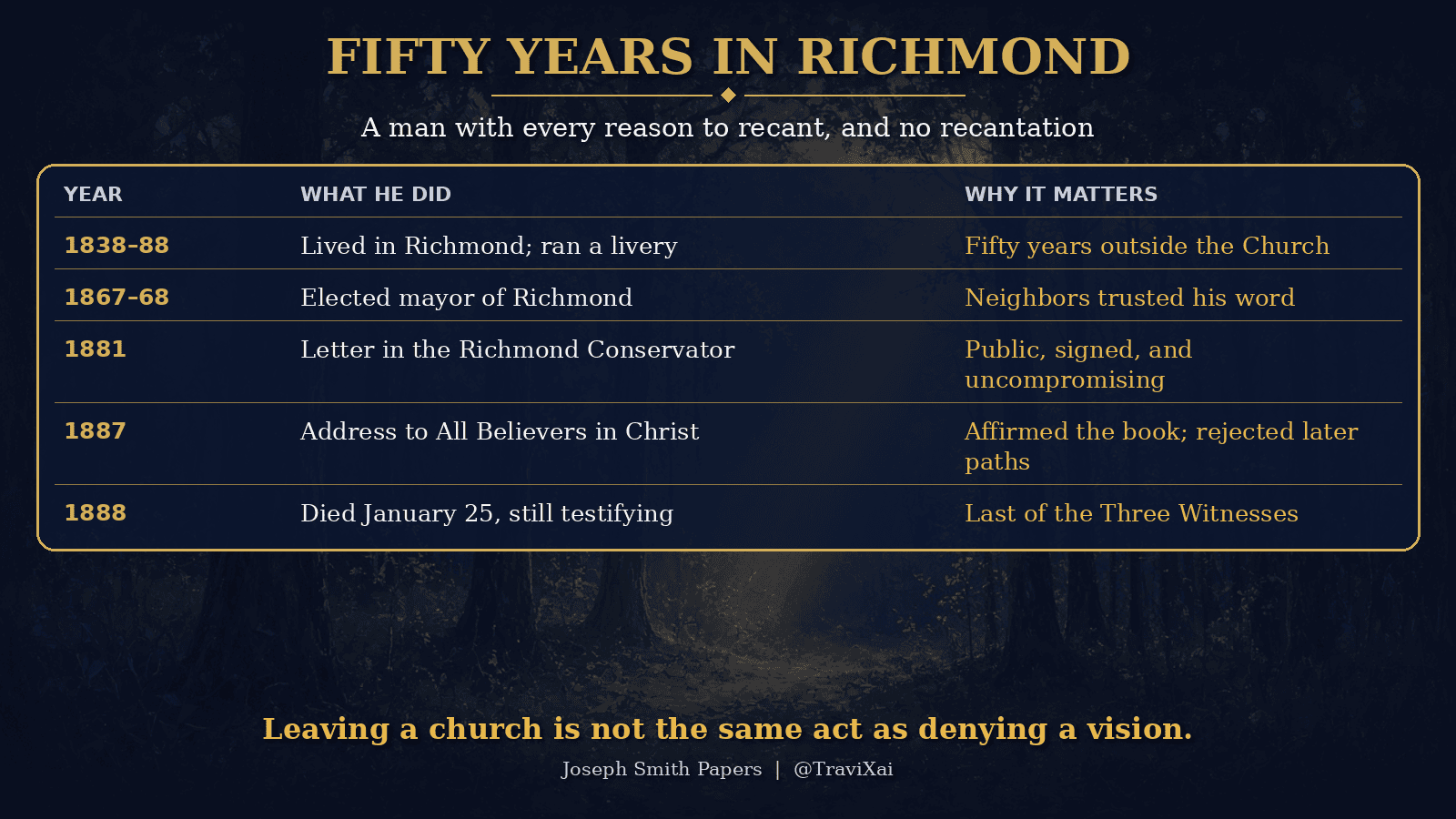
On July 7, 1834, Joseph appointed David president of the Church in Missouri. That trust did not hold. In February 1838 he was rejected as president in Missouri, and on April 13, 1838, he was excommunicated at Far West. He never returned to The Church of Jesus Christ of Latter-day Saints. In 1875 he organized a small Church of Christ, and in 1887 he published An Address to All Believers in Christ, by a Witness to the Divine Authenticity of the Book of Mormon. In that pamphlet he still defended the Book of Mormon and still rejected later developments, including plural marriage. Those later disagreements are real, and they should be stated plainly. They do not erase June 1829. If anything, they isolate it. A man willing to break with Joseph, with Brigham, and with the body of the Church still would not say he had not seen what he had seen.
D&C 30 had already warned him, months after the Church was organized: “you have feared man and have not relied on me for strength as you ought,” and “your mind has been on the things of the earth more than on the things of me, your Maker” (D&C 30:1–2). The canon does not flinch at a witness’s weakness. It also does not let later weakness rewrite the earlier view of the plates.
The Richmond yearsMayor, a public letter, and no recantation
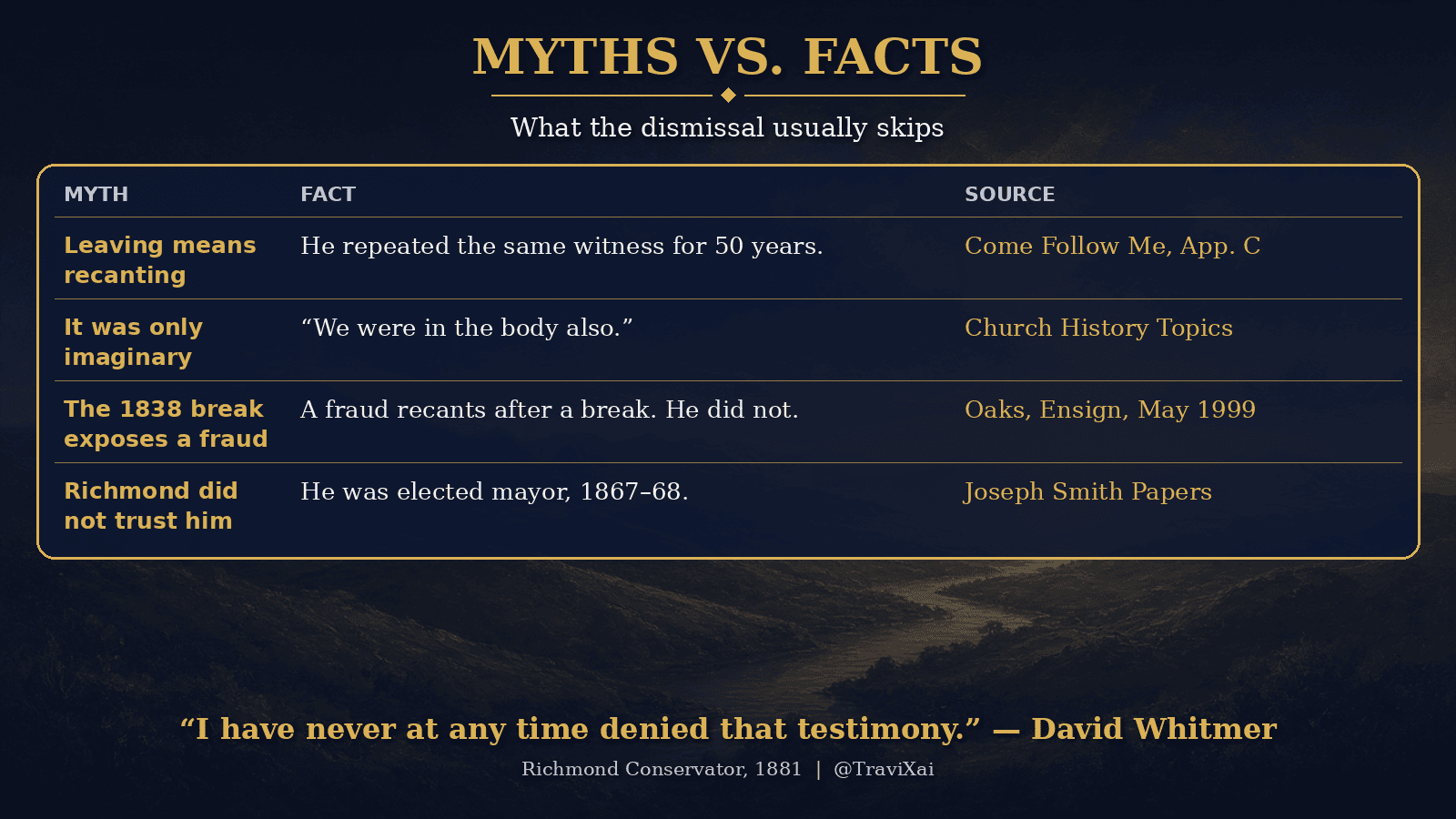
After 1838 David settled in Richmond, Ray County, Missouri, and kept a livery stable. The Joseph Smith Papers record that he was elected mayor of Richmond for 1867–1868. That is not a man hiding in disgrace. In later years, when rumors spread that he had denied his testimony, he answered in a letter published in the Richmond Conservator in 1881. Come Follow Me, Appendix C, quotes him: “I have never at any time denied that testimony, or any part thereof, which has so long since been published with that Book, as one of the three witnesses. Those who know me best, well know that I have always adhered to that testimony.” He added, “it was no delusion!”
Some critics lean on phrases like “spiritual view” and hope you will hear “imaginary.” Church History Topics quotes Whitmer’s own clarification: “Of course we were in the spirit when we had the view, for no man can behold the face of an angel, except in a spiritual view,” he said, “but we were in the body also, and everything was as natural to us, as it is at any time.” That is not a man walking the statement back. That is a man trying to describe an angelic encounter without pretending it was an ordinary afternoon on the farm. The Eight Witnesses were shown the plates by Joseph himself and “hefted” them. The two testimonies are not rivals. They are two kinds of evidence the book itself said would come: three who would see by the power of God, and “a few according to the will of God” who would also bear record (2 Nephi 27:13). See Where Are the Golden Plates Now?.
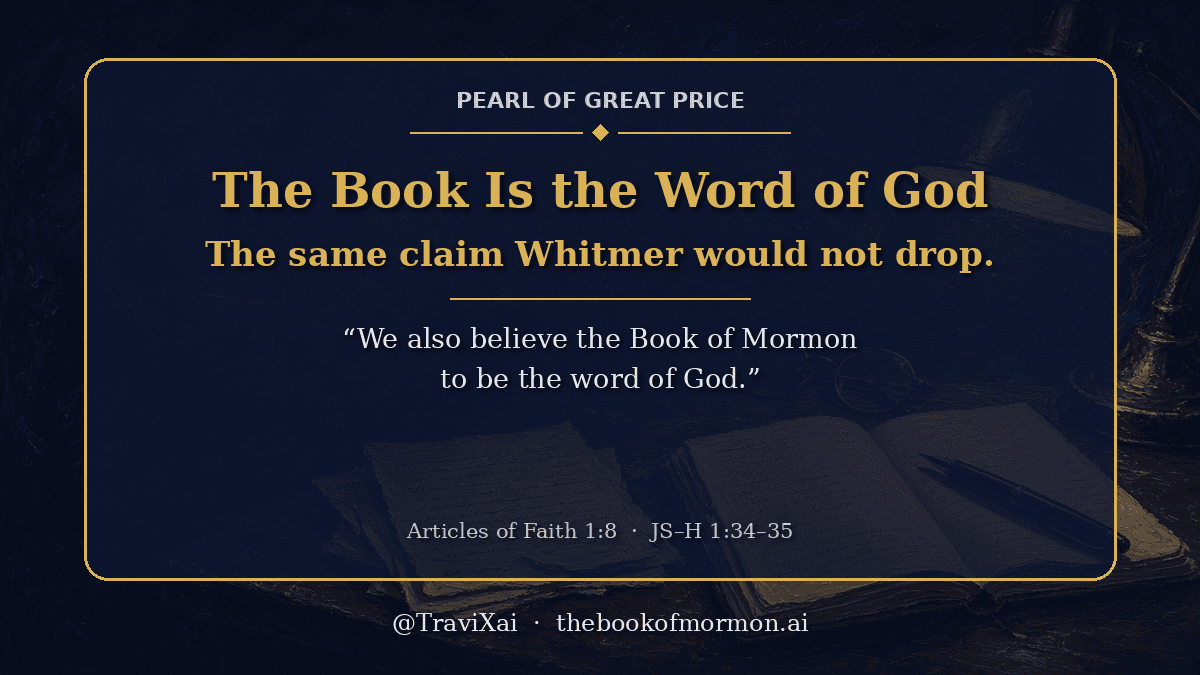
The Pearl of Great Price puts the same claim in a shorter creed: “We also believe the Book of Mormon to be the word of God” (Articles of Faith 1:8). Joseph Smith—History records what Moroni said the plates contained: “a book deposited, written upon gold plates, giving an account of the former inhabitants of this continent,” with the Urim and Thummim “deposited with the plates” (Joseph Smith—History 1:34–35). David Whitmer said he saw those plates. He said it in 1829, he said it after he left the Church, he said it as an old man in Richmond, and he never published a denial.
Check the premiseThe presuppositions baked into the question
Before this question can be answered fairly, the person asking has to justify a few assumptions packed inside it:
- That a witness who left the Church must have recanted. David was out of the Church for fifty years, from 1838 to 1888. No denial of his signed testimony is on record. In 1881 he published a letter saying he had never denied it “or any part thereof.”
- That “spiritual” language means the plates were imaginary. Whitmer said they were “in the body also, and everything was as natural to us, as it is at any time.” Church History Topics quotes that clarification for a reason.
- That later disagreement with Joseph or with Brigham disproves the 1829 experience. It does the opposite. He had motive, time, and a public platform to recant. He used the platform to reaffirm the Book of Mormon.
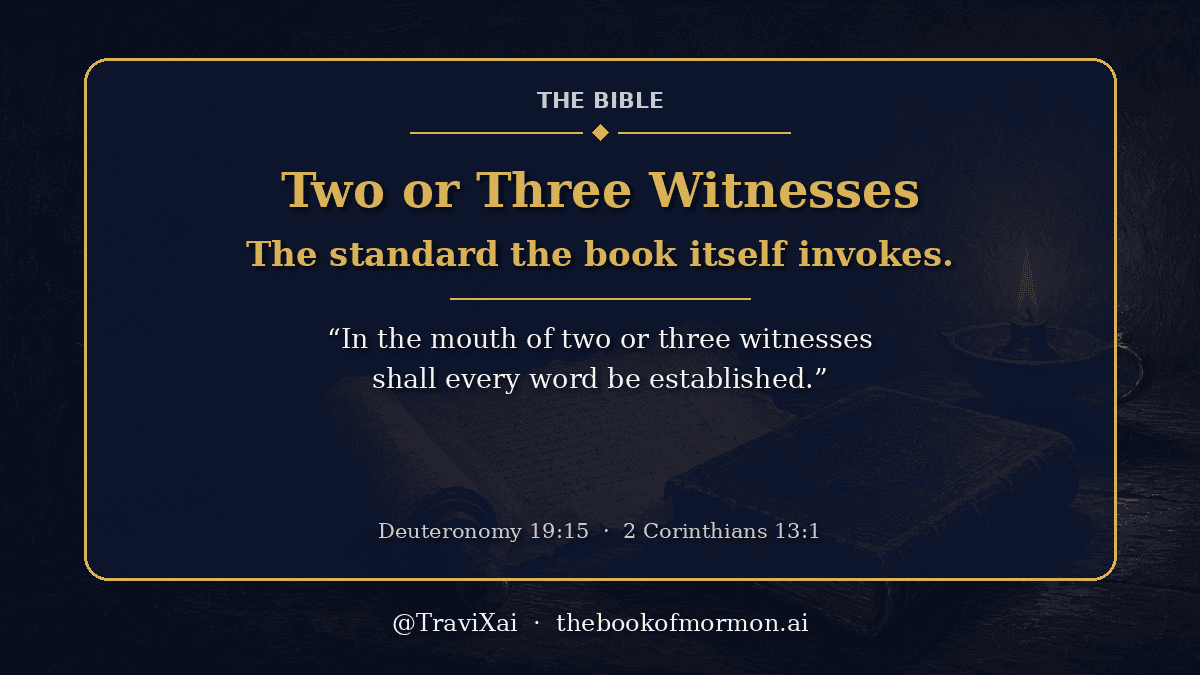
- That one man’s testimony is enough to accept or dismiss the book. The book itself refused that standard. It required three witnesses, then “a few” more, and then the reader’s own inquiry of God.
FAQQuick answers
Who was David Whitmer?
One of the Three Witnesses of the Book of Mormon (1805–1888). The translation was finished at his father’s home in Fayette, New York, in June 1829, and he was among the six original members of the Church on April 6, 1830.
Was David Whitmer one of the Three Witnesses?
Yes, with Oliver Cowdery and Martin Harris. Their testimony, printed in every copy of the Book of Mormon, says an angel showed them the plates and the voice of God declared the translation true.
Did David Whitmer leave the Church?
Yes. He was rejected as president of the Church in Missouri in February 1838 and excommunicated at Far West on April 13, 1838. He never returned.
Did David Whitmer deny his testimony?
No. In an 1881 letter published in the Richmond Conservator, quoted in Come Follow Me, Appendix C, he said he had “never at any time denied that testimony, or any part thereof.”
Was David Whitmer mayor of Richmond, Missouri?
Yes. The Joseph Smith Papers record that he was elected mayor of Richmond for 1867–1868. He also kept a livery stable there for decades.
What was An Address to All Believers in Christ?
A pamphlet David published in 1887. He still called himself a witness to the divine authenticity of the Book of Mormon, and he rejected some later developments, including plural marriage.
When and where did David Whitmer die?
January 25, 1888, in Richmond, Ray County, Missouri, the last of the Three Witnesses to die.
Is David Whitmer mentioned in scripture?
Yes. D&C 14 and 30 are addressed to him, D&C 17 and 18 include him, and he signed the Testimony of Three Witnesses in the Book of Mormon.
SummaryKey takeaways
- One of the Three Witnesses, June 1829, with Oliver Cowdery and Martin Harris.
- The Book of Mormon translation was finished at the Whitmer home in Fayette, New York.
- Among the six original members of the Church, April 6, 1830; later president of the Church in Missouri.
- Excommunicated April 13, 1838; never returned; never denied the published testimony.
- Elected mayor of Richmond, 1867–1868; died there January 25, 1888, the last of the Three Witnesses.
Read Ether 5, D&C 17 and the Testimony of Three Witnesses tonight. For quick, sourced answers, open Galatians18, and follow me on X at @TraviXai.
Sources
- King James Bible (churchofjesuschrist.org): Deuteronomy 19:15 · 2 Corinthians 13:1
- Book of Mormon: Ether 5:2–4 · 2 Nephi 11:3 · 2 Nephi 27:12–14 · The Testimony of Three Witnesses
- Doctrine and Covenants: D&C 14:1–8 · D&C 17:1–9 · D&C 18:9 · D&C 30:1–4
- Pearl of Great Price: JS–H 1:34–35 · Articles of Faith 1:8
- Come Follow Me, Appendix C: The Three Witnesses · Church History Topics, “Witnesses of the Book of Mormon” · Joseph Smith Papers, “Whitmer, David” · David Whitmer Gravesite · Dallin H. Oaks, “The Witness: Martin Harris,” Ensign, May 1999
- Featured image and in-article graphic: original graphics by thebookofmormon.ai (painterly backgrounds; no photographs or likenesses of real people).