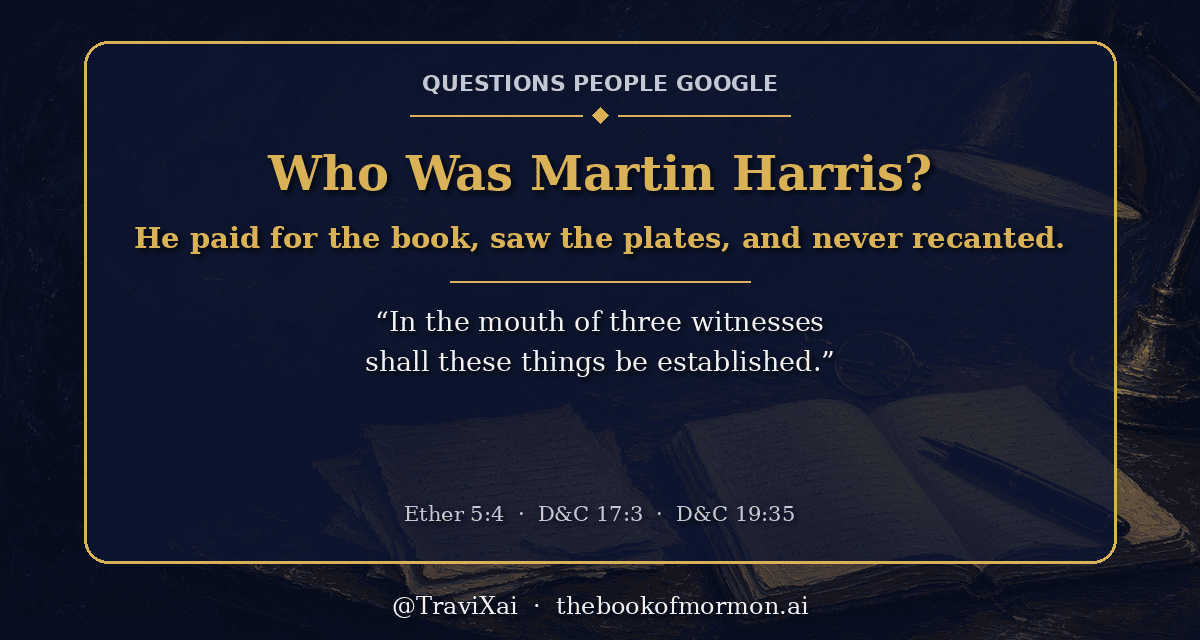

He mortgaged his farm to print the Book of Mormon, saw the plates, left the Church for a time, and died in Utah still saying the same thing. That is not how a hoax usually ends.
Martin Harris was the Palmyra farmer who paid to print the Book of Mormon and became one of its Three Witnesses. In June 1829 he testified that an angel showed him the plates and that the voice of God declared the translation true. He mortgaged his farm to pay the printer, as D&C 19 commanded. He lost the 116 pages in 1828, was rebuked, then humbled himself and received the promised witness. He left the Church in the Kirtland crisis of 1837 and never recanted. He came to Utah in 1870 at age 87, was rebaptized, and died in Clarkston on July 10, 1875, still bearing that testimony.
Who he wasThe farmer who paid for the book
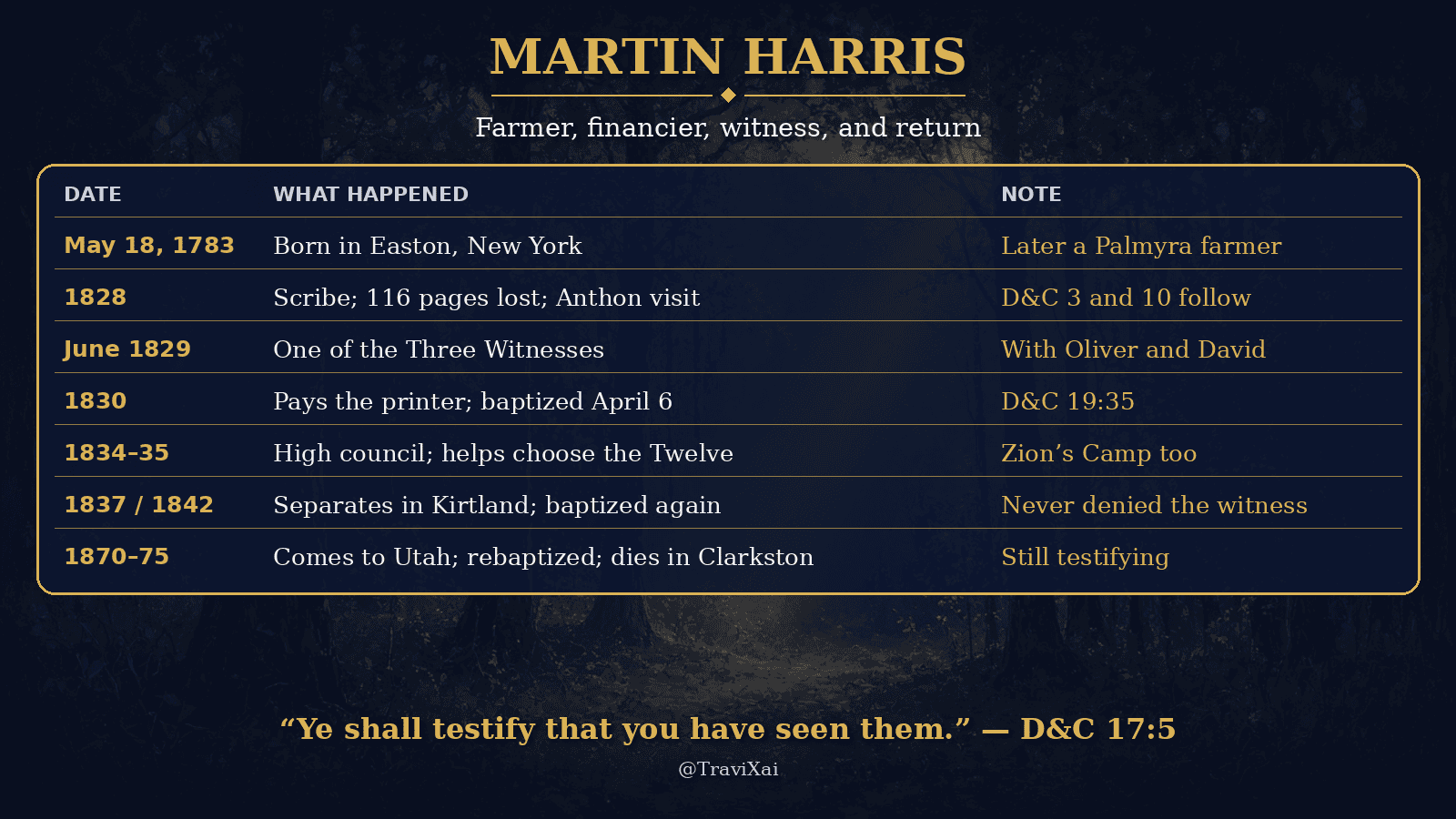
Martin Harris was born May 18, 1783, in Easton, Washington County, New York, and became a prosperous Palmyra farmer. He is one of the Three Witnesses of the Book of Mormon. He also financed the first edition: he mortgaged his farm to pay E. B. Grandin of Palmyra $3,000 to print 5,000 copies. The Lord had commanded him, “Pay the debt thou hast contracted with the printer. Release thyself from bondage” (D&C 19:35). A man who risks his land to print a book, then spends the rest of his life repeating the same witness, is not a footnote. He is a problem for the fraud theory.
He left the Church during the Kirtland crisis of 1837, was baptized again in 1842, stayed in Kirtland when the Saints went west, came to Utah in 1870 at age 87, and was rebaptized on September 17, 1870. He died July 10, 1875, in Clarkston, Utah Territory, still bearing the same testimony. See Who Was Oliver Cowdery? and Is the Book of Mormon True?.
The 116 pages, then the witnessesRebuke, then a view
In 1828 Martin served as scribe while Joseph translated the first manuscript of the Book of Mormon, 116 pages covering the book of Lehi. Martin took that manuscript home and it was lost. The Lord rebuked Joseph for delivering “that which was sacred into the hands of a wicked man, Who has set at naught the counsels of God, and has broken the most sacred promises which were made before God” (D&C 3:12–13). That is in the canon. It is not a flattering line. It is also not the end of the story. See What Were the 116 Lost Pages?.
The same Lord later told Joseph, of “the man that desires the witness,” that if he would “humble himself in mighty prayer and faith … then will I grant unto him a view of the things which he desires to see” (D&C 5:23–24). In June 1829, with Oliver Cowdery and David Whitmer, that promise was kept. The Lord had said: “after that you have obtained faith, and have seen them with your eyes, you shall testify of them, by the power of God … And ye shall testify that you have seen them, even as my servant Joseph Smith, Jun., has seen them” (D&C 17:3, 5).
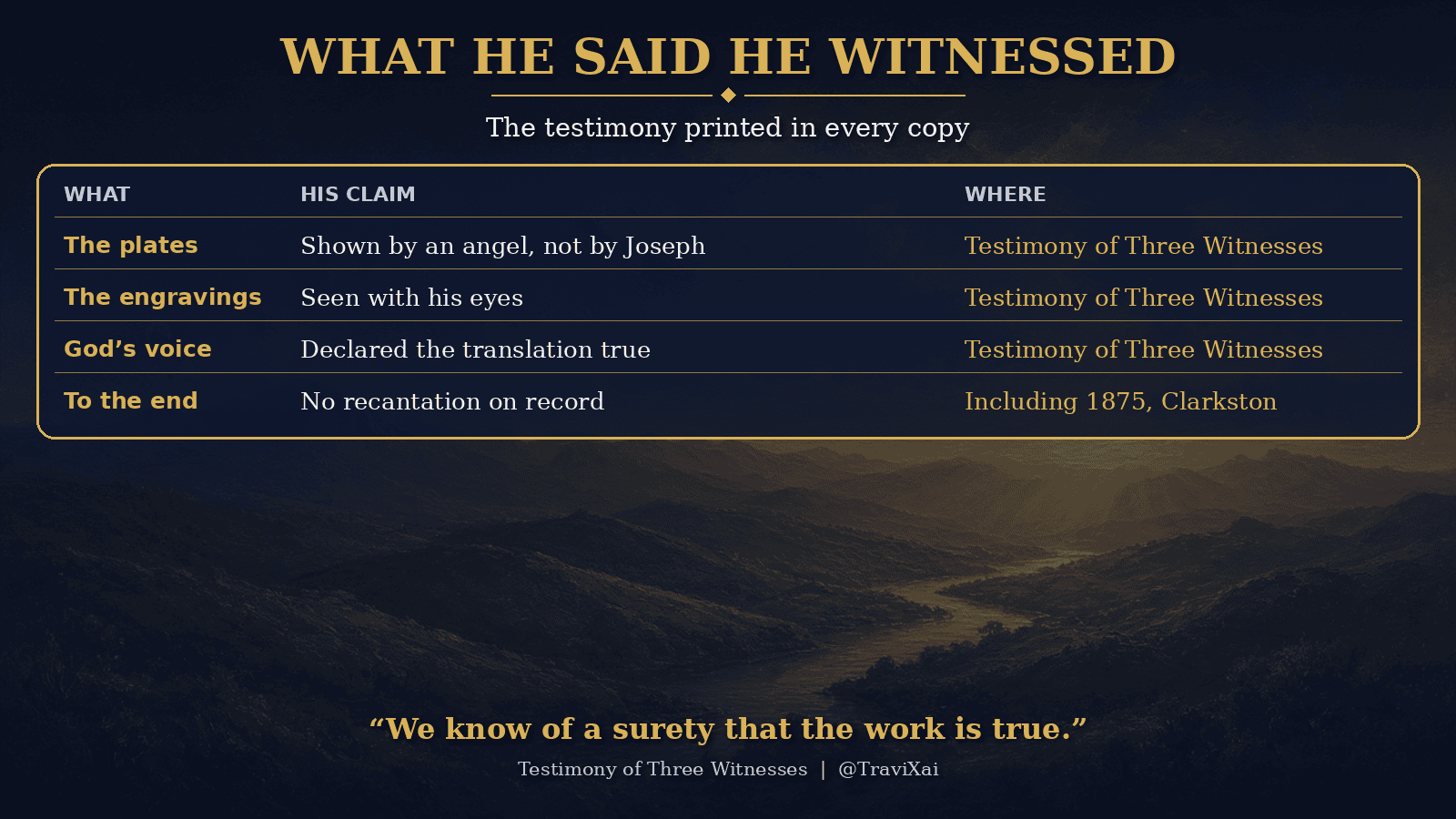
The Testimony of Three Witnesses, printed in every copy of the Book of Mormon, is their signed statement: they had “seen the plates which contain this record,” they knew the work was “translated by the gift and power of God, for his voice hath declared it unto us,” and “an angel of God came down from heaven, and he brought and laid before our eyes, that we beheld and saw the plates, and the engravings thereon.” That is not a claim that Joseph showed them a box in a barn. It is a claim that an angel did, and that the voice of God confirmed it.
The printer’s debtImpart thy property
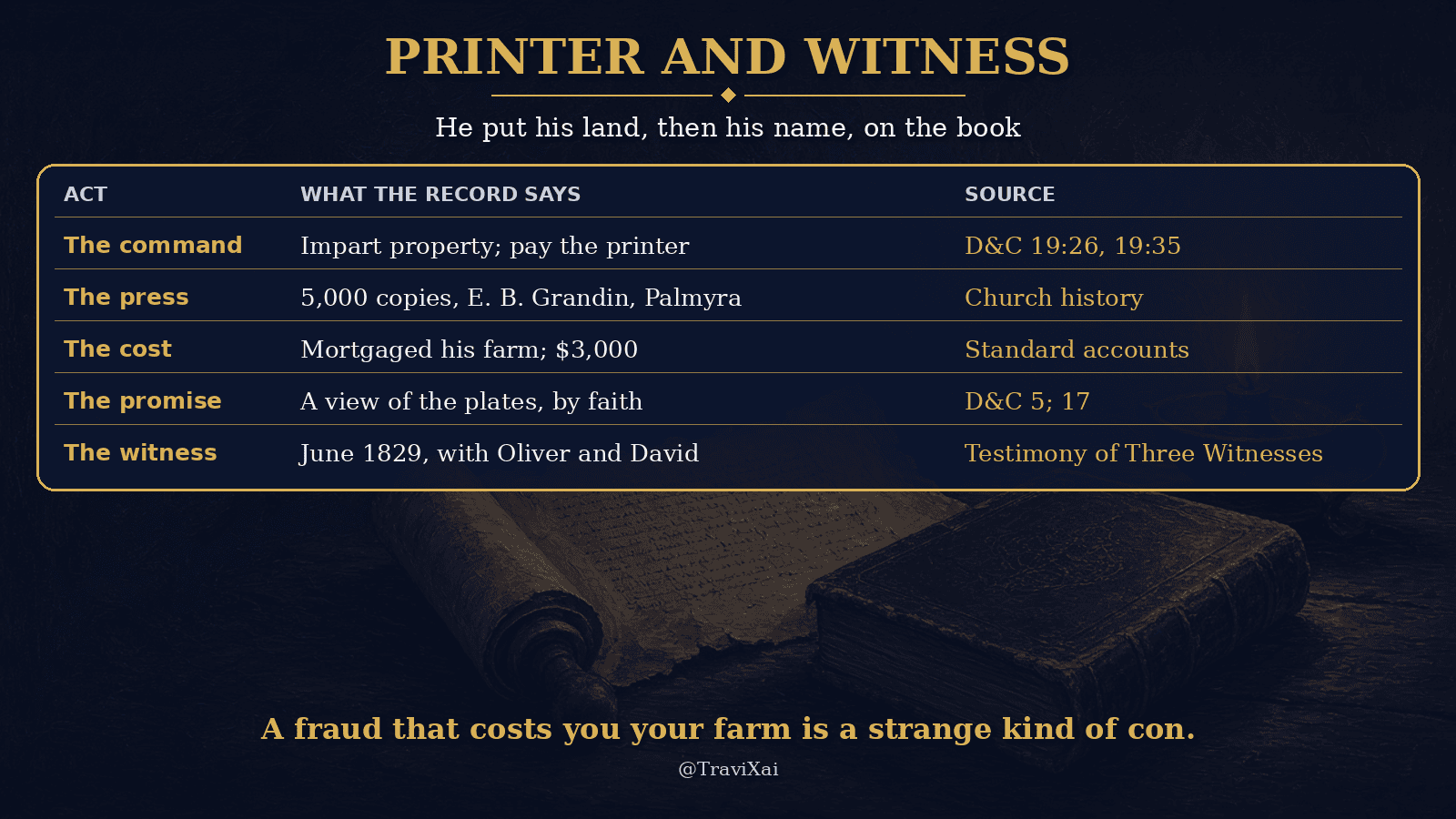
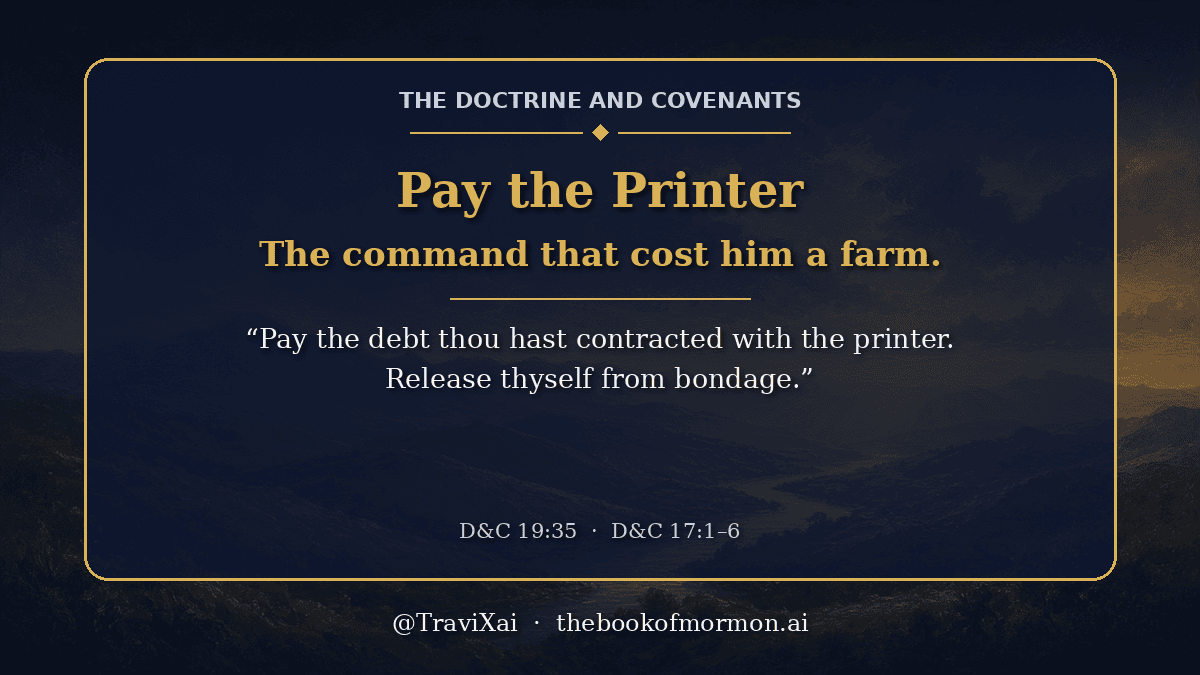
Section 19, given in March 1830, is aimed at Martin’s wallet as much as his soul: “thou shalt not covet thine own property, but impart it freely to the printing of the Book of Mormon, which contains the truth and the word of God … Impart a portion of thy property, yea, even part of thy lands, and all save the support of thy family. Pay the debt thou hast contracted with the printer. Release thyself from bondage” (D&C 19:26, 34–35). He did. The first edition came off Grandin’s press in Palmyra that year. If this were a confidence game, the financier chose a remarkably expensive way to play it, and then refused to cash out when he later broke with Joseph.
He left, and he did not recant1837 to 1875
Martin was in the first high council at Kirtland in 1834, marched with Zion’s Camp, and on February 14, 1835, as one of the Three Witnesses, helped select the first Quorum of the Twelve Apostles. In the Kirtland conflict of 1837 he was released from the high council and separated from the Church. He was baptized again on November 7, 1842, then remained in Kirtland for decades when the main body of the Saints went west, at times acting as a caretaker of the deserted Kirtland Temple. In all of that, no statement from Martin Harris denying his witness has ever been produced.
In 1870 Edward Stevenson accompanied him to Utah. He arrived in Salt Lake City on August 30, at eighty-seven, and was rebaptized on September 17. He moved to Harrisville, then Smithfield, then Clarkston, and died there on July 10, 1875. The Church’s Come Follow Me manual quotes him in later years: “I know the Book of Mormon to be verily true. And although all men should deny the truth of that book, I dare not do it. My heart is fixed.” The same manual quotes George Godfrey’s account of a conversation a few hours before Martin’s death. Asked whether there was “an element at least, of fraudulence and deception” in the coming forth of the book, Martin answered: “The Book of Mormon is no fake. I know what I know. I have seen what I have seen and I have heard what I have heard. I have seen the gold plates from which the Book of Mormon is written. An angel appeared to me and others and testified to the truthfulness of the record.”
The BibleIn the mouth of two or three witnesses
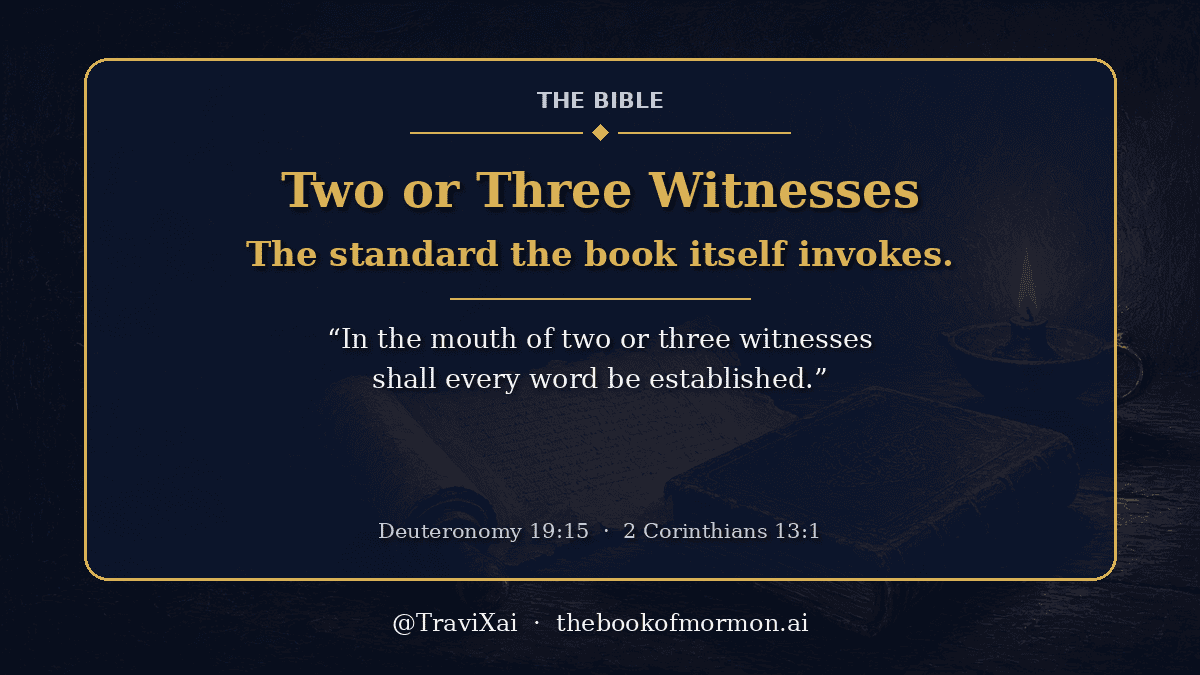
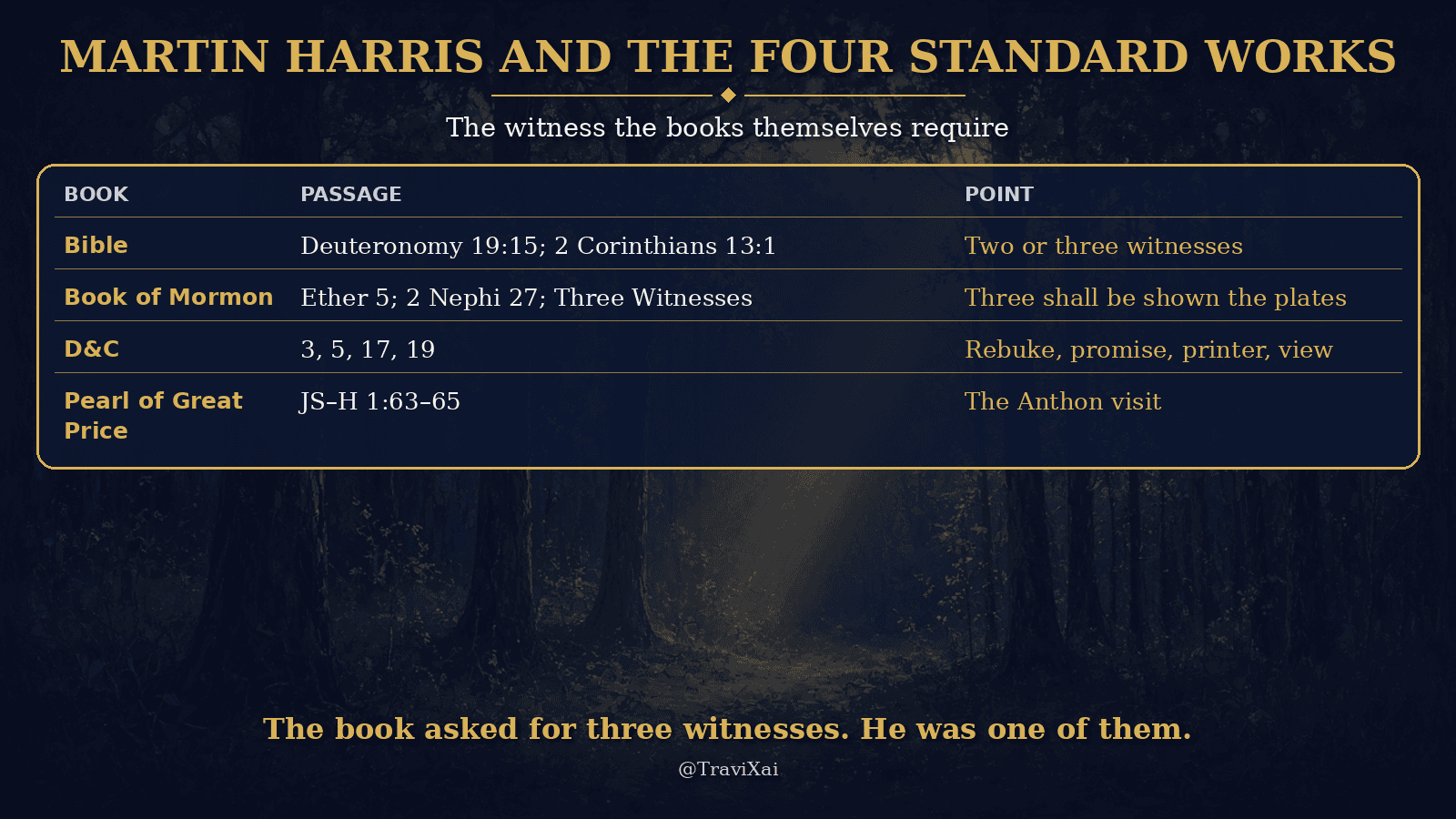
The law of witnesses is not a Latter-day Saint invention. “One witness shall not rise up against a man for any iniquity, or for any sin, in any sin that he sinneth: at the mouth of two witnesses, or at the mouth of three witnesses, shall the matter be established” (Deuteronomy 19:15). Paul repeats it: “In the mouth of two or three witnesses shall every word be established” (2 Corinthians 13:1). The Book of Mormon puts itself under that rule. Martin is one of the three names that rule required.
The Book of MormonThree shall be shown the plates
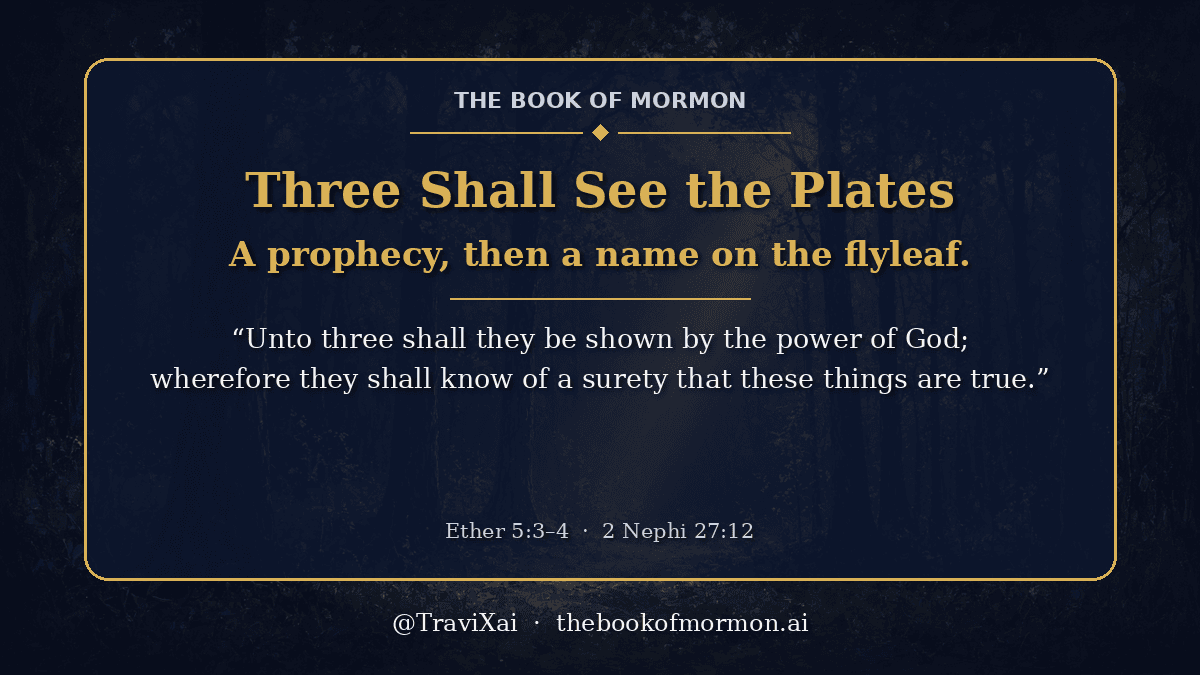
Moroni wrote to the future translator: “unto three shall they be shown by the power of God; wherefore they shall know of a surety that these things are true. And in the mouth of three witnesses shall these things be established” (Ether 5:3–4). Nephi had already seen the same requirement: “the eyes of none shall behold it save it be that three witnesses shall behold it, by the power of God, besides him to whom the book shall be delivered; and they shall testify to the truth of the book and the things therein” (2 Nephi 27:12). The prophecy is in the book. The signatures are in the front. See Who Wrote the Book of Mormon? and Where Are the Golden Plates Now?.
The Pearl of Great PriceThe Anthon visit
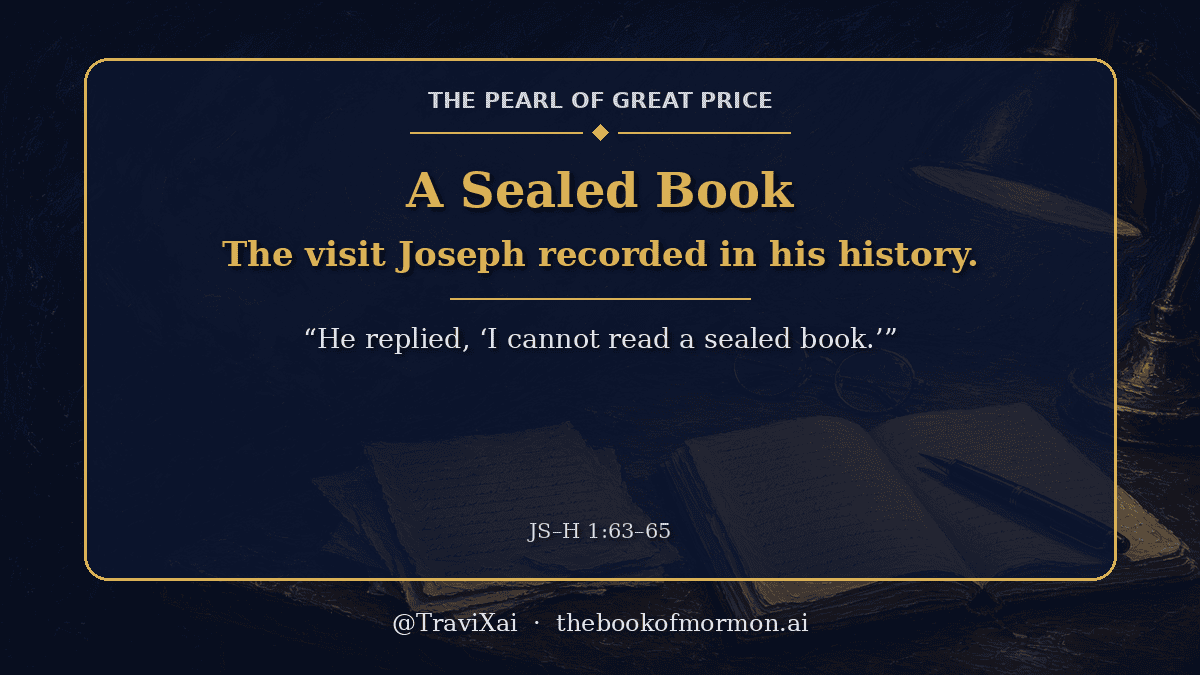
Joseph’s history records that Martin took a transcript of characters from the plates, and a translation of part of them, to scholars in the East, including Charles Anthon of Columbia College. In Joseph’s account, Anthon first gave Martin a statement, then tore it up, “saying that there was no such thing now as ministering of angels,” and, when told that part of the plates were sealed, replied, “I cannot read a sealed book” (JS–H 1:63–65). Anthon later gave his own, less friendly version of the meeting. The visit itself is not in dispute. What it shows is that Martin was already spending his money and his reputation to test the work before he ever saw the angel.
Check the premiseThe presuppositions baked into the question
Before this question can be answered fairly, the person asking has to justify a few assumptions packed inside it:
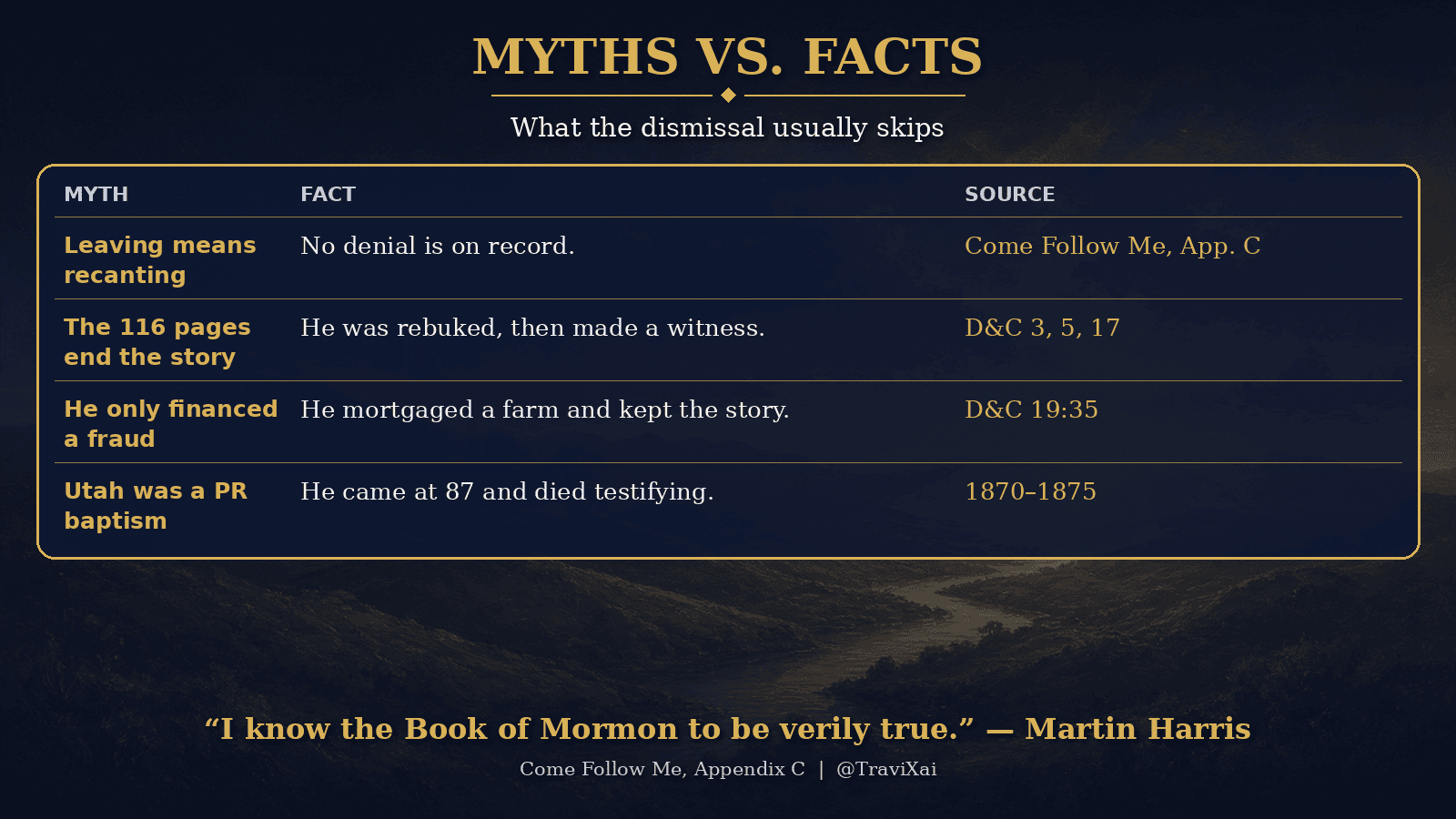
- That a witness who left the Church must have recanted. Martin was out of the Church for years. No denial of his testimony is on record. He was still bearing it on his deathbed in 1875.
- That the lost 116 pages disqualify him as a witness. The Lord rebuked him in D&C 3, then promised a view if he humbled himself (D&C 5, 17). He received that view in June 1829.
- That financing the book makes him a co-conspirator, not a witness. A conspirator does not mortgage his farm to print the book, then keep the same story for decades after falling out with Joseph.
- That his 1870 rebaptism was staged for the Church’s image. He came to Utah at eighty-seven, was rebaptized, and was still testifying a few hours before he died.
FAQQuick answers
Who was Martin Harris?
A Palmyra farmer (1783–1875), one of the Three Witnesses of the Book of Mormon, and the man who mortgaged his farm to pay for the first edition.
Was Martin Harris one of the Three Witnesses?
Yes. In June 1829, with Oliver Cowdery and David Whitmer, he testified that an angel showed them the plates and that the voice of God declared the translation true.
Did Martin Harris pay for the Book of Mormon?
Yes. D&C 19 commanded him to impart property and “pay the debt thou hast contracted with the printer.” He mortgaged his farm to pay E. B. Grandin $3,000 for 5,000 copies.
What were the 116 lost pages?
The first Book of Mormon manuscript, the book of Lehi, which Martin took home in 1828 and which was lost. D&C 3 and 10 explain why it was not retranslated.
Did Martin Harris leave the Church?
Yes. He separated from the Church in the Kirtland crisis of 1837, was baptized again in 1842, remained in Kirtland for years, and was rebaptized in Utah on September 17, 1870.
Did Martin Harris deny his testimony?
No denial by him is on record. Church curriculum quotes his later words: “I know the Book of Mormon to be verily true,” and a deathbed statement, “The Book of Mormon is no fake.”
When and where did Martin Harris die?
July 10, 1875, in Clarkston, Cache County, Utah Territory, at age 92, still bearing his witness of the plates.
Is Martin Harris mentioned in scripture?
Yes. He is named in D&C 5 and addressed in D&C 19, promised a view of the plates in D&C 17, and is one of the Three Witnesses whose testimony stands in the Book of Mormon.
SummaryKey takeaways
- One of the Three Witnesses, June 1829, with Oliver Cowdery and David Whitmer.
- Mortgaged his farm to pay E. B. Grandin $3,000 for 5,000 copies (D&C 19:35).
- Lost the 116 pages in 1828; was rebuked in D&C 3, then promised and given a view of the plates.
- Separated from the Church in 1837; no denial of his witness is on record.
- Rebaptized in Utah on September 17, 1870; died in Clarkston, July 10, 1875, still testifying.
Read Ether 5, D&C 17 and the Testimony of Three Witnesses tonight. For quick, sourced answers, open Galatians18, and follow me on X at @TraviXai.
Sources
- King James Bible (churchofjesuschrist.org): Deuteronomy 19:15 · 2 Corinthians 13:1
- Book of Mormon: Ether 5:2–4 · 2 Nephi 27:12–14 · The Testimony of Three Witnesses
- Doctrine and Covenants: D&C 3:12–13 · D&C 5:23–24 · D&C 17:1–6 · D&C 19:26–35
- Pearl of Great Price: JS–H 1:63–65
- Come Follow Me, Appendix C: The Three Witnesses · Church History Topics, “Witnesses of the Book of Mormon” · “Printing and Publishing the Book of Mormon” · “Lost Manuscript of the Book of Mormon”
- Featured image and in-article graphic: original graphics by thebookofmormon.ai (painterly backgrounds; no photographs or likenesses of real people).