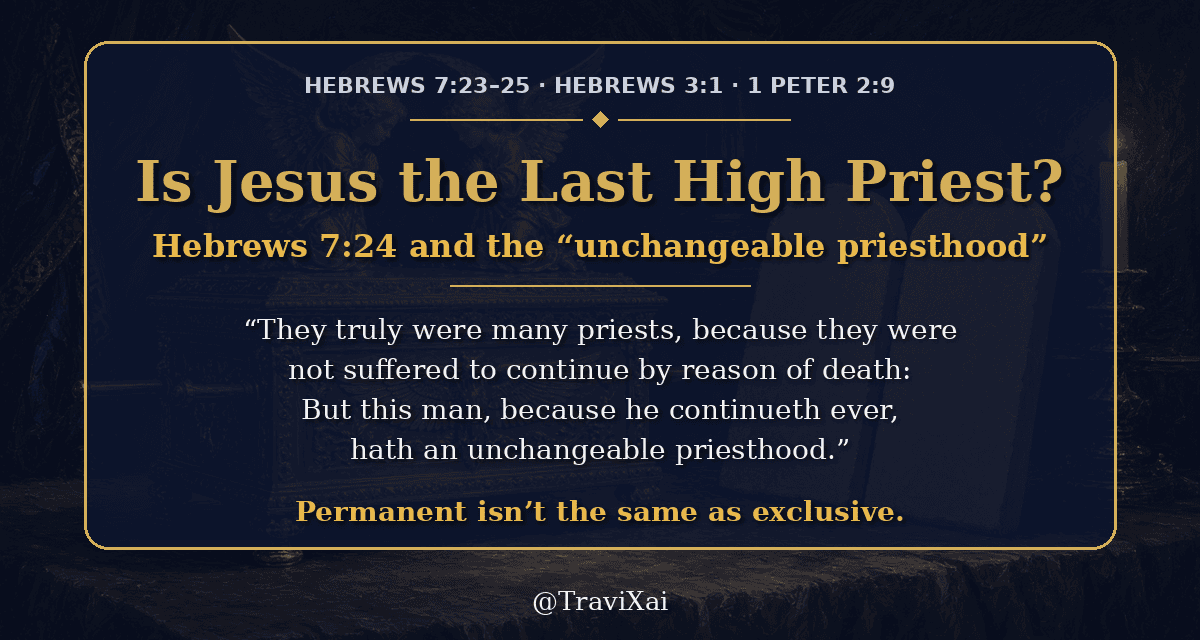

Critics say Hebrews 7:24 means nobody can hold priesthood after Christ. Read the verse. The contrast is between priests who died and the Priest who lives, not between Christ and everyone who serves under Him.
Home › Answering Critics › Start here: Priesthood Authority: Korah, Uzziah, and Hebrews 5:4
Hebrews 7:24 says Christ “hath an unchangeable priesthood” “because he continueth ever.” The verse right before it explains why: the Levitical priests “were many,” because death kept taking them. Christ never dies, so His priesthood never passes to a successor. That’s true, and Latter-day Saints believe it. But “nobody replaces Him” is not “nobody serves under Him.” The same letter calls Him “the Apostle and High Priest of our profession,” and He still ordained apostles. Peter still calls the Church “a royal priesthood.” And John says Christ “hath made us kings and priests.”
“Jesus is the last High Priest. Nobody can hold priesthood after Him. Your whole priesthood is blasphemy.” Ok. Name the verse that says that…. You can’t. What they have is Hebrews 7:24, and a word they never looked up.
I hear this one all the time, and I get why. It sounds reverent. It sounds like you’re protecting Jesus. But you’re not protecting Him from anything. You’re protecting a tradition, and you’re doing it by reading a verse halfway. So let’s read the whole thing.
The claim”Jesus is the last High Priest”
Here’s the argument in its strongest form, the way people actually say it to me:
- Jesus is the great High Priest (Hebrews 4:14).
- His priesthood is “unchangeable” (Hebrews 7:24), so it can’t be passed to anyone else.
- So anyone claiming priesthood today is claiming what belongs to Christ alone.
Every Latter-day Saint agrees with the first line. Christ is the High Priest. He offered Himself once. Nobody replaces Him, nobody adds to His sacrifice, and nobody else intercedes for us the way He does. We say all of that every week.
The problem is the jump from line two to line three. “Christ’s priesthood doesn’t pass to a successor” is one claim. “Nobody can hold priesthood under Christ” is a totally different claim. Hebrews makes the first one. It never makes the second one. So let’s see what the author is actually comparing.
Read the verseWhat Hebrews 7:23–25 actually contrasts
Read it with the verse before and the verse after:
And they truly were many priests, because they were not suffered to continue by reason of death: But this man, because he continueth ever, hath an unchangeable priesthood. Wherefore he is able also to save them to the uttermost that come unto God by him, seeing he ever liveth to make intercession for them.
Hebrews 7:23–25 (KJV)
Look at what’s on each side. On one side: the Levitical priests. There were “many” of them. Why? “Because they were not suffered to continue by reason of death.” A high priest served, died, and had to be replaced by his son. Then he died. Then his son. Over and over.
On the other side: “this man.” He “continueth ever.” He “ever liveth.” So His priesthood doesn’t get handed down when He dies, because He doesn’t die. That’s the whole contrast. It’s death versus life. It is not Christ versus everyone who would ever be ordained by Him.
And the author tells you what he’s comparing the whole chapter. “The Levitical priesthood” and “the order of Aaron” on one side, “the order of Melchisedec” on the other (Hebrews 7:11). Then: “For the priesthood being changed, there is made of necessity a change also of the law” (Hebrews 7:12). The subject is the old Levitical system giving way. It’s not a ban on priesthood. It’s a change of priesthood.
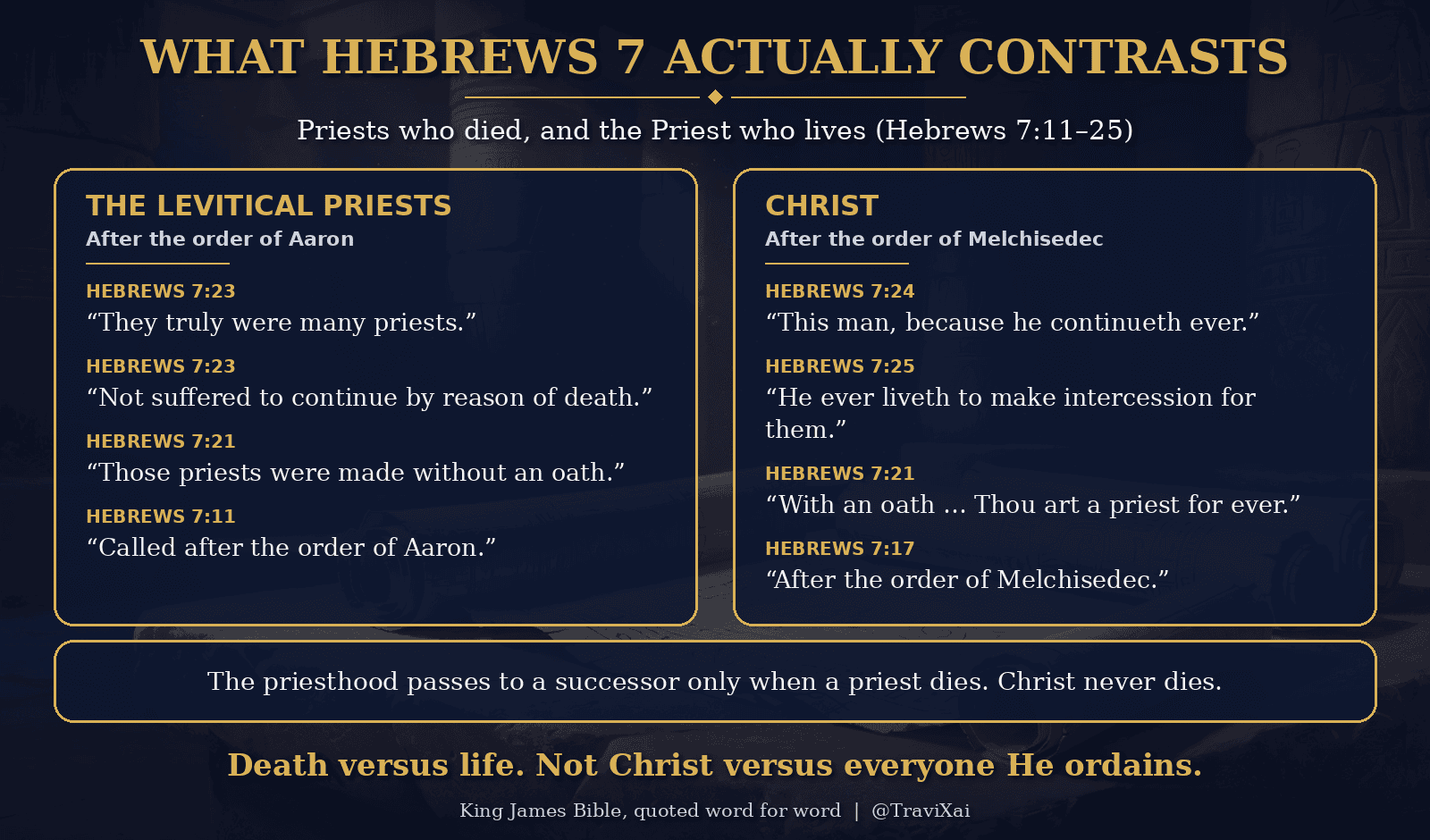
“They truly were many priests, because they were not suffered to continue by reason of death.” That’s the contrast. Death versus life. Not Christ versus everyone He ordains.
The word”Unchangeable” means permanent, not exclusive
The word the KJV translates “unchangeable” is the Greek aparabatos. It shows up exactly once in the whole New Testament, right here. Strong’s gives “not passing away, i.e. untransferable (perpetual).” The NASB says He “holds His priesthood permanently.” The ESV says the same thing: “permanently.”
Critics like to quote Thayer’s lexicon, which says the word can mean “unchangeable and therefore not liable to pass to a successor.” Fine. I’ll take that reading. Read it again: not liable to pass to a successor. A successor is somebody who takes over when you’re gone. Christ is never gone. Nobody takes His place. Amen.
But a successor isn’t the same thing as a servant. When a king has no successor because he never dies, that doesn’t mean he has no officers. It means nobody sits on his throne. Latter-day Saint priesthood holders don’t claim Christ’s throne. They don’t offer an atoning sacrifice. They act in His name, by His authority, because He gave it. That’s not succession. That’s delegation.
And here’s the thing that should end the argument. The same chapter uses even stronger language about somebody other than Jesus. Melchizedek “abideth a priest continually” (Hebrews 7:3). If “for ever” and “continually” mean nobody else can be a priest, then Melchizedek’s “continually” would have locked Jesus out. It obviously didn’t. Two priests, both “continually,” same order.
The orderA priest “after the order” of somebody else
Hebrews keeps coming back to Psalm 110:4: “Thou art a priest for ever after the order of Melchisedec” (Hebrews 5:6; Psalm 110:4). Notice the phrase: after the order of. An order is not one man. It’s a category, a rank, something a person can be placed into.
And that order was already there before Jesus was born in Bethlehem. “Melchizedek king of Salem brought forth bread and wine: and he was the priest of the most high God” (Genesis 14:18). Abraham paid him tithes (Hebrews 7:1–2). So the order of Melchizedek had at least one member centuries before Christ came in the flesh. If one man could hold it before Christ, the idea that nobody can hold it after Christ needs a verse. There isn’t one.
Hebrews even tells you how anybody gets into it: “no man taketh this honour unto himself, but he that is called of God, as was Aaron. So also Christ glorified not himself to be made an high priest” (Hebrews 5:4–5). That’s a rule for how priests are made. Why give the rule for calling priests if nobody will ever be called again? I walk through that verse, plus Korah and Uzziah, in Priesthood Authority: Korah, Uzziah, and Hebrews 5:4.
Same logic testApostle, Shepherd, Bishop, and High Priest
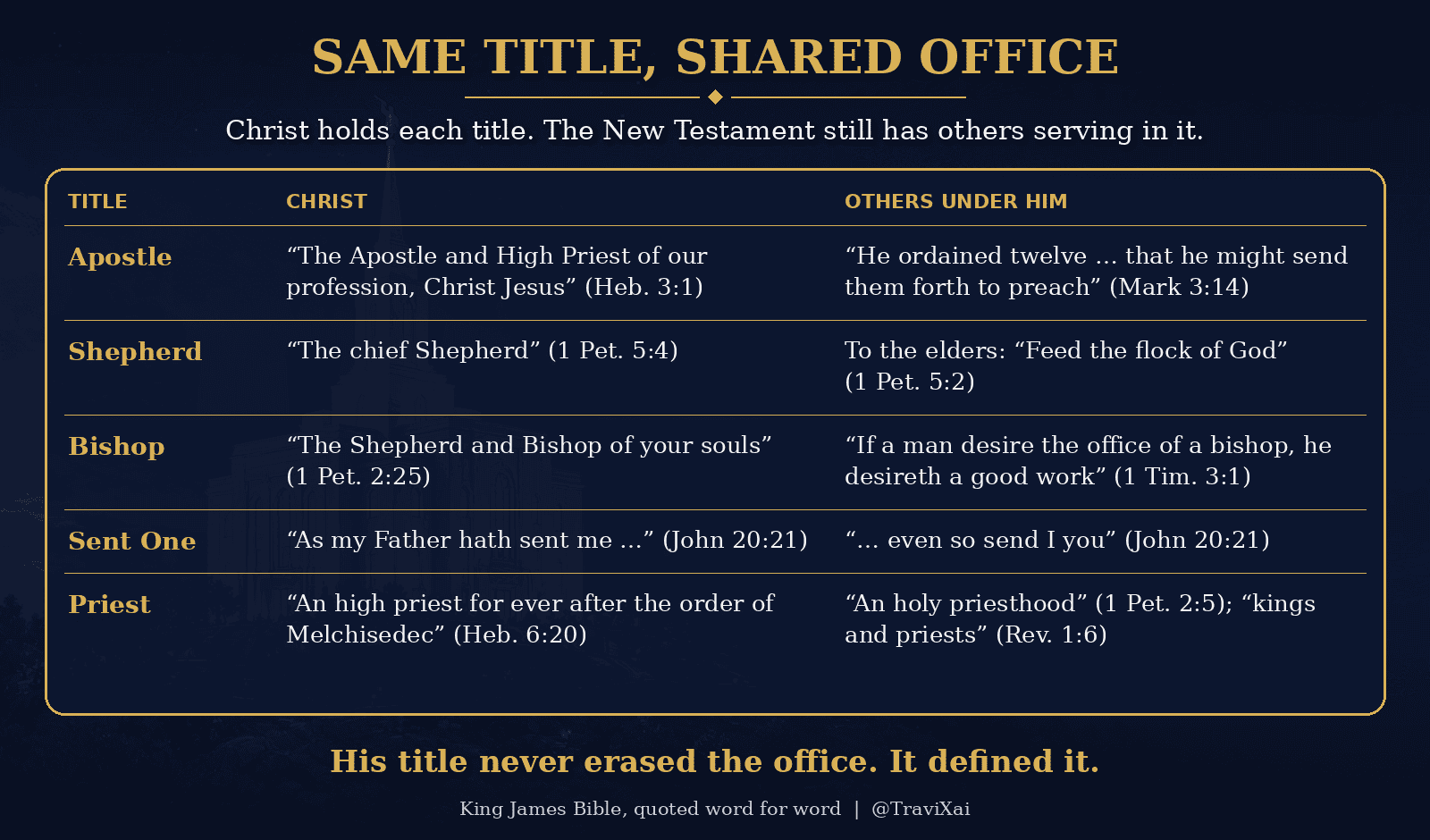
Here’s the test I like most, because it uses the critic’s own logic against him. Hebrews 3:1 calls Jesus two things in the same breath:
Wherefore, holy brethren, partakers of the heavenly calling, consider the Apostle and High Priest of our profession, Christ Jesus;
Hebrews 3:1 (KJV)
Jesus is THE Apostle. Did that mean nobody else could be an apostle? No. “He ordained twelve, that they should be with him, and that he might send them forth to preach” (Mark 3:14). The word apostle means “one sent,” and He said it Himself: “as my Father hath sent me, even so send I you” (John 20:21).
Peter does the same thing. He calls Jesus “the Shepherd and Bishop of your souls” (1 Peter 2:25) and “the chief Shepherd” (1 Peter 5:4). Then, in the same letter, he tells the elders to “Feed the flock of God” (1 Peter 5:2). Paul says “If a man desire the office of a bishop, he desireth a good work” (1 Timothy 3:1). Christ is the Bishop, and the Church still had bishops. Christ is the chief Shepherd, and the Church still had shepherds.
So which is it? Either Christ’s titles erase every office that shares the name, and the New Testament church was blasphemous for having apostles, bishops, and elders. Or His title defines the office, and others serve in it under Him. You can’t apply the rule to “High Priest” and quietly skip “Apostle” and “Bishop” in the same chapters.
The New TestamentPriests after the cross
Now look at what the apostles said after the cross and after the veil tore. Peter:
Ye also, as lively stones, are built up a spiritual house, an holy priesthood, to offer up spiritual sacrifices, acceptable to God by Jesus Christ.
1 Peter 2:5 (KJV)
“An holy priesthood.” Four verses later, “a royal priesthood” (1 Peter 2:9). John in Revelation: Christ “hath made us kings and priests unto God and his Father” (Revelation 1:6). The saints sing that He “hast made us unto our God kings and priests: and we shall reign on the earth” (Revelation 5:10). And in the resurrection, “they shall be priests of God and of Christ” (Revelation 20:6).
Notice who made them priests. Christ did. “Priests of God and of Christ.” Their priesthood doesn’t compete with His. It comes from Him. Isaiah saw it coming too: “I will also take of them for priests and for Levites, saith the Lord” (Isaiah 66:21).
Even their own church disagrees with them
Here’s the double standard. The largest church in Christianity ordains priests today and has for centuries. The Catechism of the Catholic Church (1545) says Christ’s priesthood “is made present through the ministerial priesthood without diminishing the uniqueness of Christ’s priesthood: ‘Only Christ is the true priest, the others being only his ministers.’” Many Protestant churches lay hands on their pastors and ordain them. Then some of the same folks tell me that ordaining anyone under Christ is blasphemy, but only when Latter-day Saints do it. Yeah, ok!
The Restoration”After the Order of the Son of God”
This is where Latter-day Saint teaching is actually more careful about Christ’s priesthood than the critic is, not less. Look at what the priesthood is called:
Before his day it was called the Holy Priesthood, after the Order of the Son of God. But out of respect or reverence to the name of the Supreme Being, to avoid the too frequent repetition of his name, they, the church, in ancient days, called that priesthood after Melchizedek, or the Melchizedek Priesthood.
D&C 107:3–4
It’s HIS. The real name is “the Holy Priesthood, after the Order of the Son of God.” Nobody holds it as their own. The Book of Mormon says the same thing, long before the critic’s objection was ever made. Alma taught that “the Lord God ordained priests, after his holy order, which was after the order of his Son,” and that they were ordained “in a manner that thereby the people might know in what manner to look forward to his Son for redemption” (Alma 13:1–2).
So the point of every priest is to point at Christ. Then Alma says the line that makes critics squirm:
Thus they become high priests forever, after the order of the Son, the Only Begotten of the Father, who is without beginning of days or end of years, who is full of grace, equity, and truth. And thus it is. Amen.
Alma 13:9
“High priests forever, after the order of the Son.” That’s the same language as Psalm 110 and Hebrews 7, and it puts the Son at the center. Joseph Smith didn’t invent a rival to Christ. He restored the order that belongs to Christ, conferred by those who held it, just like Hebrews 5:4 requires. For how that order is organized, see Aaronic vs. Melchizedek Priesthood and What Is the Priesthood?.
SummaryKey takeaways
- Hebrews 7:23–24 contrasts priests who died with the Priest who lives. It’s death versus life, not Christ versus everyone He ordains.
- Aparabatos means permanent. Even the strongest reading, “not liable to pass to a successor,” says nobody replaces Christ. Latter-day Saints agree.
- “After the order of Melchisedec” names an order. Melchizedek held it before Christ (Genesis 14:18; Hebrews 7:3).
- Christ is “the Apostle and High Priest” (Hebrews 3:1), and He still ordained apostles. His titles define the offices; they don’t erase them.
- After the cross, the New Testament still has “an holy priesthood” and “kings and priests” made by Christ (1 Peter 2:5, 9; Revelation 1:6; 20:6).
- The restored priesthood is “the Holy Priesthood, after the Order of the Son of God” (D&C 107:3). It points to Christ. It doesn’t compete with Him.
The last High Priest: quick answers
Does Hebrews 7:24 say no one else can hold the priesthood?
No. It says Christ “hath an unchangeable priesthood” “because he continueth ever.” Verse 23 gives the contrast: the Levitical priests “were many” because death kept replacing them. Christ’s priesthood never passes to a successor because He never dies.
What does “unchangeable” (aparabatos) mean in Hebrews 7:24?
It means permanent or perpetual. Thayer’s lexicon says “unchangeable and therefore not liable to pass to a successor.” Nobody replaces Christ. That is different from saying nobody can serve under Him.
Was anyone a priest after the order of Melchizedek besides Jesus?
Yes. Melchizedek himself, “the priest of the most high God” (Genesis 14:18), who “abideth a priest continually” (Hebrews 7:3). Alma 13:9 says faithful men “become high priests forever, after the order of the Son.”
Doesn’t 1 Peter 2:9 make every believer a priest, so ordination isn’t needed?
Peter quotes Exodus 19:6, said to Israel, which still had ordained priests. The apostles kept ordaining (Acts 14:23), and Hebrews 5:4 says no one takes this honor unless “called of God, as was Aaron.”
Why is it called the Melchizedek Priesthood?
D&C 107:3–4 says its full name is “the Holy Priesthood, after the Order of the Son of God,” and it was called after Melchizedek “to avoid the too frequent repetition of his name.”
Where can I read more?
Next time someone tells you Jesus is the last High Priest, agree with them. Then ask: “He’s also the Apostle in Hebrews 3:1. So why did He ordain twelve?” For quick, sourced answers on priesthood authority, the priesthood restoration, the Great Apostasy, and living prophets, open Galatians18. And for more like this every day, follow me on X at @TraviXai.
Sources
- Bible (KJV, churchofjesuschrist.org): Genesis 14:18 · Exodus 40:15 · Numbers 25:13 · Psalm 110:4 · Isaiah 66:21 · Mark 3:14 · John 20:21 · Acts 14:23 · 1 Timothy 3:1 · Hebrews 3:1 · Hebrews 4:14 · Hebrews 5:4–6 · Hebrews 7:1–3 · Hebrews 7:11–12 · Hebrews 7:23–25 · 1 Peter 2:5, 9, 25 · 1 Peter 5:2–4 · Revelation 1:6 · Revelation 5:10 · Revelation 20:6
- Book of Mormon: Alma 13:1–9
- Doctrine and Covenants: D&C 107:2–4
- Strong’s Concordance and Thayer’s Greek Lexicon, G531 aparabatos (Bible Hub)
- Catechism of the Catholic Church, paragraphs 1545–1546, “The Sacrament of Holy Orders” (vatican.va)
- Galatians18: Priesthood Authority · Priesthood Restoration · The Great Apostasy · Living Prophets
- Featured image and charts: original graphics by thebookofmormon.ai on reused painted backgrounds (no photographs or likenesses of real people; Jesus is not depicted).