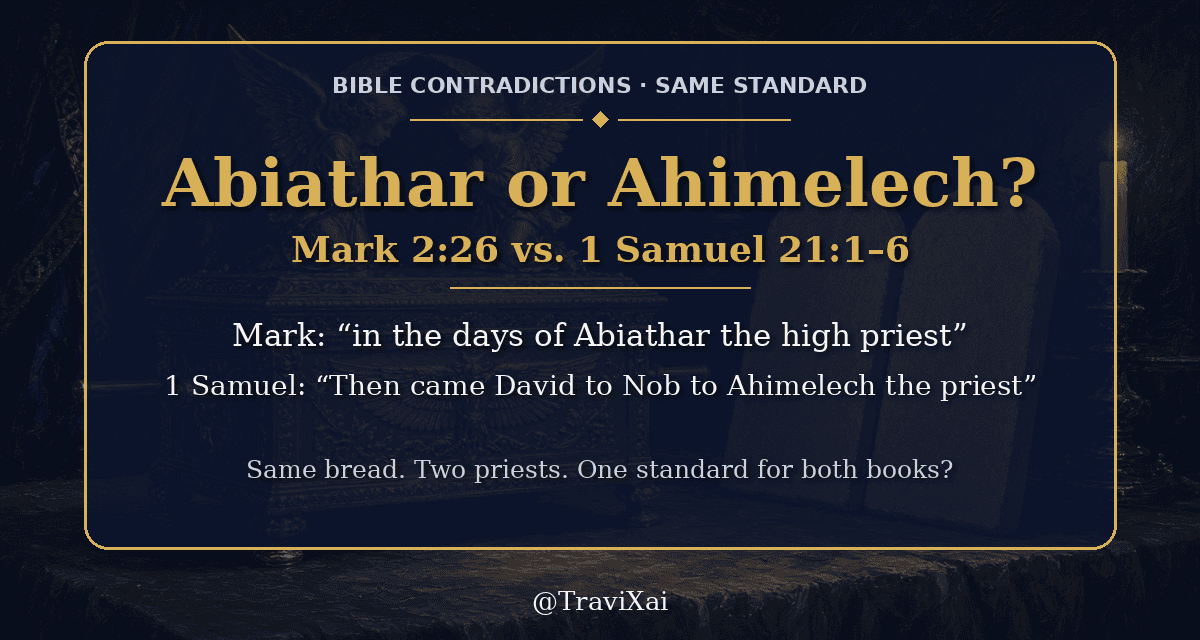

Jesus says David ate the holy bread “in the days of Abiathar the high priest.” First Samuel says the priest was Ahimelech, Abiathar’s father. Bible defenders stretch Mark’s words to make it fit, then refuse the Book of Mormon the same stretch.
Home › Answering Critics › Start here: Are Latter-day Saints Christian? · The CES Letter: A Faithful Response
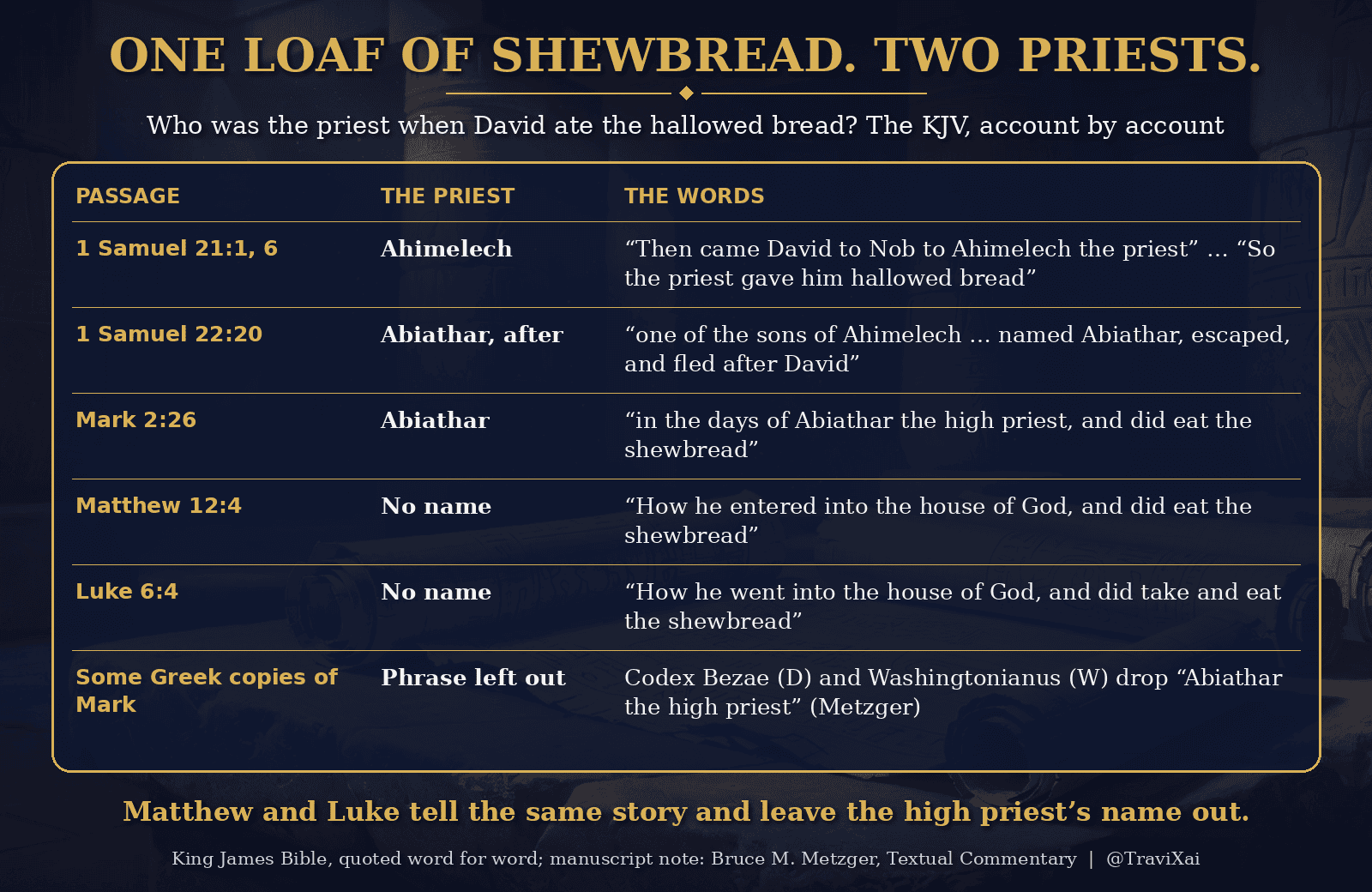
Mark and 1 Samuel name different priests. In Mark 2:26, Jesus says David ate the shewbread “in the days of Abiathar the high priest.” First Samuel 21 says the priest who gave David the bread was Ahimelech, Abiathar’s father. Matthew and Luke tell the same story and leave the name out. Defenders stretch Mark to fit. Critics never give the Book of Mormon that slack.
Jesus is arguing with the Pharisees about the Sabbath, and He reaches for a Bible story everybody knows. David was hungry, so he walked into the house of God and ate the holy bread. Then Jesus names the high priest: Abiathar. Open 1 Samuel 21, the only place that story is told, and the priest is Ahimelech. Abiathar is his son, and he doesn’t walk on stage until the next chapter.
This is one of the most famous problems in the New Testament. It helped push Bart Ehrman from evangelical to skeptic. I’m not here to make you doubt the Bible. I love it. I’m here to show you what Bible defenders do with this verse, because it’s the exact thing they won’t let Latter-day Saints do with the Book of Mormon.
Check the assumptions first
Critics who say one slip sinks the Book of Mormon lean on assumptions they never apply to Mark:
- That an inspired account can’t get a name wrong. Mark names Abiathar. First Samuel names Ahimelech. Christians keep both books anyway.
- That a possible reading is the plain reading. Reading “in the days of” as “sometime in his life” is possible. It isn’t what the words normally mean.
- That every book gets the same rules. Mark gets the loosest reading available. The Book of Mormon gets the strictest.
- That scripture claims to be flawless. The Book of Mormon never does. Its title page says, “if there are faults they are the mistakes of men.”
Exhibit AMark: in the days of Abiathar
The disciples were walking through the grain fields on the Sabbath, plucking “the ears of corn” as they went (Mark 2:23). The Pharisees pounced: “why do they on the sabbath day that which is not lawful?” (2:24). Jesus answered with scripture:
Have ye never read what David did, when he had need, and was an hungred, he, and they that were with him? How he went into the house of God in the days of Abiathar the high priest, and did eat the shewbread, which is not lawful to eat but for the priests, and gave also to them which were with him?
Mark 2:25–26 (KJV)
Then the point: “The sabbath was made for man, and not man for the sabbath” (Mark 2:27). The point never needed a name, but Mark has Jesus give one. The Revised Version of 1881 even translated it “when Abiathar was high priest” (Cambridge Greek Testament).
Exhibit B1 Samuel: Ahimelech gave the bread
Here’s the original story:
Then came David to Nob to Ahimelech the priest: and Ahimelech was afraid at the meeting of David, and said unto him, Why art thou alone, and no man with thee?
1 Samuel 21:1 (KJV)
David asks for five loaves, and then: “So the priest gave him hallowed bread: for there was no bread there but the shewbread” (1 Samuel 21:6). The priest in the room is Ahimelech, start to finish. Saul later has him killed along with the priests of Nob, “fourscore and five persons that did wear a linen ephod” (22:18).
Only then does Abiathar enter the story: “one of the sons of Ahimelech the son of Ahitub, named Abiathar, escaped, and fled after David” (1 Samuel 22:20). Abiathar did become David’s priest later, until Solomon “thrust out Abiathar” (1 Kings 2:27). But on the day of the bread, his father was the priest.
Now the other gospels. Matthew: “How he entered into the house of God, and did eat the shewbread” (Matthew 12:4). Luke: “How he went into the house of God, and did take and eat the shewbread” (Luke 6:4). Same story, same argument, and both of them leave the name out.
The patchesFour ways around it
Patch 1: “in the days of” means “in his lifetime”
The most common answer: it only happened in Abiathar’s days. GotQuestions says Abiathar “is called the ‘high priest’ in anticipation of his future title,” the way we talk about “President Eisenhower” giving the order on D-Day, “although D-Day was almost nine years before Eisenhower was inaugurated President.” Its verdict: “Mark 2:26 is a difficult passage, but Jesus was not in error.”
Possible? Sure. Plain? No. Luke uses the same Greek pattern to date events by who held the office: “Annas and Caiaphas being the high priests” (Luke 3:2). Nobody reads that as “sometime in their lives.”
Patch 2: “in the passage about Abiathar”
When I posted this on X, a critic pushed back: the Greek word epi can mean “in the passage about,” the way Mark 12:26 points to the burning bush: “have ye not read in the book of Moses, how in the bush God spake unto him” (Mark 12:26).
Good point, but it doesn’t fit. In 12:26 it points to a thing, the bush. In 2:26 it points to a person with a title, the way dates were given. And even read that way, the shewbread story is in 1 Samuel 21, where Abiathar isn’t. He shows up in chapter 22. The Cambridge Greek Testament called this idea, and the idea that both priests had both names, “unsatisfactory.”
A young Bart Ehrman made this argument in a paper at Princeton, that the event “took place in the part of the scriptural text that has Abiathar as one of the main characters.” His professor, Cullen Story, wrote one line at the end: “Maybe Mark just made a mistake.” Ehrman says it “went straight through me,” and that once he admitted it, “the floodgates opened” (Misquoting Jesus, as quoted by Essential Church; Associates for Biblical Research). That’s the danger of telling people the Bible has to be perfect.
Patch 3: both men had both names
Some point to 2 Samuel 8:17, which lists “Ahimelech the son of Abiathar” as a priest under David, names flipped (also 1 Chronicles 24:6). Maybe both men carried both names, or a copyist flipped them. Either way, that’s a second problem used to solve the first, and 1 Samuel still calls him “Abiathar the son of Ahimelech” (1 Samuel 23:6).
Patch 4: let the copyists fix it
The scribes saw the problem too. Bruce Metzger notes that Codex Bezae (D), Codex Washingtonianus (W), and others drop the phrase “in order to avoid the historical difficulty,” matching Matthew and Luke. Other copyists, “reluctant to go so far as to delete the phrase,” added a word so it could mean the time of Abiathar but not his high priesthood. The oldest fix for Mark 2:26 was done with a pen (more on “as far as it is translated correctly”).
If the scribes had to edit it, don’t tell me it was never a problem.
Could one of these patches be right? Sure. But every one is brought to the text, not found in it. That’s charity. Remember that word.
The standardNow do Mulek
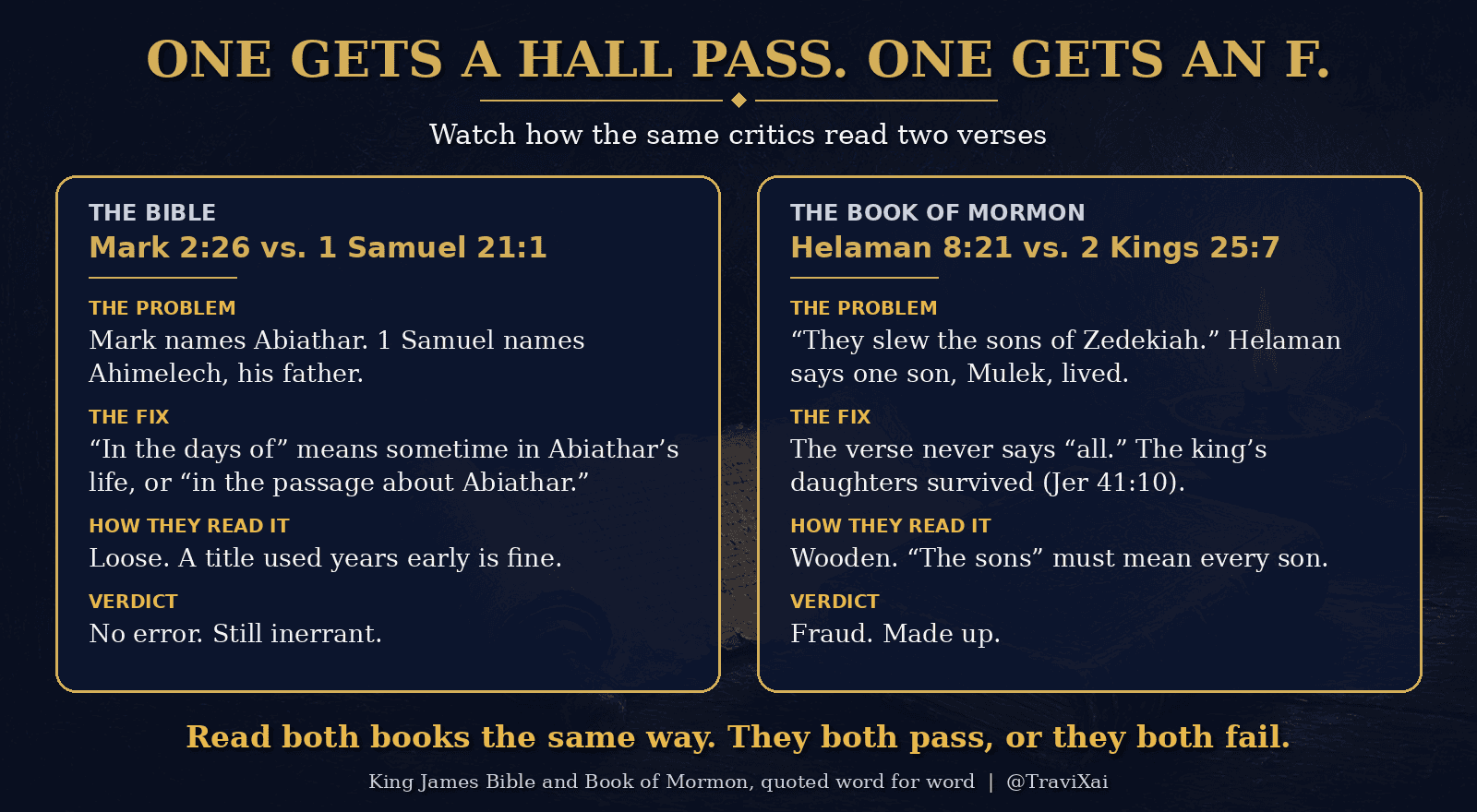
Now flip it. Helaman 8:21 asks, “Will ye say that the sons of Zedekiah were not slain, all except it were Mulek?” The Book of Mormon says one of King Zedekiah’s sons survived the fall of Jerusalem, and “the Lord did bring Mulek into the land north” (Helaman 6:10). Critics laugh, because the Bible says “they slew the sons of Zedekiah before his eyes” (2 Kings 25:7; Jeremiah 52:10). Case closed?
Read it the way they read Mark. The verse says “the sons.” It never says “all.” After the fall, Jeremiah mentions “the king’s daughters” still at Mizpah (Jeremiah 41:10). And Jeremiah was cast “into the dungeon of Malchiah the son of Hammelech” (Jeremiah 38:6). Scripture Central notes the King James translators “confusingly rendered Hammelech as a proper name when in fact it is simply a Hebrew title that means ‘the king.’” A king’s son in Zedekiah’s day, with a name built on the same Hebrew root as Mulek. Jeffrey Chadwick even asked in the Journal of Book of Mormon Studies, “Has the Seal of Mulek Been Found?”
The Mulek answer sits right in the Bible’s own wording. The Abiathar answers need words to mean what they normally don’t, a reading Mark’s own copyists didn’t trust. Yet Mark gets “no error,” and Helaman gets “fraud.” Yeah, mmm hmm. Do better.
It’s the same move I walked through with who Joseph’s father was, who killed Goliath, and how Judas died. Critics tried it with Alma 7:10 and “born at Jerusalem” too.
The answerWhat a Latter-day Saint does with it
I don’t need Abiathar to be high priest early. Article of Faith 8 says, “We believe the Bible to be the word of God as far as it is translated correctly.” The BYU New Testament Commentary, a Latter-day Saint project, says it straight: the Abiathar reading “is a textbook example of ‘the mistakes of men’ that can occur in a record.” It adds, “Most scholars agree that the text is in error; the other theories come mostly from those committed to the inerrancy of scripture.”
The Chicago Statement on Biblical Inerrancy takes the other road. Article XIV: “We deny that alleged errors and discrepancies that have not yet been resolved vitiate the truth claims of the Bible.” Translation: if we can’t fix it yet, it still doesn’t count. That’s a hall pass, and they hand it to one book.
And here’s the irony. Jesus told this story to Pharisees who cared more about the rule than the person: “The sabbath was made for man, and not man for the sabbath” (Mark 2:27). Inerrancy flips that. The Bible isn’t God. If it were perfect, people would worship it instead of turning to Him.
How do I know it’s true anyway? The same way I know the Book of Mormon is true. God told me, and I choose to believe Him. So stretch “in the days of” if you want. Just give Mulek the same courtesy. They both pass, or they both fail.
What all four standard works say about judging scripture fairly
The Bible
Jesus gave the rule for every critic:
For with what judgment ye judge, ye shall be judged: and with what measure ye mete, it shall be measured to you again.
Matthew 7:2
The Book of Mormon
And now, if there are faults they are the mistakes of men; wherefore, condemn not the things of God, that ye may be found spotless at the judgment-seat of Christ.
Title page of the Book of Mormon
The Doctrine and Covenants
… these commandments are of me, and were given unto my servants in their weakness, after the manner of their language, that they might come to understanding.
D&C 1:24
The Pearl of Great Price
We believe the Bible to be the word of God as far as it is translated correctly; we also believe the Book of Mormon to be the word of God.
Articles of Faith 1:8
SummaryKey takeaways
- Mark 2:26 says “in the days of Abiathar the high priest.” First Samuel 21:1 says “Then came David to Nob to Ahimelech the priest.”
- Abiathar was Ahimelech’s son. He enters the story after the bread, when he “escaped, and fled after David” (1 Samuel 22:20).
- Matthew 12:4 and Luke 6:4 tell the same story without the name. Some early copies of Mark drop it too (Metzger).
- The “lifetime” and “passage about” readings are possible, not plain. Ehrman’s professor put it simply: “Maybe Mark just made a mistake.”
- Second Kings 25:7 never says “all” of Zedekiah’s sons died. Critics who stretch Mark should read Helaman 8:21 with the same grace. Pick one standard.
Abiathar or Ahimelech? Quick answers
Who was the high priest when David ate the shewbread?
First Samuel 21:1–6 says it was “Ahimelech the priest.” Mark 2:26 says it happened “in the days of Abiathar the high priest.” Abiathar was Ahimelech’s son.
Did Jesus make a mistake in Mark 2:26?
Inerrantists say no and read “in the days of” loosely. Many scholars say the name is an error by Mark, his source, or an early copyist. Matthew 12:4 and Luke 6:4 leave the name out.
Was Abiathar the son of Ahimelech?
Yes. First Samuel 22:20 says “one of the sons of Ahimelech the son of Ahitub, named Abiathar, escaped, and fled after David.”
Why do 2 Samuel 8:17 and 1 Chronicles 24:6 say “Ahimelech the son of Abiathar”?
Those verses reverse the names. Some suggest both men bore both names; others suspect a copying slip. First Samuel 23:6 calls him “Abiathar the son of Ahimelech.”
Do some manuscripts leave out “Abiathar” in Mark 2:26?
Yes. Bruce Metzger notes that Codex Bezae (D), Codex Washingtonianus (W), and others omit the phrase, matching Matthew and Luke.
What did Bart Ehrman say about Mark 2:26?
In Misquoting Jesus he recalls a seminary paper harmonizing the verse. His professor, Cullen Story, wrote, “Maybe Mark just made a mistake.”
What other Bible contradictions get a pass?
Do Latter-day Saints believe the Bible is inerrant?
No. We believe “the Bible to be the word of God as far as it is translated correctly” (Articles of Faith 1:8), and the Book of Mormon title page says any faults “are the mistakes of men.”
Next time someone says one Book of Mormon verse proves the whole book is fake, ask them who the high priest was when David ate the shewbread. For quick, sourced answers on apparent Bible contradictions, Bible inerrancy, and Book of Mormon historicity, open Galatians18. And for more like this every day, follow me on X at @TraviXai.
Sources
- Bible (KJV, churchofjesuschrist.org): Mark 2:23–28 · 1 Samuel 21:1–7 · 1 Samuel 22:9–23 · 1 Samuel 23:6 · Matthew 12:3–4 · Luke 6:3–4 · Mark 12:26 · Luke 3:2 · 2 Samuel 8:17 · 1 Chronicles 18:16 · 1 Chronicles 24:6 · 1 Kings 2:27 · 2 Kings 25:7 · Jeremiah 52:10 · Jeremiah 41:10 · Jeremiah 38:6 · Matthew 7:2
- Bruce M. Metzger, A Textual Commentary on the Greek New Testament, on Mark 2:26: BibliaPlus
- Cambridge Greek Testament for Schools and Colleges, on Mark 2:26: BibliaPlus
- GotQuestions: “Why does Jesus call Abiathar the high priest in Mark 2:26, when 1 Samuel 21 indicates it was Ahimelech?”
- BYU New Testament Commentary: “Is There a Mistake in Mark 2:26?”
- Bart D. Ehrman, Misquoting Jesus, pp. 8–9, as quoted by Essential Church and Associates for Biblical Research
- The Chicago Statement on Biblical Inerrancy (1978), Article XIV
- Scripture Central: “Book of Mormon Evidence: Mulek” · Jeffrey R. Chadwick, “Has the Seal of Mulek Been Found?”, Journal of Book of Mormon Studies 12, no. 2 (2003)
- Book of Mormon: Title page · Helaman 6:10 · Helaman 8:21
- Doctrine and Covenants and Pearl of Great Price: D&C 1:24 · Articles of Faith 1:8
- Galatians18: Apparent Biblical Contradictions · Is the Bible Infallible? · Book of Mormon Historicity
- Featured image and comparison charts: original graphics by thebookofmormon.ai (no photographs or likenesses of real people).