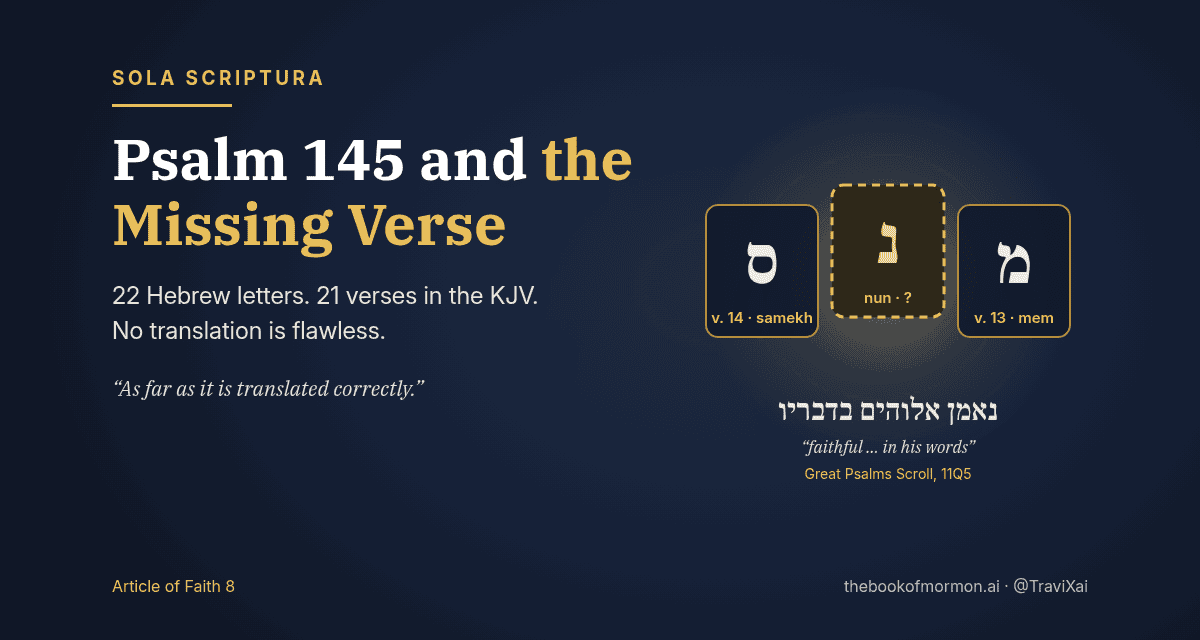

Psalm 145 walks through the Hebrew alphabet one verse at a time, but the King James Bible skips a letter. The missing line turned up in a Dead Sea Scroll, and the way modern Bibles handle it shows exactly what “as far as it is translated correctly” means.
Psalm 145 comes with a built-in checksum. Each verse begins with the next letter of the Hebrew alphabet, from aleph to tav. The Hebrew alphabet has 22 letters. Open a King James Bible and count the verses of Psalm 145: 21.
One letter didn’t make the trip. And of all the lines that could have gone missing, the one that dropped out says God is faithful in his words. This morning I asked which verse teaches sola scriptura. This afternoon I looked at the books the Bible quotes that aren’t in the Bible. Tonight: what went missing inside a single chapter, and why serious Bible translations admit it.
The puzzleA psalm with a built-in checksum
Hebrew poets loved the alphabet. Psalm 119 gives eight verses to each letter, and Proverbs 31:10–31 and Lamentations 1–4 run aleph to tav. An acrostic is praise from A to Z.
Psalm 145, one line per letter, is among the best loved. In Jewish prayer it is the Ashrei, and the Talmud explains it was given that place of honor “because it contains both an alphabetic acrostic as well as mention of God’s provision of sustenance to all creation” (Berakhot 4b). Here is the whole alphabet with the King James verse numbers:
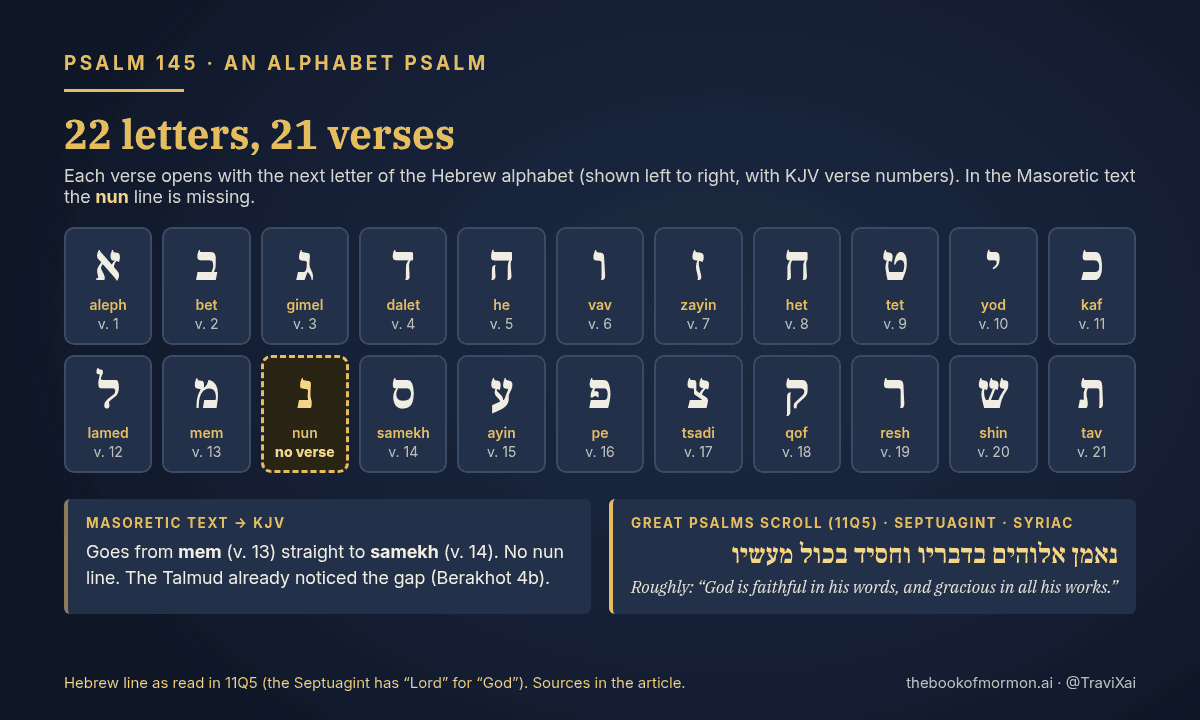
Watch the seam between mem and samekh. Verse 13 is the mem line:
Thy kingdom is an everlasting kingdom, and thy dominion endureth throughout all generations.
Psalm 145:13 (KJV)
The very next verse should start with nun. Instead it starts with samekh:
The LORD upholdeth all that fall, and raiseth up all those that be bowed down.
Psalm 145:14 (KJV)
The gapThe rabbis noticed first
This isn’t a new gotcha. The rabbis saw the hole in the alphabet long ago and tried to explain it:
Rabbi Yoḥanan said: Why is there no verse beginning with the letter nun in ashrei? Because it contains an allusion to the downfall of the enemies of Israel, a euphemism for Israel itself.
Babylonian Talmud, Berakhot 4b (William Davidson translation)
His reasoning: the verse Amos wrote about Israel’s fall, “The virgin of Israel is fallen; she shall no more rise” (Amos 5:2), begins with nun, so David left that letter out. Rav Naḥman bar Yitzḥak adds that David answered it in the very next verse: “The LORD upholdeth all that fall.” A beautiful sermon. But notice what it assumes: the rabbis’ Hebrew text already lacked the line, and the gap was well known enough to need explaining.
Cave 11The line turns up
In 1956 a scroll turned up in Cave 11 at Qumran that scholars call the Great Psalms Scroll, or 11Q5 (also 11QPsa). It is the best preserved Psalms manuscript among the Dead Sea Scrolls, usually dated to roughly AD 30–50, nearly a thousand years older than the Leningrad Codex (AD 1008), the oldest complete Masoretic Bible and the text behind the standard scholarly Hebrew editions. You can page through it in the Leon Levy Dead Sea Scrolls Digital Library. (For more on what else came out of those caves, see Galatians18 on the Dead Sea Scrolls and the Restoration.)
Right between mem and samekh, the scroll has a nun line: נאמן אלוהים בדבריו וחסיד בכול מעשיו, roughly “God is faithful in his words, and gracious in all his works.”
It isn’t alone. The Septuagint, the Greek Old Testament the early church read, has it too. In Brenton’s classic English translation of the Greek: “The Lord is faithful in his words, and holy in all his works” (Psalm 144:13a LXX; the Greek numbers this psalm 144). The Syriac Peshitta has it, and so does at least one medieval Hebrew manuscript, as the NIV, ESV, and CSB footnotes note.
In fairness, scholars don’t all agree the line is original. The NET Bible’s note lays out the debate: some argue for keeping it, while others suggest Psalm 145 may be a partial acrostic like Psalms 25 and 34, and that a scribe might have filled the gap. The second half of the nun line closely matches verse 17: “The LORD is righteous in all his ways, and holy in all his works” (Psalm 145:17).
But look at what both options mean. Either the Hebrew text lost a line, or ancient copyists added one. Either way, the manuscripts of a single psalm disagree, and somebody has to decide what your Bible says.
Your BibleSame verse, different Bibles
Somebody did decide, and they didn’t all decide the same thing. Here is Psalm 145:13 in eleven English Bibles, with the translators’ own footnotes quoted from Bible Gateway:
| Translation | Nun line in the text? | What the footnote says |
|---|---|---|
| KJV | No | No note |
| NKJV | No | “So with MT, Tg.; DSS, LXX, Syr., Vg. add” the line |
| RSV | Yes | “supplied by one Hebrew Ms, Gk and Syr” |
| NRSV | Yes | “Q ms Gk Syr: MT lacks” the line |
| NIV | Yes | “most manuscripts of the Masoretic Text do not have the last two lines” |
| ESV | Yes, in [brackets] | “supplied by one Hebrew manuscript, Septuagint, Syriac (compare Dead Sea Scroll)” |
| NASB | Yes | “in LXX (cf. DSS); not found in MT” |
| CSB | Yes | “other Hb mss omit” the line |
| NLT | Yes | “the Masoretic Text lacks the final two lines” |
| NABRE | Yes | No note shown |
| NRSVue | Yes | Same note as the NRSV |
Same chapter, same God, two different Bibles. The NIV gives the line as “The LORD is trustworthy in all he promises and faithful in all he does.” The ESV puts it in square brackets so you can see the seam. The KJV and NKJV follow the Masoretic text, and the NKJV tells you in a footnote what it left out.
That isn’t a scandal. It’s honesty: your Bible makes textual decisions all the time, and the good ones tell you so.
The fine printWhat inerrantists actually claim
Some critics talk as if their Bible is a flawless, letter-perfect transmission from Moses to the print shop. The strictest inerrancy document in modern evangelicalism, the 1978 Chicago Statement on Biblical Inerrancy, doesn’t make that claim. Article X says:
We affirm that inspiration, strictly speaking, applies only to the autographic text of Scripture, which in the providence of God can be ascertained from available manuscripts with great accuracy. We further affirm that copies and translations of Scripture are the Word of God to the extent that they faithfully represent the original.
Chicago Statement on Biblical Inerrancy, Article X (1978)
Its exposition goes further: “Since God has nowhere promised an inerrant transmission of Scripture, it is necessary to affirm that only the autographic text of the original documents was inspired.” And: “no translation is or can be perfect, and all translations are an additional step away from the autographa.”
The King James translators said much the same in their 1611 preface, “The Translators to the Reader.” A translation is still the word of God, they argued, “notwithstanding that some imperfections and blemishes may be noted in the setting forth of it,” just as a man can be “a comely man and lovely, though he have some warts upon his hand.” Warts and all, from the men who made the KJV. (Galatians18 has a short page on Bible inerrancy for when this comes up in a thread.)
Article of Faith 8“As far as it is translated correctly”
Now set that beside what Latter-day Saints actually believe:
We believe the Bible to be the word of God as far as it is translated correctly; we also believe the Book of Mormon to be the word of God.
Articles of Faith 1:8
It calls the Bible “the word of God.” The qualifier doesn’t attack the Bible; it describes it the way the NIV footnote, the Chicago Statement, and the 1611 translators do. Joseph Smith meant “translated” broadly, covering copying as well as rendering into English. In 1843 he said: “I believe the bible as it read when it came from the pen of the original writers; ignorant translators, careless transcribers, or designing and corrupt priests have committed many errors” (Joseph Smith Papers).
Nephi saw it centuries earlier, and he was blunt about it:
Wherefore, thou seest that after the book hath gone forth through the hands of the great and abominable church, that there are many plain and precious things taken away from the book, which is the book of the Lamb of God.
1 Nephi 13:28
Psalm 145 is a small, gentle example, with no doctrine riding on it. Nephi speaks of bigger losses, but the principle is the same, and so is the remedy: later records would “establish the truth of the first” and “make known the plain and precious things which have been taken away” (1 Nephi 13:40). That is one reason Joseph Smith went through the Bible itself, a project Galatians18 covers under the Joseph Smith Translation.
The double standardOne rule for both books
Here the argument turns. A critic will say, “The Book of Mormon has had corrections since 1830, so it can’t be from God.” Fine. Hold the Bible to that same rule. If a missing nun line, a bracketed verse, and a dozen different footnotes don’t make Psalm 145 false, then spelling and grammar fixes between editions don’t make the Book of Mormon false.
The Book of Mormon was honest about this from its title page:
And now, if there are faults they are the mistakes of men; wherefore, condemn not the things of God, that ye may be found spotless at the judgment-seat of Christ.
Book of Mormon, title page
Same humility as the KJV translators. “A perfect text or nothing” is a standard the Bible doesn’t meet and never claims to. No verse promises that every copy and translation will be flawless. What the Bible does promise is a God who keeps speaking, and Psalm 145 says why He can be trusted: He is faithful in His words, whether or not every scribe was.
SummaryKey takeaways
- Psalm 145 is an alphabetic acrostic, but the Masoretic text and the KJV have 21 verses for 22 letters. The nun line is missing.
- The gap was known by the time of the Talmud (Berakhot 4b), where Rabbi Yoḥanan offered an explanation.
- The Great Psalms Scroll (11Q5, roughly AD 30–50), the Septuagint, and the Syriac all have a nun line: “faithful in his words.”
- The NRSV, NIV, ESV, NASB, CSB, NLT, RSV, and NABRE put the line in their text; the KJV and NKJV leave it out.
- The Chicago Statement says “no translation is or can be perfect.” Article of Faith 8 says it in seven words: “as far as it is translated correctly.”
Next time someone tells you the Bible came down letter-perfect and complete, open Psalm 145 together and count to 22. Then read Article of Faith 8 and ask which one sounds like the footnotes in their own Bible. For quick answers you can drop into any thread, try the Galatians18 app. And for more like this every day, follow me on X at @TraviXai.
Sources
- Great Psalms Scroll (11Q5 / 11QPsa), Israel Antiquities Authority: Leon Levy Dead Sea Scrolls Digital Library · background: Great Psalms Scroll and Psalm 145 (Wikipedia)
- Babylonian Talmud, Berakhot 4b, William Davidson translation: Sefaria
- Septuagint Psalm 144:13a, trans. L. C. L. Brenton (1844): eBible.org
- NET Bible translators’ note on Psalm 145:13: netbible.org
- Psalm 145:13 with footnotes: KJV · NKJV · RSV · NRSV · NIV · ESV · NASB · CSB · NLT · NABRE · NRSVue · all versions (Bible Gateway)
- Chicago Statement on Biblical Inerrancy (1978), Article X and exposition: Dallas Theological Seminary library (PDF) · reformed.org
- “The Translators to the Reader,” preface to the King James Version (1611): bible-researcher.com
- Joseph Smith, discourse of October 15, 1843, History, 1838–1856, vol. E-1, p. 1755: Joseph Smith Papers · Teachings of Presidents of the Church: Joseph Smith, ch. 17
- Book of Mormon title page: churchofjesuschrist.org
- Scriptures: Psalm 145:13 · Psalm 145:14 · Psalm 145:17 · Amos 5:2 · 1 Nephi 13:28 · 1 Nephi 13:40 · Articles of Faith 1:8
- Related: Sola Scriptura: Which Verse Teaches It? · Books the Bible Quotes That Aren’t in the Bible · The Canon Was Never Meant to Close
- Featured image and the Psalm 145 acrostic chart: original graphics by thebookofmormon.ai (no photographs or likenesses of real people). Hebrew line as read in 11Q5.